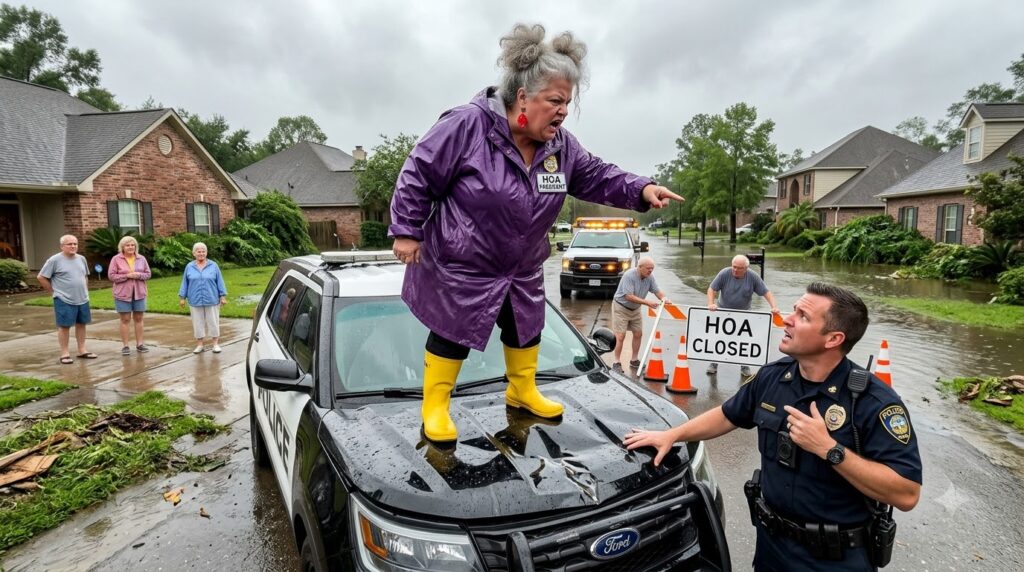
Chapter 1: The Woman on the Hood
The first sound was a metallic bang so loud that seventy-five-year-old Walter Bennett thought a transformer had exploded.
Then he saw the woman standing on the hood of the police SUV.
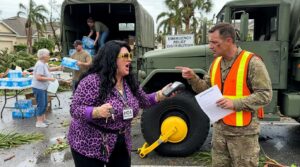
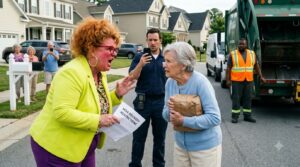
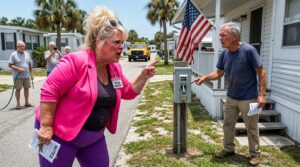
Her name was Patricia Whitmore, though nearly everyone in Cypress Landing called her Karen when she wasn’t around. At sixty-one, she was the president of the homeowners association, a position she treated less like a volunteer responsibility and more like a personal kingdom.
She was an enormous woman, with silver hair piled into two oversized curly buns. Her shiny purple raincoat stretched across her broad shoulders, and her bright yellow rubber boots stood out against the black-and-white police vehicle. Oversized red earrings swung beside her flushed cheeks.
Pinned to her raincoat was a gold badge.
HOA PRESIDENT.
Patricia had ordered the neighborhood’s only passable exit road closed following three days of relentless Louisiana rain.
Now she was standing on a police vehicle, determined to make sure nobody challenged her authority.
Officer Daniel Mercer stared at her in disbelief.
He had been a police officer for eighteen years. He had handled domestic disputes, highway accidents, hurricane evacuations, and more than a few unreasonable homeowners.
But he had never seen anything quite like this.
Patricia bent her knees.
Before Mercer could reach the front bumper, she jumped.
Both yellow boots slammed into the center of the hood.
The metal buckled beneath her weight, leaving a deep depression.
Water splashed from the windshield.
Several elderly residents standing along the flooded street gasped.
Mercer rushed forward, raising one hand.
Patricia glared down at him.
“I’ll crush this car before I open my road!”
Then she jumped again.
The second impact drove the already-damaged hood even deeper. Metal groaned beneath her boots. She briefly lost her balance and caught herself against the crushed surface.
Mercer stopped just beyond the front bumper.
“That’s criminal property damage!”
Patricia straightened, breathing heavily.
Behind her, two residents began dragging orange traffic barriers away from the roadway.
She spun toward them.
“Put those back!”
Nobody obeyed.
For the first time that morning, Patricia Whitmore looked genuinely frightened.
Not because she had destroyed government property.
Not because a police officer was preparing to call for backup.
But because the barricade was coming down.
And beyond that barricade stood a rescue utility truck carrying the equipment Walter Bennett desperately needed.
Walter had lived in Cypress Landing for thirty-eight years.
He had buried his wife there, raised two daughters there, and watched the neighborhood change from a quiet collection of modest houses into a gated community with expensive landscaping and increasingly aggressive rules.
His house stood near the lowest part of the subdivision.
The flooding had reached his front steps before sunrise.
By eight o’clock, water had entered his living room.
By nine, the electricity had failed.
Walter’s daughter, Rebecca, had been trying to reach him for hours.
She was fifty-two, a registered nurse living twenty miles away in Baton Rouge. She knew her father’s stubbornness better than anyone.
He would never willingly abandon his home.
Especially not after losing his wife.
But Walter had a heart condition, limited mobility, and medication that needed to remain refrigerated.
The rescue truck carried portable generators, medical supplies, and equipment for moving residents through shallow floodwater.
It had been dispatched after Rebecca contacted parish emergency management.
Patricia had refused to let it enter.
She claimed the HOA had exclusive authority over neighborhood roads.
Mercer had arrived to resolve the obstruction.
That was when Patricia climbed onto his SUV.
Now Walter stood behind the partially removed barricade, his soaked brown jacket hanging heavily from his shoulders.
He lifted one trembling arm toward the rescue workers.
A young utility crew member spotted him.
The man immediately began unloading equipment.
Mercer raised his radio.
“Dispatch, this is Unit Twelve. Requesting supervisor and additional unit. We have intentional damage to a marked police vehicle and interference with emergency access.”
Patricia pointed at the residents moving the barriers.
“Those people are violating community regulations!”
Mercer looked at her.
Then he looked at Walter, whose face had turned an unhealthy shade of gray.
“Ma’am, your regulations are not more important than somebody’s life.”
Patricia opened her mouth.
But something happened that stopped her.
A rescue worker had stepped beyond the barricade and was looking down at the flooded pavement.
Near the curb, beneath several inches of muddy water, a dark stream was moving against the natural flow.
The worker crouched.
He examined the water, then looked toward a landscaped embankment behind Patricia’s house.
His expression changed.
He called another crew member over.
Within seconds, both men were staring at the same place.
Walter knew that embankment.
It had been rebuilt six months earlier under Patricia’s supervision.
And he remembered something about the construction that had troubled him ever since.
Something Patricia had ordered the contractors to bury.