Chapter 3: The File That Disappeared
Rebecca Bennett arrived at Cypress Landing shortly before noon.
She had spent the morning navigating flooded intersections, fallen branches, and road closures.
When she finally saw her father’s neighborhood, she barely recognized it.
Brown water covered the street.
Household belongings floated near mailboxes.
A child’s plastic bicycle lay against a storm drain.
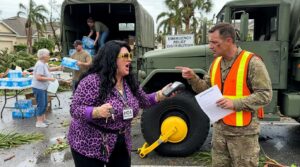
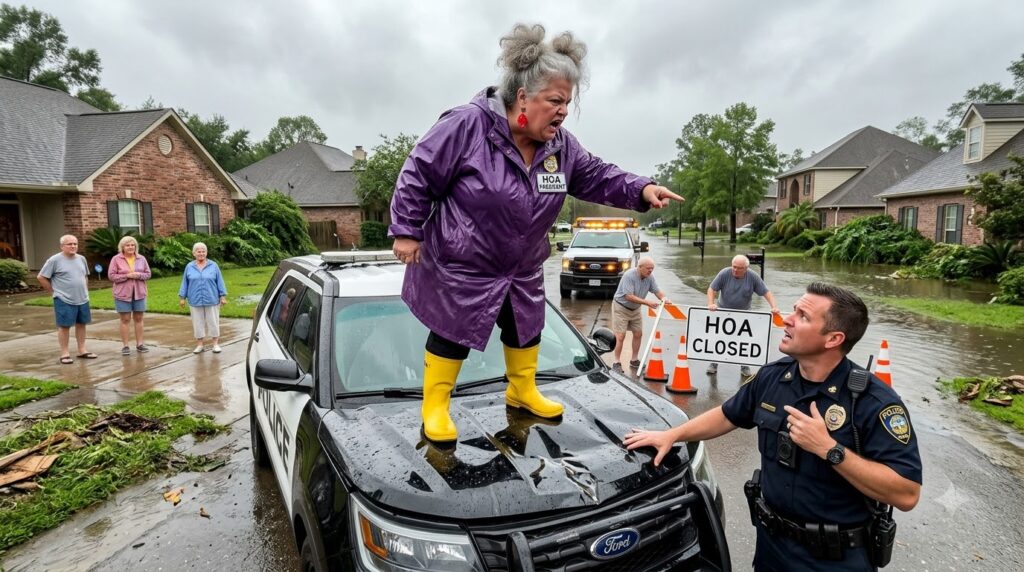
And at the entrance stood a police SUV with a severely crushed hood.
Rebecca parked on higher ground and hurried toward the rescue vehicles.
She found Walter sitting inside a utility truck, wrapped in a dry blanket.
He looked exhausted.
His hands were trembling around a paper cup of water.
Rebecca embraced him so tightly that he winced.
For several seconds, neither spoke.
Then she examined his face with the practiced concern of a daughter who had spent her career caring for patients.
Walter tried to reassure her.
He insisted he was fine.
Rebecca knew better.
The medic had already explained that Walter was dehydrated and needed further evaluation. His refrigerated medication had been exposed to unsafe temperatures after the power failure, and he had missed a scheduled dose while trying to protect his belongings.
Rebecca arranged to take him to a medical facility as soon as the access road was secure.
But Walter refused to leave until she heard what had happened.
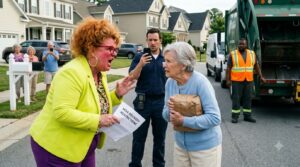
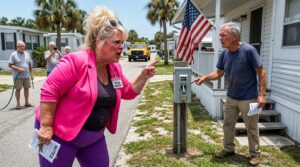
He told her about Patricia.
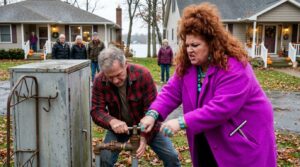
The barricade.
The police SUV.
And the blocked drainage pipe.
Rebecca listened without interrupting.
When he finished, she looked toward Patricia’s house.
She remembered the beautification project.
She also remembered arguing with her father about it.
At the time, she had urged him to stop fighting the HOA.
She worried the stress was affecting his health.
Now she wondered whether he had been right all along.
Rebecca asked where his HOA documents were.
Walter told her about the blue accordion folder in the bottom drawer of his bedroom dresser.
Unfortunately, the dresser stood inside the flooded house.
Rebecca stared at him.
He gave a tired shrug.
“I didn’t think I’d need to rescue paperwork from a flood.”
Meanwhile, Sergeant Carver had begun interviewing residents.
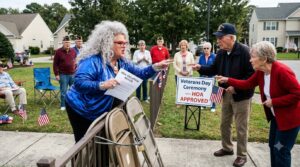
Several described Patricia’s increasingly authoritarian management of the association.
She had issued fines for faded porch furniture, unapproved flowerpots, and vehicles parked overnight in private driveways.
One widow had received a warning because her grandson’s pickup truck remained outside during a weekend visit.
Another resident had been threatened with legal action for installing a temporary wheelchair ramp.
But the complaints became more serious when Carver asked about the drainage project.
A retired accountant named Helen Brooks stepped forward.
Helen was sixty-eight and had served as Cypress Landing’s volunteer treasurer until Patricia removed her from the position.
She explained that the beautification project had originally been budgeted at $42,000.
The final cost exceeded $190,000.
Helen had questioned the increase.
Patricia claimed the additional expense covered drainage improvements.
Yet Helen had never seen invoices documenting those improvements.
She had requested copies of the contracts.
Within two weeks, Patricia called a special board meeting and announced that Helen had resigned.
Helen had not resigned.
She had been removed by a board vote after Patricia accused her of creating unnecessary conflict.
Carver asked whether Helen retained any financial records.
Helen hesitated.
“I kept copies of the statements I was allowed to see.”
“Where are they?”
“At home.”
Her house stood on the higher southern side of the neighborhood.
It had escaped the worst flooding.
Carver asked her to preserve the records.
That afternoon, the parish public works inspector arrived.
His name was Michael Landry.
At fifty-nine, Landry had spent more than three decades maintaining drainage systems across southern Louisiana.
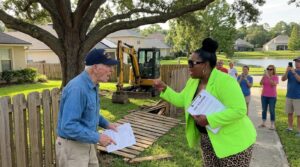
He examined the submerged pipe.
Then he ordered workers to remove a section of decorative landscaping to expose the opening.
Beneath the shrubs, they discovered a concrete structure that did not match the parish’s drainage drawings.
A heavy panel had been installed across much of the outlet.
The remaining opening was clogged with sediment and construction debris.
Landry photographed the obstruction.
He studied the fasteners.
Then he looked at Reed.
“This wasn’t caused by the storm.”
Reed asked what he meant.
Landry pointed to the panel.
“Somebody installed this.”
The discovery changed the investigation.
What had begun as a bizarre confrontation over a barricade was becoming a possible case of unauthorized construction and negligent drainage alteration.
Carver requested that the HOA produce its engineering approvals, construction contracts, and board records.
Patricia’s attorney responded by telephone.
He claimed the documents were temporarily unavailable because the association office had suffered storm damage.
But the office sat on high ground.
Its windows were intact.
And its parking lot was dry.
When Helen Brooks heard the explanation, she remembered something.
The HOA had switched to an electronic records system earlier that year.
Patricia had told residents the new system would improve transparency.
Helen had been given temporary access before her removal.
She still had an old email containing the name of the software provider.
And she knew one more thing.
The original construction invoices had been uploaded before Patricia took control of the account.