Chapter 2: The Road Nobody Was Supposed to Open
By the time the rescue crew reached Walter Bennett, the water had climbed another inch.
Officer Mercer helped the older man across the slick pavement while two workers carried a portable medical kit toward the houses.
Walter tried to walk without assistance.
He had spent forty years working as an electrician at a chemical plant outside Baton Rouge. He was accustomed to solving problems with his own hands, and accepting help still felt like surrendering a piece of his independence.
But his legs were shaking.
Mercer noticed.
He supported Walter by the elbow without making a fuss.
That small courtesy meant more to Walter than the officer could have known.
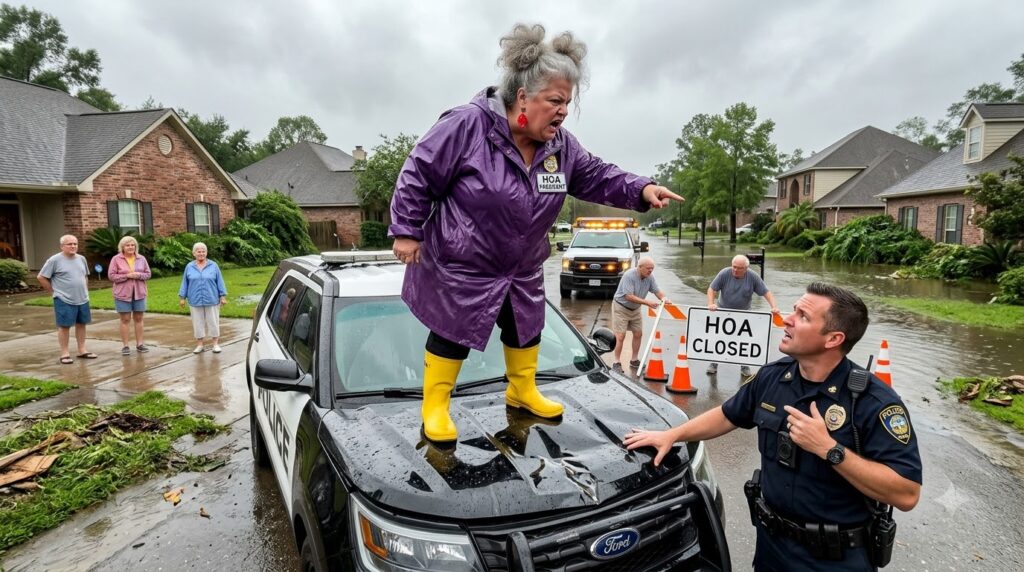
Behind them, Patricia remained perched on the damaged police SUV.
Her earlier fury had turned into a stream of complaints about insurance, property rights, and unauthorized visitors.
Nobody was listening.
A second patrol car arrived.
Sergeant Linda Carver stepped out, surveyed the crushed hood, and looked up at Patricia.
Carver was fifty-six, with close-cropped gray hair and the weary patience of someone who had spent decades dealing with people who confused volume with authority.
She instructed Patricia to climb down.
Patricia refused.
Carver explained that she was being detained while officers investigated the damage and obstruction.
The word detained finally reached Patricia.
She climbed down carefully, accepting an officer’s assistance despite having spent the previous several minutes declaring that the police had no authority over her.
Her yellow boots splashed into the muddy water.
The gold HOA badge remained pinned to her chest.
Meanwhile, rescue coordinator Thomas Reed had begun evaluating the flooded road.
Reed was forty-three, a former National Guard logistics specialist who now worked with a regional disaster-response organization.
He had spent the previous twenty-four hours moving generators and medical supplies between flooded neighborhoods.
He recognized dangerous drainage patterns.
The water near Patricia’s landscaped embankment was behaving strangely.
Instead of moving toward the neighborhood’s main drainage canal, it was curling around the base of the raised earthwork.
Reed followed the current with his eyes.
A row of expensive ornamental shrubs stood above the waterline.
Behind them was a decorative stone wall.
And beneath that wall, almost entirely hidden by muddy water, lay the mouth of a drainage pipe.
It appeared to have been deliberately obstructed.
Reed called the parish public works department.
He requested a drainage inspection.
Walter overheard the conversation while a medic checked his blood pressure.
“The pipe behind Whitmore’s place?” he asked.
Reed turned.
“You know about it?”
Walter nodded slowly.
“That pipe used to carry most of the runoff from the north side of the neighborhood.”
“What happened to it?”
Walter looked toward Patricia.
“She said it was an eyesore.”
Six months earlier, Patricia had launched what she called the Cypress Landing Beautification Initiative.
The project included new landscaping, decorative stonework, and a raised garden behind her property.
Residents had been told that the improvements would increase home values.
The HOA had approved a special assessment of $1,850 per household.
Many residents had protested.
Walter had questioned why the project required so much money when several storm drains needed maintenance.
Patricia had dismissed his concerns.
She had called him an outdated troublemaker who didn’t understand modern property management.
Walter remembered the contractors arriving with a small excavator.
He remembered concrete pipes stacked beside the road.
Most importantly, he remembered watching workers cover part of the old drainage system.
When he questioned them, one worker told him they were following revised plans.
Walter asked Patricia for those plans.
She never provided them.
Instead, he received a formal HOA violation notice accusing him of harassing authorized contractors.
He had kept the notice in a folder with his other association documents.
At the time, it seemed like another petty dispute.
Now his living room was underwater.
Reed listened carefully.
Then he asked a question that made Walter’s stomach tighten.
“Mr. Bennett, did the neighborhood flood like this before that construction?”
Walter looked down at his soaked shoes.
“Not once in thirty-eight years.”
Across the street, Sergeant Carver was speaking with Patricia.
The HOA president had stopped shouting.
She was watching Reed and Walter.
Watching them closely.
When Reed pointed toward the drainage pipe, Patricia’s expression hardened.
She reached for her phone.
Her fingers moved quickly across the screen.
A moment later, Walter heard her say something that chilled him.
“Get the paperwork out of the office. Right now.”