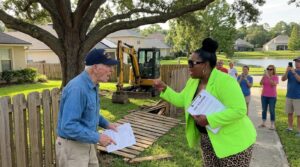
Chapter 7: The Truth Beneath the Water
The parish drainage report took nearly six weeks to complete.
During that time, Cypress Landing became a neighborhood of open garage doors, discarded drywall, and restoration trucks.
The smell of damp wood lingered.
Contractors moved from house to house.
Insurance adjusters inspected damage.
Families argued with repair companies, sorted belongings, and tried to determine what could be saved.
Walter spent most afternoons at Rebecca’s house.
He hated being away from his own home.
But he gradually accepted that recovery would take longer than he wanted.
Rebecca helped him organize receipts, photographs, and insurance correspondence.
Samuel Price’s evidence had been delivered to investigators.
Helen’s financial records were being reviewed by an independent accountant retained through the homeowners’ legal counsel.
And the parish engineering team had completed hydraulic calculations comparing the drainage system before and after the modifications.
The findings were serious.
The decorative wall and concrete panel had substantially reduced the capacity of a major drainage outlet.
During the storm, debris collected against the obstruction, restricting the flow even further.
The resulting backup raised water levels along the northern residential streets.
The engineers concluded that the unauthorized modifications materially worsened flooding in several areas.
They did not claim the entire storm disaster had been caused by the wall.
The rainfall had been extraordinary.
But the report found that the obstruction increased the depth and duration of flooding affecting Walter’s street.
That distinction was important.
It transformed the residents’ suspicions into an engineering conclusion supported by physical evidence.
The parish ordered the obstruction removed and required a properly reviewed drainage restoration plan.
Investigators also found no valid parish approval for the modified outlet.
The recovered electronic records showed that the original plans had called for clearing and repairing the drainage system.
Later revisions introduced the decorative wall and partial blockage.
Those revisions had been uploaded using Patricia’s administrative credentials.
Further investigation would be needed to establish who had authorized each change and whether the actions violated criminal law.
But the civil implications were already substantial.
The HOA faced potential claims from homeowners whose properties had been damaged.
Its insurer began reviewing the project history and policy terms.
The board’s legal counsel advised the association to preserve funds and cooperate with the investigation.
Then the financial audit produced another discovery.
Bayou Property Solutions had received payments that could not be fully reconciled with the available invoices and completed work.
The accountant also identified a business relationship that had not been disclosed in the board records.
Charles Whitmore, Patricia’s brother, had an ownership interest in the contracting company through a separate business entity.
The connection did not automatically prove fraud.
But it raised serious conflict-of-interest questions.
Patricia had recommended the contractor, participated in discussions approving payments, and failed to disclose the relationship in the records reviewed.
The audit findings were referred to the appropriate authorities for further examination.
When Rebecca told Walter, he sat quietly for a long time.
He had expected arrogance.
He had expected poor judgment.
But he had not expected the project to involve Patricia’s own family.
He thought about the residents who had paid the special assessment.
Some had used savings.
Others had postponed necessary repairs.
A few had borrowed money.
They had trusted the association to act in their interests.
That trust had been used to support a project whose benefits and risks had never been properly explained.
Meanwhile, the homeowners’ petition succeeded.
A properly noticed special meeting was scheduled.
The association’s attorney confirmed the applicable procedures.
Members would vote on removing certain directors and filling vacancies in accordance with the bylaws.
Patricia challenged the petition.
She claimed signatures were invalid.
She questioned whether residents who were temporarily displaced could participate.
She accused Helen of conducting a personal vendetta.
But the petition had been carefully prepared.
The signatures were verified.
The notices were issued.
And residents who could not attend were given the voting options permitted by the governing documents.
On the evening before the meeting, Patricia sat alone inside her large house.
The decorative garden behind it had been torn apart during the drainage investigation.
The stone wall was gone.
The expensive shrubs had been removed.
Mud covered the area where she once hosted outdoor gatherings.
Her phone lay on the kitchen counter.
For years, it had delivered a steady stream of messages from homeowners seeking permission, asking questions, or requesting exceptions.
Now most of the messages came from attorneys.
She looked at the HOA badge beside her purse.
For the first time, she left it there.