Chapter 5: The Man Who Tried to Warn Them
Samuel Price answered Rebecca’s call on the fourth ring.
He sounded cautious.
When she mentioned Cypress Landing, there was a long silence.
Then he asked whether anyone had been hurt.
Rebecca explained that her father had been hospitalized after the flood and that several homes had suffered extensive damage.
Samuel sighed.
“I was afraid something like that would happen.”
They arranged to meet the following afternoon.
Samuel was fifty-four, a licensed equipment operator who had worked on drainage and excavation projects throughout southern Louisiana.
He lived in a modest house outside Hammond with his wife and teenage grandson.
When Rebecca arrived, he was repairing a lawn mower in his garage.
He wiped his hands on a rag and invited her inside.
At first, he was reluctant to speak.
He explained that he had been hired as a subcontractor for the Cypress Landing landscaping project.
His responsibility was excavation and preparation around the drainage outlet.
The original plans called for clearing the existing pipe, replacing damaged sections, and improving the flow into the drainage canal.
That work made sense.
But midway through the project, the contractor received revised instructions.
A raised decorative garden was to be constructed behind Patricia Whitmore’s property.
To support the landscaping, workers were told to install a concrete panel across part of the drainage opening.
Samuel objected.
He explained that reducing the outlet capacity could cause water to back up during heavy rainfall.
The site supervisor told him the modification had been approved.
Samuel asked to see the engineering documents.
Nobody produced them.
A few days later, Charles Whitmore arrived.
He insisted the installation proceed.
Samuel refused to operate his equipment for that portion of the work.
He was removed from the project.
His final invoice was never fully paid.
Rebecca asked whether he had documented his concerns.
Samuel opened a drawer and removed a folder.
Inside were photographs taken during construction.
One showed the original drainage opening.
Another showed workers positioning the concrete panel.
A third showed Charles Whitmore standing beside the partially completed structure.
Samuel had also kept text messages from the site supervisor.
One message instructed him to proceed despite his objections.
Another stated that the HOA president wanted the wall finished before the next board meeting.
Rebecca studied the photographs.
She recognized the decorative stonework.
It stood behind Patricia’s house.
The same stonework now being dismantled by parish workers.
Samuel explained that he had considered reporting the project.
But he was supporting his family, and the contractor had threatened to withhold payment if he caused trouble.
He regretted remaining silent.
Rebecca didn’t accuse him.
She knew fear could make people compromise.
What mattered now was that he was willing to tell the truth.
Samuel agreed to provide the records to investigators.
He also agreed to give a formal statement.
Meanwhile, back at Cypress Landing, the situation had become more complicated.
Patricia had been released after processing, with the police investigation continuing.
Her attorney advised her not to discuss the incident.
She ignored that advice.
Instead, she sent an emergency HOA email accusing residents of creating unsafe conditions by removing the barricade.
She claimed the police had overreacted to a misunderstanding.
She also announced that the association would consider special assessments to cover legal expenses arising from what she called the unauthorized emergency response.
The message enraged homeowners.
Several had lost furniture, appliances, and family possessions.
Others were facing expensive repairs.
Now Patricia appeared to be threatening to charge them for the consequences of her own actions.
Helen forwarded the email to Sergeant Carver.
Carver added it to the investigation file.
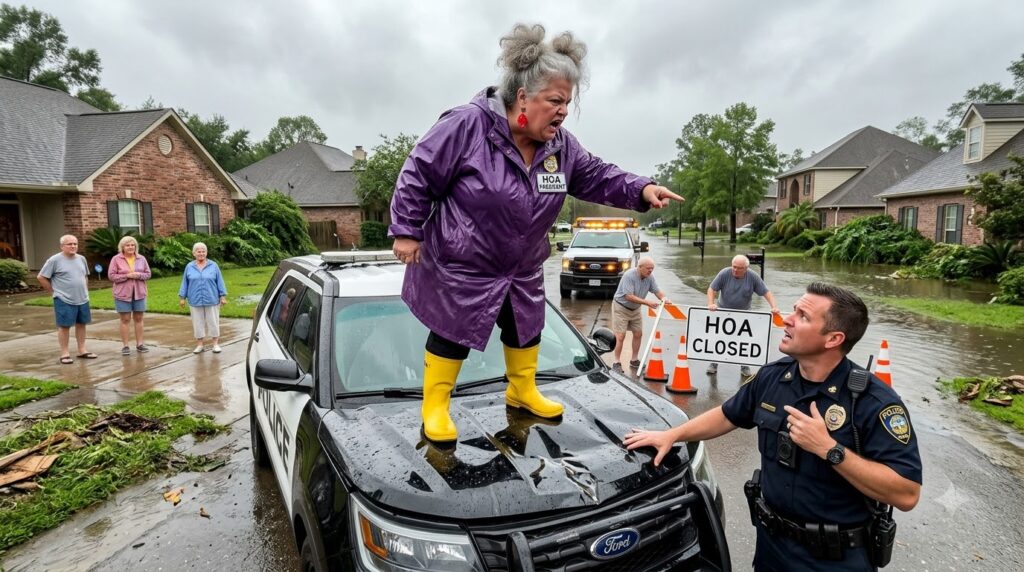
The police department had already documented the damage to Mercer’s SUV.
The vehicle was removed from service pending inspection.
An initial repair estimate suggested substantial damage to the hood, hinges, and surrounding components.
The department was considering charges related to intentional property damage and interference with emergency operations, subject to prosecutorial review.
But the drainage investigation was more complex.
The parish needed to determine whether the construction violated applicable permits and whether it materially contributed to the flooding.
The storm itself had been severe.
Some flooding might have occurred regardless.
Investigators could not simply blame every damaged house on the HOA.
They needed evidence.
Samuel’s photographs provided an important piece.
Then another development changed everything.
The software company that managed the HOA’s electronic records responded to a preservation request.
Its system maintained historical versions of uploaded documents.
Even when users deleted files, certain records remained recoverable under the provider’s retention procedures.
The original project plans were still there.
So were the revised versions.
And the system logs identified the account that uploaded the revisions.
It was Patricia Whitmore’s administrator account.