Chapter 8: A Vote for the Neighborhood
The special membership meeting drew the largest turnout in Cypress Landing’s history.
More than eighty percent of eligible households participated in person or through authorized voting methods.
The church fellowship hall was crowded.
Residents who had barely spoken to one another for years sat side by side.
Some still lived in temporary housing.
Others had returned home but were sleeping in bedrooms surrounded by unfinished walls.
Walter arrived with Rebecca.
He wore a clean blue shirt, dark trousers, and the brown leather shoes Margaret had given him for their fortieth wedding anniversary.
He had polished them himself.
Rebecca noticed.
She said nothing.
She understood.
The meeting was conducted by an independent professional familiar with association governance.
The association’s attorney attended to address procedural questions.
Patricia was present with her own counsel.
The agenda was narrow and carefully structured.
The homeowners would consider the removal of directors, fill any resulting vacancies, and authorize further steps to protect the association’s interests.
The meeting was not a criminal trial.
It was not an opportunity to punish someone without due process.
It was a decision about who should be trusted to govern the neighborhood.
Helen presented the findings available to members.
The drainage report.
The financial audit.
The record-access concerns.
The handling of emergency access during the flood.
She explained which matters had been established and which remained under investigation.
Then the members voted.
The result was decisive.
Patricia and the directors who had supported her continued leadership were removed in accordance with the association’s governing procedures.
A new board was elected.
Helen agreed to serve as treasurer temporarily, provided an outside accountant continued reviewing the finances.
Marcus Bell became board president.
Dorothy Ellis joined as a director.
Two additional homeowners accepted positions.
None had campaigned for power.
They had volunteered because the neighborhood needed people willing to do the work.
When the result was announced, there was applause.
Not the wild cheering of a victory celebration.
Something quieter.
Relief.
For years, residents had believed challenging Patricia would only make their lives more difficult.
Now they had used the rules themselves to restore accountability.
Patricia stood.
Her face was pale.
She looked around the room, searching for someone who might defend her.
No one did.
She left with her attorney.
Outside, reporters waited near the parking lot.
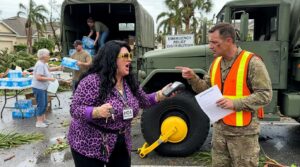
The video of Patricia crushing the police SUV had circulated widely online.
Millions of viewers had watched the enormous HOA president jump twice on the hood while an officer ordered her to stop.
Some treated the footage as comedy.
Others saw it as an example of authority taken to an absurd extreme.
But the residents of Cypress Landing no longer found it funny.
They knew what had been happening beyond the camera frame.
An elderly man needed medical assistance.
A rescue truck had been blocked.
Families were standing in flooded homes.
And a woman entrusted with community leadership had decided that enforcing her personal authority mattered more than helping them.
Walter avoided the reporters.
He didn’t want fame.
He wanted his house repaired.
He wanted his neighbors treated fairly.
And he wanted to know that the next time someone needed help, nobody would stand in the road demanding permission.
The new board’s first official actions reflected those priorities.
It suspended nonessential enforcement activity while residents recovered.
It established a process for emergency access coordination with local authorities.
It retained independent professionals to review drainage maintenance and association finances.
It also arranged a neighborhood volunteer day to help elderly and disabled residents with cleanup.
The board could not simply erase the special assessment or guarantee that insurance would cover every loss.
Those issues required legal, financial, and contractual review.
But the new leadership committed to publishing clear financial reports and making records available through proper procedures.
Walter attended the first volunteer day.
He couldn’t lift heavy furniture.
His doctor had made that clear.
So he sat beneath a portable canopy, sorting electrical supplies and advising younger volunteers on safe restoration practices.
At one point, Marcus brought him a cup of coffee.
The new HOA president thanked Walter for speaking up.
Walter smiled faintly.
“I just wanted the water to go where it was supposed to.”
Marcus laughed.
Then he looked toward the houses still undergoing repairs.
“So do we.”