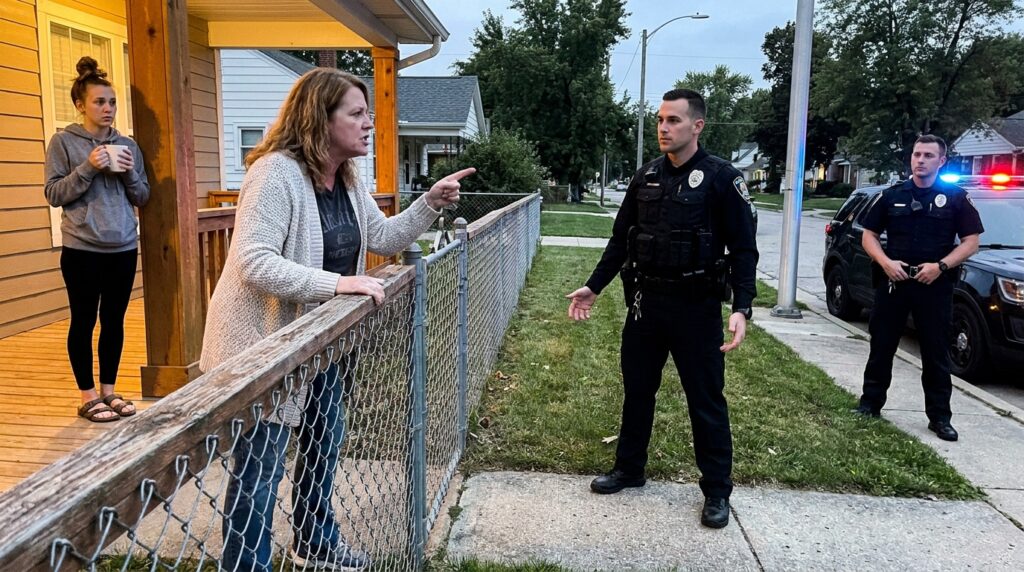
The Boundary Line: Where the Earth Ends and the Code Begins
CHAPTER 1: THE RECKONING ON RUSTED CURBS
Layer 1 (Midpoint Twist): The protagonist discovers a certified county survey tucked inside an old structural folder, revealing that the neighbor’s own detached workshop encroaches four inches onto her deeded property—meaning the neighbor has been violating the exact codes she weaponized.
Layer 2 (Core Truth): The neighborhood association’s regional board has been quietly monitoring the street for systemic harassment lawsuits; the police dispatch wasn’t a random response to the neighbor’s call, but a coordinated intervention to catch the antagonist committing a documented civic civil rights violation on camera.
Case A (Complete Story)
[Total Chapters: 6]
Scene 1: The protagonist stands on her porch holding her white mug, watching her neighbor map out property lines with an old iron tape measure.
Scene 2: A certified letter arrives from the city inspector regarding a fabricated drainage violation on the property line.
Scene 3: The antagonist blocks a delivery truck from unloading building materials at the curb, escalating into a shouting match with the driver.
Scene 4: Two municipal cruisers pull up to the curb at twilight as the antagonist launches herself at the chain-link divider.
Scene 5: The primary officer forces the antagonist back from the fence, shifting the focus of the investigation from the homeowner to the accuser.
Scene 6: The antagonist retreats across her lawn under a formal warning for public nuisance, leaving the protagonist alone in the quiet dusk.
Selection Strategy: The Dialogue Cut
“You don’t get to stand there and judge my life,” the voice scraped through the humid twilight air, hard and thin like rusted tin.
Maya didn’t move her chin from the rim of the ceramic mug. The porcelain was the only warm thing left on the porch, heating the palms of her hands while the damp dampness of a Delaware dusk settled into the floorboards. Across the yard, the chain-link fence rattled—a sharp, metallic shudder that meant Evelyn’s fingers were clamped into the links again, pulling the mesh until the top wooden rail groaned.
“I’m just standing on my porch having coffee, Evelyn,” Maya said. Her voice didn’t rise. She kept it flat, tucked into the thick fleece of her oversized hoodie, letting the subtext do the heavy lifting. Every word was an exercise in weight and friction. If she raised her tone by an octave, she gave the woman across the line the fuel she had been searching for since the moving trucks left three months ago.
Evelyn didn’t step back. The light knit cardigan she wore was pulled tight over her forward-braced shoulders, her silhouette thick and dark against the graying asphalt behind her. She looked exactly like what she was—someone performing the role of an authority over an inch of dirt she had no legal right to govern. “You think because you signed a piece of paper at a bank you belong here? Look at those bins. Look at the curb. You’re dragging the whole block down to your level.”
The air between them smelled of cut grass and old iron. Then the blue hit the siding.
It wasn’t a sudden burst, but a rhythmic, heavy pulse that turned the dusk into a series of sharp, cool shadows. Two standard municipal cruisers cut their engines at the curb, their low-profile lightbars casting long crimson and indigo reflections across the chain-link. Maya didn’t break her gaze. She watched Evelyn’s finger jab through the square mesh—an accusatory wedge of flesh aimed directly at her chest.
The car doors clicked open, the sound of heavy utility belts clinking as two officers stepped into the gravel lane. The primary officer moved with an upright, deliberate pace, his tactical vest stiff against his black uniform shirt. He didn’t look at Maya. His eyes stayed on the woman whose fingers were still white-knuckled around the boundary rail.
“He’s here for you,” Evelyn hissed, her face turning a blotchy, dark red under the blue strobe. “He’s here to clean this up.”
The primary officer stopped three feet from the wire. He didn’t draw a tool, but his palms went flat, open at chest level—the heavy, unyielding posture of an administrative machine that had seen this exact backyard theater fifty times before. He looked down at Evelyn’s boots, then up at her face.
“Ma’am,” the officer said, his voice clipped and entirely devoid of neighborly patience. “Step back from the fence, hands down.”
Evelyn froze. Her raised finger remained suspended in the air between them, trembling slightly as the backup officer took his place by the cruiser’s rear bumper, his hands resting lightly near his waist, eyes sweeping the empty street. The silence that followed was heavy with the smell of exhaust and cold ceramic.
Maya took a slow, deliberate sip from her mug, her eyes locked on the old surveyor’s stake protruding from the dirt right beneath Evelyn’s left heel.
CHAPTER 2: The Encroachment Notice
The click of Evelyn’s teeth was audible over the steady, heavy throb of the cruiser’s lightbar.
Maya kept her fingers clamped around the white ceramic mug, using its weight to steady her pulse. She didn’t look down at the gravel, but she could see the shift in Evelyn’s shadow—the way the older woman’s shoulders collapsed inward under the light knit cardigan as the primary officer’s words settled into the cool air. The fence between them didn’t rattle now. The galvanized wire mesh simply vibrated with the residual energy of Evelyn’s release, a faint, metallic hum that sounded like a dying spring.
“Officer,” Evelyn began, her voice dropping into a rhythmic, practiced tremor that Maya had heard on three separate occasions since the moving trucks left. “You don’t understand the history here. This property—”
“Ma’am,” the officer interrupted. He didn’t raise his voice, but the syllable carried the clean, flat weight of a standard-issue sidearm. He drew a small, grid-lined notebook from his chest pocket, his thumb flicking the elastic band with a dry snap. “I didn’t ask for the history. I asked you to step back from the perimeter line. The homeowner on the porch is within her curtilage. You are leaning over the boundary.”
Evelyn took the single required step backward, her sneakers grinding into the dry dirt at the edge of her own lawn. Her face, caught in the alternating indigo and crimson strobe, looked gray and lined with a deep, systemic frustration. Her hand dipped into her cardigan pocket, fingers closing around a folded square of paper—the blue-inked municipal complaint form she had been brandishing like a weapon since four in the afternoon.
Maya didn’t offer a defense. She stayed behind the safety of the warm-lit porch column, her gray hoodie absorbing the cool twilight. She knew the rules of the block better than Evelyn thought she did. In a town built on old deed registries and half-forgotten easement maps, the person who spoke least usually kept the dirt.
The backup officer stayed near the rear bumper of the lead cruiser, his boots fixed on the asphalt, his eyes tracing the upper windows of the adjacent houses where the blinds were beginning to twitch. The neighborhood was watching. Every rusted mailbox and oil-stained driveway on the street had a witness behind it, but none of them were stepping into the blue light.
“The noise,” Evelyn muttered, her eyes darting toward the officer’s notebook, trying to read the upside-down lines of his script. “The deliveries. The trucks are breaking the asphalt at the curb. It’s a violation of code section four-point-two.”
“The delivery truck left at two this afternoon, ma’am,” the primary officer said, his pen moving with an agonizing, bureaucratic slowness. “The dispatch log shows you called at six-fifteen. That’s a four-hour discrepancy on a active obstruction complaint.” He stopped writing, his thumb resting against the silver clip of his pen. “We’ve had four calls from this specific address within the last twenty-eight days. All of them regarding this lot. None of them resulted in a citation because none of them met the statutory definition of a nuisance.”
A small, sharp breath escaped Evelyn’s lips. She looked past the officer’s shoulder, her gaze fixing on Maya with an intensity that felt old, almost historical. It wasn’t about the trash bins or the gravel pile near the porch. It was about the preservation of an illusion—the idea that forty years of residency gave her the right to dictate who could breathe the air on this side of the cul-de-sac.
“I am protecting the value of this block,” Evelyn said, her voice dropping its performance and hardening into something flat and transactional. “The registry matters. The standards matter.”
“The law matters more, ma’am,” the officer replied. He closed the notebook with a clean thud that seemed to signal the end of the official interaction. “We’re going to file this as an informational report. But I’m advising you now: if we are called out here again for a non-hazardous dispute that lacks physical evidence, we will refer the file to the city attorney for review under the code for persistent false reporting.”
He didn’t wait for her to acknowledge the warning. He turned his back—a deliberate, professional slight that stripped Evelyn of her self-appointed title—and walked toward the first cruiser.
Maya watched Evelyn stand frozen in the gravel for three long seconds. The older woman’s hand remained inside her cardigan pocket, her fingers twitching against the paper. Then, without a word, she turned and marched toward her own dark porch, her sneakers leaving shallow, aggressive tracks in the dry topsoil.
Maya waited until the red tail lights of the cruisers faded at the end of the street before she lowered the mug from her chin. The ceramic was cold now. She stepped down from the top porch wooden step, her boots clicking softly against the concrete walkway until she reached the chain-link line.
The air smelled of ozone and damp grass. Maya knelt down near the primary fencepost where Evelyn’s hand had been gripping the rail. The dirt there was loose, kicked up by the confrontation. Her fingers brushed against something hard and metallic buried beneath the weeds—a small, circular disk made of tarnished zinc, secured to a rusted iron pin by an old lead wire.
It was a surveyor’s benchmark from 1984.
Maya pulled her phone from her pocket, turning on the flashlight to trace the stamped numbers on the metal face. Her heart didn’t jump, but her thumb went cold against the screen. The pin wasn’t aligned with the fence line. It was sitting four inches to the left, well inside Evelyn’s manicured turf, directly in line with the concrete foundation of the older woman’s detached tool workshop.
Maya turned the flashlight off, her eyes adjusting back to the dark. The house across the wire was completely silent, but the kitchen light was still burning behind the thin white curtains.

CHAPTER 3: The Boundary Enforcer
The morning sun didn’t soothe the cul-de-sac; it simply baked the gray asphalt until the smell of old tar rose between the houses. By eight o’clock, the diesel rumble of a flatbed delivery truck was vibrating the glass pane of Maya’s front door.
Maya stood at the boundary line, her boots half-buried in the loose, dry topsoil right beside the tarnished zinc surveyor’s pin she had uncovered the night before. In her hand, she held the original, brittle cardboard property folder the bank had handed her at closing. The edges were fraying into gray fuzz, and the paper within smelled faintly of cellar mold and old ink, but the red line drawn across lot forty-two was legally immutable.
“I can’t drop the timber on the street, miss,” the delivery driver said, his voice competing with the rhythmic wheeze of the truck’s hydraulic brakes. He was leaning out of the cab, his neon vest coated in a thin sheen of highway dust, his hand tapping against the grease-stained steering wheel. “The municipal code says I can’t block the public easement for more than fifteen minutes without a city permit. If I drop it there, I’m the one who gets the citation.”
“You aren’t dropping it on the street,” Maya said, her thumb pressing down hard against the cold, galvanized steel fence post. Her voice stayed low, matching the steady drone of the truck. “You’re dropping it right here on the grass lane. Four inches inside this wire mesh.”
“That’s a tight squeeze,” the driver muttered, squinting down at the narrow strip of turf between the chain-link divider and Evelyn’s perfectly edged brick border. “Looks like I’ll be scraping her hedges if the forklift swings too wide.”
“The dirt belongs to this lot,” Maya replied. She didn’t look up at the windows of Evelyn’s house, but she knew the blinds were already functional. She could hear the faint, dry scrape of a front screen door sliding along its aluminum track across the wire.
The hydraulic arm of the flatbed groaned, a high-pitched metallic shriek that set the local crows off in the maples. The first bundle of treated pressure-treated four-by-fours swung out over the property line, casting a heavy, moving shadow across the dry grass. It was the raw material for the new privacy barrier—thick, heavy timber that smelled of chemicals and wet earth, ready to replace the see-through mesh that Evelyn had weaponized for months.
“Stop that machine right now!”
Evelyn’s voice didn’t have the theatrical tremor of the previous night. It was sharp, transactional, and carried the specific authority of someone who had spent thirty years monitoring the city zoning maps from her kitchen table. She was marching across her lawn, her sneakers sinking into the manicured sod, a thick white three-ring binder clamped under her arm like a shield. She wasn’t wearing the cardigan today; she was in a stiff denim shirt with the sleeves rolled up to her elbows, her skin looking like dry parchment under the morning glare.
“The driver cannot unload that material,” Evelyn said, stopping exactly two inches from her side of the wire mesh. She didn’t address Maya; she looked directly up at the operator in the cab, her finger pointing down at the brick border. “You are in direct violation of the residential setback codes. Section twelve-B clearly states that no commercial delivery may disrupt the sightlines of an adjacent driveway.”
The forklift operator paused, the bundle of timber dangling six inches above the dirt, swaying slightly in the hot breeze. The heavy chains clinked against the iron frame with a dry, rhythmic sound.
“The material is being placed on my deeded land, Evelyn,” Maya said, stepping forward until her boot touched the rusted base of the fencepost. She opened the brittle folder, revealing the faded plot map with its certified blue county seal. “The sightline code applies to permanent structures, not temporary drops for active construction. I checked the clerk’s database at six this morning.”
Evelyn’s jaw tightened, her teeth making a dry click before she opened the white binder. “This block has an implied covenant of architectural continuity. You cannot erect a solid barrier without the review of the district committee. I have the petition right here.”
“There is no registered HOA on this subdivision map, and you know it,” Maya said, her voice remaining entirely flat, devoid of the anger Evelyn was trying to cultivate. She pointed her phone down toward the loose dirt near her heel, where the zinc pin remained exposed. “And according to the 1984 county survey baseline, this entire fence line is misaligned. Your detached tool workshop back there isn’t just violating the three-foot residential setback rule—the concrete foundation is sitting four inches over my deeded property line.”
The silence that followed was heavy, filled only with the heat-tick of the truck’s cooling engine. The forklift operator looked between the two women, his gloved hand still resting on the hydraulic lever.
Evelyn didn’t look down at the exposed zinc tag. Her eyes stayed locked on Maya’s face, her pupils small and dark behind her sunglasses. The confidence in her silhouette didn’t vanish, but it shifted, hardening into something calculated and dangerous. She knew the map was real. She had always known where the concrete met the dirt, but forty years of silence from the previous owner had turned her overreach into an assumed right.
“You think you’re very smart, don’t you?” Evelyn said, her voice dropping into a low, scratchy whisper that didn’t carry past the wire mesh. “You think because you found an old iron pin you can rewrite the peace of this block? This street has a memory, girl. If you dig up this line, you’re digging up things you can’t afford to settle.”
“Drop the lumber,” Maya said to the driver, her eyes never leaving Evelyn’s face.
The operator pulled the lever. The heavy bundle of four-by-fours hit the dry turf with a dull, ground-shaking thud, flattening Evelyn’s encroaching weeds and sending a small cloud of gray dust rising between them.
CHAPTER 4: The Twilight Standoff
The chemical odor of the pressure-treated lumber hung low over the boundary line as dusk pulled a blue-gray sheet across the block. Maya stood near the freshly dropped timber, her palms pressed flat against the raw, split grain of the top beam. Splinters of green-tinted pine bit into the meat of her thumb, a dull physical irritation that grounded her as the blue and red flashes of municipal emergency vehicles sliced through the darkness once more.
Two municipal cruisers didn’t slow down this time. They cut their tires straight across the curb lane, the front bumpers dipping low as they ground into the dry gravel right outside Maya’s fence line. The primary officer stepped from the lead car before the engine had completely wound down, his heavy leather boots hitting the gravel with a double-thud. Behind him, a second white vehicle bearing the municipal emblem of the Code Enforcement Division idled, its yellow roof beacon spinning a slow, low-profile amber light over Evelyn’s house.
“Maya Lin?” the primary officer called out, his utility belt clinking as he cleared the space between the cruiser bumper and the chain-link gate. His tactical vest was cinched tight, casting long, blocky shadows across the yard under the alternating strobes.
“I’m here,” Maya said, her voice remaining low, kept within the collar of her hoodie. She didn’t move away from the wood pile.
Across the wire, Evelyn’s front screen door slammed with a violent, metallic crash that rattled the aluminum housing. Evelyn descended her porch steps in three rapid, heavy strides, her face an unreadable mask of cold triumph beneath the blue lights. Clamped in her right hand was a bright orange document, fresh from a legal printer.
“Officer, thank God you’re back,” Evelyn announced, her tone shifting seamlessly into its practiced public register. She stopped exactly at her brick border, thrusting the orange page toward the officer’s chest. “I have the emergency injunction right here. The district court office processed the filing at four-thirty. This unauthorized construction must cease immediately. The setback violation is documented.”
The primary officer didn’t reach for the paper. He stopped two feet from Evelyn, his open palms resting flat at his hips, his face completely shadowed by the brim of his campaign cap. “Ma’am, step back from the fence lane. I’m not here to review a civil injunction.”
“This isn’t a civil matter anymore,” Evelyn snapped, her voice tightening as she pointed a stiff finger across the wire toward Maya’s wood pile. “She is actively manipulating the historical property stakes. She’s attempting to encroach on an established municipal easement. I’ve lived on this cul-de-sac for forty years—”
“Evelyn,” the officer interrupted, his voice dropping into a flat, mechanical register that carried the chill of an official indictment. “I advised you this morning about the parameters of code section nine-B regarding persistent false reporting. Your emergency filing today was flagged by the city attorney’s office before the ink was dry.”
Evelyn froze, her orange paper fluttering slightly in the cool evening draft. “What are you talking about? The code is clear.”
The side door of the Code Enforcement vehicle swung open, and a tall man wearing a dark blue municipal jacket stepped into the blue light. He carried a heavy, weathered leather case under his arm, the brass latches tarnished by years of field use. He didn’t look at Evelyn; he walked straight to the corner of the chain-link fence, where Maya had cleared the dirt away from the 1984 zinc benchmark pin.
“The registry isn’t the problem, ma’am,” the code inspector said, his voice dry and dusty from years of reading deed archives. He knelt in the weeds, pulling a digital transit level from his case and aligning the laser sight with the zinc disk. “The problem is your detached tool workshop. We pulled the original structural blueprints from the county repository three hours ago.”
Maya watched Evelyn’s shoulders lock. The older woman’s hand stayed frozen in the air, the orange injunction paper trembling against the blue backdrop of the police cruiser.
“The workshop has been there since ninety-two,” Evelyn whispered, her teeth making that sharp, dry click against each other. “It’s grandfathered. The timeline holds.”
“It’s not grandfathered if the foundation was poured over an active utility easement,” the inspector said, his laser level casting a tiny, brilliant red dot across the concrete base of Evelyn’s shed. “And it’s definitely not grandfathered when the structure encroaches four inches onto lot forty-two. You’ve been taxing the city line and this private property for thirty-four years, Evelyn.”
The primary officer took half a step forward, his shadow completely swallowing Evelyn’s silhouette against the fence line. He drew a small, white municipal placard from his pocket—a formal citation with an internal case reference code stamped in bold black ink across the top.
“We aren’t here for the fence, ma’am,” the officer said, his eyes locking onto Evelyn with an unyielding administrative focus. “We are here because the city attorney has issued a formal cease-and-desist on your entire property under the targeted harassment ordinance. Your calls weren’t complaints, Evelyn. They were a documented pattern of civil overreach.”
He slapped the placard directly onto the wood rail of the fence between them, the paper making a sharp, hollow sound against the timber.
Maya looked down at the orange document still dangling from Evelyn’s fingers. The decoy victory of the neighbor’s injunction had dissolved into the dry gravel within minutes, but as she watched the code inspector pull a second, larger file from his leather case, she realized the ultimate truth of the street was still locked behind the flashing lights. The backup officer hadn’t moved from the cruiser bumper, his eyes still fixed on the empty street, his hand resting steady near his belt.
CHAPTER 5: The Shifting Focus
The white municipal placard slapped against the raw timber with a sound like a small pistol shot.
Maya kept her fingers clamped to the rough, splintered edge of the stacked pine planks, watching the paper vibrate under the rhythmic, low-frequency hum of the code enforcement truck’s engine. Evelyn’s hand dropped. The orange document she had spent her afternoon securing at the district clerk’s office slipped from her fingertips, its crisp, clean corners dipping into the gray, alkaline dust at the base of the fence line.
“This is an administrative error,” Evelyn said. Her voice didn’t rise; it had lost its public timber entirely, turning into a thin, scratchy whistle that barely carried over the clicking heat-shields of the idling police cruisers. “The structure was surveyed during the ninety-two expansion. The tax maps were certified.”
“The tax maps reflect self-reported footprints until a dispute triggers a physical verification, ma’am,” the code inspector said. He didn’t lift his head from the transit level. His gloved hand turned a knurled brass screw on the instrument’s side, adjusting the narrow crimson line that cut across Evelyn’s gravel border and crawled up the raw concrete foundation of her tool workshop. “Your foundation isn’t just sitting over the residential line. It’s sitting squarely over a primary municipal drainage corridor. That means the city has an automatic right of summary removal at the owner’s expense.”
Maya didn’t step back. Her boots remained fixed in the dry soil beside the exposed zinc benchmark pin. She watched the primary officer lift his clipboard—a heavy, matte-black aluminum folder with a double-hinged steel clip that held a three-page state citation package. The blue strobe lights caught the white paper, turning each sheet into an alternating window of indigo and sharp, cold gray.
“Sign the acknowledgment line, ma’am,” the officer said, his voice entirely devoid of neighborly patience. He extended a solid plastic pen across the wire rail, the tip pointing at the bottom of the form.
Evelyn didn’t move her arm. Her fingers stayed tucked inside the pockets of her stiff denim shirt, her shoulders hunched forward as if she could absorb the weight of the municipal machinery by sheer physical resistance. “I am not signing an admission of harassment. I have documented every infraction on this block for thirty-four years. I have a record of every commercial vehicle that has broken the curb weight rules.”
“This isn’t an admission of guilt,” the officer replied, his voice dropping an octave, carrying the flat, mechanical certainty of an institutional grinder. “It’s an acknowledgment of service. If you refuse to sign, the backup officer will log the refusal on camera, and the city attorney will move to the next phase of the enforcement protocol by sunrise. That includes an immediate freeze on all active structural variances for this parcel.”
The silence that followed was dense, smelling of unburnt diesel and the damp stone dust kicked up by the inspector’s boots. Across the street, a curtain in lot thirty-eight snapped shut, the white plastic slats clattering against the frame as a porch watcher pulled back into the dark. The street wasn’t supporting Evelyn anymore. The audience she had spent weeks cultivating with her phone calls and her clipboards had vanished, leaving her alone on a four-inch strip of contested dirt.
“Sign it, Evelyn,” Maya said, her voice flat, matching the rhythm of the officer’s delivery.
Evelyn’s head snapped toward Maya, her pupils needle-thin behind her glasses. “You think you’ve settled this? You think because you brought the city into my yard you own this cul-de-sac? This house was here before your bank was even chartered.”
“The deed doesn’t care about the history, Evelyn,” Maya said, her thumb pressing down into the green-tinted timber until a small drop of moisture rolled from the wood. “The deed only cares about the line.”
Evelyn’s hand emerged from her pocket, trembling slightly as she snatched the plastic pen from the officer’s glove. She dragged the tip across the bottom sheet, the paper tearing slightly under the pressure of her stroke before she dropped the pen into the gravel between them. Without looking back at the inspector or the cruisers, she turned and marched toward her dark kitchen door, her boots dragging through the loose sod she had spent half her life maintaining.
The code inspector stood up, his leather case closing with a sharp click of its brass latches. He walked over to Maya’s side of the fence, his eyes running along the stacked timber. He didn’t smile; his face had the same weathered, dry texture as the maps in the county vault.
“Don’t start digging the post-holes yet, Miss Lin,” the inspector said, his voice dropped so low it didn’t carry past the wood pile.
Maya paused, her hand freezing on the pine plank. “The survey is certified. The line belongs to this lot.”
“The line belongs to the lot,” the inspector agreed, his fingers tapping the rusted metal edge of his clipboard. “But the city attorney didn’t flag your neighbor’s file because of four inches of concrete. They flagged it because the state human relations commission has been running an active monitoring folder on this entire subdivision since last winter. Your call wasn’t the first, but it was the one that completed the pattern for a federal civil injunction.”
He turned away before Maya could answer, his boots crunching toward the waiting white sedan. The primary officer was already back in his cruiser, the blue and red flashes dying out one by one until the front yard was left in the quiet, dim orange glow of the streetlamp at the end of the lane.
Maya stood alone in the cool air, her phone screen illuminating the stamped numbers on the zinc tag by her feet, while the ultimate reality of the street remained locked behind the closed doors of the municipal office.
CHAPTER 6: The Dusty Gray Frontier
The tail lights did not snap out; they bled into the dark curve of the avenue like hot iron cooling under grease.
Maya remained exactly where she had spent the last hour, her weight settled backward against the stacked, pressure-treated lumber. The cold, raw chemical pine oil seeped through the canvas of her jacket, a sharp, medicinal burn against her skin that matched the static hum in her ears. Across the wire mesh, Evelyn’s house was completely black now. The single kitchen light had been cut from the inside, leaving only the dull, grease-stained outline of the sliding screen track catching the orange beam of the distant municipal streetlamp.
The silence that returned to the cul-de-sac was different than the one before the cruisers arrived. It was heavier, granular, packed with the cold dust of an ancient neighborhood realizing its internal boundaries had been permanently redrawn. Maya looked down at the bright white placard the officer had left pinned to the wooden rail. Under the orange glare of the high-pressure sodium bulb, the black ink didn’t look like an authority’s seal; it looked like a structural fracture across the block’s history.
Her fingers traced the stamped reference numbers at the top of the card—a deep, mechanical indentation that had crushed the wood fibers beneath it. It wasn’t just a notice of code enforcement. The inspector’s final words still vibrated against her palms: The state human relations commission has been running an active monitoring folder.
She had believed she was playing a simple game of leverage. She had spent weeks tracking fence lines, looking for old survey iron buried in the dry topsoil, calculating the inches of concrete encroachment beneath Evelyn’s detached workshop to buy herself a single yard of peace. But the physical reality she had uncovered—the four-inch violation—was merely the small, visible latch on a much heavier door. The city hadn’t responded to her call or to Evelyn’s fraudulent noise complaints because of an administrative error. They had waited for Evelyn to move to the fence line, to hammer that orange injunction into the wire on camera, to fulfill the precise legal definition of a targeted, systemic pattern of civil intimidation.
The front screen door of lot forty didn’t open, but a shape moved behind the dark glass of the porch panel. Maya didn’t look up, yet she felt the shift in the air—the weight of forty years of unpunished surveillance coming to a dead stop against a set of certified deed coordinates.
She pulled her boots out of the loose soil, the dry grit grinding between the rubber soles and the concrete walkway as she moved toward her porch. The white ceramic mug still sat on the top step, completely drained, its porcelain surface gray and cold under the twilight. She didn’t pick it up. Instead, she sat down on the rough wood planking of the riser, her hands dropping between her knees, her thumbs catching the rough fiber of the old bank document folder.
The block was quiet, but it wasn’t settled. In two days, the construction crew would arrive with the augers to sink the heavy cedar posts four inches deep into the strip of grass Evelyn had manicured since 1992. The concrete base of the old woman’s workshop would remain visible, a gray, encroaching heel of stone trapped inside Maya’s new line—a permanent, physical reminder of a victory that felt less like a triumph and more like the cold maintenance of a perimeter.
Evelyn had been right about one thing: the street had a memory. But as Maya turned her phone off, letting the blue glow dissolve into the dark, she knew the memory was no longer under Evelyn’s control. The code had eaten the history, and the dirt was just dirt.