
The Frozen Boundary: A Novel of Strategic Restraint, Iron Borders, and the Price of Public Vindication
CHAPTER 1: THE CRUNCH OF PLASTIC
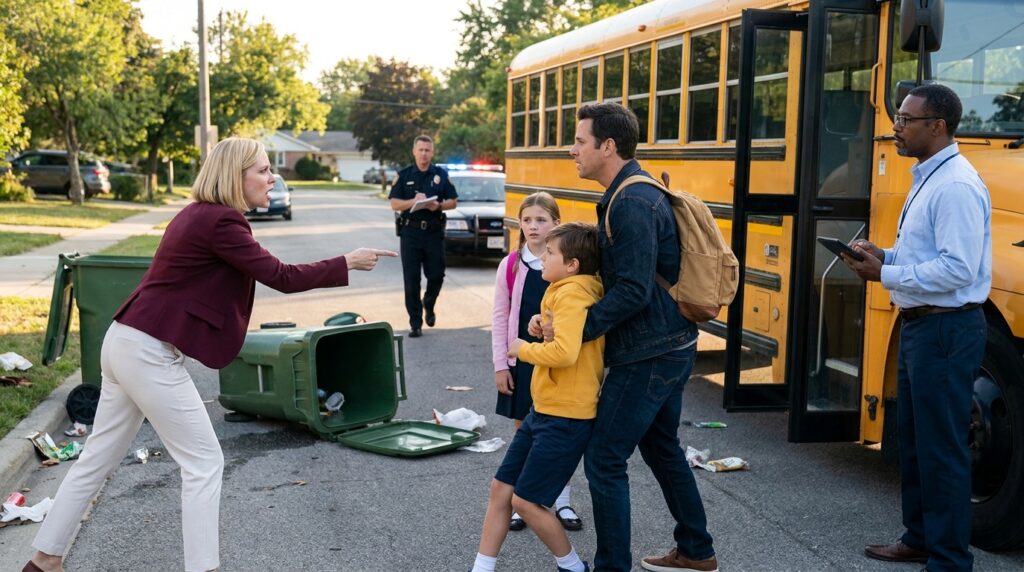
The heavy green polyethylene bin struck the bumper with a sound like a small mortar shell clearing its tube.
Marcus Vance didn’t let his breath drop into his chest. His right forearm was already a rigid bar against Leo’s ribs, his work boots shifting a fraction of an inch into the dry grass line to absorb the momentum. The yellow paint of the International Blue Bird chassis was too close; it smelled of hot drum brakes, old vinyl seats, and the unwashed diesel exhaust that hung over the curb every afternoon at exactly 4:10.
“Stay behind the seam,” Marcus muttered. His voice didn’t carry past the red nylon strap of his son’s backpack. He didn’t look down to check if the boy was crying. In this section of the subdivision, any display of vulnerability was simply data collected by the windows across the lane.
Across the asphalt, the burgundy sleeve of Evelyn Garber’s jacket was still extended. Her fingers were curled tight around the matte plastic edge of her phone, the glass screen angled up to catch the reflection of the sun setting behind the split-level rooflines. Her white tailored trousers were pristine, completely untouched by the gray slush of milk cartons and shredded circulars now drifting across the lane. She didn’t look at the bus. She looked at Marcus’s collar, her shoulder-length blonde bob perfectly still against the starched line of her coat.
“Stop that bus, you nearly hit that child!” Her voice had the thin, practiced edge of a woman who had spent twenty years calling code enforcement on cars parked left-wheel-to-curb. She took half a step into the street, her beige flats avoiding a flattened aluminum can with a precision that could only be achieved through total spatial awareness of the block. “He shoved my bins into traffic, officer, arrest him now!”
The street didn’t have an officer yet, but it had the porches.
To the left, the screen door at number forty-two gave its characteristic double-click. Marcus didn’t turn his skull. He kept his eyes locked on the scuffed white serial number stamped into the side of the overturned bin three feet from his left toe. The numbers were 0-4-1-1. A municipal mark. Evelyn’s phone was still tracking his face, the tiny lens reflecting a miniature, distorted version of his own denim jacket. He could feel the micro-tension in his jaw, the automatic calculation of every muscle fiber in his throat. If he spoke too loudly, the audio track on her device would compress the sound into aggression. If he stayed entirely silent, her narrative would fill the vacuum.
“I didn’t touch your property, Evelyn,” Marcus said. The words were flat, transactional, cleared of any tonal moisture. “The kids are trying to get home.”
“You’ve been blocking this easement since noon,” she shot back, her thumb twitching against the side of her phone case. She didn’t look at the schoolbus door as it began to fold back with a heavy, pneumatic sigh. “The entire association has been watching you. You think because you’re at the end of the cul-de-sac, the rules don’t cross the asphalt?”
A small piece of blue plastic—a cap from a water bottle—rolled against the toe of Marcus’s work boot. It stopped against the dark, grease-stained leather. Behind him, Leo’s fingers tightened into the denim of his pocket, small and twitching. Marcus felt the weight of the backpack on his shoulders, the straps digging into his collarbone like cold iron. The light on Crimson Lane was changing now, the shadows of the utility poles stretching out into long, dark spears that intersected exactly where the green bins had split wide open.

CHAPTER 2: THE RECONNAISSANCE LINE
“The rules,” Evelyn said, her voice dropping into a register that was surgically precise and completely devoid of vibration, “are the only reason your porch has a structural permit, Mr. Vance.”
She didn’t lower the phone. The reflection of the streetlights, which had just flickered to life under the early evening sensor lock, cut a silver notch across the top edge of her device. Her white trousers remained inches away from the gray mush of the leaking milk cartons, but her posture had shifted. Her weight was balanced on the heels of her beige flats, a stance Marcus recognized from his four years in the logistics division at Fort Meade—the defensive lock of an auditor who knew the regulatory code by heart and had already filed the injunction before the target even noticed the discrepancy.
Marcus kept his hand flat against the yellow nylon of Leo’s hood. The boy’s ribs were small, rhythmic bellows beneath his palm, steadying as the immediate danger of the International Blue Bird’s chassis receded into a dull, hot diesel idle.
“The curb isn’t association property, Evelyn,” Marcus said. His voice was a flat slab of pine. He didn’t let his eyes wander to the windows of number forty-two, where the silhouette behind the horizontal blinds had just adjusted its angle by three degrees. “Check the county plat map. The public right-of-way extends eight feet from the asphalt centerline. Your bins were in the county lane.”
Evelyn’s mouth twitched, a micro-expression that lasted less than seventy milliseconds before the starched line of her jaw reclaimed its symmetry. “The association maintains the easement. If your son cannot respect the physical perimeter of the Crimson Lane stops, the board will vote on a safety variance. We’ve already logged the spatial violations from your driveway.”
Marcus didn’t answer. He was looking past the sharp edge of her blonde bob, toward the gray cedar utility pole that marked the boundary between their properties. The wood was old, creosoted, split by decades of mid-Atlantic frost. But three feet below the primary transformer bracket, there was an anomaly—a small, matte-black cylinder no larger than a standard hex bolt, its crystalline face oriented directly at the lockset of his front door. It wasn’t county equipment. The casing lacked the standard metallic asset tag of the regional grid authority. It was an unlisted lens, positioned to capture the exact entry and exit logs of his household.
The realization sat in his throat like cold iron, but his face didn’t register the hit. In a tactical calculation, information was only valuable if the opposing force believed it remained hidden.
“The bus is waiting, ma’am,” Arthur Miller’s voice cut through the humidity from the top step of the bus well. The driver hadn’t turned his head toward Evelyn; his glasses reflected the green and red indicators of his digital diagnostic dashboard, his light-blue shirt stiff under his navy sweater vest. His fingers remained wrapped around the mechanical handle of the door control, holding the platform open but refusing to step down into the municipal debris. “The schedule is timed to the minute. If we’re holding the lane for a civil dispute, I’m required to log the ignition pause with the central dispatch.”
“Log it,” Evelyn said without turning around. Her phone remained locked on Marcus’s forehead, her thumb hovering over the interface as if she were waiting for him to step past the scuffed white serial number on the split bin. “The township needs a record of the environment he’s creating. My husband has already forwarded the parking logs from last Tuesday to the zoning commission.”
Marcus shifted his weight, his scuffed leather work boots crunching softly on a fragment of dry gravel. He felt a small, hard object shift beneath the tread of his heel. He didn’t look down immediately. Instead, he allowed his gaze to track the long, sharp spear of a shadow cast by the overturned bin. The plastic container had split along its thermal seam, revealing its inner ribbing. Tucked into the unvandalized interior corner of the plastic wall, held in place by a strip of high-tack industrial filament tape, was a notched brass key. It wasn’t a standard house key; the barrel was cylindrical, machined for a high-security cabinet or a commercial data locker.
The bin hadn’t been placed here for garbage. It was a dead-drop location, positioned at the exact dead-zone between the three private security cameras lining the cul-de-sac.
“Leo,” Marcus murmured, his fingers tightening slightly on the boy’s shoulder. “Go to the steps. Don’t look at the lane.”
“The boy stays until the authority arrives,” Evelyn stepped forward, her burgundy sleeve cutting across Marcus’s field of vision, her proximity close enough that he could smell the dry-cleaning fluid on her collar. “You don’t get to clear the scene before the baseline is established.”
The air grew significantly colder as the sun dipped entirely behind the ridge line, leaving the street in a desaturated, zinc-colored twilight. From three blocks away, the low, undulating whine of a municipal siren began to rise, its frequency bouncing off the uniform vinyl siding of the houses like a rhythmic warning. Marcus remained planted, his posture low-centered, his internal monologue running the risk models with a cold, unemotional efficiency. Evelyn wasn’t moving her bins because she hated his truck or his lawn; she was guarding the physical site. Every second she held him here under the pretense of a public disturbance was another sixty seconds the dead-drop remained under her direct surveillance.
“I’m not clearing anything,” Marcus said, his eyes dropping back to the small black bolt on the utility pole. “The street is already recorded.”
CHAPTER 3: THE STRATEGIC INTERCEPT
The cruiser didn’t slow down until its front bumper occupied the exact center of the lane, the black iron push-bar stopping less than eighteen inches from the cracked shell of the green polyethylene bin.
The red and blue strobes did not flash with a soft pulse; they were hard, high-intensity square blocks of light that cut across Evelyn Garber’s burgundy sleeve every point-eight seconds, turning her white trousers into a flickering sequence of severe geometric lines. The engine bay of the Ford Police Interceptor gave off a sharp, metallic click as the block settled against its mounts, the smell of hot transmission fluid immediately mixing with the stagnant diesel idle of the school bus.
Marcus Vance stayed flat against the curb. He didn’t drop his chin, nor did he allow his hands to retreat into the pockets of his denim jacket. Every protocol he had memorized during his cycles at Fort Meade required a neutral profile when a third-party asset occupied the box. He kept Leo exactly behind the line of his left hip, his palm flat against the small yellow nylon shoulder of the boy’s hoodie.
The door of the cruiser swung open with a heavy, hydraulic click. Officer Brooks stepped down onto the asphalt, his boots making a dry, crunching sound as they met the scattered plastic caps and shredded circulars. His uniform shirt was starched, the dark blue twill forming sharp, geometric ridges across his shoulder blades. He didn’t draw his sidearm, but his right hand remained anchored flat against the hard polymer edge of his duty belt, his thumb hooked just above the retention latch of his holster.
“Keep your hands where they are, sir,” Brooks said. The instruction wasn’t shouted; it was delivered in the flat, clipped cadence of a state employee who had already cleared three civil disturbance logs before his mid-shift break. He didn’t look at Marcus’s face; his eyes were tracking the spatial anchors—the scuffed white serial number 0-4-1-1 on the split bin, the yellow frame of the Blue Bird bus, the phone still vibrating in Evelyn’s right hand.
“Officer, thank God,” Evelyn stepped into the light band, her beige flats clicking with a sudden, rhythmic urgency. She raised her phone, the glass face reflecting the blue flash of the light bar like a small mirror. “He shoved my bins into the traffic lane. He deliberately targeted the school bus while the children were preparing to dismount. I have the entire sequence logged on my storage drive.”
Marcus watched Brooks’s eyes. The officer was calculating the geometry of the spill. The trash hadn’t drifted toward the lawn; it had scattered in a precise sixty-degree cone from the point of impact, a physical footprint that matched a heavy external push from the curb, not an accidental roll from a driveway incline.
“Evelyn,” Marcus said, his voice dropping into the same timber he used when verifying shipping manifests under fire. “The phone isn’t recording the lane. It’s angled toward my door lock.”
Brooks stopped his advance. His gaze drifted from the split plastic to the gray cedar utility pole forty feet behind Marcus’s left shoulder. His clean-shaven jaw tightened by a fraction of a millimeter. For a second, a tiny, silver reflection caught the corner of the officer’s eye—the lens of the matte-black hex bolt tracking the intersection. Brooks didn’t acknowledge the device verbally, but his left hand moved to his notebook, his fingers unhooking the metal clip with a mechanical snap that sounded like a firing pin dropping into an empty chamber.
“Ma’am, step back behind the white line,” Brooks commanded, his chest turning forty-five degrees to isolate Evelyn from the core vector. “Sir, keep your boy on the grass. Nobody moves any property until I verify the electronic sequence.”
“The sequence is already verified by the association,” Evelyn’s voice rose, a sharp, metallic vibration that fought against the low rumble of the bus engine. She didn’t drop her arm. Her thumb remained locked against the side of her phone case, her body rigid beneath the burgundy coat. “My husband is on the phone with the district commissioner right now. This vehicle has been an unauthorized obstruction in the cul-de-sac for three weeks.”
The mechanical folding door of the school bus gave a sharp, high-pressure hiss.
Arthur Miller didn’t step onto the asphalt; he remained on the top step of the well, his glasses catching the red pulse of the cruiser’s light bar. In his right hand, he held the thick black edge of the transportation department’s diagnostic tablet. The screen was live, a grid of four real-time video feeds displaying the exterior flanks of the bus from the high-mounted fisheye lenses above the rub-rails.
“Officer,” Arthur said. The driver’s voice was thin, dry, cleared of any local dialect. He reached across the iron handrail, extending the tablet into the neutral zone between Brooks and the bus chassis. “The fleet ran the optical upgrade last month. The loop captures the curb from the moment I cleared the intersection at Crimson Lane.”
Brooks didn’t reach for the screen immediately. He stood in the desaturated gray twilight, his boots planted in the debris, his eyes scanning the narrow gap between Marcus’s shoulder and the split bin. Marcus could see the internal tracking running behind the officer’s professional mask. Evelyn wasn’t watching the tablet; her eyes were fixed on the black hex bolt on the utility pole, her fingers twitching against her white trousers with a frantic, unscripted rhythm.
Marcus shifted his foot, his leather heel clearing a final inch of gravel. Beneath the sole of his boot, the edge of the machined brass key remained buried in the dirt, a cold, hard secret waiting for the field to clear.
“Let’s see the loop,” Brooks said, his hand finally closing around the rubberized edge of the tablet.
CHAPTER 4: THE SHATTERING OF THE COMPONENT
The glare from the transit tablet cut across Officer Brooks’s face like a cold blade.
On the four-quadrant tactical grid, the high-definition fisheye loop didn’t flicker. It rendered the scene in chilling, unyielding increments of sixty frames per second. The lens captured the quiet block forty seconds before the impact: the desaturated gray twilight, the empty curb lane, and then the distinct, aggressive silhouette of Evelyn Garber stepping from her manicured hedge line. The footage was mathematically absolute. It tracked her burgundy sleeve extending, her fingers white with force as she violently launched the heavy green polyethylene bins off the sidewalk strip and directly into the path of the oncoming International Blue Bird.
“Hold the playback,” Brooks said. His cadence was low, clipped, completely drained of the administrative neutrality he had maintained since clearing his cruiser door.
Marcus Vance stayed fixed to the curb, his work boots absorbing the rhythmic thrum of the idling bus. He didn’t lean forward to inspect the screen; he didn’t need to. His internal monologue had already mapped the sequence of her movements against the blind spots of the street’s public lenses. But what the loop revealed next changed the entire geometry of the confrontation. The camera didn’t just catch Evelyn’s physical manipulation of the bins; it caught her dropping a compact, aluminum-cased data ledger into the split seam of the plastic container three seconds before she forced it into the lane.
It wasn’t a dead-drop. It was a disposal.
“That’s a localized file distortion,” Evelyn said, but her voice missed its mark by a full octave. The starched line of her jaw didn’t hold; the muscles near her ear twitched with a frantic, unscripted vibration that ruined the symmetry of her blonde bob. She jabbed her phone hand toward the screen, the glass face striking the edge of Brooks’s duty belt with a sharp, hollow click. “The driver has modified the metadata. My husband has the administrative access codes for the municipal grid—we know exactly what the perimeter logs should look like.”
“Ma’am,” Brooks said, his torso turning thirty degrees to physically isolate her from the tablet’s field. His left hand didn’t drop to his notebook; instead, his thumb locked onto the top of his heavy polymer flashlight casing, the severe angle of his arm casting a long, dark spear of a shadow across her white tailored trousers. “The fleet logs are encrypted through the county central mainframe. No one touches the metadata from a driving station. Look at the display.”
Evelyn didn’t look. Her eyes darted instead to the gray cedar utility pole forty feet behind Marcus’s left shoulder, where the matte-black hex bolt lens remained oriented at his lockset. For a fraction of a second, the red pulse of the cruiser’s light bar caught her profile, revealing a cold, hollow terror that had nothing to do with a civil trash dispute. Her structure was collapsing, not from the exposure of a petty lie, but from the premature shattering of a much larger component.
Marcus took half a step forward, his leather boot clearing the gravel where the machined brass key remained buried in the dirt. He felt the cold iron of the situation settling into its final configuration. “Officer,” Marcus said, his voice flat and transactional, keeping his profile entirely neutral beneath his denim jacket. “Look at the interior lining of the split container. The data ledger she dropped isn’t residential garbage. It’s a physical mapping ledger for the subdivision.”
Brooks didn’t answer. He moved across the lane with a deliberate, low-centered stride, his boots crunching heavily through the scattered plastic caps and spilled circulars. He reached into the cracked shell of bin 0-4-1-1, his starched blue sleeve disappearing for three seconds into the dark interior. When his hand emerged, he wasn’t holding an administrative notice or an association complaint. He was holding a heavily encrypted commercial storage block, its metallic casing stamped with the logistics logo of a private land buyout firm.
The decoy secret was out, but the absolute reality remained locked beneath the surface. The buyout map didn’t just list Marcus’s property; it had every home on Crimson Lane marked for an artificial valuation depression, a systematic campaign executed by the very board that claimed to protect the neighborhood’s standards.
Evelyn’s phone hand finally dropped to her side, the glass screen clattering against the metal button of her coat. Her posture was completely broken now, her weight shifting unevenly on her beige flats as the cold glare of the neighborhood watch windows turned back toward her own driveway.
“The recording is part of the state record now, ma’am,” Brooks said, his voice dropping into the severe cadence of an arrest warning. “You put those bins there, and you just logged a federal infrastructure interference charge.”
Evelyn took one shallow, ragged breath, her eyes tracking Marcus’s face as if searching for a single pocket of empathy in his dark denim jacket. She found nothing but the unyielding calculation of a man who had survived far worse perimeters.
CHAPTER 5: THE FINAL FOOTPRINT
“The citation stays on the county wire, ma’am,” Officer Brooks said, his hand clamping around the heavy aluminum edge of the storage block with a clear, mechanical finality.
The red and blue strobes from the Interceptor had ceased to feel rhythmic; they were sharp, kinetic spikes that cut through the zinc-colored twilight, pinning Evelyn Garber against her own manicured property boundary. The plastic shell of bin 0-4-1-1 remained split wide open across the asphalt centerline, its gray contents leaking toward the pristine line of her beige flats. The starched fabric of her burgundy coat didn’t move, but her posture had undergone a total structural default.
Marcus Vance did not release his lock on Leo’s shoulder. His work boots were steady against the dry turf, the rough leather anchoring his frame while the neighborhood fields silently reconfigured themselves. Through the horizontal blinds at number forty-two, the silhouette was no longer adjusting its lens; the window had gone dark, the internal watchers sliding their doors shut as the legal perimeter expanded across the cul-de-sac.
“The storage block isn’t mine,” Evelyn said. The utterance was small, brittle, stripped of the administrative resonance she had spent twenty years manufacturing at the curb. Her smartphone hung loose against her white tailored trousers, the glass face smudged with grease from her own thumb. “The maintenance crew handles the logistical bins. I was simply resetting the perimeter safety markers before the transit asset cleared the block.”
“The loop doesn’t show a reset,” Brooks said. He stepped backward into the neutral center of the street, his leather belt squeaking against the weight of his duty gear. He adjusted his notebook with a single, clipped swipe of his thumb, his gaze dropping to the serialized registration plate welded to the underside of the recovered metallic casing. The numbers were stamped in cold, deep iron: ID-NODE-04. It was the exact diagnostic designation sequence matching the unlisted black hex-bolt lens currently tracking Marcus’s front door dead-bolt from the utility pole.
The entire network was documented. The artificial code complaints, the staged tracking, the deliberate obstruction of the school-bus lane—it wasn’t a personal dispute. It was a coordinated corporate reconnaissance grid designed to force an immediate, depressed valuation exit for every independent resident on Crimson Lane.
Marcus let his fingers sink slightly into the yellow fabric of Leo’s hood, his gaze tracking a long, jagged shadow that split the asphalt between his boots and her driveway. He didn’t execute a verbal counter-attack. In the tactical space he had occupied during his tours with the logistics units, a complete structural exposure required no additional noise. The data had already cleared the box.
“Leo,” Marcus said, his voice flat as a granite slab. “Get on the bus. Arthur is holding the clock.”
The boy didn’t look back at the broken plastic or the flashing light bar. His blue sneakers made a light, skipping sound against the transit well’s rubber steps, his small yellow shape disappearing behind the heavy green-tinted windshield glass of the Blue Bird. Arthur Miller reached for the iron control lever, his light-blue shirt taut across his shoulders as he pulled the folding mechanism closed with a deep, hydraulic hiss that signaled the completion of the pickup cycle.
The veteran driver caught Marcus’s eye through the split side-mirror. He didn’t salute, but his glasses reflected the clean, unyielding white display of his fleet tablet before he shifted the chassis into drive, the heavy tires rolling through the gray sludge of discarded circulars without a single hesitation.
Evelyn watched the yellow bumper clear the lane, her eyes tracing the gray exhaust pattern as it settled into the grass line. The silence that fell over Crimson Lane was heavy, a suffocating neighborhood stillness where every porch was now an empty, judging lens turned back toward her driveway. She turned her face toward Marcus, her lips parted slightly as if searching for a single loophole in his dark denim jacket, a fraction of a second where his composure might crack and offer her an escape route from the record.
She found nothing but a blank ledger.
“I was wrong,” she whispered, her chin dropping until the sharp line of her blonde bob fell forward, obscuring the edge of her starched collar. The smartphone slipped entirely from her fingers, landing on the gravel strip with a dull, hollow thud that marked the absolute end of her authority faker mask. “I’m sorry I blamed you.”
Marcus didn’t pick up the phone. He didn’t step onto her driveway to offer a civilized exit line. He simply turned his scuffed work boots away from the property marker, his tan canvas backpack shifting with the weight of his frame as he walked toward his own split-level entry. Behind him, the click of Officer Brooks’s pen closing was the final administrative anchor on the street, leaving Evelyn alone at the boundary line to gather her own scattered debris under the cold, recording gaze of the utility poles.







