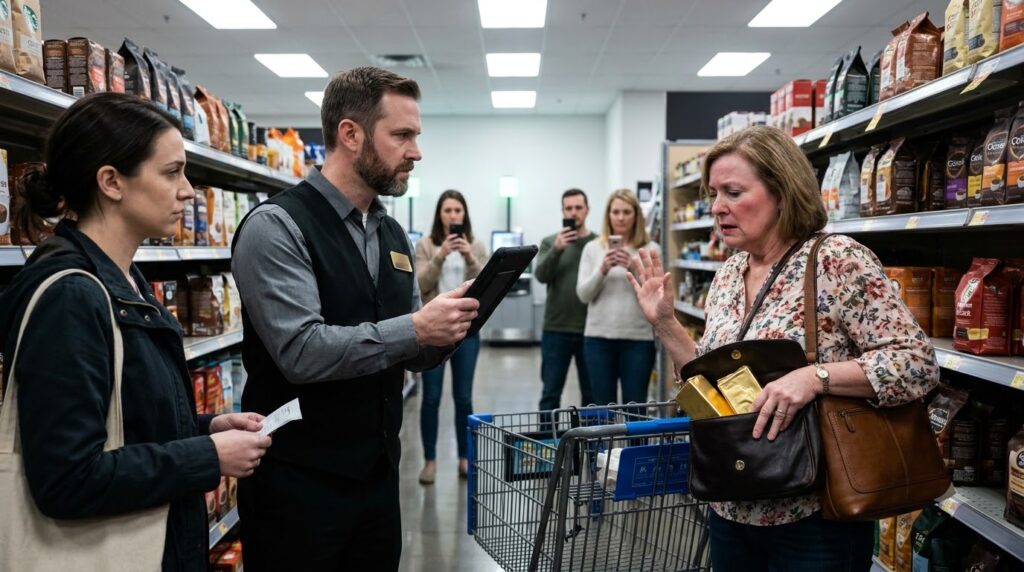
Cold Precision Under Fire: The Quiet Triumph of Truth Over Manufactured Public Shaming
CHAPTER 1: THE PUBLIC BLOCKAGE
The air in Aisle 4 smelled of roasted coffee beans, cardboard, and the faint, metallic hum of industrial refrigeration units. Maya did not flinch when the cart struck the shelving unit beside her shoulder. She kept her right hand resting flat against her canvas tote, feeling the firm outline of her sourdough loaf and the crisp, folded edge of the paper receipt tucked inside her jacket pocket.
“You didn’t pay for those items at the quick-scan counter,” Brenda announced, her voice pitched perfectly to carry across the open rafters toward the main checkout bank. She stood square behind the handle, her broad silhouette framed by a floral blouse, a rigid leather shoulder bag, and a face flushed with instant authority. “I saw you step right around Register 3.”
Three shoppers stopped dead in their tracks. A man holding two boxes of green tea paused mid-reach, his gaze darting between Brenda’s pointing finger and Maya’s dark jacket. Further down the aisle, a woman pushing a stroller pulled out her phone, her thumb already tapping the camera icon.
“I completed my transaction three minutes ago,” Maya said. Her voice was flat, measured, stripped of any defensive tremor. She did not raise her volume to match the room; she lowered it, forcing anyone who wanted to hear the truth to lean in closer. “I came back for coffee.”
“Nonsense,” Brenda snapped, taking a half-step forward and slamming her hip against the cart handle to seal the gap against the shelf. “I was standing right by the end cap. You walked past the scanner, stuffed your personal bag, and looped back inside to blend into the crowd. I know how people like you operate. Hand the bag over so I can inventory it before security arrives.”
Maya calculated the distance between the edge of the cart and the coffee displays. Four inches. Not enough to clear without physical contact. She kept her hands visible, fingers spread slightly, refusing to touch the cart or Brenda’s outstretched wrist. In her mind, she wasn’t arguing with a neighbor; she was reading a broken system log. The anomaly wasn’t hers.
“I am not handing my personal property to a stranger,” Maya said softly. “And you do not have the right to block my movement.”
“I am protecting this store and this community!” Brenda declared, raising both hands to address the half-dozen shoppers now clustering at the aisle entrance. “Look at her! No store bag, no employee escort, refusing to show what’s inside! This is how theft happens every single day while the rest of us pay full price!”
The crowd shifted. Whispers began to circulate—low, uncertain sounds that drifted through the fluorescent light. Maya felt the weight of twelve pairs of eyes scanning her dark hair, her practical shoes, her quiet posture. It was an old pressure, familiar and heavy, designed to force a quick, embarrassed surrender just to make the noise stop.
Instead, Maya reached into her jacket pocket with two fingers, pulling the thermal paper slip halfway out so the bold black lettering of the store’s header showed in the light.
Brenda didn’t look at the paper. She swiped her hand through the air, her knuckles brushing within an inch of Maya’s sleeve. “Receipts mean nothing! Anyone can pick a discarded slip off the floor by the trash cans!”
Maya didn’t pull back. Her eyes locked onto Brenda’s grip on her shoulder bag—a heavy, stiff-leather purse that bulged unnaturally at the top seam, held tight against her ribs.
“Keep your hands to yourself,” Maya said quietly. “We will wait right here for the store manager to pull the terminal log.”
Brenda smiled, a tight, cold curve that didn’t reach her eyes. “Oh, we’ll wait. But when he gets here, you aren’t going to like what the cameras show.”

CHAPTER 2: ESCALATION AT THE COUNTER
“She’s trying to stall!” Brenda’s voice sliced through the low hum of the refrigeration units, sharp and echoing off the steel girders above. She took another aggressive step forward, her knuckles white where she gripped the cart’s top bar, her oversized leather bag swinging heavily against her ribs. “She knows if she stays right here until the crowd gets bigger, someone will get uncomfortable and let her slide. That’s the trick, isn’t it? Make a scene, act offended, and wait for management to offer a free pass just to clear the aisle!”
Maya did not shift her posture. She kept her heels planted firmly on the polished grey concrete, her canvas tote resting against her thigh. She could feel the stares of seven, maybe eight shoppers now lined up near the end cap of Aisle 4. A middle-aged man in a rain-jacket took a step closer, his phone raised at chest height, the small red recording indicator glowing like a cinder in the fluorescent glare.
“I am not asking for a pass,” Maya said, her tone level and unhurried. “I am asking for the register log. Register 3, transaction timestamped 2:14 PM.”
“Anyone can read a clock!” Brenda turned her torso toward the crowd, her floral blouse stretching tight across her shoulders as she gestured wildly with her free hand. “She stands near the self-checkout, watches someone else leave a paper receipt in the plastic recycling bin, scoops it up, and walks back into the store to fill her personal bag with matching items! It’s a classic scam, people! I’ve read about this on the community watch board!”
A murmur rippled through the onlookers. The woman with the stroller frowned, her eyes darting from Brenda’s confident, flushed face down to Maya’s plain canvas bag. The social temperature in the aisle was rising, shifting away from curiosity toward active judgment.
Maya’s internal eye mapped the room with surgical detachment. She noted the subtle shift in crowd dynamics—the way people instinctively gravitated toward the louder, more assertive voice because volume mimicked authority. But she also noted the physical details Brenda was attempting to mask: the erratic rhythm of Brenda’s breathing, the way her eyes darted toward the front sliding doors every time they hissed open, and the distinct, stiff shape pressed against the interior lining of Brenda’s handbag. It wasn’t the soft, flexible bulk of a wallet or a scarf; it was a heavy, square block with sharp corners that gave off the faint, rich aroma of aged wax and cultured dairy.
“If the receipt is forged,” Maya said, her voice cutting through the rising whispers, “then the register memory won’t match my card’s digital token. And the overhead camera above Register 3 won’t show me standing there alone at 2:14 PM.”
Brenda scoffed, a loud, artificial sound that lacked true amusement. “Cameras? You think the store staff has time to pull up video feeds for every petty thief who thinks she’s clever? You’re blocking the aisle, you’re disrupting honest shoppers, and you’re refusing to open your bag for a basic inspection.” She reached out suddenly, her fingers curling into a claw as she lunged toward the canvas strap resting on Maya’s shoulder. “If you have nothing to hide, open it now!”
Maya didn’t flinch or swat the hand away; she simply took one precise step backward, letting Brenda’s momentum carry her hand uselessly through empty air. The sudden overreach caused Brenda’s heavy leather bag to swing forward, thumping hard against the metal edge of the shopping cart with a dense, solid clack.
Brenda winced, instantly pulling the bag back against her hip, her hand flying over the open top flap as if to cover something inside. For a split second, her composure cracked, her eyes flashing with a sudden, sharp spike of panic before she smoothed her features back into a mask of righteous indignation.
“Don’t touch me,” Maya said calmly, her eyes lingering for a second on the top flap of Brenda’s purse before rising to meet her gaze. “And don’t touch my property. We wait for the floor manager.”
“He’s already coming,” the man with the recording phone muttered from the edge of the crowd, his eyes glued to his screen as he captured Brenda’s reddening neck. “I saw the cashier at Register 1 hit the call button.”
Brenda’s jaw tightened. She didn’t let go of the cart, but her posture subtly shifted from offensive aggression to a guarded stance, her fingers digging so hard into the rubber grip of the handle that her fingernails turned pale. “Fine,” Brenda hissed under her breath, stepping closer so only Maya could hear her over the store’s background music. “We’ll wait for Marcus. But when he sees you refusing a simple bag check, don’t expect him to take your side over a neighborhood board member.”
Maya kept her hands still at her sides, her receipt held firmly between her index and middle finger, watching the aisle entrance as a tall figure in a black store vest began pushing through the gathering crowd.
CHAPTER 3: THE MANAGERS ARRIVAL
Marcus Brooks did not run. He walked with a steady, practiced stride that instantly cut through the atmospheric static of Aisle 4. His black store vest was zipped flush to his throat, the brass name tag gleaming under the high-bay LEDs. He stepped directly into the narrow breach between Brenda’s shopping cart and Maya’s shoulder, his tall frame acting as a physical bulkhead against the mounting pressure of the aisle.
“Alright,” Marcus said. His voice was low, resonant, and devoid of performative urgency. He didn’t look at the crowd, nor did he look at the glowing smartphone screens floating in the air five feet back. He looked straight at the cart pinned across the aisle. “What is the disruption here?”
“Marcus, thank God,” Brenda blurted out instantly, her tone executing a sharp, practiced pivot from hostile screech to aggrieved civic partner. She pointed a manicured finger directly at Maya’s face. “I caught this girl attempting to walk straight out the front doors with a full tote bag. She bypassed the entire self-checkout bank. When I stepped in to perform a routine check, she refused to cooperate, threatened me, and tried to push her way past my cart.”
Maya didn’t interrupt. She stood motionless, observing Marcus’s eyes as they scanned the physical setup. She watched him take in the precise geometric angle of the cart wedged against the shelf, the distance between her feet and the store exit, and the tight, defensive tension in Brenda’s shoulders.
“Is this your bag, ma’am?” Marcus asked, turning his head toward Maya. His expression was a blank slate—neither accusatory nor sympathetic.
“It is,” Maya replied, her voice cutting through the ambient hum of the refrigeration units with absolute clarity. “And I did not bypass the checkout. I completed my transaction at Register 3 four minutes ago. I tucked my items into my tote, took my receipt, and walked back to Aisle 4 to grab dark roast coffee before leaving.”
“She’s lying, Marcus!” Brenda interjected loudly, taking a step around the front wheel of the cart to press her advantage. “I was standing right near the end cap! She never touched a scanner! Ask anyone standing behind me—they saw her wandering the aisle with a personal bag full of un-bagged items!”
“Ma’am, please let me conduct the inquiry,” Marcus said, raising one flat palm toward Brenda without taking his eyes off Maya. The gesture was polite, but it possessed the immovable weight of store policy. He turned back to Maya. “Do you have the receipt on you?”
Maya extended her hand, offering the folded strip of thermal paper. “Register 3. Timestamped 2:14 PM. Paid via contactless card.”
Marcus took the paper by its edges. Before his eyes could even settle on the printed text, Brenda let out a sharp, condescending laugh that bounced off the metal shelving.
“Oh, please! Marcus, you’re smarter than this!” Brenda stepped closer, her hand clutching her heavy leather handbag tight against her ribs. The movement caused the top flap of her purse to shift, exposing a faint glint of clear gold plastic wrapping beneath the leather lip before she pulled it tight. “Anyone can scoop a discarded receipt out of the recycling bin by the door! I saw three people throw their slips away while I was walking in! She picked up an abandoned receipt, read what was on it, and went back into the aisles to grab the exact same items so she’d have an excuse if she got caught!”
The statement landed in the aisle like a smoke grenade. A collective intake of breath echoed through the crowd. The man recording on his phone tilted his device lower, zooming in on the paper in Marcus’s hand.
“Look at her!” Brenda pushed further, her voice rising to capture the room again. “Notice how she doesn’t have a single plastic store bag? She brought her own canvas tote precisely so she could pull this duplicate receipt stunt! It’s an organized retail theft method, Marcus! You need to call the local precinct immediately and have her detained!”
Maya felt the air in the room grow heavy. Brenda’s argument was structured like a classic decoy—it took a verifiable fact (a valid receipt) and wrapped it in a plausible lie (the trash-bin duplicate theory) to create just enough reasonable doubt to flip the narrative. It was designed to force a floor manager into defensive risk management: call the police, clear the aisle, and detain the target behind closed doors where public proof didn’t apply.
Marcus looked down at the receipt in his palm, his thumb tracing the crisp, uncreased edge of the thermal paper. “A duplicate slip from the trash bin,” he repeated, his tone completely unreadable.
“Precisely!” Brenda insisted, her chest puffing up with visible triumph as she glanced around at the watching shoppers. “It’s obvious! Check her bag right now, or call the police!”
Maya took a half-step forward, keeping her hands open and visible. “Mr. Brooks, a paper receipt can be claimed as a duplicate. But a register terminal log cannot be forged from a trash can. Neither can an overhead camera stream.”
Marcus stared at Maya for three long seconds. In his eyes, Maya saw the subtle shift of a man who dealt with daily inventory reconciliation. He wasn’t evaluating emotional performances; he was evaluating data integrity.
“Stay right here,” Marcus said cleanly. He reached down to his belt, unholstering a ruggedized store tablet encased in thick black rubber. He tapped the glass screen, the bright blue interface reflecting off the dark lenses of his eyes. “We’re going to cross-reference Transaction 408 directly against the central server.”
Brenda’s posture froze. For a fraction of a second, her confidence faltered, her fingers tightening so hard around the strap of her shoulder bag that the leather creaked in the silence of the aisle.
CHAPTER 4: THE PROOF FLIP
“Register 3,” Marcus read aloud, his thumb tapping the glass tablet screen with precise, rhythmic taps. His voice was completely flat, a neutral instrument broadcasting data into the tense silence of Aisle 4. “Terminal 03, Transaction 408. Timestamp: 2:14 PM. Payment authorization: Visa token ending in 4102. Total: $28.45.”
He didn’t look up from the glowing blue backlight. He swiped his thumb across the panel, pulling up the itemized breakdown.
“Almond milk, two cartons. Sourdough loaf, artisanal. Honeycrisp apples, one bag. Paper towels, two-pack.” Marcus raised his eyes, his gaze locking onto Maya’s open canvas tote. “Four items total. Every single piece sitting in your bag matches the itemized record logged to the central processor four minutes ago.”
A sudden drop in air pressure seemed to hit the aisle. The woman with the stroller let out a soft exhale, her hands relaxing on the handlebar. The man recording with his smartphone leaned three inches closer, angling his camera lens to capture Marcus’s face and the rubber-clad tablet held in his grip.
“That doesn’t prove anything!” Brenda’s voice cracked, the high-pitched strain revealing the first real fracture in her composure. She slammed her palm onto the top rail of her shopping cart, shaking the metal frame. “I told you, Marcus! She found a discarded slip! She read what was on it and grabbed those exact items off the shelves to pull off the duplicate trick! You’re looking at a screen, not at what she actually did!”
“I’m looking at the terminal camera feed, Mrs. Vance-Holloway,” Marcus said quietly.
He didn’t raise his voice, but the name landed with the weight of an iron anchor. He turned the tablet ninety degrees, tilting the wide, glare-free screen toward the crowd so the onlookers standing three feet away could see the crisp, high-definition video grid.
On the screen, timestamped 2:13:42 PM, the camera angle from directly above Register 3 played in smooth, high-fps motion. The footage showed Maya standing alone at the self-checkout kiosk. She scanned the almond milk, scanned the sourdough, tapped her card against the contactless terminal, waited for the green checkmark, placed the items into her canvas tote, and picked up her printed paper receipt.
There was no hesitation. No second bag. No scavenging near the recycling bin.
The video continued to play. At 2:14:10 PM, as Maya turned to walk down the main concourse toward Aisle 4, the camera frame captured another figure standing ten feet away near the end cap: Brenda Vance-Holloway. On the screen, Brenda was staring intently down at her personal phone, completely oblivious to Maya’s transaction, her body turned away from the self-checkout bank entirely.
“The footage is timestamped and synchronized to the register system,” Marcus said, his voice dropping into an icy, unyielding register. “Miss Lin paid for every item in her tote at 2:14 PM. She followed every store protocol.”
The silence in Aisle 4 collapsed into a sudden surge of low, furious murmurs.
“Unbelievable,” a man near the back muttered.
“She made the whole thing up,” a woman whispered, her phone held high as she recorded Brenda’s face.
Maya stood perfectly still, watching Brenda’s reaction with calculating precision. She didn’t smile, nor did she posture in victory. She watched the dark, mottling flush spread up Brenda’s neck, creeping past her collar line to stain her cheeks a deep, furious crimson. The decoy argument—the elaborate narrative of trash-bin forgery and organized retail crime—had vanished in an instant, shredded by twenty seconds of unassailable digital record.
“Well… she was acting suspicious!” Brenda stammered, her hands trembling as she pulled back from the shopping cart handle. She tried to lift her chin, attempting to re-assemble the shattered pieces of her neighborhood authority. “Carrying an open tote bag back into the sales floor after checking out is bad practice! It invites confusion! As a concerned community member, I had every right to ask questions!”
“You didn’t ask questions, ma’am,” Marcus corrected sternly, stepping past the cart to place himself directly between Brenda and Maya. “You physically blocked an aisle, slandered a paying customer in front of a dozen people, and demanded a search without a shred of evidence.”
Brenda’s mouth opened, but no sound came out. She gripped her heavy leather shoulder bag tightly against her ribs, her knuckles white against the dark grain. She took a step backward, intending to turn toward the main concourse and make a rapid, humiliated exit.
“Wait a moment, Mrs. Vance-Holloway,” Marcus said, his voice stopping her dead in her tracks.
Marcus’s eyes hadn’t missed the sudden, awkward way Brenda held her purse, nor had he missed the stiff, rectangular outline straining the interior lining. During the struggle with the cart in Chapter 2, when the heavy purse had thumped against the metal frame, a small tear in the inner tissue paper wrapping had shifted.
Now, under the harsh blue light of the aisle, Marcus reached out, his finger pointing directly at the open top flap of Brenda’s leather handbag. Tucked visibly between her personal items were two large, unpackaged blocks of imported Dutch gouda from the specialty deli display—each wrapped in gold foil and clear wax, bearing no checkout barcodes or register stickers.
“Before you leave,” Marcus said, his tone shifting into something far darker, “I need you to step into the back office. We need to discuss the unpaid specialty inventory sitting in your purse.”
Brenda froze. The color drained from her face so fast she looked suddenly fragile, her eyes wide with unvarnished terror as she realized the entire room was watching her.
CHAPTER 5: PUBLIC COLLAPSE AND CONSEQUENCES
“I… I don’t know how those got in there,” Brenda whispered. Her voice had lost all its booming cadence, shrinking into a thin, brittle rascal that barely carried past the front wheels of her cart.
Marcus did not answer immediately. He let the silence hang in Aisle 4, heavy and suffocating under the harsh white glow of the overhead fluorescent panels. He reached down and gripped the metal handle of Brenda’s shopping cart, pulling it back three inches with a crisp, grinding scrape against the polished concrete floor. The physical barrier blocking Aisle 4 vanished. The path was open.
“You can explain that to store security in the back office, Mrs. Vance-Holloway,” Marcus said, his tone unyielding and formal. He raised his hand slightly, gesturing toward two uniformed loss-prevention guards who were already walking swiftly down the main concourse toward the aisle entrance.
The crowd of onlookers parted like water around a hull. Phones remained held high, glowing screens capturing every micro-expression on Brenda’s face as her cheeks turned from mottled crimson to a hollow, papery white. The young man with the smartphone didn’t lower his arm; he stepped closer, angling his camera lens straight at the golden foil corners peeking out from her unzipped leather purse.
“She was pointing fingers at everyone else while stuffing her own bag,” a woman in the back called out, her voice loud enough to carry across the neighboring display aisles.
“Classic,” the man recording muttered, shaking his head. “Absolute classic.”
Brenda looked around frantically, searching the sea of faces for a single nod of sympathy, a familiar neighbor, or an ally from the neighborhood association. She found only cold, unblinking phone lenses and turned shoulders. The social capital she had spent years building through arbitrary rule enforcement and public shaming vanished in twenty seconds of recorded video and objective inventory audits.
“This is a mistake,” Brenda tried again, her fingers trembling as she pulled her leather bag tighter against her coat, as if she could hide the stiff, square shapes bulging against the lining. “I am a member of the HOA board. I am a regular patron. I demand—”
“You will step this way, ma’am,” one of the uniformed security guards interrupted quietly, placing himself on her left flank while the second guard took position on her right. “Keep your hands visible, please.”
Brenda hesitated for one agonizing second, her shoulders slumping as the rigid, artificial posture of authority completely disintegrated. She did not look at Maya. She could not bring herself to raise her eyes to meet the quiet, level gaze of the woman she had trapped against the display shelf minutes earlier. With her head bowed and her feet dragging against the concrete, Brenda was ushered past the rows of coffee bags and led down the narrow corridor toward the store’s security suite.
Marcus watched them leave until the door swung shut. He turned back to face Maya, his posture dropping its rigid guard posture and relaxing into a professional, respectful stance.
“Miss Lin,” Marcus said, speaking clearly so his voice carried to the remaining shoppers who were still lingering near the aisle threshold. “I apologize for the disturbance and the unprovoked harassment you experienced in our store today. Westside Market values your business, and I appreciate your patience while we verified the system logs.”
Maya adjusted the strap of her canvas tote, resting her hand comfortably against the sourdough loaf and the dark roast coffee bag she had just retrieved from the shelf. She felt no rush of adrenaline, no sudden surge of triumph—only the calm, clean weight of an accurate calculation.
“Thank you, Mr. Brooks,” Maya said softly, her voice steady and resonant in the quieted aisle. “I appreciate you checking the data directly.”
Marcus nodded once, stepping aside completely to give her an unobstructed view of the front registers.
Maya walked down Aisle 4 with unhurried, measured steps. As she passed the remaining shoppers, hands dropped and phones were tucked back into pockets. People stepped back to give her space, their expressions filled with a quiet, respectful deference. She walked up to Register 1, placed her single bag of dark roast coffee on the conveyor, and scanned it under the steady green glow of the terminal laser.
The machine chimed softly. She tapped her card, picked up her final receipt, and stepped out through the automatic sliding glass doors into the bright afternoon sunlight.
Behind her, the store was quiet again, the hum of the refrigeration units lost in the vast, orderly rhythm of the day.