
CHAPTER 3: THE MANAGERS ARRIVAL
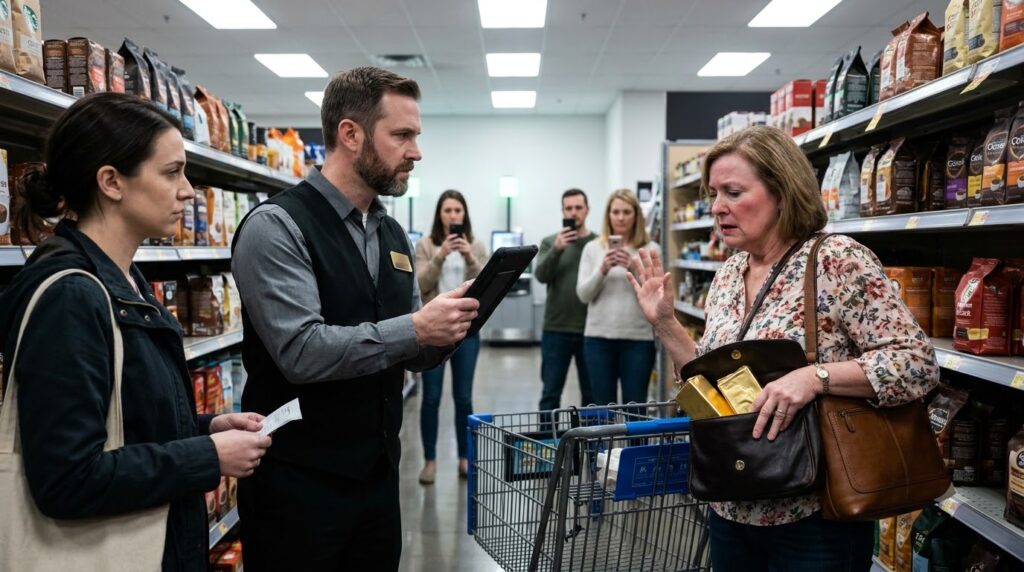
Marcus Brooks did not run. He walked with a steady, practiced stride that instantly cut through the atmospheric static of Aisle 4. His black store vest was zipped flush to his throat, the brass name tag gleaming under the high-bay LEDs. He stepped directly into the narrow breach between Brenda’s shopping cart and Maya’s shoulder, his tall frame acting as a physical bulkhead against the mounting pressure of the aisle.
“Alright,” Marcus said. His voice was low, resonant, and devoid of performative urgency. He didn’t look at the crowd, nor did he look at the glowing smartphone screens floating in the air five feet back. He looked straight at the cart pinned across the aisle. “What is the disruption here?”
“Marcus, thank God,” Brenda blurted out instantly, her tone executing a sharp, practiced pivot from hostile screech to aggrieved civic partner. She pointed a manicured finger directly at Maya’s face. “I caught this girl attempting to walk straight out the front doors with a full tote bag. She bypassed the entire self-checkout bank. When I stepped in to perform a routine check, she refused to cooperate, threatened me, and tried to push her way past my cart.”
Maya didn’t interrupt. She stood motionless, observing Marcus’s eyes as they scanned the physical setup. She watched him take in the precise geometric angle of the cart wedged against the shelf, the distance between her feet and the store exit, and the tight, defensive tension in Brenda’s shoulders.
“Is this your bag, ma’am?” Marcus asked, turning his head toward Maya. His expression was a blank slate—neither accusatory nor sympathetic.
“It is,” Maya replied, her voice cutting through the ambient hum of the refrigeration units with absolute clarity. “And I did not bypass the checkout. I completed my transaction at Register 3 four minutes ago. I tucked my items into my tote, took my receipt, and walked back to Aisle 4 to grab dark roast coffee before leaving.”
“She’s lying, Marcus!” Brenda interjected loudly, taking a step around the front wheel of the cart to press her advantage. “I was standing right near the end cap! She never touched a scanner! Ask anyone standing behind me—they saw her wandering the aisle with a personal bag full of un-bagged items!”
“Ma’am, please let me conduct the inquiry,” Marcus said, raising one flat palm toward Brenda without taking his eyes off Maya. The gesture was polite, but it possessed the immovable weight of store policy. He turned back to Maya. “Do you have the receipt on you?”
Maya extended her hand, offering the folded strip of thermal paper. “Register 3. Timestamped 2:14 PM. Paid via contactless card.”
Marcus took the paper by its edges. Before his eyes could even settle on the printed text, Brenda let out a sharp, condescending laugh that bounced off the metal shelving.
“Oh, please! Marcus, you’re smarter than this!” Brenda stepped closer, her hand clutching her heavy leather handbag tight against her ribs. The movement caused the top flap of her purse to shift, exposing a faint glint of clear gold plastic wrapping beneath the leather lip before she pulled it tight. “Anyone can scoop a discarded receipt out of the recycling bin by the door! I saw three people throw their slips away while I was walking in! She picked up an abandoned receipt, read what was on it, and went back into the aisles to grab the exact same items so she’d have an excuse if she got caught!”
The statement landed in the aisle like a smoke grenade. A collective intake of breath echoed through the crowd. The man recording on his phone tilted his device lower, zooming in on the paper in Marcus’s hand.
“Look at her!” Brenda pushed further, her voice rising to capture the room again. “Notice how she doesn’t have a single plastic store bag? She brought her own canvas tote precisely so she could pull this duplicate receipt stunt! It’s an organized retail theft method, Marcus! You need to call the local precinct immediately and have her detained!”
Maya felt the air in the room grow heavy. Brenda’s argument was structured like a classic decoy—it took a verifiable fact (a valid receipt) and wrapped it in a plausible lie (the trash-bin duplicate theory) to create just enough reasonable doubt to flip the narrative. It was designed to force a floor manager into defensive risk management: call the police, clear the aisle, and detain the target behind closed doors where public proof didn’t apply.
Marcus looked down at the receipt in his palm, his thumb tracing the crisp, uncreased edge of the thermal paper. “A duplicate slip from the trash bin,” he repeated, his tone completely unreadable.
“Precisely!” Brenda insisted, her chest puffing up with visible triumph as she glanced around at the watching shoppers. “It’s obvious! Check her bag right now, or call the police!”
Maya took a half-step forward, keeping her hands open and visible. “Mr. Brooks, a paper receipt can be claimed as a duplicate. But a register terminal log cannot be forged from a trash can. Neither can an overhead camera stream.”
Marcus stared at Maya for three long seconds. In his eyes, Maya saw the subtle shift of a man who dealt with daily inventory reconciliation. He wasn’t evaluating emotional performances; he was evaluating data integrity.
“Stay right here,” Marcus said cleanly. He reached down to his belt, unholstering a ruggedized store tablet encased in thick black rubber. He tapped the glass screen, the bright blue interface reflecting off the dark lenses of his eyes. “We’re going to cross-reference Transaction 408 directly against the central server.”
Brenda’s posture froze. For a fraction of a second, her confidence faltered, her fingers tightening so hard around the strap of her shoulder bag that the leather creaked in the silence of the aisle.








