
The Iron Metric of a Heat-Stained Boundary Line on a Broken Curb

CHAPTER 1: THE RECOIL OF GASOLINE

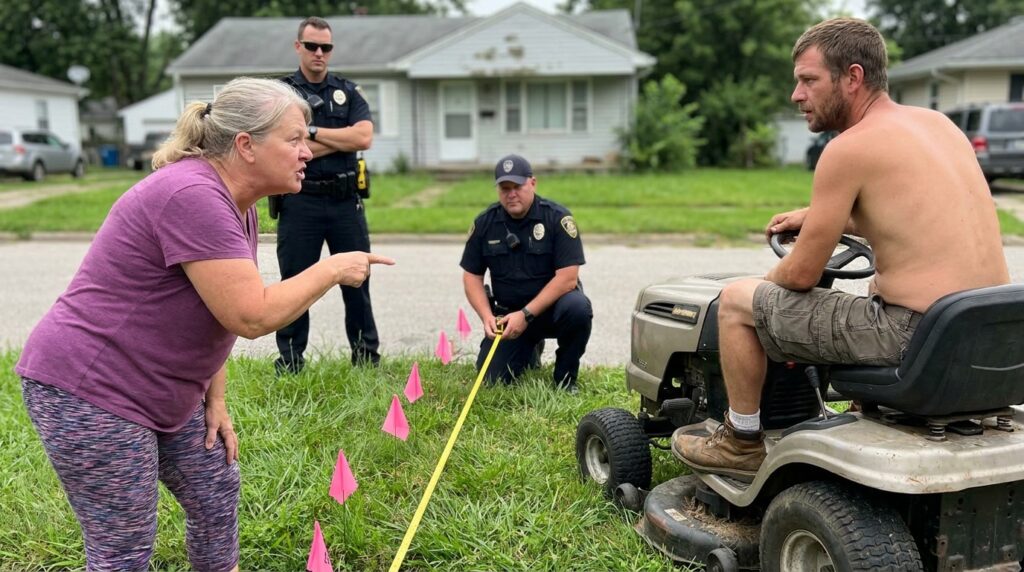
The heat came off the block of the twelve-horsepower engine in rhythmic, oily waves, cooking the scent of bitter dandelion sap into the scruff of his chin. He had his right work boot pinned to the hydrostatic pedal, the green machine creeping at three miles an hour along the edge of the unpaved ditch where the residential asphalt gave up and turned into wild rye. Then the shadow fell across his steering wheel. It wasn’t a soft shadow; it was thick, rigid, and smelled of heavy laundry detergent and stale air-conditioning.

“Kill it,” she said.

Her mouth was a flat, gray line beneath her sunglasses. She didn’t look at his face; she looked at the iron housing of the deck where the safety discharge chute threw a fine spray of grit against the tips of her clean white sneakers. She had her short, gray-blonde hair tucked behind her ears, her posture pitched forward like a fence post that had taken a bad lean after a hard winter.

He didn’t drop the throttle. He simply backed his boot off the pedal, letting the transmission whine to a dead halt three inches from her patterned leggings. The grass between them was nearly ten inches high, seed-heavy and yellowing from three weeks without rain. A line of six pink plastic survey flags poked out of the weeds like miniature warning spikes, spaced exactly two feet apart.

“I’m on the county strip, ma’am,” he said. His voice was dry, the words scraping out of his throat with the texture of the dust he’d been swallowing since seven that morning. His shirtless torso was covered in a film of grease and green flecks that stuck to the hollows of his collarbones.

“You’re on my property,” she snapped, her index finger jabbing down toward the first pink marker. The plastic shaft vibrated from the force of her gesture. “Those flags were set by a professional. If you take one more inch off this side, I’m having your rig impounded for criminal mischief. I’ve already called the township.”

He didn’t argue. He knew the look of a woman who spent her mornings tracking code violations through a pair of kitchen blinds. He watched her left hand; it was clamped around a blue plastic folder, the edges of white paper swelling out from the seal like a deck of cards she’d been shuffling all day. Underneath her purple tee, her chest rose and fell in short, shallow jerks.

Farther back, across the blacktop, a front door on a ranch house clicked shut. A neighbor in a gray undershirt stepped onto a concrete porch, holding a yellow ceramic mug, his eyes locking onto the green machine idling in the weeds.

The contractor reached down with his left hand, his fingers tracing the coarse plastic of the ignition key. He turned it back. The engine gave a violent, throat-clearing rattle, the belt under the deck squealing once before the absolute silence of the suburban street slammed down over the yard. The only sound left was the slow, metallic tick-tick-tick of the exhaust manifold contracting in the July heat.

He swung his leg over the high-backed vinyl seat, his work boots sinking into the dry thatch. As his heels hit the ground, he noticed a fresh patch of dark, wet earth right beneath the fourth survey flag—an oil-black circle no bigger than a silver dollar, smelling faintly of sulfur and rusted iron, bubbling out from a gap where the sod had been recently sliced away.


CHAPTER 2: THE BLUE PLASTIC SHIELD

The plastic snap of her blue folder bit into the silence like a small-caliber pistol shot.

“You think you’re slick, don’t you?” her voice didn’t rise; it dropped into a dry, gravelly vibration that belonged to courtroom corridors and code-enforcement desks. She slid a single sheet of paper from the plastic sleeve. The paper was laminated, thick enough to resist the damp heat rising from the wild rye, its corners yellowed to the color of old fat. “This is the 2014 township plat for lot forty-two. See that dotted index line? That’s four feet from your current tire tread. You’re trespassing on private improvements, mister.”

The contractor didn’t reach for the paper. He stayed planted in his boots, his hands resting on the hot green hood of the mower. The metal was already starting to tick louder as it cooled, the scent of parched iron and unrefined oil filling the gap between them. He looked past the laminated sheet, his eyes fixing on her fingers. They were short, the skin around her knuckles white from the pressure she was putting on the blue plastic. She wasn’t just angry; she was holding the folder like a shield against something she expected to come out of the ground.

“I don’t map ’em, ma’am,” he said, keeping his chin low. “The homeowner gave me the digital stakes on the county app. My blades don’t drop until the GPS clears the grid.”

“The app is garbage,” she said. She took a step closer, the white rubber soles of her sneakers crunching into the dry thatch right over the oil-black dollar-sized circle he’d noticed moments before. She didn’t look down. She leaned her weight onto her forward leg, her purple tee straining against her shoulders. “The county didn’t account for the 2018 easement correction. I paid three hundred dollars out of pocket for these pink stakes. If you run them down, you’re paying for the reset, plus the downtime for my landscaper.”

Behind her, the door to the ranch house across the street didn’t just open—it stayed unlatched. The man with the yellow mug had shifted his weight from the porch railing to the first concrete step. He wasn’t the only one. Two houses down, an old sedan idled in a driveway, the driver’s side window rolled down three inches, the glint of a smartphone screen reflecting the noon glare from inside the dark interior. The neighborhood was waking up to the rhythm of the dead engine.

The contractor reached into his cargo shorts and pulled out a clean cotton rag, slowly wiping the green grass paste from his forearms. He wasn’t looking at her face; he was looking at the way the pink survey flags were aligned. They weren’t straight. If you lined up your eye with the concrete curb fifty feet down, the third flag took a sharp two-inch hook toward her house, right where that wet spot was bubbling through the sod.

“Your landscaper use an iron probe when he set these?” he asked, pointing the rag toward the crooked marker.

Her mouth twitched. For less than a second, her sunglasses slipped down the bridge of her nose, revealing a pair of small, pale eyes that didn’t match the confidence of her posture. They were wide, darting from his grease-stained boots to the small black circle of wet earth between her feet. She pulled the sunglasses back into place with a sharp jerk of her chin.

“That’s none of your business,” she said, her voice thinning out. “What’s your boss’s name? The name on the side of the truck is faded out. I want the registration number for the LLC.”

Before he could answer, a low, dual-tone chirp cut through the humid air from the corner of the block. It was the dry, unhurried squawk of a municipal siren. A black-and-white utility cruiser turned the corner, its tires making a gritty, sand-paper sound against the unwashed asphalt of the gutter. The roof lights weren’t spinning, but the nose of the car dipped hard as the driver hit the brakes, angling the bumper directly toward the line of pink flags.

The contractor didn’t move. He felt the grease on his neck turning cold under the sudden draft of the cruiser’s air-conditioned exhaust as the driver’s side door clicked open.

CHAPTER 3: THE CRUNCH OF CONCRETE MARGINS

The driver’s side door of the Ford utility cruiser opened with a heavy, mechanical click, swinging wide enough to block the narrow gutter lane. A black leather boot, thick-soled and coated in a dull layer of dried highway dust, hit the sun-baked asphalt. The car didn’t idle like a standard civilian vehicle; it carried a deep, low-frequency thrum from its cooling fans that vibrated right through the soles of the contractor’s work boots, an undercurrent of industrial weight that redefined the empty air between the two properties.

The stocky officer who stepped out didn’t look at the pink flags right away. He adjusted his duty belt with a practiced, double-handed tug, the braided nylon creaking against the steel buckles of his taser holster. His dark uniform cap sat precisely parallel to his brow, casting a sharp, triangular shadow across a clean-shaven face that had spent twenty years hardening under the flat glare of county code disputes.

“Afternoon,” the officer said. His voice was a flat baritone, entirely clear of the theatrical heat the neighbor had been projecting. He walked with a short, measured stride toward the point where the gravel driveway met the wild rye, his eyes tracking the grease-stained chassis of the green mower before stopping on the laminated sheet still pinched between the woman’s fingers.

“Officer,” she said, her posture shifting seamlessly from a lean to an upright, formal stance. The blue plastic folder came up to her chest like an identification badge. “I’m glad you’re here. This contractor is actively ignoring the survey boundary. I’ve requested three times that he disengage his machinery until the township clerk can verify the registration of his LLC, but he’s insisting on moving forward based on a consumer-grade phone application.”

The stocky officer didn’t offer his hand for the folder. He stopped exactly twenty inches from her sneakers, his weight distributed evenly between his heels, his left hand resting loosely on the thick nylon edge of his radio pouch. He looked down at the pink flags, then across the unpaved ditch toward the weathered foundation of the neighboring ranch house.

“Your name?” the officer asked, looking at the contractor.

“Garrett,” the contractor said. He kept his hands visible, flat against the green iron cowl of the engine. The metal beneath his palms was starting to lose its aggressive heat, turning into a dense, passive block of warm iron. “I’m working for the property owner on forty-four. The job order covers the full easement cut down to the concrete margin.”

“The margin is contested,” the woman broke in, her index finger pointing rigidly at the officer’s uniform patch. “My husband was a senior technician with the county water district for thirty-two years. He laid the original stone markers when this plat was separated from the orchard parcel. This man’s blades are going to ruin the grade, and the township ordinance explicitly states that any disruption to the established turf line requires a twenty-four-hour administrative notice to the abutting neighbors.”

The stocky officer turned his head slightly, his sunglasses catching the hard glint of the noon sun. From the passenger side of the cruiser, a second figure emerged—the tall backup officer. He didn’t approach the circle. Instead, he took up a tracking position six feet back, his hips angled away to keep his service weapon clear of the fence line, his dark lenses scanning the windows of the houses across the street. The neighbor with the yellow mug had been joined by a woman in a housecoat; they stood side-by-side on the concrete step, their silence heavy and expectant.

“Let me see the sheet, ma’am,” the stocky officer said.

He took the laminated document by the very edge, holding it up against the glare rather than looking down at it. His thumb ran along the plastic seam. The contractor watched the officer’s face; there was no sudden realization, no shifting of the jaw. But his eyes didn’t stay on the dotted index line she had pointed out. They traveled down to the bottom margin, where the official stamp of the county clerk should have been embossed into the paper. There was only a flat, blue-ink photocopy of a seal, the registration digits slightly blurred from an old machine.

“This is a 2014 field layout,” the officer noted, his voice dropping an octave as he turned his attention toward the ground between them. He walked three steps down the flagged line, his heavy boots pressing into the dry thatch. When he reached the fourth flag—the one where the third marker dipped toward the house—he stopped.

The dark, wet patch was larger now. The sulfur smell had sharpened, a metallic tang that mixed with the odor of scorched grass clippings. The sod around the base of the pink plastic shaft was slightly spongy, the water dark and slick with a iridescent sheen of old mineral deposits.

The officer looked at the neighbor, then back at the contractor. “Garrett, you drop your deck yet?”

“No, sir,” Garrett said, his thumb pointing toward the clean, dry discharge chute. “I was on the first pass when she came off the porch. The blades haven’t touched the dirt.”

“Good,” the officer said. He reached down to his belt, his fingers unclipping a heavy, dull-finish aluminum case from his rear pocket. He didn’t pull a ticket book. He pulled a heavy three-inch steel spring clip that held a hundred-foot retractable measuring line, its silver ring jingling against the iron rivets of his uniform pants. “We’re going to pull the metric from the county pin at the intersection. Hold on, ma’am, we need to check where this line is.”

The woman’s hand went white against the blue folder, her mouth opening to speak, but the backup officer took one step closer, his tall shadow crossing her shoulder like a solid bar.

CHAPTER 4: THE IRON UNDERNEATH

The scuff of Garrett’s work boots against the heat-shrunk weeds was the only sound for three seconds after the officer spoke. He dropped his weight off the green step of the riding mower, the thick rubber soles sinking into a patch of earth that felt entirely wrong for a high-summer easement line. It didn’t crack under his heels like the parched clay near the asphalt; it gave way with a heavy, sucking wetness that pushed a thick bubble of dark, iron-slick grease up through the yellowed stalks of rye.

He knelt down, his bare shoulder blade nearly brushing the hot metal of the exhaust shroud. The scent of sulfur was no longer a faint trace drifting on the midday air; it was a localized, heavy rot that seemed to radiate directly from the base of the fourth pink plastic flag. The plastic shaft itself was crooked, leaning toward the woman’s yard at an angle that looked less like a casual placement error and more like a deliberate attempt to crowd a specific point in the sod.

“Don’t touch that,” she said. Her voice didn’t carry its previous administrative weight. The gravelly edge had cracked, shifting into a thin, sharp projection that sounded like a dry branch rubbing against a screen door. She hadn’t moved off the sidewalk, but her clean white sneakers were twitching against the concrete seam, her hands tightening until the blue plastic folder bowed under the strain. “That’s private landscaping turf. You have no legal authority to excavate or disrupt the subsoil structure without an environmental clearance from the county board.”

Garrett didn’t look up at her. He didn’t look at the stocky officer either, who was already walking toward the concrete curb with the ring of his steel tape measure jingling against his hip. Instead, Garrett reached out with his thumb and forefinger, grasping the muddy base of the pink flag. The plastic was slick with a cold, greasy film that didn’t feel like ordinary ditch water. He pulled.

The stake didn’t come out with the clean pop of an iron pin driven into standard clay. It slid free along a three-inch track of gray, liquefied silt that reeked of old pipe scale and stagnant municipal rust. Beneath the hole left by the shaft, something hard resisted the pressure of his boot heel. It wasn’t a stone; the shape was too geometric, the edge too straight, even under two inches of accumulated weed thatch and wet soil.

He used the flat edge of his cotton rag to clear the top layer of muck. The gray fabric came away blackened with iron oxide, revealing a thick, circular plate of oxidized iron. It was pitted, heavily scarred by decades of ground moisture, but the raised letters across the center were still readable under the crust of dry mud: MUNICIPAL DISTRICT 4 – MAIN ISOLATION.

A heavy, flanged water valve cover was sitting directly under the line she had marked with her commercial flags.

Garrett wiped his palm on his cargo shorts, his skin catching on the gritty rust residue. He stood up slowly, looking across the four-foot strip toward her porch. “This valve is on the county master grid, ma’am. If your husband laid these markers based on the water district plats, he knew exactly where the city easement stopped.”

The woman didn’t reply right away. Her face stayed locked behind the dark sunglasses, but her chin dropped a fraction of an inch. Her eyes seemed fixed on the exposed iron lid, where a tiny, steady bead of dark water was welling out from the central pry-hole, glistening like engine oil under the noon glare. The water didn’t drain toward the ditch; it was pooling in the small hollow she had claimed as her yard, softening the foundation line of her own gravel driveway.

The stocky officer stopped thirty feet down the line, his black leather boot pinned against a brass marker disk embedded in the concrete header. He didn’t look down at the iron valve Garrett had uncovered. He kept his attention on his aluminum case, pulling the silver ring of the tape measure until the steel ribbon gave a long, metallic hiss across the parched grass.

“Hold the zero end on the pin, Garrett,” the officer called out, his baritone voice flat and conversational against the distant murmur of the sedan idling down the block. “Let’s see what the chain says before the ground gives out under us.”

Garrett walked toward the front of the cruiser, his boots leaving dark, oily prints on the dry grass, his fingers reaching for the cold steel ring of the tape measure while the neighbor’s blue folder remained raised like a shield that had just taken its first hit.

CHAPTER 5: THE METRIC SLIP

The steel ribbon of the tape measure gave a loud, singing screech as Garrett hooked the brass loop over the center bolt of the rusted isolation valve. He pinned the ring down with his thumb, the pitted iron plate cold and slick against his skin despite the baking heat of the sun. Thirty feet away, the stocky measuring officer backed up with an unhurried, rhythmic heavy step, his uniform boots crunching into the dry ditch grass as the silver tape rolled out between them like a cold wire.

“Keep it flat, Garrett,” the officer directed, his baritone voice clipped. He was kneeling near the concrete header block at the corner of the block, his thumb holding the heavy aluminum housing. The tape was tight now, singing in the slight breeze that ran between the houses, a straight line cut through the dry weeds that didn’t follow the curve of the neighbor’s pink plastic stakes.

The woman didn’t move from her position on the sidewalk margin, but her jaw had tightened until the skin over her cheekbones looked like yellow parchment. She held the blue plastic folder across her stomach like body armor, her fingers sinking into the plastic.

“This is an inaccurate benchmark,” she said. Her voice didn’t shake, but it carried the brittle tone of old iron under load. “The intersection header was reset during the 2018 curb repair. The original township pin was removed by the contractor. If you’re measuring from that block, your entire baseline is skewed by thirty-six inches. My husband explicitly noted that correction in the master file.”

The stocky officer didn’t look up from his housing. He reached down to his belt, pulled a small steel scribe from his tool pouch, and pressed the hardened tip into the grass at a specific graduation mark on the silver tape. “Thirty-one feet, six inches from the centerline pin,” he muttered, more to himself than to her. He shifted his weight, his knee joint giving a dry click. “According to the municipal grid, the easement line sits exactly twenty-eight feet from the concrete gutter header. Garrett, what mark do you have on that flanged lid?”

Garrett squinted against the glare off the silver metal. “Thirty-one six, right on the central nut.”

“Then the isolation valve is exactly three feet inside the public utility lane,” the officer said. He stood up slowly, letting the spring-loaded reel hiss as it swallowed thirty feet of steel tape back into the casing. The metallic snap of the final loop hitting the housing sounded like a small hammer blow. “Which means your flags are sitting four feet into the county right-of-way, ma’am. This worker isn’t trespassing. He’s within the cleared work boundary.”

Across the street, the neighbor with the yellow mug let out a short, dry laugh that cut through the idling rumble of the distant sedan. The woman in the housecoat took a step forward, leaning against her porch railing to see the exposed iron plate in the sod. The social friction on the block was shifting, the heavy silence breaking as the neighborhood realized the gatekeeper’s boundary was melting into the mud.

The woman’s hand jerked, the blue plastic folder slipping an inch. She adjusted her dark sunglasses with her thumb, her mouth twisting into a tight line. “The utility lane map you’re using is a digital rendering. It doesn’t have the legal status of the certified plat sheets. I have the signed layout right here.” She thrust the laminated sheet toward the officer again, the plastic catching the hard glare of the noon sun.

The stocky officer walked back down the flagged line, his boots leaving a crushed path through the high rye. He stopped in front of her, his shadow broad enough to completely cover her white sneakers. He didn’t take the sheet. He simply reached down and pointed his scribe at the blurred blue photocopy seal at the bottom of the page.

“This layout wasn’t recorded at the clerk’s office, ma’am,” the officer said, his tone flat and entirely empty of empathy. “This is a field draft from the water district maintenance shop. It’s a work-order sheet for an underground repair, not a deeded boundary. And the signature at the bottom isn’t a county surveyor’s stamp. It’s an internal inventory clearance.”

The woman froze, her shoulders dropping an inch as her forward-leaning posture failed her. For the first time, she looked down at the dark, wet patch of soil bubbling around the rusted iron valve between her feet, where the water was continuing to rise, staining her patterned leggings with a fine spray of muddy spray.

The tall backup officer shifted his stance behind her, his hand resting loosely on his duty belt, his shadow holding her fixed against the hard concrete of the sidewalk.

CHAPTER 6: THE WALKWAY BUFFER

“Step back onto the concrete, ma’am.”

The backup officer’s voice didn’t rise above the dull, rhythmic idle of the patrol car, but his long, black-gloved hand extended across her lane of movement like a iron bar. His fingers didn’t make contact with the purple fabric of her tee, yet the weight of his shadow was enough to check her momentum. She had pivoted on her heel, her white sneakers skidding half an inch through the gray, waterlogged silt that had begun to bleed over the edge of the curb.

“You don’t understand the liability here,” she said. Her hands were shaking now, the blue plastic folder rattling against her belt line with a thin, cheap sound. The dark lenses of her sunglasses leaned up toward the tall officer, reflecting two tiny, distorted versions of his uniform chest patch. “If that machine drops its deck onto this strip, it’s going to rupture the primary conduit casing. The township will hold your department responsible for the structural failure of the driveway.”

“The measurement is complete, ma’am,” the stocky officer said from behind her. He didn’t look up from his aluminum field case, his thumb snapping the lid down with a dry, plastic click that signaled the end of the technical evaluation. He stepped around her, his heavy boots carefully avoiding the wet, sulfurous ooze that was bubbling faster from the central nut of the exposed iron valve cover. “The worker is cleared to clear the easement. The boundary line is three feet inside the turf.”

Garrett watched her from the seat of the riding mower, his right boot resting lightly on the hydrostatic pedal but not pressing down. He could feel the fine, gritty rust film from the municipal lid drying under his fingernails, turning into a stiff, orange crust that smelled of stagnant lime and wet metal. He didn’t start the engine. He wanted to see her retreat. He wanted to see the exact moment the authority she had manufactured out of old district work orders collapsed entirely under the weight of the steel tape.

She didn’t run. She stood on the very edge of the concrete walkway, her heels balanced on the sharp margin where the gray stone met the mud. Her body was rigid, her teeth clamped together so tightly that the muscles along her jawline stood out like cords of dry hemp. She looked past the tall officer, her eyes fixing on the green chassis of the mower, then down at the pink survey flags she had driven into the dirt under the cover of darkness. They looked ridiculous now—crooked, muddy, and legally neutralized by a simple length of silver ribbon.

Across the asphalt, the neighbor with the yellow mug didn’t move, but he leaned his weight back against his porch post, his shoulders relaxing as if a long-expected piece of structural timber had finally settled into place. The sedan two houses down shifted into reverse, its brake lights flaring once before it backed slowly up its own driveway, the driver realizing the spectacle was over. The block was closing its blinds again, leaving her isolated on the concrete strip.

“This isn’t the final plat,” she muttered, her voice dropping into a raspy whisper that didn’t travel past the backup officer’s duty belt. She clutched the blue folder tighter against her ribs, her knuckles white. “The master files in the basement at the water district… they don’t match your digital pins. My husband didn’t make mistakes about coordinates.”

“Your husband was a maintenance supervisor, ma’am, not a licensed surveyor,” the stocky officer replied, his voice flat as he walked back toward the open door of the cruiser. He didn’t offer her a copy of his field log. He didn’t even tell her to go inside. He simply reached for the heavy frame of the patrol car door, his fingers wrapping around the black metal latch. “If you want to contest the county line, you’ll have to file an injunction at the county seat on Monday. Right now, this contractor has a valid job order, and he’s within his rights to finish the cut.”

The backup officer held his position for two more seconds, his glove remaining flat against the humid air, maintaining the precise twenty-inch buffer between her purple shirt and the active yard. When she finally took her first step backward—her sneaker making a wet, sucking pop as it broke free from the margin of the gray silt—the tall officer let his hand drop slowly back to his side, his face hidden behind his dark sunglasses as he turned his back on her.

Garrett shifted his weight on the vinyl seat, his hand reaching back down toward the key. The metal was cold now, the heat of the noon standoff giving way to the cold utility of the work that remained.

CHAPTER 7: THE CONFETTI OF PARCHED PLASTIC

The cold iron key clicked forward against the ignition terminals, and the twelve-horsepower block hit the air with an explosive, throat-clearing rattle. A dense, blue-gray cloud of unrefined fuel coughed from the exhaust pipe, hanging thick in the humid space between the machine chassis and the neighbor’s clean concrete driveway. The green iron hull began its rhythmic, teeth-chattering vibration again, the belt under the deck squealing under the sudden tension as Garrett engaged the primary clutch lever.

He didn’t wait for the cruiser to back out completely. His heavy work boot pushed the hydrostatic pedal forward, and the riding mower lurked three feet down the ditch, its left front tire crushing the first pink plastic survey flag into the wet, sulfurous silt. The thin plastic shaft didn’t just snap; it split lengthwise with a dry, hollow crack, the bright neon triangular flag flattening into the gray ooze under twelve hundred pounds of green steel and commercial iron.

The neighbor didn’t step into the path of the wheels this time. She stood five feet back on her walkway, the blue plastic folder clamped under her left armpit like an old piece of structural timber that had outlived its purpose. Her eyes stayed locked behind her dark sunglasses, but her lower lip had begun a slow, involuntary twitch that matched the vibration of the diesel engine idling at her feet. As the mower took its second tire-length through the rye, a gust of hot, oil-scented exhaust blew across her clean white sneakers, staining the canvas tongues with a fine layer of soot.

Garrett kept his chin tucked down near his chest, his hands gripping the rubber steering hoop so tightly that the rust crust under his fingernails began to flake onto the green paint. He wasn’t tracking her face. He was tracking the blade engagement line. He reached out with his right hand and hit the toggle.

The three rotating steel blades under the deck dropped into the high weeds with a screaming, high-pitched howl that drowned out the idle of the patrol car. The air went thick with the scent of pulverized dandelion stalks, parched clay dust, and the metallic tang of old mineral scale being shredded by thirty-two inches of spinning iron. When the machine passed over the second and third survey flags, there was no hesitation from the transmission. The blades caught the thin plastic markers, lifting them into the internal vortex of the deck and grinding them into penny-sized pieces of neon confetti that shot out of the side discharge chute in a long, glittering arc.

But as the deck approached the fourth position—the spot right beside the exposed municipal valve cover—the mechanical rhythm broke. The front right tire sank four inches into an unmapped hollow where the gray silt had liquefied into a subterranean pocket. The green machine groaned, the rear drive tires spinning in place, flinging a heavy spray of black, sulfurous mud against the neighbor’s stone mailbox pillar.

Garrett slammed his boot onto the reverse pedal, but the frame didn’t shift. The transmission whined under the sudden friction, the heat coming off the belt housing smelling of scorched rubber and hot iron. Through the high-pitched scream of the blades, a new sound emerged from beneath the mud—a dull, rhythmic clunk-clunk-clunk against the underside of the iron deck, as if something solid and metallic was being lifted out of the earth by the vacuum of the rotation.

He killed the blade clutch instantly, the screaming whine dying into a heavy, gasping rattle.

Through the sudden drop in noise, Garrett looked toward the sidewalk. The neighbor hadn’t moved, but her blue folder had slipped from her armpit. It hit the concrete face-down, the plastic clip breaking free and spilling three sheets of thick grid paper across the wet walk. Garrett’s eyes locked onto the top sheet before she could reach for it. It wasn’t an official county map, and it wasn’t a water district work order. It was a series of hand-drawn survey grids, the ink faded to a dull sepia, with rows of specific numeric coordinates scrawled along the margin in a tight, precise hand—except every single index number on the forty-four lot boundary had been manually scratched out with a black ballpoint pen and replaced with a set of figures that read two degrees farther to the west.

The woman dropped to her knees, her patterned leggings soaking up the muddy gray water from the curb as her short, thick fingers scrambled to cover the altered grid lines before the stocky officer could put his boots back onto the walk.

CHAPTER 8: THE TRUTH AT THE REAR MARGIN

The hydrostatic transmission didn’t just stall; it died with a flat, metallic groan that resonated directly through the steering columns into Garrett’s palms. The right rear drive wheel locked hard against an unyielding slab of stone buried two inches beneath the gray, waterlogged silt. The sudden deceleration pitched his weight forward against the rubber wheel, his boots skidding off the wet footrest as the spinning blades under the deck made a final, brutal screech against iron before their drive belt smoked into static silence.

Time didn’t track by seconds anymore; it tracked by the slow, suffocating drop of water hitting the engine block. The heat from the exhaust manifold cooked the scent of shredded grass and ancient, sulfurous scale into a gray mist that sat motionless in the humid midday air. Garrett climbed down off the vinyl seat, his knees stiff from the mechanical vibration. He didn’t look at the neighbor’s face right away. He looked down into the muddy trench where the mower’s blades had carved a clean, six-inch furrow through the yellowed thatch.

The iron isolation valve cover was only the surface. The vacuum of the rotation had stripped away a massive section of false sod, revealing a continuous, poured-concrete footing that didn’t run straight down the block. It took a sharp, two-foot hook directly across the county easement line, its gray edge scarred by the impact of his commercial blades. Beneath the fractured top layer of concrete lay a row of heavy, old-style structural iron pins—the kind used by county teams forty years ago to mark permanent municipal boundaries.

The neighbor remained on her knees on the wet concrete walk, her short, thick fingers pressed flat against the spilt sheets of grid paper. Her head was down, her gray-blonde tied hair coming loose from its pins to hang in damp strands across her cheekbones. She had lost her sunglasses in the scramble; her pale eyes were wide, fixed on the scrawled sepia coordinates that the water from the curb was slowly turning into blurred blue clouds.

The stocky officer didn’t hurry his step. He walked over to her side, his heavy leather boots making a gritty crunch as he stepped right onto the corner of the first fallen layout sheet. He didn’t reach down to pull her up. He simply knelt with a slow, heavy joint-click, his thick hand reaching past her fingers to lift the second page—the master plot rendering with the black ballpoint revisions.

“These aren’t township alignment marks,” the officer said, his baritone voice dropped to a quiet, level rumble that carried no personal anger, only the cold precision of an inspection desk. He held the thick paper up against the glare, his thumb tracing the altered index column where her husband’s tight hand had scratched out the official county numbers. “These are the internal coordinates for the 1984 reservoir bypass line. He didn’t just adjust the grass line, ma’am. He shifted the block’s master reference point forty-eight inches west to cover the footer for this basement extension.”

The woman didn’t scream. Her mouth opened a fraction of an inch, a small, dry wheeze escaping her throat that smelled of cold coffee and stale indoor air. She pulled her hands back into the lap of her patterned leggings, leaving two dark, muddy palm prints across the center of her husband’s fraudulent blueprints. “The house was built before the easement code was ratified,” she whispered, her voice thinning down into the gravelly vibration of an old iron pipe scraping against bedrock. “If the district finds the structural footing on the main isolation valve, they’ll declare the entire foundation a municipal hazard. They’ll pull the certificate of occupancy.”

Garrett stood by the stalled mower, his palm resting on the wet green fender. He understood the metric now. The decades of harassment, the manicured borders, the frantic calls to code enforcement—it had never been about the height of the rye or the speed of an independent contractor’s machine. It was about the heavy, unpermitted iron structural mass sitting directly inside the city’s path, a secret buried under four inches of carefully guarded topsoil that his blades had finally dragged into the light.

The tall backup officer walked to the edge of the trench, his black-gloved fingers tracing the exposed line of the concrete footing where it choked the neck of the isolation valve. He looked at the stocky officer, then back at Garrett, his face completely neutral behind his dark lenses. The block remained dead silent; across the blacktop, the neighbor with the yellow mug slowly lowered his container, his eyes locked onto the police uniform crouching over the muddy grid sheets.

“We’re done with the measurement, Garrett,” the stocky officer said, rising to his full height and slipping the altered papers into his own aluminum field case with a sharp, definitive snap. He looked down at the woman still kneeling on the concrete margin. “Ma’am, get up. We’re going to need to clear the driveway line for the county engineering unit. They’re going to have to pull this turf layout by the roots before the line starts to leak.”

Garrett didn’t say a word. He climbed back onto the green vinyl seat, his boot catching the starter toggle. The engine turned over on the first crank, its throat-clearing roar slamming down over the open yard, its deep industrial rhythm resuming as he backed the heavy machine out of the muck, leaving the true boundary line open to the sky.

Similar Posts

Leave a Reply

Your email address will not be published. Required fields are marked *






