
The Line in the Dirt: A Stand Against Suburban Encroachment and Territorial Siege
CHAPTER 1: THE IMPACT AT THE THRESHOLD
The heavy oak front door shuddered in its frame, sending a shower of dried paint flecks onto the hardwood floor as the crack of dense ash wood echoed through the entryway.
In the dim hallway, Marcus stood motionless, four inches from the brass peep-hole. His hand rested on the brass deadbolt, cold and immovable, his knuckles pale against the metal. He didn’t turn the latch. He didn’t breathe. He simply watched the 4K monitor mounted on the hall wall, where the overhead lens captured the entire porch in crisp, unflinching detail.
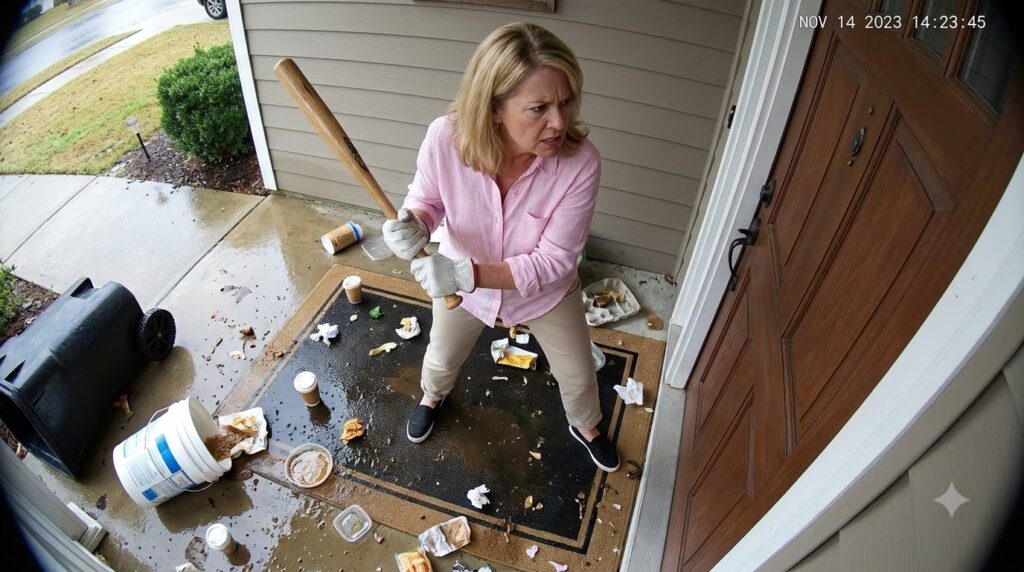
Outside, the air smelled of wet earth and sour household refuse. Brenda stood on the stained tan concrete, her light pink button-up shirt smeared with dark grime at the cuffs. Heavy white work gloves gripped the handle of a thirty-two-inch Louisville Slugger, her boots planted directly in the middle of a spilled pile of wet coffee grounds, shredded junk mail, and crushed plastic cups. Five seconds earlier, she had dragged her black wheeled trash bin up the front steps, tipped it over with a violent jerk of her hip, and emptied two weeks of rotting kitchen scraps onto his doormat.
She didn’t look like a woman in her sixties losing her mind; she looked like a surveyor marking captured territory.
“You think you own this walkway!” Brenda’s voice cut through the heavy wood, muffled but sharp, vibrating through the door panel. “Every single inch of this concrete violates municipal code, Marcus! You’re encroaching on easement! I’m clearing the line!”
She reached down, picked up a heavy white utility bucket with a faded blue paint logo, and tipped it forward. A thick, dark stream of saturated mud and lawn runoff spilled out, washing over the scattered trash and pooling against the weatherstripping at the bottom of the door. The liquid seeped beneath the crack, touching the tip of Marcus’s work boots.
Marcus didn’t yell. He didn’t reach for a weapon. He reached into his pocket, pulled out his phone, and opened the security application. The green recording indicator blazed steadily in the upper corner of the interface: 3:14:22 PM — CAMERA 01 (PORCH HEADER) — 4K HDR.
Through the wide-angle camera view, Brenda stepped deeper into the mess she had created. Her beige trousers were speckled with black dirt, her chest heaving beneath the pink cotton shirt. She raised the bat again, both gloved hands choking up near the handle. She drew the wood back over her right shoulder, her eyes locked on the brass house numbers beside the frame.
“This is community land!” she screamed at the wood.
She swung. The tip of the bat clipped the edge of the doorframe before slamming broadside into the solid oak panel. The vibration traveled up her arms, causing her left boot to slip on the wet mud. She recoiled, regaining her balance with a awkward jerk of her torso, the heel of her boot leaving a raw, dark skid mark across the white paint of the porch step.
Inside, Marcus tapped the screen twice. He locked the clip, saved the raw file to a local secure drive, and dialed three digits. He brought the speaker to his ear, his eyes never leaving the monitor as Brenda stood breathing heavily on his ruined threshold, the wooden bat hanging loose at her side, waiting for the door to open.
“Dispatch,” Marcus said, his voice flat, low, and devoid of heat. “I need an officer at 414 Elm Street. My neighbor is standing on my porch with a baseball bat, and the camera just caught everything.”
On the screen, Brenda turned her head toward the street. In the lower corner of the wide-angle frame, a blue sedan had just slowed down at the curb, its driver leaning over the steering wheel to stare at the black trash bin resting sideways on the lawn.

CHAPTER 2: THE SECURE LINE
“Dispatch received, 414 Elm Street,” the operator’s voice crackled through the small speaker of the phone. “Units are en route. Priority two. Remain inside and keep your doors locked, sir.”
“I’m locked in,” Marcus said. His voice didn’t rise; it stayed anchored in his chest, low and steady as iron dragged across gravel. “She’s got a thirty-two-inch wooden bat. She just took a swing at the door frame. I have live high-definition video running on the entryway monitor.”
“Do not engage,” the operator repeated. “Is anyone else in the house?”
“Just me.” Marcus didn’t take his eyes off the wall-mounted screen. “She’s standing in the mud she dumped on the porch step. She isn’t moving.”
He ended the call without waiting for a canned reassurance, setting the phone screen-side up on the entryway console next to a rolled-up laminated municipal plat map. The paper was bound by a yellowed rubber band, its edges crisp despite years of sitting in the bottom drawer of his metal desk.
On the 4K feed, Brenda hadn’t retreated to her side of the driveway. Instead, she leaned the barrel of the ash bat against her hip like a fence post, her gloved hands resting on the knob. Her shoulders hitched with heavy, wet breaths, the pink cotton of her shirt plastered to her ribs in dark, crescent-shaped sweat stains. With her boot, she kicked a plastic takeout container out of the mud, sending it tumbling over the lip of the concrete step where it wedged against the lowest wooden riser.
Marcus zoomed in on the bottom right quadrant of the feed. There, right where the painted pine riser met the concrete foundation, a small, disc-shaped piece of metal glinted dull gray beneath a layer of wet silt. It was an old zinc surveyor’s tag, stamped with a four-digit registry code, nailed flush into the wood thirty years ago during the original platting of Elm Street. Brenda’s left heel was currently resting three inches to the left of it, well over the line.
She reached into her back pocket, her heavy white work gloves clumsy against the stiff denim, and pulled out a sheet of folded yellowed paper. She snapped it open with a sharp flick of her wrist, holding it out toward the camera lens as if the wide-angle glass were a living witness she could intimidate.
“Look at it!” she shouted at the camera. Her voice was strained, raspy from the effort of swinging five pounds of solid ash. “1984 Municipal Overlay, Section 4! Right-of-way easement for utility maintenance! You built this porch over public access, Marcus! I have every legal right to clear an obstruction from the easement!”
Marcus watched her thumb press against the creased corner of the paper. It was a hand-drawn lot sketch, the ink faded to a pale indigo, complete with red hatch marks along the northern boundary of his property line.
Inside the quiet front hall, the smell of damp earth seeping under the door threshold was growing stronger, mixed with the iron tang of wet rust from the porch railing. He didn’t answer her. Answering meant giving her a focal point for her rage, giving her an opponent to trade noise with. In his experience on the lines, noise was what people used when they didn’t have a title deed.
He reached down and unrolled the laminated map on the wooden console. His thumb traced the thick blue boundary line printed by the county surveyor five years ago when he took title to the property. The blue ink was bold, continuous, and absolute. It didn’t stutter at the porch. It wrapped clean around the concrete slab, encompassing the steps, the walkway, and two feet of the grass strip Brenda routinely mowed down to the dirt.
A distant siren wailed, two miles out, clipping the quiet air of the suburban afternoon.
On the screen, Brenda’s head snapped toward the sound. She didn’t drop the paper, but her gloved hands tightened on the handle of the bat, her knuckles bulging under the thick white cloth. She looked down at the mud pooling over his doormat, then back up at the black dome of the camera mounted on the header above the door. Her jaw set into a hard, stubborn line, her teeth bared slightly behind thin lips.
“You call them!” she yelled, her voice pitching higher against the rising whine of the siren. “Call whoever you want! I’ve got the original municipal draft right here! They can’t override city planning!”
Marcus reached out and tapped the console screen, switching the view to Camera 02—the side-yard angle facing the shared gravel driveway. The blue sedan that had slowed down earlier had pulled over to the curb across the street. Two houses down, old man Miller had stepped out onto his front lawn, wearing an oversized cardigan, a pair of garden shears dangling forgotten in his right hand as he stared at the pink shirt and the wooden bat on Marcus’s porch.
The law wasn’t about who was loud, and it wasn’t about who held a piece of paper from forty years ago. It was about what was recorded in the county vault when the ink dried. Marcus picked up his phone, switched the screen back to the raw 4K clip of the bat hitting the oak frame, and slid his thumb over the lock toggle.
Outside, tires crunched over the gravel at the edge of his property line as a white-and-black municipal cruiser pulled up behind Brenda’s parked sedan, its red and blue lights flashing silently against the wet pavement.
CHAPTER 3: THE DEEDS AND THE DRAFT
Red and blue strobes painted the entryway walls in violent, rhythmic pulses, casting long shadows across the dark oak flooring. Outside, the engine of the patrol cruiser idled with a deep, low rumble that vibrated through the foundation.
Inside the front hall, Marcus picked up the laminated municipal map from the console. The heavy plastic felt cold against his fingers, rigid and unyielding. Beside it lay his smartphone, its battery warm from continuous recording, showing two live camera feeds: Deputy Vance stepping out of the cruiser with his duty belt squeaking under his weight, and Brenda standing her ground on the ruined porch, her gloved fingers still clutching the ash bat like a battle standard.
Marcus didn’t rush to the door. He unlatched the brass deadbolt with a slow, deliberate twist. The lock withdrew into the strike plate with a metallic clack that sounded remarkably small against the chaos outside.
He drew the heavy oak door open six inches—just far enough to speak without exposing his flank. The damp air hit him instantly, thick with the stench of rotting vegetables, sour milk, and the metallic tang of wet clay.
“Deputy,” Marcus called out through the gap, his voice dropping into a flat, steady register that bypassed the screaming outside. “I am inside the residence. I am unarmed. I am coming out on the threshold to present official documentation.”
Deputy Vance paused three feet from the bottom step, his hand resting near his sidearm, his eyes darting between the bat in Brenda’s gloved grip and the dark sludge coating the concrete. “Stay right there on the step, sir. Ma’am, set the bat down on the lawn now.”
Brenda didn’t lower the wood. Instead, she thrust the creased yellow paper in her left hand directly at Vance’s face. The ink had bled slightly along the folds, revealing a series of faded red cross-hatchings labeled Utility Right-of-Way #84-B.
“I am executing lawful maintenance on a public easement, Officer!” Brenda’s voice rasped, the adrenaline stripping away whatever civility she usually reserved for HOA meetings. “Look at the draft! 1984 Municipal Overlay! This entire porch structure was built illegally over a municipal drain line. He’s obstructing drainage, causing water to back up onto my property! I had to clear the obstruction by force!”
Vance took a half-step back, his boots crunching over a plastic water bottle Brenda had dumped from the bin. He squinted at the indigo lines on the aged sheet. “Ma’am, I said put the bat down. We’re going to look at the paperwork, but you’re holding a weapon on private property.”
“It’s not private property!” Brenda yelled, her thumb pressing so hard into the yellow paper that the corner tore away. “It’s a shared easement! The city designated six feet from the property line as common drainage in eighty-four! He doesn’t own this concrete! I have the right to enter and abate a nuisance!”
Marcus stepped fully onto the threshold, his work boots settling deliberately onto the clean wood frame just behind the mud line. He didn’t look at Brenda. He held out the unrolled laminated map, the embossed county seal visible under the flashing emergency lights.
“Deputy Vance,” Marcus said quietly, handing over the heavy sheet. “That paper she’s holding is a preliminary draft from forty years ago. This is the certified boundary survey from the county registrar, completed five years ago when the title transferred. Look at Section B.”
Vance shifted his flashlight, the sharp white beam cutting through the dusk to illuminate the crisp blue lines on Marcus’s map. The deputy’s eyes moved slowly across the page, tracing the solid outer perimeter that sealed the entire porch and walkway inside Marcus’s deeded acreage.
“She claims there’s an active easement,” Marcus continued, his eyes locked on Vance’s face, reading the subtle shift as the officer recognized the official raised seal. “The county map shows no overlay. Every inch of this concrete is private title.”
Brenda took a aggressive step forward, her boot slipping slightly in the mud she had poured. “He’s lying! He hid the original sewer records! That eighty-four draft is registered with the city engineer! Ask him about the secondary pipe beneath the steps!”
Vance raised a hand, his face hardening as he looked from the crisp, laminated plat back to the torn, faded draft in Brenda’s shaking gloved hand. The distinction between a legitimate property dispute and a criminal trespass was beginning to crystallize in the beam of his flashlight, but the old indigo draft still held just enough official jargon to cloud the immediate legal standing.
“Neither of you is moving an inch,” Vance ordered, taking a step up onto the bottom step, his eyes fixed on the muddy bat dangling at Brenda’s hip. “I’m calling dispatch to cross-reference the county clerk’s deed registry right now.”
Marcus remained standing in his doorway, his thumb feeling the cold edge of his phone inside his pocket. The trap was set, but the full weight of the law had yet to drop its hammer.
CHAPTER 4: THE DECOY ON THE LAWN
Deputy Vance’s radio squawked, a harsh burst of digital static cutting through the damp evening air. He unclipped the lapel mic with a gloved thumb, his eyes swinging back and forth between the two neighbors.
“Dispatch, 114,” Vance said, his voice clipped and practiced. “I’m at 414 Elm. I have a boundary dispute in progress with property damage. Requesting a quick check on property parcel 08-B-11. Need to verify if there’s an active municipal drainage easement along the northern line.”
Brenda shifted her boots in the silt, the wet mud sucking at her heels. She thrust her yellowed paper closer to Vance’s chest, her white work gloves leaving dark grey smears along the margin. “Tell them to pull the 1984 public works blueprint, Deputy! Section 4! It’s stamped by the city engineer! This man built his porch over a designated drain pipe. That makes his structure an illegal encroachment, and it gives the adjacent property owner full right-of-way to clear it!”
Marcus stood immovable on the dry oak threshold. He didn’t raise his voice, nor did he reach out to snatch the paper. Instead, he pointed a single finger toward the lower reverse corner of the faded sheet Brenda was holding.
“Turn the page over, Deputy,” Marcus said softly. “Look at the back of her draft.”
Vance’s flashlight beam pivoted sharply. The intense white beam bored through the aging paper, illuminating the bleed-through ink. Brenda flinched slightly, her grip tightening on the top edge, but Vance reached out with two fingers and flipped the bottom corner upward.
There, stamped in faded, flaking red ink across the bottom right quadrant, was a faint oval seal: TENTATIVE EASEMENT — PENDING MUNICIPAL REVIEW — 1984.
“That draft was never finalized,” Marcus stated, his tone devoid of triumph, purely analytical. “That was a proposed right-of-way for a stormwater culvert that the city never broke ground on. She’s been holding onto a forty-year-old proposal as if it gives her power of eminent domain over my front door.”
Brenda’s chest heaved, her face flushing a deep, mottled red under the strobing police lights. “It was approved by the board! My husband signed the petition in eighty-four! You bought this place five years ago—you don’t know the history of this land!”
“A petition isn’t a deed, Brenda,” Marcus replied, keeping his gaze level. “And a draft isn’t a title.”
Vance grunted, his thumb running over the dry texture of the red ink stamp. “Dispatch,” Vance spoke into his lapel mic again, “hold on that parcel check. I’m looking at a 1984 tentative sketch here. Is there any record of a recorded easement deed attached to parcel 08-B-11?”
The radio paused. Seconds stretched into long, uncomfortable silences on the front step. Down on the sidewalk, two more neighbors had stopped walking their dog, their silhouettes frozen against the streetlights as they watched the deputy inspect the paper.
Brenda’s jaw worked silently. The wooden bat in her right hand dipped two inches lower, its painted barrel resting in the dark sludge coating the concrete step. She had built her entire legal defense around the red lines on that yellow sheet—a physical shield forged from four decades of neighborhood assumption.
“Unit 114,” the radio crackled back, the dispatcher’s voice sharp and clear. “County registry shows no active public or private easement recorded on parcel 08-B-11. Title is unencumbered private property.”
The red stamp on the yellow paper stood exposed—a decoy secret, a half-baked legal fiction that Brenda had wielded like an iron bar for years.
Brenda’s eyes widened, her gloved fingers trembling as the paper fluttered in the breeze. “No… that’s impossible. The sewer pipe is right under those steps! I’ve seen the drainage during heavy rain!”
Marcus didn’t move. He knew the pipe was there—he had felt the cold concrete curve beneath his shovel when he planted hydrangeas two springs ago. But he also knew something Brenda didn’t: why the city had abandoned the 1984 project in the first place, and where the real sewer main actually ran.
“The paper doesn’t hold, Brenda,” Vance said, his tone shifting from cautious inquiry to stern authority. “You’re standing on private land, holding a baseball bat, with a pile of trash you dumped on his porch.”
Vance took a firm step up the riser, his hand moving to the leather snap on his handcuff case. But before he could speak another word, Brenda’s face twisted from frustration into raw, unpredictable panic. She didn’t drop the bat. She swung her gaze toward the dark gap beneath the porch steps, her boots slipping violently as she pivoted on the wet mud.
CHAPTER 5: THE DIGITAL RECORD ON THE STEP
Brenda’s boot skidded sideways on the wet, silt-slicked concrete, her weight shifting backward as she lunged toward the dark gap beneath the porch riser. The wooden bat swung wide, its painted barrel clipping the wrought-iron handrail with a sharp, ringing metallic clang that echoed down the block.
“Hold it right there!” Vance barked, his hand slamming down onto his sidearm holster, thumb unsnapping the leather retention strap. “Don’t move, Brenda!”
Marcus didn’t step back into the hall. He didn’t flinch as the bat scraped the iron. Instead, he reached into his jacket, pulled out his black smartphone, and stepped down onto the second porch riser—placing his own boots directly between Brenda and the doorway.
“Deputy,” Marcus said. His voice was flat, cutting through the sudden noise like a cold blade. “Don’t guess what happened here. Don’t rely on forty-year-old drafts or who yells louder. Look at the feed.”
He didn’t hand the device over freely. He held the phone out in his left palm, his thumb resting firmly over the bezel to lock the screen in landscape orientation. The OLED display blazed with harsh, unyielding clarity against the dusk, throwing a square of white light onto Vance’s chest.
Vance froze, his hand still pinned to his hip, his eyes dropping to the screen.
On the high-bitrate 4K display, the overhead camera angle showed the entire porch from a fixed eight-foot elevation. The timestamp in the top right corner ticked steadily: 15:14:18 PM. The video was crystal clear, capturing the crisp contrast between the tan concrete and the black plastic of Brenda’s wheeled bin as she dragged it across the property line.
On screen, Brenda snapped the bin forward. Loose household garbage spilled across the doormat in real-time motion. Then came the white utility bucket, the thick dark stream of mud washing over the threshold. Finally, the camera captured the arc of the ash bat—drawn back over her right shoulder, gloved hands choked high, slamming broadside into the solid oak frame while Marcus stood silently inside.
“The camera didn’t miss a second, Deputy,” Marcus said, his voice completely level. “She brought the refuse onto private land. She poured the liquid. She struck the primary entry door with a wooden weapon while I was inside the dwelling.”
Vance leaned down, his face inches from the glass. The glare of the recording reflected off the silver badge on his chest. His jaw set hard, the relaxed stance of a routine civil caller vanishing entirely.
Brenda clawed at the iron railing to regain her balance, her pink shirt stretched tight across her back, her breath coming in ragged, whistling gasps. “He provoked me! He’s been diverting water onto my driveway for three months! He built that step to flood my garage!”
“The video has audio, Brenda,” Marcus said, his thumb tapping the screen to un-mute the track.
From the phone’s speaker, Brenda’s own recorded voice rang out with absolute fidelity, echoing across the real porch in eerie synchronization with the flashing police lights: “You think you own this walkway! Every single inch of this concrete violates municipal code, Marcus! I’m clearing the line!”
Vance looked up from the glass, his eyes cold. “Ma’am, set the bat on the grass. Right now.”
“It’s a civil matter!” Brenda screamed, her voice cracking as she looked around at the street, where three more neighbors had gathered near the curb, their faces pale in the blue light. “He’s recording me illegally! That camera is aimed at my property line!”
“The camera is mounted on my house, pointing down at my front door,” Marcus replied, his eyes never leaving Vance’s face. “The property line runs two feet beyond that step, as verified by the county registry five minutes ago. You are standing in the middle of a recorded criminal trespass.”
Vance took a final step up the riser, his heavy boot pinning the edge of the yellowed 1984 draft into the mud beneath his heel. He didn’t draw his weapon, but his left hand reached out and firmly grasped the wooden barrel of the baseball bat, twisting it out of Brenda’s gloved grip with a single, practiced motion.
“Bat’s secured,” Vance said into his lapel mic, his tone dropping into the cold, clinical rhythm of a formal arrest procedure. “Dispatch, send a secondary unit to 414 Elm for property damage and trespass processing.”
Brenda stood with her hands empty, her gloved fingers opening and closing against the cold air, her mouth working without sound as the digital evidence sealed the space around her. But as Vance pulled a pair of steel cuffs from his belt, Brenda looked past the officer, her eyes locking onto the small zinc tag embedded in the bottom riser—and a dark, ugly smile twitched at the corner of her lips.
“You think you won, Marcus?” she whispered, her voice dropping into a raspy, venomous murmur. “Check the sewer registry from ninety-nine. You think that pipe under your feet belongs to you?”
CHAPTER 6: THE EXTENDED TITLE
The rasp in Brenda’s voice lingered over the mud-slicked porch, competing with the idle chug of Deputy Vance’s cruiser. Vance pulled Brenda’s wrist back with a firm, practiced twist, the steel handcuff clicking into place around her gloved wrist with a sharp, double-notched clack.
“Save it for the magistrate, ma’am,” Vance said, his voice dropping into a steady, flat tone. He led her down the concrete steps, her boots dragging through the dark sludge she’d poured across the doorway.
Marcus stayed on the step, his work boots planted right at the dry threshold. He didn’t watch her stumble toward the back door of the patrol car. Instead, his eyes dropped to the laminated plat map he still held in his left hand. The heavy plastic sheet was cool against his fingers, but the words she’d whispered hit an old mental gear. Ninety-nine.
He turned the map over. Stapled to the stiff cardboard backing board was a secondary municipal attachment—an addendum page he’d retrieved from the county archives during his closing five years back. His thumb swept across the clear plastic overlay, brushing away a stray droplet of dirty water.
There, tucked under a faint red line marked MUNICIPAL INFRASTRUCTURE RE-ROUTE — ORD. 99-142, was the missing piece of geometry Brenda had spent twenty-five years misreading.
In 1999, the city hadn’t expanded the easement. They’d done the exact opposite. The municipal public works department had executed a complete re-route of the main storm culvert, shifting the drainage line thirty feet east under the primary road bed. The old secondary pipe running beneath Marcus’s porch steps hadn’t just been abandoned—the city council had formally vacated the utility easement in its entirety, releasing the land back to the fee-simple title of the lot.
The 1984 draft Brenda held wasn’t just a tentative sketch; it was a ghost. The 1999 ordinance had legally extinguished the encumbrance fifteen years before Marcus ever signed his mortgage papers.
“Deputy,” Marcus called out, his voice cutting across the narrow yard just as Vance reached the rear driver-side door of the cruiser.
Vance paused, his hand on the door handle, keeping Brenda pinned against the side panel. “Mr. Vance? What is it?”
Marcus walked down the two steps, his boots grinding against the grit on the bottom riser. He held out the backing board of the survey, pointing directly to the stamped ordinance number on the archived county sheet.
“She’s relying on a pipe that was legally decommissioned in 1999,” Marcus said as Vance leaned over to read the text under his flashlight. “Ordinance 99-142. The city formally extinguished the easement twenty-seven years ago and surrendered all municipal right-of-way back to this parcel. There is no shared pipe. There is no utility corridor. The land beneath this step is completely unencumbered private property.”
Vance’s flashlight beam lingered on the embossed county registrar stamp adjacent to the ordinance line. He let out a low breath that fogged slightly in the cooling evening air. “So her draft wasn’t just pending approval back then. It was wiped off the city books entirely.”
“It was dead before I bought the house,” Marcus said. “And she knew the city moved the main line to the street.”
From inside the open door frame of the cruiser, Brenda’s jaw worked silently. The pink collar of her shirt was crooked, her hair damp with sweat and drizzle, her hands bound behind her back. The neighbor watching from the curb stepped closer, taking in the full sight of the municipal paper held side-by-side with the sheriff’s report.
Vance straightened up, his hand settling on the door frame. “Dispatch,” he spoke into his shoulder microphone, his tone final and unyielding. “Update incident report for 414 Elm. Property title verified unencumbered. Proceeding with transport for criminal mischief and third-degree criminal trespass.”
He guided Brenda into the back seat and shut the door with a heavy, solid thud that echoed off the damp concrete of the driveway. The red and blue flashes reflected off the wet windows of the house across the street, illuminating the clear, undisturbed line where Marcus’s property met the road.
Marcus turned and walked back up his steps, leaving the deputy to finalize his notes at the curb. The boundary was marked, recorded, and sealed.
CHAPTER 7: THE COLLAPSE OF AUTHORITY
The metallic slam of the cruiser’s rear door echoed down Elm Street, a flat, final sound that cut through the idling rumble of the V8 engine. Inside the vehicle, behind the heavy wire partition, Brenda sat motionless, her silhouette framed by the pulsating red and blue strobes reflecting off the wet rear glass.
Deputy Vance didn’t immediately step into the driver’s seat. He stood at the edge of the curb, pulling a thick yellow citation pad from his tactical vest pocket. He leaned over the warm hood of the patrol car, the tip of his ballpoint pen scratching loudly against the carbon copy paper as he filled out the official incident log.
Down the sidewalk, the quiet tension of the afternoon broke. Old man Miller stepped off his lawn, his garden shears still dangling from his weathered hand, his oversized cardigan flapping open in the damp breeze. Behind him, two more neighbors from across the cul-de-sac moved closer to the property line, standing in silent, watchful alignment along the asphalt edge.
“Deputy,” Miller called out, his voice thin but carrying clearly over the diesel exhaust. “Is she being cited?”
Vance didn’t look up from his clipboard, his pen continuing its deliberate rhythm. “Formal citations issued for criminal mischief and criminal trespass, Mr. Miller. The property boundaries have been verified by county records. This porch and walkway are private land.”
A soft, collective rustle passed through the watching neighbors—a subtle shift in the street’s gravitational pull. For six years, Brenda had run the neighborhood association with a steel grip, issuing handwritten notices, threatening fines, and invoking forty-year-old easements to dictate who could park where and how high the grass could grow. Now, standing on the curb, the gathered homeowners watched the official yellow carbons tear off the deputy’s pad with a crisp, sharp rip.
Marcus stepped off his bottom step, his work boots leaving clean impressions in the wet silt as he walked toward the curb. He carried the unrolled laminated survey, its blue boundary lines bright under the streetlight.
“Mr. Miller,” Marcus said, stopping two feet short of the asphalt edge. “If anyone on the board needs a copy of the recorded 1999 easement extinction ordinance for the street records, I have the certified county packet right here.”
Miller looked from the laminated map in Marcus’s hand to the rear window of the cruiser, where Brenda’s eyes were locked on the exchange, her jaw set into a bitter, frozen line behind the glass. Miller nodded slowly, his fingers tightening on the grip of his shears.
“We won’t be needing the 1984 draft anymore, Marcus,” Miller said, his voice firming up as he looked back at the patrol car. “The board will update the perimeter logs tonight.”
Vance folded the yellow citation slips, walked around the front bumper of his cruiser, and handed Marcus the blue copy stamped with the municipal case number.
“This is your official record, Mr. Vance,” the deputy said, his voice flat and professional. “A copy goes to the district court. If she steps back onto this concrete before the hearing, call dispatch immediately. It will trigger an automatic violation of conditions.”
Marcus accepted the paper. The blue carbon felt thin, slightly damp from the air, but the ink was deep and dark. “Thank you, Deputy.”
Vance climbed into the driver’s seat, pulled the shift lever into drive, and eased the cruiser away from the curb. The tires crunched over the loose gravel at the edge of Marcus’s property line, the red and blue flashes receding down Elm Street until only the steady, yellow glow of the streetlights remained.
Down on the sidewalk, the neighbors stood for a long moment in the quiet dusk. One by one, they turned and walked back toward their homes, their footsteps fading into the quiet rustle of evening leaves.
Marcus stood alone at the edge of his lawn. The false authority that had hovered over his threshold for months had vanished with the patrol car’s taillights. But behind him, the porch remained a ruined landscape of scattered trash, wet paper, and dark mud.
He turned back toward his front door, pulled a pair of heavy rubber work gloves from his coat pocket, and walked toward the steps to clear the line.
CHAPTER 8: RESTORATION OF THE THRESHOLD
The heavy rubber of the work gloves groaned as Marcus pulled them tight over his knuckles. The street had fallen into a deep, cool quiet, the exhaust fumes of the patrol cruiser dissolving into the evening dampness. Where Brenda’s black bin had rested, two crushed plastic cups lay flattened in the gravel like discarded skin.
Marcus stepped up to the porch step. The dark, silt-heavy mud she had poured from the utility bucket had begun to set near the edges, forming a tacky, dark skin over the tan concrete.
He walked around the side of the house, uncoiling thirty feet of heavy black garden hose from its iron reel. The brass nozzle clinked sharply against the gravel as he dragged it around the corner, the sound metallic and grounding against the silence of the cul-de-sac. He turned the spigot valve three full rotations. Water surged through the rubber line with a firm, rigid pressure that thrummed against his palm.
Standing at the base of the steps, Marcus opened the nozzle. A high-pressure fan of cold water slammed into the porch floor, tearing through the dried mud and sweeping the scattered paper scraps off the threshold. The brown sludge liquefied instantly, churning into a dark, foaming current that ran down the concrete risers, through the dirt trench at the edge of the lawn, and out toward the street gutter where the municipal storm drain sat waiting.
He picked up a stiff-bristled deck broom, its worn oak handle smooth from years of season-cleaning. Methodically, he worked the bristles into the corners of the doorframe, scrubbing away the dark residue Brenda’s boots had left behind.
With every pass of the broom, the physical evidence of the siege washed away. The wet coffee grounds, the shredded junk mail, the sour kitchen waste—all of it yielded to the friction of stiff bristles and cold water. Beneath the layer of filth, the tan concrete emerged clean and unmarked, its surface rough-textured and solid beneath his work boots.
At the lowest riser, the cold spray cleared a pocket of heavy silt from the corner where the wood met the foundation. The stream of water washed over the small, disc-shaped piece of metal nailed flush into the pine. The old zinc surveyor’s tag glinted bright gray beneath the porch light, its four stamped registry digits completely clear of mud. Marcus brought the hose nozzle closer, flushing out the tight seam around the nail head until the zinc stood bare against the wood.
It wasn’t a boundary built on shouting or forty-year-old indigo drafts. It was a line anchored in zinc, concrete, and county ink.
He turned off the spigot, the sudden silence falling heavy and clean across the yard. He rolled the black hose back onto its reel, methodically wiping the brass nozzle dry before hanging it on the iron bracket.
Returning to the porch, he picked up the blue carbon copy of the citation Deputy Vance had left on the console. He brought it inside, laying it flat on the entryway table right next to the laminated surveyor’s map and the smartphone containing the raw, unedited 4K video file. The paper, the digital record, and the physical land were aligned—a seamless, indisputable record of title.
Marcus stepped onto the porch one last time. He grabbed the handle of his heavy oak front door, pulling it shut. The brass latch engaged with a sharp, deep click that seated the wood firmly into the weatherstripping.
Inside the quiet hallway, he turned the deadbolt. The cold brass cylinder slid into the strike plate, locking the frame tight against the night. He didn’t look back at the monitor. The line had been drawn, the record was set, and the boundary was entirely his own.







