
CHAPTER 2: THE SECURE LINE
“Dispatch received, 414 Elm Street,” the operator’s voice crackled through the small speaker of the phone. “Units are en route. Priority two. Remain inside and keep your doors locked, sir.”
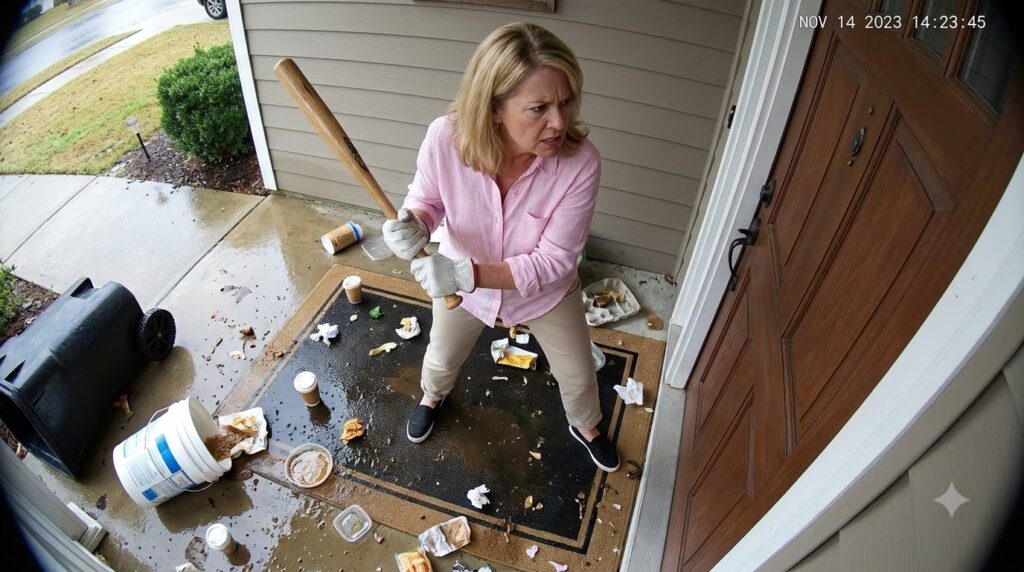
“I’m locked in,” Marcus said. His voice didn’t rise; it stayed anchored in his chest, low and steady as iron dragged across gravel. “She’s got a thirty-two-inch wooden bat. She just took a swing at the door frame. I have live high-definition video running on the entryway monitor.”
“Do not engage,” the operator repeated. “Is anyone else in the house?”
“Just me.” Marcus didn’t take his eyes off the wall-mounted screen. “She’s standing in the mud she dumped on the porch step. She isn’t moving.”
He ended the call without waiting for a canned reassurance, setting the phone screen-side up on the entryway console next to a rolled-up laminated municipal plat map. The paper was bound by a yellowed rubber band, its edges crisp despite years of sitting in the bottom drawer of his metal desk.
On the 4K feed, Brenda hadn’t retreated to her side of the driveway. Instead, she leaned the barrel of the ash bat against her hip like a fence post, her gloved hands resting on the knob. Her shoulders hitched with heavy, wet breaths, the pink cotton of her shirt plastered to her ribs in dark, crescent-shaped sweat stains. With her boot, she kicked a plastic takeout container out of the mud, sending it tumbling over the lip of the concrete step where it wedged against the lowest wooden riser.
Marcus zoomed in on the bottom right quadrant of the feed. There, right where the painted pine riser met the concrete foundation, a small, disc-shaped piece of metal glinted dull gray beneath a layer of wet silt. It was an old zinc surveyor’s tag, stamped with a four-digit registry code, nailed flush into the wood thirty years ago during the original platting of Elm Street. Brenda’s left heel was currently resting three inches to the left of it, well over the line.
She reached into her back pocket, her heavy white work gloves clumsy against the stiff denim, and pulled out a sheet of folded yellowed paper. She snapped it open with a sharp flick of her wrist, holding it out toward the camera lens as if the wide-angle glass were a living witness she could intimidate.
“Look at it!” she shouted at the camera. Her voice was strained, raspy from the effort of swinging five pounds of solid ash. “1984 Municipal Overlay, Section 4! Right-of-way easement for utility maintenance! You built this porch over public access, Marcus! I have every legal right to clear an obstruction from the easement!”
Marcus watched her thumb press against the creased corner of the paper. It was a hand-drawn lot sketch, the ink faded to a pale indigo, complete with red hatch marks along the northern boundary of his property line.
Inside the quiet front hall, the smell of damp earth seeping under the door threshold was growing stronger, mixed with the iron tang of wet rust from the porch railing. He didn’t answer her. Answering meant giving her a focal point for her rage, giving her an opponent to trade noise with. In his experience on the lines, noise was what people used when they didn’t have a title deed.
He reached down and unrolled the laminated map on the wooden console. His thumb traced the thick blue boundary line printed by the county surveyor five years ago when he took title to the property. The blue ink was bold, continuous, and absolute. It didn’t stutter at the porch. It wrapped clean around the concrete slab, encompassing the steps, the walkway, and two feet of the grass strip Brenda routinely mowed down to the dirt.
A distant siren wailed, two miles out, clipping the quiet air of the suburban afternoon.
On the screen, Brenda’s head snapped toward the sound. She didn’t drop the paper, but her gloved hands tightened on the handle of the bat, her knuckles bulging under the thick white cloth. She looked down at the mud pooling over his doormat, then back up at the black dome of the camera mounted on the header above the door. Her jaw set into a hard, stubborn line, her teeth bared slightly behind thin lips.
“You call them!” she yelled, her voice pitching higher against the rising whine of the siren. “Call whoever you want! I’ve got the original municipal draft right here! They can’t override city planning!”
Marcus reached out and tapped the console screen, switching the view to Camera 02—the side-yard angle facing the shared gravel driveway. The blue sedan that had slowed down earlier had pulled over to the curb across the street. Two houses down, old man Miller had stepped out onto his front lawn, wearing an oversized cardigan, a pair of garden shears dangling forgotten in his right hand as he stared at the pink shirt and the wooden bat on Marcus’s porch.
The law wasn’t about who was loud, and it wasn’t about who held a piece of paper from forty years ago. It was about what was recorded in the county vault when the ink dried. Marcus picked up his phone, switched the screen back to the raw 4K clip of the bat hitting the oak frame, and slid his thumb over the lock toggle.
Outside, tires crunched over the gravel at the edge of his property line as a white-and-black municipal cruiser pulled up behind Brenda’s parked sedan, its red and blue lights flashing silently against the wet pavement.








