
CHAPTER 4: THE DECOY ON THE LAWN
Deputy Vance’s radio squawked, a harsh burst of digital static cutting through the damp evening air. He unclipped the lapel mic with a gloved thumb, his eyes swinging back and forth between the two neighbors.
“Dispatch, 114,” Vance said, his voice clipped and practiced. “I’m at 414 Elm. I have a boundary dispute in progress with property damage. Requesting a quick check on property parcel 08-B-11. Need to verify if there’s an active municipal drainage easement along the northern line.”
Brenda shifted her boots in the silt, the wet mud sucking at her heels. She thrust her yellowed paper closer to Vance’s chest, her white work gloves leaving dark grey smears along the margin. “Tell them to pull the 1984 public works blueprint, Deputy! Section 4! It’s stamped by the city engineer! This man built his porch over a designated drain pipe. That makes his structure an illegal encroachment, and it gives the adjacent property owner full right-of-way to clear it!”
Marcus stood immovable on the dry oak threshold. He didn’t raise his voice, nor did he reach out to snatch the paper. Instead, he pointed a single finger toward the lower reverse corner of the faded sheet Brenda was holding.
“Turn the page over, Deputy,” Marcus said softly. “Look at the back of her draft.”
Vance’s flashlight beam pivoted sharply. The intense white beam bored through the aging paper, illuminating the bleed-through ink. Brenda flinched slightly, her grip tightening on the top edge, but Vance reached out with two fingers and flipped the bottom corner upward.
There, stamped in faded, flaking red ink across the bottom right quadrant, was a faint oval seal: TENTATIVE EASEMENT — PENDING MUNICIPAL REVIEW — 1984.
“That draft was never finalized,” Marcus stated, his tone devoid of triumph, purely analytical. “That was a proposed right-of-way for a stormwater culvert that the city never broke ground on. She’s been holding onto a forty-year-old proposal as if it gives her power of eminent domain over my front door.”
Brenda’s chest heaved, her face flushing a deep, mottled red under the strobing police lights. “It was approved by the board! My husband signed the petition in eighty-four! You bought this place five years ago—you don’t know the history of this land!”
“A petition isn’t a deed, Brenda,” Marcus replied, keeping his gaze level. “And a draft isn’t a title.”
Vance grunted, his thumb running over the dry texture of the red ink stamp. “Dispatch,” Vance spoke into his lapel mic again, “hold on that parcel check. I’m looking at a 1984 tentative sketch here. Is there any record of a recorded easement deed attached to parcel 08-B-11?”
The radio paused. Seconds stretched into long, uncomfortable silences on the front step. Down on the sidewalk, two more neighbors had stopped walking their dog, their silhouettes frozen against the streetlights as they watched the deputy inspect the paper.
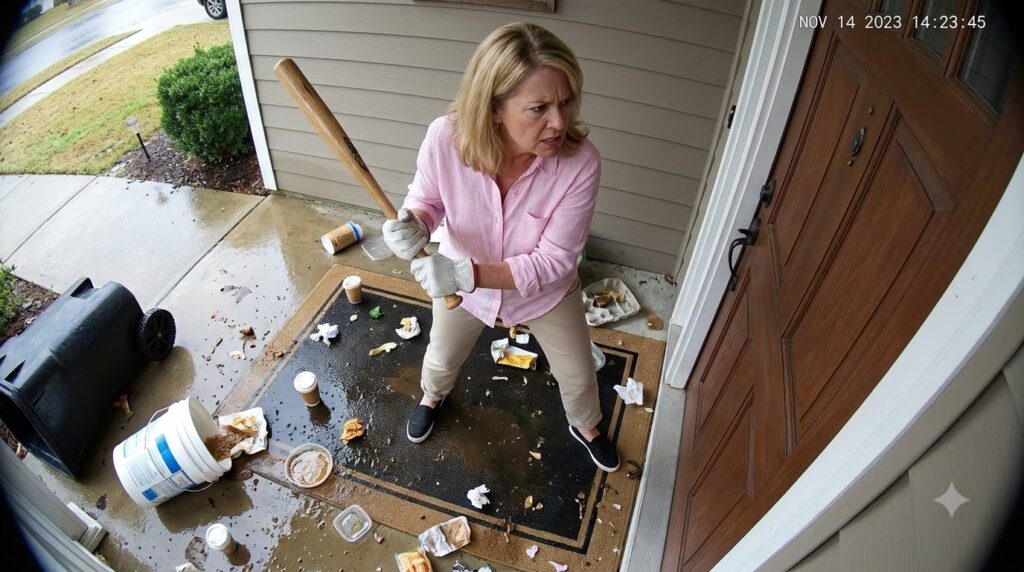
Brenda’s jaw worked silently. The wooden bat in her right hand dipped two inches lower, its painted barrel resting in the dark sludge coating the concrete step. She had built her entire legal defense around the red lines on that yellow sheet—a physical shield forged from four decades of neighborhood assumption.
“Unit 114,” the radio crackled back, the dispatcher’s voice sharp and clear. “County registry shows no active public or private easement recorded on parcel 08-B-11. Title is unencumbered private property.”
The red stamp on the yellow paper stood exposed—a decoy secret, a half-baked legal fiction that Brenda had wielded like an iron bar for years.
Brenda’s eyes widened, her gloved fingers trembling as the paper fluttered in the breeze. “No… that’s impossible. The sewer pipe is right under those steps! I’ve seen the drainage during heavy rain!”
Marcus didn’t move. He knew the pipe was there—he had felt the cold concrete curve beneath his shovel when he planted hydrangeas two springs ago. But he also knew something Brenda didn’t: why the city had abandoned the 1984 project in the first place, and where the real sewer main actually ran.
“The paper doesn’t hold, Brenda,” Vance said, his tone shifting from cautious inquiry to stern authority. “You’re standing on private land, holding a baseball bat, with a pile of trash you dumped on his porch.”
Vance took a firm step up the riser, his hand moving to the leather snap on his handcuff case. But before he could speak another word, Brenda’s face twisted from frustration into raw, unpredictable panic. She didn’t drop the bat. She swung her gaze toward the dark gap beneath the porch steps, her boots slipping violently as she pivoted on the wet mud.








