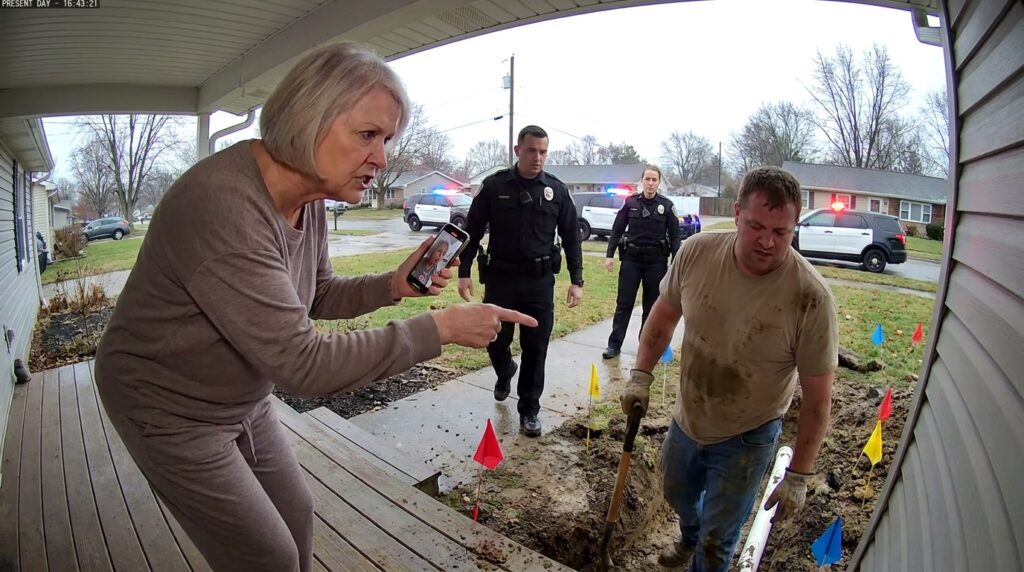
The Weight of the Loam: A Sovereign Recounting of Iron, Bone, and the Inviolate Suburban Boundary
CHAPTER 1: THE COLD IRON RUN
The spade did not strike dirt first; it struck the calcified grease of an old residential curb line, the shock vibrating through the hickory handle and straight into the meat of his forearms. Miller didn’t curse. Cursing wasted the salt in his mouth, and the humidity at six in the morning was already thick enough to slick his collar before the sun cleared the roof eaves. He drove the iron point down again, using the heavy heel of his work boot to grind through three inches of compacted gray limestone fill.
The residential street was quiet, desaturated by the dawn, the lawns holding that peculiar chemical green sheen that looked clean from fifty feet but left a bitter, powdery residue on his knuckles if he touched a blade. To his left, the concrete walkway was clean—swept clean of every leaf and pebble by someone who treated dirt like a personal insult.
He leaned into the shovel, his stocky frame working by dead weight rather than muscle. Below the limestone, the earth turned the color of dried liver—dark, dense loam that had been buried under sod forty years ago when the development went up. The city map said the water main ran exactly eighteen inches from the curb edge, pinned inside a four-foot municipal easement that gave him the legal right to dig up any root, rock, or flower bed that stood in his way. But maps were drawn by men in air-conditioned rooms, and Miller had spent fifteen years learning that the ground never followed the ink.
He reached down, his leather work gloves caked in cold clay, and planted three pink plastic utility flags along the margin of the grass strip. They looked like little plastic teeth against the perfection of the sod.
A shadow broke the light across the trench.
It didn’t come from the sun. It came from the wide, covered porch three yards away. The front door hadn’t clicked—it had slid open with the soft, oiled friction of a house that cost more than Miller would clear in a decade. She didn’t walk down the steps so much as occupy them, her slim frame wrapped in a taupe lounge set that looked heavy, expensive, and dry.
“You’re two inches over the line,” she said. Her voice didn’t carry the raw gravel of a street argument; it had the cold, rhythmic precision of a formal deposition.
Miller kept his thumbs locked over the iron cap of his shovel. He didn’t look up immediately. He looked at her shoes first—clean, white sneakers without a single grain of dust on the rubber trim. “Morning, ma’am. City water repair. The main valve under this section has a hairline split.”
“I don’t care about the valve,” she said, her phone already held at chest height, the lens dark and steady, aimed directly at the mud on his t-shirt. “I care about the plat map filed with the county clerk in ninety-two. The public right-of-way ends at the concrete curb line. This grass is deeded. You’re trespassing on private improvements.”
Miller wiped his brow with the back of his sleeve, leaving a rust-colored smear across his forehead. He could see his own reflection in her dark sunglasses—a stocky shape trapped in a square hole, holding a piece of blunt iron. In the lower corner of the porch ceiling, the small black dome of her doorbell camera hummed, its tiny blue ledger light blinking once every three seconds. There was a third shape in the dirt beside his boot—a thin, black wire wrapped in frayed canvas insulation that didn’t belong to the city water system at all.

CHAPTER 2: THE PLAT MAP DISCREPANCY
Miller did not take his hands off the iron grip of the shovel. If he lifted the spade now, he ceded the physical territory he had spent forty-five minutes clearing through the limestone crust. He let his weight settle into the boot heel, pressing the blade deeper into the dark, liver-colored loam until he felt the dull, scraping shudder of iron grinding against the frayed canvas insulation of that unmapped cable.
“The county clerk has the ninety-two plat, ma’am,” Miller said, his tone dry, flat, and entirely unbothered by the lens pointed at his chest. “But the city utility registry has the ninety-five amendment for the regional water loop. That gives us forty-eight inches from the curb face. If I stop digging, the pressure drop down the block snaps the fire line by noon.”
The woman—Mrs. Vance, according to the small bronze plaque screwed into the oak pillar of her porch—did not shift the phone. Her fingers were steady, the pale skin over her knuckles tight and bloodless. The taupe fabric of her lounge set didn’t ruffle in the slight, dusty breeze coming off the asphalt. She was looking at the small, ragged lip of dirt he had piled onto her manicured sod.
“The ninety-five amendment was struck down in the third circuit during the development’s secondary phase,” she said. Her lips barely moved, the words dropping like small, hard gravel. “My husband was the lead counsel for the Oakridge Syndicate. We retained the subterranean rights to every linear foot from the curb to the foundation. You are destroying private improvements, Mr. Miller. Every shovel of earth you turn is a separate misdemeanor count.”
Miller looked down into the trench. The rusted iron head of his spade was wedged between a thick taproot of an old cedar and the strange, canvas-wrapped sleeve. The insulation was rotten, the weave splitting apart under the damp pressure of the loam to reveal a glimpse of thick, armored copper underneath. It wasn’t water. It wasn’t residential electric. It was heavy-gauge commercial data infrastructure, buried deep, entirely missing from his utility breakdown sheet, and running straight toward the crawlspace vent beneath her porch.
He felt the small, sharp prickle of an anomaly. In his line of work, an unmapped line was either a death sentence or a lie. If he hit it with a pick, the arc could blind him; if it was dead, it meant someone had put it there without paying the county its pound of flesh.
“Your husband might have written the deeds, ma’am,” Miller said, his voice dropping into the quiet rhythm of an operator who knew the limits of his machinery. “But he didn’t lay the pipe. This main is leaking three gallons a minute into your foundation wall. If I don’t clear the shoulder of this valve now, the clay under your walkway is going to turn to soup before the mail truck gets here.”
“Then let it sink,” she replied. She finally lowered the phone, but her thumb remained locked on the glass screen, the red recording indicator still pulsing a faint, regular heartbeat against her palm. “I have an injunction template already drafted for municipal overreach. It takes five minutes to file the emergency stay. If that shovel touches the white PVC line again, I’m calling the county precinct.”
Miller took his boot off the shoulder of the spade. He reached down slowly, his thick leather work gloves scraping against the side of the trench, and cleared a handful of loose, crumbly limestone dust away from the frayed canvas wire. The insulation wasn’t just old—it was branded. Through the gray mold and grease, he could see the rusted imprint of a corporate logo: Vance & Co. Infrastructure Ltd.
The name matched the bronze plate on her porch.
He didn’t look up to see if she was watching his hands, but he knew she was. The silence from the porch had changed; it had lost its aggressive, bureaucratic momentum and turned into something heavy, watchful, and still. The blue ledger light on her doorbell camera kept up its mechanical blink, recording a man in a mud-stained t-shirt staring at a hidden corporate signature buried four feet inside a public right-of-way.
“You knew this was down here,” Miller muttered, his fingers tracing the rusted canvas where the copper wire disappeared under her concrete walkway.
“I know what belongs to me,” she said from the top step. Her white sneakers didn’t move, but her posture had shifted, her shoulders squaring against the light as she raised the phone once more, her thumb hovering over the speed-dial lane for the local sheriff’s dispatch. “And I know exactly what it costs to remove someone who doesn’t understand where their permit ends.”
CHAPTER 3: THE EXPOSED MAIN
The canvas fibers did not pull away easily from the clay. They had spent decades bonding with the wet iron sediment in the soil, turning into a tough, synthetic skin that required the short serrated edge of Miller’s pocket utility knife to split. He worked with small, deliberate strokes, the stainless-steel blade grating against the armored copper shield beneath the insulation. Every scrape sent a distinct vibration straight up his thumb—a dull, metallic rasp that confirmed the structural integrity of the illicit wire.
He did not look back up at the porch where Mrs. Vance stood with her thumb resting on her phone’s screen. Instead, he forced his attention down into the narrower shelf of the pit, scraping out three more pounds of damp, compacted earth from the side of the municipal water line. The white PVC main was there, six inches beneath the stolen data run, its surface dull and slick with a fine film of escaping water. The leak wasn’t a sudden burst; it was an old, weeping split near the coupling, the steady pressure carving a tiny, smooth cave into the surrounding limestone bed.
“The water isn’t coming from the street, ma’am,” Miller said, his voice flat as he shoved the spade back into the gray limestone dust at his heels. “It’s pooling right underneath your porch pillars because this secondary run is pinned over the city line. It’s forcing the coupling down. The weight is splitting the joint.”
“Your technical assessments are irrelevant, Mr. Miller,” she said. The voice remained high, thin, and static, coming down from the top step with the same bureaucratic weight as her initial warning. “The county zoning map dictates that any physical excavation within twelve feet of my property foundation requires a civil engineer’s signature. You are an hourly field technician. You do not possess the statutory authority to evaluate structural stress on private improvements.”
Miller wiped his palms against the rough denim of his jeans, the fabric stiff with gray clay. He reached into the leather tool roll sitting on the dry section of the concrete walkway and pulled out a heavy pair of iron-jawed channel locks. The tool was rusted along the hinge, the pitting deep enough to hold the dark grease he used to keep the pins from seizing. He didn’t want to cut the data line yet. In the city registry, an undocumented utility line was technically classified as abandoned material unless someone stepped forward with an active commercial lease number.
And Vance & Co. Infrastructure Ltd. had been liquidated twelve years ago, according to the bankruptcy listings he had scanned during the previous winter’s corridor overhaul.
“I have an emergency repair ticket from the district water board,” Miller muttered, adjusting the iron teeth of the pliers until they locked around the lower sleeve of the leaking coupling. “That overrides the local signature rule when the loss exceeds fifty gallons a day. If I don’t set this collar now, the whole walkway is going to crack by sunset. I’m saving your concrete, ma’am.”
“You’re destroying an asset,” she corrected sharply. For the first time, her white sneakers took a single step down the brick riser. The phone came up again, the camera angle shifting down to capture the precise location of his iron pliers against the city main. “The wire you are pulling at has a registered corporate easement attached to the original ninety-two plat. My husband didn’t just write the deeds—he secured the infrastructure corridors for the entire subdivision. The city cannot retroactively absorb a private commercial trunk line just because your map is missing a page.”
Miller paused, his forearms locked against the resistance of the rusted pliers. He looked at the way the canvas-wrapped line ran straight through the foundation vent, its black sleeve vanishing cleanly behind a custom-cut iron grate. It wasn’t an old utility stub left behind by a construction crew. It was a live tap, the faint, high-frequency hum of high-voltage data transmission vibrating through the spade head whenever he rested his boot against the steel edge.
He took his left hand off the pliers and pulled a pocket multimeter from his tool belt, pressing the two copper leads through the torn canvas skin of the Vance line. The digital screen blinked twice, then settled on a steady, high-frequency signal that didn’t match any municipal telemetry standard. It was private data—massive, unmetered, and pulled straight out of the county’s commercial backbone line down the state highway.
He understood the angle now. The property line dispute wasn’t about the grass or the color of the dirt. It was about the forty inches of hidden dirt that kept the city from looking under her porch floorboards.
“This isn’t an asset, Mrs. Vance,” Miller said, his voice dropping into the quiet, hard tone of an operator who had just found the real boundary marker. “This is a bypass lane. And your husband forgot to pay the state tax on the trench.”
The woman did not retreat. Her mouth set into a thin, colorless line, and her thumb finally pressed the glass surface of her screen, her voice rising slightly as she spoke into the active speaker. “This is Unit forty-two at the Oakridge Gate. I have an aggressive, un-certified laborer actively destroying buried private property and refusing to clear the residential setback. Send a deputy down immediately.”
CHAPTER 4: THE WEAPONIZED CALL
The low, hydraulic growl of a diesel engine rolled down the block before the first strobe flash caught the underside of the cedar branches. It wasn’t the single cruiser Mrs. Vance had asked for; it was two standard county sheriff interceptors, their tires crunching over the loose gravel at the edge of the asphalt line as they pulled up abreast of Miller’s utility van. The red and blue lights didn’t look heroic in the early mist—they looked greasy, reflecting off the damp concrete walkway and casting long, rhythmic bars of violet light across the dug-up trench.
Miller didn’t take his work gloves off. He remained standing in the two-foot deep cut, his boots embedded in the heavy loam, one hand still resting on the rough ash handle of his trenching spade.
Mrs. Vance didn’t retreat to her screen door. She held her ground on the lower riser of her brick porch, her phone pinned between her thumb and palm like an iron sight, her eyes tracking the lead deputy as he cleared the driver-side door. The taupe lounge set she wore caught the quick strobe pulses, changing from soft gray to sharp blue with every cycle of the light bar.
“He’s in the cut,” she said before the deputy could reach the property line. Her voice didn’t rise to meet the rumble of the idling engines; she maintained that flat, statutory level, directing the authority toward the trench like a finger pointing out a code violation. “He was instructed three separate times to stand down until an engineer verified the easement boundary. He has intentionally severed a private data trunk line and is actively undermining the walkway support.”
The first officer—a broad-shouldered man with a salt-and-pepper buzz cut and a black uniform that smelled faintly of vehicle grease and stale coffee—didn’t look at the dirt first. He looked at Miller’s hands, then down at the iron-jawed pliers resting near the exposed white PVC main. His badge number, stitched in gray thread over his pocket, caught the light as he stepped into the gap between the concrete path and the trench wall.
“Step out of the hole, sir,” the officer said. The command wasn’t aggressive, but it carried the dead weight of an operator who had spent twenty years handling civil boundary disputes in subdivisions where everyone owned a lawyer.
Miller didn’t move his feet. He felt the cold mud sucking at the rubber soles of his work boots, the weight of the earth keeping him pinned to the utility lane. “I’m within the forty-eight-inch municipal margin, Deputy. I’ve got a live split on a three-inch main line water feed. If I drop this pressure collar to climb out, the back-flow goes straight under her sub-floor.”
“I don’t care about the water pressure, Deputy,” Mrs. Vance interrupted, her sneakers stepping off the brick completely, landing on the very edge of the grass line where Miller had planted his pink plastic flags. “The county code is explicit under Section twelve. Unauthorized interference with a registered utility corridor by a third-party contractor constitutes criminal mischief in the second degree. I want him cited and the equipment impounded.”
The second officer—a younger woman with her hair pulled into a tight bun—moved along the rear edge of the property line, her eyes scanning the dark crawlspace vent where the canvas-wrapped line ran beneath the porch floorboards. She didn’t speak, but her flashlight beam cut through the mist, tracking the black wire down into the loam where Miller’s spade had split the synthetic insulation.
Miller felt the tactical trap closing. It was the same mechanism the Oakridge Syndicate had used since the first foundation was poured—using the local department like a private security force by citing conflicting ordinances faster than a field worker could read a registry sheet. If he yielded the trench now, his company would pull his certification before noon to avoid a county lawsuit.
“Check the tracking pad, Deputy,” Miller said, nodding toward the small, rugged tablet clamped to the side of his tool roll on the concrete. “The district water board pushed an automatic override at five-thirty. This isn’t a standard service call. It’s an active infrastructure failure. The line running over the top of the water main doesn’t have a county tag because it shouldn’t be here.”
The lead deputy paused, his boots catching on the edge of a split survey stake Miller had uncovered an hour ago. He didn’t look at the tablet. He looked at Mrs. Vance, then down at the branded canvas insulation that Miller had cleared with his knife. The corporate logo—Vance & Co.—was fully visible now under the strobe lights, the rusted iron sediment making the letters look like they had been burned into the fabric.
“Mrs. Vance,” the deputy said, his voice dropping an octave, losing its formal edge. “Is this line connected to the old commercial relay on the bypass road?”
“The legal status of that line is protected by a non-disclosure rider in the original development contract,” she replied. She didn’t lower her phone, but her index finger twitched twice against the glass case. “The sheriff’s department does not possess the administrative authority to audit private infrastructure. Your instructions are to remove the trespasser.”
The younger officer stopped her flashlight beam right on the iron grate covering the foundation vent. A tiny, oily film of condensation was forming around the rim of the opening—not from the water main, but from the heat generated by an industrial-scale server bank running inside the dark crawlspace.
“We have a problem with the map, sir,” the younger officer called out from the rear lane, her hand resting near her utility belt as she looked back at the lead deputy. “The physical markers don’t match the county dispatch layout.”
CHAPTER 5: THE SEPARATION LANE
The lead deputy’s heavy black boot came down right on the line where the manicured sod had been cut, flattening one of Miller’s neon-pink plastic flags into the gray limestone dust. He did not touch his holster, but his broad shoulders squared, creating a physical barrier between the concrete walkway where Mrs. Vance stood and the muddy trench where Miller was holding his spade. The wet red and blue strobe lights from the interceptors flashed rhythmically across the officer’s face, turning his skin an oily purple under the morning mist.
“Nobody’s arresting anyone yet, ma’am,” the deputy said, his voice carrying the dry, hollow drone of an enforcement officer who had spent decades watching property owners treat county margins like personal kingdoms. “But nobody’s moving any more dirt until we see where the real iron is.”
Miller didn’t drop his shovel. He let the rusted steel blade settle into the muck at the bottom of the pit, his wet leather gloves sticking slightly to the ash handle. “The real iron is forty inches out from her foundation riser, Deputy. There’s an old surveyor pin buried right under that split root if your partner shines her light down here.”
The younger officer didn’t wait for the instruction. Her flashlight beam sliced through the diesel exhaust lingering over the yard, illuminating the dark, narrow crevice beneath the main white PVC water line. The bright circle of light reflecting off the wet clay revealed a small, square column of rusted iron—a benchmark stake driven deep into the glacial till during the initial county survey. It was painted with a faded coat of high-visibility orange zinc, but a secondary, hand-filed notch had been cut directly into the metal face, two inches lower than the official county mark.
“I have already informed you that the survey pins were updated during the ninety-two phase,” Mrs. Vance said. She didn’t lower her phone. Her slim fingers remained clamped to the plastic chassis, her manicured nails bloodless from the cold air. “My husband’s firm handled the absolute title clearance for this entire parcel. If that deputy is suggesting our foundation encroaches on the municipal lane, he’s misreading the plat.”
“I’m not reading the plat yet, ma’am,” the lead deputy said, turning his head slightly toward her but keeping his body locked in the separation lane. “I’m looking at the tracking pad on Mr. Miller’s tool roll. The district water board has this entire block flagged for a structural emergency. If he doesn’t secure that split coupling, the pressure drop is going to compromise the primary fire main down the road. That’s a state-level infrastructure hazard.”
“The water board does not hold a superior title to a deeded residential improvement,” she replied, her voice sharpening for the first time, losing its smooth, deposition-like cadence. Her white sneakers shifted on the brick riser, stepping closer to the mud line. “This is an illegal, retaliatory audit. You are allowing an uncertified laborer to vandalize private commercial assets under the guise of an emergency.”
The younger officer reached down, her gloved fingers scraping away a handful of loose, gravelly clay from the side of the unmapped copper data line. Through the split canvas insulation, the thick copper shielding was sweating under the heat of the transmission.
“Deputy,” she called out, her flashlight beam tracking the line past the iron benchmark toward the foundation vent. “This line isn’t running to the regional utility loop. It bypasses the street terminal completely. It’s tied directly into the high-voltage commercial trunk that runs under the state highway.”
Miller watched Mrs. Vance’s face in the strobe light. The calculation in her eyes didn’t stop; it shifted. Her phone hand didn’t drop a millimeter, but her shoulders went rigid against the taupe fabric of her lounge set. She wasn’t looking at Miller anymore; she was tracking the younger officer’s movements along the basement riser.
“The infrastructure was laid by the development syndicate,” Mrs. Vance said, her words dropping into a cold, deliberate cadence that sounded less like an accusation and more like a warning. “Any modification of that network without a federal utility warrant is an administrative violation. If you touch that line, Deputy, you are exposing the county to a civil damages suit that your precinct budget cannot absorb.”
The lead deputy didn’t flinch. He reached down and picked up the rugged tracking tablet from Miller’s tool roll, his thumb scrolling through the digital deed registry maps provided by the municipal water board. The screen cast a pale blue glow over his face, competing with the red strobe flashes from the street.
“The water board didn’t draw this map, Mrs. Vance,” the deputy muttered, his eyes locked on the digital lines. “The county registrar did. And according to the ninety-five amendment, your husband’s firm didn’t retain the subterranean rights. They leased them back to a shell company that dissolved during the mortgage collapse.”
He looked up from the screen, his gaze moving from the rusted iron pin in the mud straight to the black dome of her doorbell camera under the roof eave.
“And that shell company didn’t have a permit to lay commercial fiber inside a residential utility easement,” the deputy added. “We’ve got an active infrastructure theft here, and your house is the terminal.”
Miller felt the ground beneath his boots shift—not from the leaking main, but from the sudden, total collapse of the homeowner’s legal leverage. He leaned his weight against the shovel, waiting for the deputy to make the final call at the boundary line.
CHAPTER 6: THE INVIOLED SURVEY
The screen of the tracking pad didn’t flicker, but the crisp blue lines of the 1995 county survey amendment laid a cold, unyielding grid over the messy dirt of the trench. The lead deputy’s thumb remained flat on the glass, pinning the historical deed data right beneath Mrs. Vance’s line of sight. The heavy engine vibration from the two idling police cruisers rattled the plastic edge of the tablet, a dull, rhythmic frequency that hummed through Miller’s boots and into the wet spade handle.
Mrs. Vance didn’t take a step back, but her arm dropped. The phone she had held up like a weapon for two hours swung down to her side, its screen going dark against the heavy taupe fabric of her lounge set. The morning sun was finally breaking over the roof eaves, cutting through the exhaust mist to hit her short gray-blonde hair, casting sharp, pale shadows across her face that made her jaw look like chiseled limestone.
“The 1995 registration was an administrative error,” she said, her voice dropping into a raspy whisper that lacked its previous legal momentum. “The syndicate was under no obligation to record the internal data grids with the county clerk. It was proprietary development infrastructure.”
“Proprietary doesn’t cover a direct splice into a federal highway line, ma’am,” the lead deputy said. He turned his torso squarely toward the porch, his hand leaving the tablet to point down at the trench floor where the younger officer was clearing the final layer of mud. “And it certainly doesn’t cover hiding a commercial trunk route under a residential deed to avoid state utility taxes for thirty years. Your late husband didn’t just write these plats—he drew them two feet short to keep the city trucks from looking at his server crawlspace.”
Miller didn’t drop his shovel. He leaned into the hickory shaft, watching the wet clay drip off the rusted iron head back into the pit. The white PVC water main was fully exposed now, a neat four-inch pipe that sat perfectly within the city’s legal margin. The split near the joint was weeping softly, the clear water rinsing a path through the dark loam to expose the deep iron benchmark pin that had stayed hidden since the subdivision was built. The hand-filed notch on the orange pin was an exact match for the fraudulent measurements recorded in the syndicate’s private ledger—a deliberate falsification of the earth designed to protect a multi-million dollar corporate bypass.
“The town isn’t going to absorb the cost of this repair, Mrs. Vance,” Miller said, his voice low, gravelly, and steady. “And my company isn’t pulling my permit. This leak gets fixed right now, and the water district is tagging this unmapped line for immediate federal seizure.”
The younger officer stood up from the crawlspace grate, her leather gloves slick with dark grease. She held a small yellow plastic tag she had snipped from the internal routing box inside the foundation vent. “It’s live, sir. The routing tags are registered to a shell asset held by an offshore trust under the name Vance Commercial Assets. The line has been drawing unmetered industrial bandwidth since ninety-six.”
Mrs. Vance didn’t look at the tag. She looked at the street where three neighbors had gathered near the curb, their faces pale and unreadable under the flashing blue lights of the interceptors. The total silence that had held the block all morning had turned brittle. The power structure that had governed the Oakridge Gate for a generation—the strict aesthetic rules, the weaponized code violations, the threat of legal ruin for anyone who crossed her lawn—collapsed into the wet loam of the utility ditch.
“This is an invasion of privacy,” she muttered, her white sneakers stepping backward onto the brick riser, her shoulders shrinking beneath the expensive fabric of her set. “The department has no jurisdiction inside the foundation line.”
“The trench is outside the line, ma’am,” the lead deputy replied, his voice flat as he unclipped a heavy aluminum citation folder from his utility belt. “And your house is sitting on top of an active felony obstruction charge. Back up onto the porch and keep your hands where my partner can see them while I write the civil injunction notice.”
Miller didn’t watch her retreat. He turned back to the white pipe, adjusted his heavy iron channel locks, and clamped them down over the split PVC sleeve. The metal teeth bit deep into the plastic, sealing the leak with a sharp, clean click that signaled the restoration of the street’s pressure line. The water stopped weeping. The dirt began to dry. He took a long, steady breath of the diesel-tinged air, drove his spade back into the stone base, and began the work of closing the hole.