
The Iron at the Boundary: A Novel of Working-Class Pride and Suburban Reclamation
CHAPTER 1: THE WEIGHT OF THE TABLE
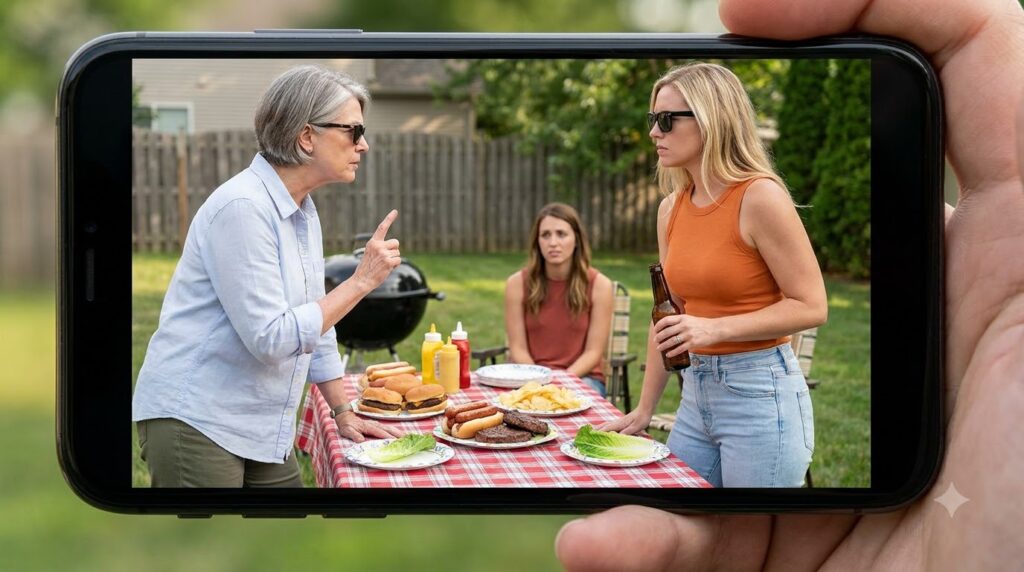
The palm hit the vinyl tablecloth with a dull, heavy thump that rattled the plastic squeeze bottles and made the paper plates jump.
Smoke from the black kettle grill drifted across the red-and-white plaid, carrying the sharp, iron tang of seared beef and burning oak charcoal into the humid afternoon air. Evelyn Vance didn’t lean over the table; she anchored herself against it. Her left hand stayed flat beside a platter of hot sirloin, her short gray hair catching the hard August light above her dark, rimless sunglasses. She was sixty-two, her shoulders square under the pale blue button-up shirt she’d rolled to the elbows before lighting the first pile of briquettes at seven in the morning.
Across the four-foot gap of worn pine, Chloe Mercer didn’t move. She stood rigid in her orange tank top, her long blonde hair falling past her shoulders, her fingers locked tight around the neck of a sweat-beaded brown beer bottle. On the paper plate balanced in her other hand sat a single green lettuce leaf. Cold. Untouched. Isolated like a warning flag in the middle of the white paper circle.
“I made this for everyone,” Evelyn said. Her voice didn’t carry the high pitch of an argument; it had the low, flat weight of an iron latch dropping into a groove. “Don’t stand here insulting it.”
To the right, Maya Reid froze with a cup of lemonade halfway to her lips. The rust-colored fabric of her top didn’t rustle. Two men by the ice cooler stopped talking, the clatter of melting cubes suddenly loud in the silence that rippled outward from the grill.
Chloe’s chin tilted up, her black sunglasses reflecting the dull green line of the back fence. Her knuckles went pale against the brown glass of her bottle. “I was just making an observation about health—”
Evelyn reached out with her right hand. She didn’t touch Chloe. She hooked two fingers under the lip of Chloe’s paper plate and dragged it two inches across the plaid cloth, forcing the solitary lettuce leaf directly into the center of the visual line between them. The paper rasped against the vinyl.
“Reject the food again,” Evelyn said, her voice dropping another notch into plain, unvarnished steel, “and that leaf is dinner.”
The heat off the grill pressed against the back of Evelyn’s neck, thick with the smell of fat rendered over coal. She watched the muscle jump in Chloe’s jaw. Chloe wanted a scene—a loud, emotional back-and-forth about processed ingredients or modern diets that she could turn into a grand statement about culture. But Evelyn hadn’t offered an argument. She had laid down a boundary on thirty-four years of quiet labor, paid for out of a machinist’s pension on the yard she mowed herself.
Chloe looked down at the leaf. The brown glass creaked faintly under the pressure of her grip. The silence in the yard held its breath, waiting for the crack.
“Okay,” Chloe muttered, the word squeezed out tight and thin through closed teeth. She shifted her heels in the dry grass, her gaze dropping to the edge of the table. “I heard you.”
Evelyn didn’t nod. She didn’t smile, and she didn’t step back to let Chloe save face. She simply held her palm flat against the wood for one more beat, feeling the rough grain beneath the thin vinyl, before she lifted her hand, reached for her iron tongs, and turned back to the fire.
Beneath the warm ash at the base of the grill, a fresh cinder popped, and three feet away, lying half-hidden under the bench where Maya sat, a heavy steel key ring dropped from someone’s pocket into the dry dirt, its brass tag stamped with a room number that didn’t belong to any house on Maple Street.

CHAPTER 2: THE PATIOS EDGE
The grease on the kettle grill’s metal side tray had cooled enough to turn cloudy under the August sun. Evelyn didn’t look back as the grass swished behind her. She picked up the heavy steel tongs, their hinge dry and grinding with a fleck of grit, and turned a row of thick sirloin steaks. The meat sizzled on the hot grate, releasing a fresh plume of oak smoke that billowed toward the back fence, masking the faint smell of spilled beer and warm vinyl.
Across the lawn, Chloe Mercer moved with a stiff, unnatural stride, her heels sinking slightly into the dry turf near the edge of the concrete patio. She didn’t drop the paper plate with the solitary lettuce leaf, nor did she put down the brown bottle. Instead, she set the plate on the glass top of a wrought-iron patio table—a table Evelyn’s late husband, Frank, had welded from scrap oil-rig pipe thirty years ago—and leaned her hip against the rusted railing. Her black sunglasses stayed fixed on the grill line, but her jaw remained tight, a thin muscle twitching beneath the smooth, tan skin.
Maya Reid remained at the picnic table, her hands wrapped around her paper cup. She didn’t look at Chloe, and she didn’t look at Evelyn. Her eyes were fixed on the patch of dirt beneath the bench, where the sun hit a small piece of stamped brass attached to a heavy steel key ring. It lay half-buried in the dry crabgrass, caught between the root of an old oak tree and the bench leg. The brass tag caught the light—stamped with three crisp digits: 314.
“Evelyn,” Maya said, her voice barely louder than the hum of the neighbor’s air conditioner compressor down the block. “Your fire’s running hot.”
“Fire’s fine,” Evelyn said without turning around. She tapped the side of the grill with the tongs, a metallic ping that signaled the end of the shift. “Coals just need to burn off the top layer. Always hot right before it settles.”
On the patio, Chloe reached into the pocket of her light blue jeans and pulled out a folded white envelope. It wasn’t a party card or a napkin. It was heavy, rag-bond paper, pre-printed with the formal crest of the municipal code enforcement division, folded twice down the center. She didn’t open it. She simply smoothed the crease with her thumb, her long blonde hair falling over her shoulder as she glanced at two younger women standing near the patio umbrella.
“It’s just about standards,” Chloe said to the air, loud enough to catch the breeze blowing back toward the table. Her voice had regained its polished, airy edge, though her fingers dug into the thick paper of the envelope. “Some people don’t realize that operating an uninspected food service setup in a residential zone isn’t just tacky—it’s a public health hazard. There are rules about grease traps, fire distances, and unregistered public gatherings. My father always said you can’t build a clean community on unregulated favors.”
The two women near the umbrella looked at each other, their plastic cups hovering mid-air. One of them shifted her weight, eyeing the red-and-white plaid table where forty pounds of grilled meat sat cooling in the sun.
Evelyn set the tongs down on the grease tray. She pulled a coarse blue shop towel from her back pocket and wiped her thumbs, her dark sunglasses hiding whatever passed through her mind. She didn’t address Chloe. She walked over to the end of the picnic table, her heavy work boots making a dull, thumping sound on the packed earth.
As she reached the bench near Maya, Evelyn stopped. She didn’t reach for the food or the condiments. Her gaze dropped to the dirt beneath Maya’s feet, locking onto the glint of brass and the heavy steel ring.
Maya didn’t move her foot. “She brought that envelope out of her car before she ever walked up to the grill, Evelyn. I saw it in her bag.”
Evelyn crouched down, her knee joints popping with a dry, rust-like click. She reached into the grass, her calloused fingers closing around the cold steel ring and the brass tag stamped 314. It wasn’t a house key, nor was it a key to any padlock on the fence line. It belonged to the long-stay motor lodge two miles down on State Route 9—a place where the neon sign stayed half-lit and the parking lot was paved with crushed limestone.
Evelyn stood up slowly, her thumb tracing the hard, stamped numbers on the brass. Across the yard, Chloe noticed the movement. Her hand froze over the folded municipal envelope, her posture locking rigid against the rusted railing of Frank’s table as her gaze fell on the glint of steel in Evelyn’s hand.
“Evelyn,” Maya whispered, her voice tight with a sudden, sharp realization. “She’s not living at her father’s house.”
Evelyn slid the key ring into the pocket of her olive work pants, next to her folding knife and her house keys. The weight of the steel settled against her hip, heavy and real.
“She can file whatever paper she brought in that bag,” Evelyn said quietly, looking past the patio toward the open side gate where the street lay quiet in the heat. “But she’s standing on my dirt, and she’s running out of room to back up.”
CHAPTER 3: SHADOWS ON THE PROPERTY LINE
The heavy weight of the steel key ring pressed against Evelyn’s thigh through the thick olive canvas of her work pants. She walked away from the picnic table toward the open garage bay, the air shifting instantly from the scorched heat of the yard to the cool, dark smell of engine oil, dry cedar, and old iron.
Behind her, the low hum of voices resumed around the cooler, but the cadence had changed. It was muted now, careful and guarded, the way people spoke when they realized the neighborhood line had been drawn and everyone was standing on one side or the other.
Evelyn reached up and dragged a wooden drawer open on her workbench. The runner ground against dry oak dust, a rasping noise that matched the steady friction in her chest. She pulled out a faded grease-pencil map—a tax assessment sheet from nine years back when Mercer, Chloe’s father, still owned the big brick colonial at the end of the cul-de-sac.
Before Mercer sold out and moved south, he had spent three summers trying to claim an eight-foot strip of easement along the eastern ditch line. He had brought out land surveyors in crisp white shirts, posted typed notices on telephone poles, and talked incessantly over the fence about “protecting neighborhood equity.” He treated every unpaved alley and shared driveway like a flaw in his personal ledger.
And Chloe had sat on the hood of his sedan back then, eighteen years old, holding an iced espresso, watching the neighbors dig post holes with the same cool, unblinking disdain she carried today.
“He never got that strip,” Evelyn muttered to the dark rafters of the garage.
She remembered the Saturday morning Frank had walked out to the ditch line with a fifty-foot steel tape and a sledgehammer. Frank hadn’t argued with Mercer’s high-priced surveyor. He had simply cleared away four inches of wet topsoil at the corner pipe, uncovered the original iron pin driven into the bedrock in 1958, and struck it three times with the hammer until the ring echoed all the way down Maple Street. Mercer had stood on his manicured lawn, his mouth opening and closing like a landed bass, unable to dispute six inches of solid American steel set in stone.
Chloe hadn’t forgotten that hammer strike.
When Mercer’s investments folded four years later and the colonial went into bank foreclosure, Chloe had vanished to the city, returning only as a ghost in high-end leisure wear, dropping in once a year to remind everyone that she had “moved beyond” the block. But the condescension hadn’t grown into real distance; it had curdled into a sharp, bitter needle. She used diet choices, imported beer brands, and municipal rules to construct a fake high ground over the very people who remembered when her father couldn’t pay the pool maintenance bill.
Outside the garage, a shadow crossed the concrete apron.
Maya Reid stepped into the threshold, blocking the glaring midday light. She held her glass of lemonade in both hands, her thumb tracing a line of condensation on the plastic.
“She’s talking to the Miller family now,” Maya said, her voice low under the steady buzz of the cicadas in the maples. “She told them that white-collar zoning laws exist to keep property values from collapsing when ‘certain demographics’ take over the street.”
Evelyn didn’t look up from the grease-pencil map. Her thumb rubbed against the corner where Mercer’s name had been crossed out in red ink years ago. “The Millers built their own back porch, Maya. They know what a day’s work costs.”
“That’s not what she’s doing, Evelyn,” Maya said, stepping further into the cool shade. Her shoes made a gritty sound on the concrete floor. “She isn’t just complaining about the burgers anymore. She told Mrs. Miller that if the city comes out here to enforce the code notice, everyone who signed up for the block fund could be cited for organizing an illegal venue. She’s trying to scare people into walking away from your table.”
Evelyn closed the wooden workbench drawer. The thump of the frame hitting the backstop was clean and final.
She turned around, her dark sunglasses resting on top of her gray hair now, exposing eyes that were clear, hard, and gray as river stone.
“A threat only works if the person making it has something to stand on,” Evelyn said. She reached into her pocket, pulled out the heavy brass tag stamped 314, and laid it flat on the wooden workbench between them. “She came here today with a folded piece of paper in her purse and a key to a twelve-dollar-a-night motel on Route 9. She’s not protecting property values, Maya. She’s trying to make us look small so nobody notices she’s living out of a trunk.”
Maya stared down at the stamped brass tag resting on the oil-stained oak. The three numbers glinted under the dim overhead bulb.
“If she files that ordinance paper with the county inspector on Monday,” Maya said slowly, the realization settling in, “the city will freeze the block permit for the fall festival.”
“She won’t get to Monday,” Evelyn said flatly, her hand closing back over the brass tag with the quiet certainty of a woman who had worked thirty-four years at a lathe. “Not while she’s standing in my yard.”
CHAPTER 4: THE ANCHOR IN THE DIRT
Evelyn walked back out of the garage into the glaring three o’clock heat, her heavy work boots crunching on the gravel apron. The brass tag in her pocket clicked against her knife with every step, a cold rhythm against her thigh.
Over by the fence line, Chloe had moved away from Frank’s wrought-iron table. She stood beside the gate, her long blonde hair caught in the dry breeze, holding her phone up as if checking a signal. But the folded white envelope was no longer in her hand. It sat tucked beneath the windshield wiper of Evelyn’s old Ford pickup parked at the edge of the lawn.
“Evelyn,” Maya called, coming up fast on her left. “She put something on the truck.”
Evelyn didn’t run. She didn’t hurry her pace. She walked up to the driver’s side of the Ford, her dark sunglasses reflecting the heat haze shimmering off the hood. She reached out, pinched the folded white paper between two calloused fingers, and pulled it out from beneath the wiper blade.
The paper was heavy, official stock. The red seal at the top read City of Oakridge Department of Code Compliance & Public Safety. But as Evelyn unfolded the page, her eye didn’t catch on a simple warning or a noise complaint.
It was an official Cease-and-Desist Notice and Summons, pre-stamped with a municipal clerk’s seal dated three days ago. Attached to the back was a carbon copy of a certified mail receipt.
Chloe had not just brought a threat to a Saturday cookout; she had filed a formal sworn affidavit seventy-two hours earlier, alleging commercial food distribution, illegal graywater disposal, and uninspected public assembly on private residential property. The fine listed at the bottom was four thousand dollars, set to trigger automatically at 5:00 PM if the premises were not cleared and inspected by a city code officer.
Evelyn’s thumb pressed against the red stamp. The ink was dry, set hard into the paper fibers.
“She didn’t write this today,” Evelyn said, her voice dropping into that flat, dangerous quiet that made Maya step back a inch. “She filed this on Wednesday. Before I ever bought the first pound of meat.”
Chloe walked over, her heels making a sharp, rhythmic clicking sound on the dry asphalt of the driveway. She held her brown beer bottle loosely in her left hand, her chin tilted up with that same smooth, practiced composure.
“I told you it was about rules, Evelyn,” Chloe said, stopping five feet short of the truck’s rear bumper. “You think because you’ve been on this block for thirty years, you own the civic standards. But the city doesn’t run on local nostalgia. The inspection team is already dispatched. When they pull up to this curb at five, every person here will be named as an unpermitted participant in a commercial violation.”
Maya gasped, stepping between them. “Chloe, this is an annual block party! My family has been coming here since I was ten!”
“It’s an illegal venue,” Chloe replied, her eyes locked on Evelyn, cold and unblinking behind her dark lenses. “And my father’s estate still holds the primary covenant rights on the ditch drainage. You’re dumping grease into an easement that belongs to the municipal watershed.”
Evelyn looked down at the paper. The logic of the decoy sat before her in black ink—a cold, calculated legal trap built on zoning codes and pre-filed affidavits. It looked absolute. It looked like an unstoppable bureaucrat’s hammer designed to shatter the neighborhood block fund and force Evelyn onto her knees in front of the city council.
Evelyn folded the document slowly, creasing the heavy paper with the flat of her thumb until it was the size of a playing card. She slid it into her shirt pocket next to her reading glasses.
“Your father’s estate,” Evelyn said, her voice cutting through the humid air like a saw blade through pine, “doesn’t own the easement, Chloe.”
Chloe’s mouth twitched, a tiny crack in her polished mask. “The county records—”
“The county records show your father signed a quitclaim deed to the city in 2018 to avoid a tax lien,” Evelyn said calmly. “And when he did that, he surrendered every covenant right on this block. You didn’t file this paper to protect a watershed, Chloe. You filed it because you needed a city inspector’s seal to cover the fact that you haven’t paid property taxes on your father’s storage unit in two years, and the city’s about to auction the contents.”
Chloe froze. The color drained from her cheeks, leaving her skin pale against her bright orange tank top. Her grip on the beer bottle tightened so hard the glass creaked.
“You don’t know what you’re talking about,” Chloe whispered, her voice losing its airy, condescending pitch for the first time.
Evelyn took one step forward, closing the distance between them until she was standing inside Chloe’s shadow.
“I know what a long-stay room at the Route 9 lodge costs,” Evelyn said, her gray eyes merciless behind her glasses. “And I know what happens when someone who lost everything comes back to the only street where people used to know her name, just to see if she can still make somebody jump.”
Before Chloe could answer, the low, heavy rumble of a diesel engine sounded at the mouth of the cul-de-sac. A white city code enforcement truck turned the corner, its yellow roof light flashing slowly against the summer leaves.
CHAPTER 5: THE CONFRONTATION AT THE CURB
The city truck’s tires crunched on the gravel shoulder, stopping three feet from Evelyn’s driveway. The yellow strobe on the cab roof cut through the afternoon sun, casting amber sweeps across the red-and-white plaid tablecloth and the faces of twenty neighbors standing motionless along the yard line.
The driver’s door opened with a heavy, hydraulic click. Inspector Miller stepped out—a thickset man in a sweat-stained khaki work shirt, carrying a aluminum clipboard clamped under his arm. He didn’t look at Chloe, and he didn’t look at the crowd. His eyes went straight to the black kettle grill puffing oak smoke into the air.
Chloe straightened instantly, her demeanor snapping back into a sharp, practiced posture. She took two steps toward the truck, raising her hand to point directly at the grill.
“Inspector,” Chloe said, her voice rising to reach the sidewalk. “I am the complainant who submitted Affidavit 408 on Wednesday. As you can see, this is an uninspected commercial food setup operating inside a residential zone without a health permit or a grease trap compliance certificate. I expect an immediate cease-and-desist closure.”
Inspector Miller adjusted his glasses, looking from Chloe’s orange tank top down to the aluminum clipboard. He flipped the top page, his thumb running down a column of printed records.
Evelyn didn’t move from where she stood beside her Ford pickup. She pulled the folded envelope from her shirt pocket, stepped up to the curb, and held it out.
“Inspector,” Evelyn said, her voice flat and even. “The complaint alleges a commercial catering enterprise. My name is Evelyn Vance. This is my property, and this is the annual Maple Street block gathering.”
Miller took the envelope, opened it, and cross-referenced the pre-stamped date with his own log sheet. He looked up at Evelyn, his expression unreadable behind his wire rims.
“Mrs. Vance,” Miller said, his tone dry as sawdust. “The affidavit states you’re charging admission and selling food prepared off-site without a commercial kitchen license.”
A low murmur rippled through the neighbors. Maya Reid stepped forward from the picnic table, her hands clenched at her sides. “That’s a lie! Evelyn pays for every piece of meat out of her own pension! No one pays a dime here!”
Chloe turned sharply toward Maya, her eyes flashing behind her dark sunglasses. “It doesn’t matter who pays for the meat! The law covers uninspected distribution! My family owned this street’s covenant rights, and I have a right to enforce public safety standards!”
“You don’t own the covenant, Chloe,” Evelyn said, her voice cutting through Chloe’s rising pitch like an iron blade. She reached into her pocket, pulled out the heavy steel key ring with the brass tag stamped 314, and laid it flat on the hood of Inspector Miller’s truck with a clear, sharp clank.
Miller looked down at the brass tag. He knew Route 9. Everyone in code enforcement knew Route 9.
“What is this?” Miller asked, looking between the two women.
“That’s where the complainant resides,” Evelyn said, her eyes locked on Chloe. “And the quitclaim deed your office filed in 2018 transferred all covenant enforcement authority on this easement directly to the city council. The block party permit was approved by the city clerk six weeks ago under the non-profit neighborhood exemption statute.”
Miller flipped to the third page on his clipboard. He drew a red pen from his pocket, made a single, firm checkmark at the bottom of the page, and slapped a red rubber stamp across the top of Chloe’s affidavit: DISMISSED – INVALID STANDING.
“Exemption holds, Mrs. Vance,” Miller said, snapping his clipboard shut with a loud metallic crack. He looked at Chloe, his voice dropping into an unsympathetic growl. “Falsifying a commercial hazard affidavit to force a emergency dispatch carries a two-hundred-dollar administrative fee, Miss Mercer. I suggest you take it up with the municipal court.”
Chloe stood frozen on the sidewalk. The sun beat down on her orange tank top, highlighting the sweat forming along her collarbone. The polished, superior mask she had worn all afternoon didn’t just crack; it dissolved entirely under the eyes of the entire neighborhood. She wasn’t a wealthy benefactor protecting neighborhood standards. She was a woman living out of a motel room, using bureaucratic paperwork to strike at the only people who remembered her father’s name.
Maya stepped up to the edge of the lawn, taking a burger from the platter on the plaid table and taking a bite, her eyes fixed on Chloe. “The food’s great, Evelyn,” Maya said clearly. “Best cookout on the block.”
Two neighbors near the cooler let out a brief, sharp cheer. The tension that had held the yard rigid for three hours broke like dry ice in hot water.
Chloe looked around the circle—at Maya, at the Millers, at the smoking grill, and finally at Evelyn standing firm beside her truck. Her jaw trembled slightly before she turned on her heel and began walking fast down the driveway toward the street, her heels clicking frantically against the hot pavement.
Evelyn watched her go, but she didn’t smile. She picked up the steel key ring from the hood of the truck, feeling the cold weight of the brass tag in her palm. The victory at the curb was complete, but as Chloe reached the corner of Maple Street, she didn’t head toward the bus stop or the Route 9 lodge. She stopped at the mailbox of her father’s former house, resting her head against the wooden post for three long seconds in total, silent defeat.
CHAPTER 6: THE QUIET AT THE GATES
The white city code enforcement truck backed out of the cul-de-sac, its tires grinding softly against the loose gravel before its engine sound faded down the main road. Farther down the block, near the corner where her father’s old brick colonial sat behind a overgrown boxwood hedge, Chloe Mercer slipped through the side gate without looking back once. Her orange tank top was a small, fading speck of color against the lengthening shadows of the neighborhood before the gate latched shut.
Evelyn Vance didn’t follow her with her eyes. She stood by the side of her Ford pickup for a long minute, letting the heat of the hood radiate against her palms. The brass key tag in her fingers felt heavy, cold, and entirely real—a tangible piece of someone else’s quiet ruin that had spilled over onto her lawn.
Across the yard, the normal rhythms of the block cookout reassembled themselves, like water settling after a heavy stone had been pulled from the pond. The ice chest lid dropped shut with a hollow plastic thunk. A folding chair scraped against the grass.
Maya Reid walked back toward the picnic table, her hands tucked into the back pockets of her shorts. She stopped near Frank’s old wrought-iron table, picked up the white paper plate where the single, untouched lettuce leaf still sat under the fading sun, and carried it over to the galvanized trash bin by the fence.
“It’s over, Evelyn,” Maya said quietly, stepping up beside the grill where the last few coals were turning from glowing orange to soft, gray ash. “She won’t come back.”
Evelyn took off her dark rimless sunglasses, wiping the dust from the lenses with the corner of her blue shirt. Her eyes were tired, surrounded by deep, sun-etched lines, but they were steady.
“She wasn’t fighting us for the lawn, Maya,” Evelyn said, her voice dropping into the low, unhurried cadence of the evening. “She was fighting the fact that when everything else fell apart, the street was still here. And she didn’t have a seat at the table anymore because she traded it for pride.”
Evelyn walked back to the workbench inside the garage. She pulled out a rusty blue coffee can—the one where Frank used to keep spare washers, cotter pins, and old brass fittings—and dropped the key ring stamped 314 inside. The metal hit the bottom with a dull, heavy chime. She slid the lid back on, pushed the can into the dark back corner of the shelf, and wiped her hands on her shop towel.
When she walked back out, the sun was dipping below the tops of the western pines, casting long, gold-and-violet rays across the red-and-white plaid tablecloth. Neighbors were leaning back in their lawn chairs, plates empty, listening to the soft hum of the evening cicadas and the distant sound of a lawnmower two streets over.
Evelyn walked over to the picnic table, picked up a clean paper plate, and served herself a small piece of grilled steak and a spoonful of potato salad. She didn’t make a speech. She didn’t raise a glass. She simply sat down on the wooden bench beside Maya, feeling the cool evening air settle over the yard she had earned, on the dirt she had defended, surrounded by the people who knew what it meant to belong.
“Good steak, Evelyn,” Mr. Miller called out from across the lawn, lifting his paper cup in a quiet salute.
Evelyn looked out over the yard, her expression softening into a brief, satisfied nod.
“It’s just honest food, Jim,” Evelyn said softly, setting her fork down on the paper. “If you come to my table, you leave your ego at the gate.”







