
The High-Roof Verdict: A Study in Boundary, Steel, and the Cold Weight of Law
CHAPTER 1: THE MARKED THRESHOLD
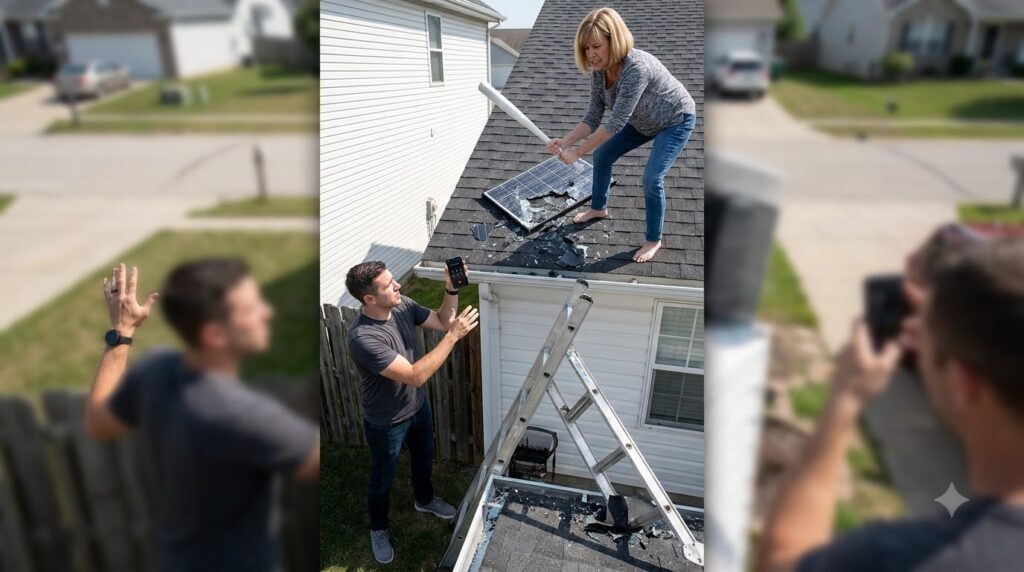
The white plastic bat struck tempered glass with the sharp, sickening crack of a small caliber round.
Marcus Vance did not flinch. He didn’t break his stride as he rounded the back bumper of his sedan, his work bag slung over his left shoulder, dark jeans shifting against the heat radiating off the concrete driveway. He stopped at the edge of the grass where the sun hit the white vinyl siding of his garage at an ugly, blinding angle.
Above him, braced against the pitch of the dark asphalt shingles, Brenda Holloway leaned into a second swing. The gray pattern of her long-sleeve top was dark with sweat at the armpits. Her shoulder-length bob swung wildly, strands sticking to her red, strained neck.
Crack.
Another dark panel shattered, spiderwebbing into thousands of glittering, mica-like cubes that skittered down the roof slope and bounced off the aluminum gutter.
Marcus didn’t yell. A shouting man was a man losing control of his variables, and Marcus lived in a world dictated by uptime, system protocols, and cold, ironclad logic. He looked down at the base of the garage wall. An eight-foot aluminum extension ladder leaned against the siding, its rubber feet digging shallow grooves into the edge of his turf.
He stepped forward. The grass was dry under his sneakers, making a quiet, brittle crunch.
“You’re trespassing, Brenda,” he said. His voice didn’t carry anger; it carried the dull, mechanical weight of an audit report.
Brenda froze mid-recoil, the bat held high over her head like a club. Her eyes, magnified behind rimless reading glasses, snapped down to meet his. Her chest heaved. “These illegal eyesores violate Section 4 of the architectural covenants! You were warned, Vance! I told you this neighborhood isn’t going to turn into a commercial utility farm!”
“The state solar access statute overrides subdivision covenants passed after 2012,” Marcus said quietly. He took two deliberate steps to the right, placing his body directly between the ladder and the side gate. “You received the certified copy of the municipal permit on Tuesday.”
“I run this board!” Brenda spat, her grip tightening on the black rubber handle of the plastic bat. She shifted her barefoot stance on the hot shingles, her toes curling frantically into the grit for traction. “Your little paper tricks don’t mean a damn thing to the people who built this street. They come down today, or I smash every single cell!”
Marcus looked at his black wristwatch. 2:14 PM. The county deputy shift change was at 2:00 PM, meaning the road units were already out on perimeter patrol along the main arterial two miles back.
He reached out with his right hand, gripped the cold aluminum rung of the ladder, and pulled.
The rubber feet scraped hard against the turf, then lifted. With a smooth, practiced shift of his weight, Marcus dragged the ladder five feet back, tilted it sideways, and laid it flat in the tall grass beside his HVAC unit.
Above, the color drained instantly from Brenda’s face. The bat lowered an inch, then two.
“What are you doing?” Her voice lost its sharp, barking edge, flattening into something thin and reedy. “Put that back!”
Marcus pulled his black-cased smartphone from his pocket. His thumb swiped the glass once. He didn’t look at her; he looked at the screen as the three digits registered and the call tone began its rhythmic, electronic hum.
“Marcus! Put the ladder back up right now!” Brenda took a small, panicked half-step down the sloped shingles, but her bare soles slipped on the loose glass fragments, and she scrambled backward, clutching the white bat against her chest like a shield.
The line connected. A neutral, female voice came through the speaker. “County Emergency, what is your location?”
Marcus raised the phone to his ear, his eyes fixed on the woman trapped against his roofline. “My name is Marcus Vance. I’m at 1408 Elmridge Drive. Someone is destroying my solar panels.”
Across the street, a porch screen door slammed open.

CHAPTER 2: THE PAPER LAWSUIT
“Repeat your location, sir,” the dispatcher’s voice rasped through the smartphone speaker, thin and metallic against the wide, sun-drenched silence of the cul-de-sac.
“1408 Elmridge Drive,” Marcus said, his voice flat, unhurried, anchored in the dirt. He didn’t take his eyes off Brenda. “White house, brick veneer front, dark trim. The suspect is on the roof slope above the garage. She’s wielding a plastic bat and has destroyed two solar modules.”
Above him, Brenda didn’t scream this time. The screaming was for when she had the upper hand, when a clip-board and a raised voice could force a tenant to pull a trash bin back from the curb three hours early. Now, stranded twelve feet up on thirty-degree asphalt shingles with dry glass crunching beneath her soft-soled shoes, her mouth worked without sound. She looked down at the aluminum ladder lying sideways in the dry Bermuda grass like a shed skin.
“Marcus,” she whispered, the edge in her tone fraying into something sharp and jagged. “Marcus, you put that up right now. You don’t know what you’re doing. You don’t know what this block was before we brought the covenants in.”
“Units dispatched,” the radio tone chirped from the phone. “Stay on the line if it is safe to do so.”
Marcus lowered the phone three inches, keeping the display lit, the red disconnect button resting under his thumb. He walked three steps toward his front porch, his sneakers kicking up fine gray dust from the edge of the expansion joint. Tucked into the gap between the white vinyl door frame and the deadbolt strike plate was a folded strip of yellow legal pad paper. It hadn’t been there when he left for the depot at seven this morning.
He pulled it free with two fingers. The paper was stiff, sun-baked, smelling faintly of old cedar and damp basement storage. Written in thick, black ballpoint ink that had bled through the cheap pulp were five words: REMOVE THEM OR THEY FALL. No signature. No HOA seal. No date.
He turned the yellow paper over. On the back, stamped in purple ink that had faded to the color of dried plum, was an old municipal recording mark: BOOK 402, PAGE 118 – COUNTY LAND RECORDS, 1994.
Brenda shifted on the roof. A cluster of glass granules skittered down the valley, pinging off the copper flashing before dropping onto the hood of his parked mower in the side yard. “That’s private correspondence, Vance! That was left for your landlord—”
“I own the parcel, Brenda,” Marcus said, folding the paper once, twice, until it was the size of a credit card. He slipped it into his breast pocket alongside his steel tire gauge. “Bought it outright from the bank receivership three years ago. The deed is warranty, clean title, no encumbrances except the primary utility easement along the rear fence line.”
“You think you bought a title,” Brenda hissed, her hands tightening around the black grip of the bat until her knuckles turned the color of lard. “You bought a file folder! You think because you sit in an air-conditioned room and look at spreadsheets all day that you own the ground under your boots? This subdivision was surveyed on a mistake, Vance! Every lot on the east side of Elmridge is six feet off the county benchmark!”
Marcus paused. The air between them tasted of dry dust, hot asphalt, and the sharp, ozone tang of cooked silicon from the ruptured solar cells baking under the two o’clock sun.
“The county surveyor marked the pins in April when the solar permit was pulled,” Marcus said, his voice dropping into the quiet register he used when a server rack went dark at midnight and every second cost five hundred dollars. “The pins are iron, driven four feet deep into the limestone base. Your fence is two feet inside my eastern boundary, Brenda. I let it sit because I don’t care about two feet of weed-choked clover. But if we’re measuring things by the inch today, we can start with the ladder.”
A dark sedan turned into the mouth of the cul-de-sac two hundred yards out—not a deputy’s cruiser, but a rusted white station wagon with a faded neighborhood watch decal slapped across the rear quarter panel. The driver slowed, tires grinding against the loose gravel near the storm drain, a arm resting on the door frame, watching.
Brenda saw the car. Her posture stiffened; the posture of a woman who had spent twenty years standing at the head of fold-out tables in the elementary school gymnasium, directing votes on lawn-height restrictions and exterior paint palettes.
“Tom!” she shouted toward the street, her voice cracking as she tried to project over the pitch of the roof. “Tom, call the board! Call Miller! Vance has locked me up here! He took the ladder!”
The station wagon didn’t accelerate. It idling at the curb, its muffler throbbing with a wet, uneven rhythm, its driver motionless behind the tinted glass.
Marcus didn’t turn around. He reached into his pocket, took out the yellow strip again, and unfolded it against his palm. The faded purple stamp from 1994 wasn’t an HOA mark. He recognized the font—old courier type from the county clerk’s old dot-matrix printer. BOOK 402, PAGE 118 was the old boundary adjustment register for the original homestead grant before the developer plowed the orchards under and laid down white vinyl and covenants.
Brenda wasn’t trying to save the neighborhood’s visual uniformity. She was trying to keep anyone from looking too closely at the dirt under the foundations.
“The deputies will be here in four minutes,” Marcus said, stepping back onto the grass, his shadow stretching long and thin toward the base of the wall. “You can come down when they set the ladder back up, or you can stay up there until the sun goes down. Either way, the report gets typed today.”
CHAPTER 3: THE COLD ARCHIVE
The rusted white station wagon didn’t just idle. Its driver door swung open with a dry, ungreased groan that cut straight through the heat shimmer rising off the asphalt.
Tom Miller stepped out onto the gravel curb. He was a broad, stooped man in his late sixties, wearing an old canvas work vest smeared with dry joint compound and grease. He didn’t look up at the roof right away. He looked at Marcus’s hands, then down at the extension ladder lying flat in the grass beside the condenser unit.
“You ought to put that back up, Marcus,” Miller said. His voice had the dry, rasping drag of a heavy smoker. He slammed the car door shut behind him, the latch catching with a hollow thump. “You’re making this a police matter, and nobody on Elmridge wants patrol cars blocking the street on a Tuesday afternoon.”
Marcus didn’t shift his stance. He kept his feet planted firmly near the corner of his garage, his thumb resting lightly against the edge of his phone casing. “She’s wielding a bat on my roof, Tom. She smashed two panels. That isn’t an HOA dispute—it’s felony destruction of property.”
“It’s a compliance action,” Brenda shouted down, her voice breaking into a harsh screech as she shifted her weight on the pitch. The white plastic bat trembled in her grip, its black rubber handle slick with sweat. “Tell him, Tom! Tell him what the board voted on at the executive session last Thursday!”
Miller reached into his vest pocket and pulled out a heavy ring of brass keys, flipping through them until his thumb settled on a wide, notched key stamped with crude, hand-punched block lettering: BOARD-REC-4.
Marcus’s eyes locked onto the metal tag. BOARD-REC-4 wasn’t a standard residential key. It belonged to the heavy steel filing cabinets housed in the annex behind the old township water office—the restricted repository where the subdivision’s original 1980s architectural filings and unrecorded covenants were stored under padlock.
“We filed the emergency architectural restriction this morning, Vance,” Miller said, taking two slow steps onto the grass. The turf groaned under his heavy boots. “Section 4, Paragraph B. Total ban on roof-mounted reflective glass arrays visible from the primary access road. It was submitted to the municipal clerk’s digital queue at eight-thirty AM. Retroactive clause included.”
“You can’t pass a retroactive covenant restriction without a ninety-percent quorum of deeded owners,” Marcus said, his voice dropping an octave into absolute, icy calm. “And you can’t file it electronically without a notarized affidavit from the county clerk. I checked the municipal queue before I left my desk at noon. Nothing was posted.”
“It’s in the queue,” Miller repeated, his jaw tightening as he gripped the key ring tighter. “It just hasn’t cleared the clerk’s index desk yet. The paperwork is valid, Vance. As far as the board is concerned, those panels are an illegal installation as of sunrise.”
A breeze swept down the cul-de-sac, carrying the acrid smell of hot asphalt and the faint, metallic tang of scorched silicon from the shattered solar cells above.
Marcus took a deliberate step toward Miller, closing the distance until barely three feet of dry grass separated them. Miller was taller, heavier, but Marcus stood with the centered, unyielding balance of a man who worked with iron beams and high-voltage conduit.
“Show me the affidavit,” Marcus said softly.
Miller didn’t flinch, but his thumb slipped off the brass key tag. “It’s filed.”
“Then why did Brenda bring a plastic bat instead of an injunction?” Marcus looked past Miller’s shoulder, up toward the roofline where Brenda stood frozen, her eyes darting frantically between the two men and the far end of the street. “You didn’t file an amendment, Tom. You dropped a forged draft into the clerk’s temporary holding inbox to buy yourselves forty-eight hours of leverage. You thought if you smashed the glass today, I’d take the insurance payout and cut my losses rather than spend six months in chancery court fighting a phantom rule.”
Up on the shingles, Brenda’s composure broke completely. “He’s not going to sign anything, Tom! Look at him! He’s calling the deputies! He doesn’t care about the board!”
“Shut up, Brenda,” Miller muttered under his breath, his eyes fixed on Marcus’s face.
Marcus reached into his breast pocket, pulled out the folded strip of yellow paper with the faded 1994 county stamp, and held it out between two fingers. He didn’t offer to hand it over; he simply held it in the harsh daylight where the faded purple ink was fully legible.
“Book 402, Page 118,” Marcus said smoothly. “This isn’t a covenant paper, Miller. It’s a land survey exception filed thirty-two years ago when the developer paved over the old drainage creek. You didn’t try to stop these panels because of architectural aesthetics or property values. You’re terrified of what the municipal inspector sees when he climbs up on my roof with a laser transit.”
Miller’s expression didn’t change, but his breathing shallowly shifted, his chest rising and falling against the heavy canvas of his vest. He didn’t look at the yellow paper. He looked at the phone in Marcus’s hand.
Far down the avenue, past the line of manicured lawns and matching vinyl fences, a faint, warbling siren cut through the midday heat.
Marcus didn’t smile. He took half a step back, maintaining his perimeter, keeping the extension ladder squarely behind his heels. “That’s the county unit turning off the highway. You have about ninety seconds to decide if you’re standing on my grass as a witness, or as an accomplice to felony vandalism.”
Miller stared at Marcus for three agonizing seconds, his fingers twitching against his key ring. Then, without saying another word to Brenda or looking back at the roof, he turned on his heel, walked back to the station wagon, and pulled himself into the driver’s seat.
“Tom!” Brenda screamed from the shingles, her voice cracking into a high, panicking wail. “Tom, don’t you leave me up here! Tom!”
The station wagon’s engine roared to life, exhaust coughing a pale blue cloud into the humid air as Miller threw the car into reverse and backed out into the middle of the street.
CHAPTER 4: THE PERMIT IN THE SHINGLES
The station wagon’s rear tires kicked up a spray of loose pea gravel that rattled against the vinyl gate behind Marcus. The red tail lights flickered once as Tom Miller reached the corner, took the turn without signaling, and vanished behind the tall cedar hedge at the mouth of Elmridge Drive.
Silence collapsed back over the driveway, heavy and stifling under the glare of the two o’clock sun.
High above, Brenda lowered the white plastic bat until the black rubber tip rested against the dark asphalt shingles. Her knuckles, white and swollen from her tight grip, slowly flushed pink as blood returned to her fingers. Without Miller standing on the lawn to lend the weight of the board to her crusade, she looked smaller, her shoulder-length blonde bob disheveled, her gray patterned top damp with sweat across the shoulder blades.
“He’s going to the township office,” Brenda said, though the sharp, commanding edge in her voice had frayed into something thin, desperate, and defensive. She didn’t look down at Marcus; her eyes were fixed on the far end of the street where the siren’s warble grew louder, turning from a distant hum into a distinct, two-tone pulse. “Tom has the master key. He’s going to pull the original architectural file before your deputy even writes his name on the clipboard.”
Marcus didn’t answer. He stepped over the collapsed extension ladder resting in the Bermuda grass and stopped directly beneath the garage overhang. From this angle, he could see where the second strike of the plastic bat had sheared through the tempered glass casing of the lower solar module. The impact hadn’t just shattered the protective top layer; it had bent the anodized aluminum mounting rail, wrenching the lag bolt three-quarters of an inch out of the rafter beneath the decking.
Tucked into that newly opened gap—pushed under the lip of the third row of shingles right beside the bent mounting bracket—was a folded slip of blue carbon paper, yellowed at the edges and stiffened by decades of trapped attic heat.
Marcus reached up. His fingers grazed the hot aluminum frame of the panel, avoiding the sharp, glittering glass fragments, and pinched the edge of the blue paper.
“Don’t touch that!” Brenda gasped, taking a sudden, jerky step down the slope. Her soft-soled shoe skidded on a cluster of loose glass cubes, and she caught herself on the roof ridge with her free hand, the bat clattering noisily against the shingles before sliding three feet and wedging itself in the gutter trough. “That’s private board property, Vance! Leave it alone!”
Marcus pulled the paper free. It was an ancient, three-part municipal receipt slip, the kind used by the county building department before digitized land records replaced paper cabinets in the mid-nineties. The carbon ink had faded to a ghostly violet, but the block lettering stamped across the top line was still crisp enough to read under the harsh daylight: NOTICE OF BUILDING PERMIT REJECTION – LOT 14, BLOCK C.
Lot 14 was Brenda’s property. The house directly adjacent to his eastern fence line.
Marcus unfolded the receipt. The date at the bottom was June 12, 1994. Signed by the old township inspector whose signature appeared on every original deed on the block. The reason for rejection was circled twice in faded purple ink: STRUCTURE ENCROACHES ON UNRECORDED TOWNSHIP DRAINAGE EASEMENT. NO EXEMPTION GRANTED.
Marcus looked up from the blue paper to the woman perched on his roof.
Midway down the street, a white-and-gold county sheriff’s cruiser turned into the cul-de-sac, its overhead light bar flashing silent blue and red bursts against the bright white vinyl siding of the surrounding houses.
“This isn’t about my solar panels, Brenda,” Marcus said softly, his voice carrying clearly over the rumble of the approaching patrol car’s engine. “And it isn’t about the HOA architectural guidelines either.”
Brenda sat down hard on the pitch of the roof, her blue jeans smearing against the dark asphalt, her hands pulling her knees up to her chest as if the heat of the shingles no longer mattered. She didn’t look at the cruiser pulling into the driveway. She stared down at the blue carbon slip in Marcus’s hand.
“The board filed an architectural amendment thirty minutes ago,” Marcus continued, folding the carbon paper with precise, deliberate movements and placing it in his pocket alongside the yellow note. “You and Miller dropped a forged document into the clerk’s digital queue to create a paper trail. You wanted a legal dispute on record so the county inspector wouldn’t cross my property line to check the damage on these panels.”
The cruiser came to a stop ten feet behind Marcus’s sedan. The driver’s door opened, and a deputy stepped out onto the concrete, his hand resting casually over the leather retention strap of his sidearm as his eyes swept from the ladder lying in the grass up to the woman stranded near the chimney.
“Because if an inspector stands on my roof with a measuring tape,” Marcus said, keeping his eyes locked on Brenda, “he’s going to look down at your garage wall and realize your entire foundation sits three feet inside the township’s fire easement.”
Brenda didn’t yell. She didn’t offer a defense. She simply closed her eyes as the deputy cleared his throat and took his first step onto the lawn.
CHAPTER 5: THE STRANDED VERDICT
Deputy Kowalski’s heavy leather utility belt creaked with a dry, rhythmic strain as he rounded the front bumper of his cruiser. He was a thick-set man with sun-reddened forearms and graying sideburns, his duty boots crunching softly over the dry Bermuda turf. He didn’t unholster his sidearm, but his right thumb rested squarely over the retention snap.
His eyes swept the scene in two seconds: the shattered glass glittering like salt on the dark shingles, the displaced extension ladder lying sideways in the weeds, and Brenda Holloway huddled beside the chimney, her white plastic bat wedged firmly in the aluminum gutter trough.
“Ma’am,” Kowalski called up, his voice gravelly and flat from twenty years of county calls. “I need you to stay exactly where you are. Don’t reach for that bat, and keep your hands visible.”
“Deputy, thank God,” Brenda stammered, her voice cracking as she leaned forward, her fingers digging into the hot asphalt. “He pulled the ladder! He trapped me up here! I was conducting an architectural assessment under board authorization, and he assaulted my access route!”
Kowalski didn’t look up at her again. He turned his head toward Marcus, taking in the clean charcoal T-shirt, the black wristwatch, and the calm, upright posture of a man who hadn’t raised his voice once.
“You the homeowner?” Kowalski asked.
“Marcus Vance. 1408 Elmridge,” Marcus said. He didn’t offer a handshake. He kept his hands at his sides, his right thumb hooked casually into his pocket near the folded carbon slip. “I pulled the ladder away from the siding after she struck the second panel with the bat. I dialed 911 immediately and stood here until your unit turned into the cul-de-sac.”
“Did you lay hands on her?”
“No,” Marcus said. “I moved the ladder five feet to the right and laid it flat on the grass. She has been in sole possession of the roof slope since two-fourteen PM.”
Kowalski glanced at the aluminum ladder lying in the turf. Then he looked up at the shattered glass panels. “Is that your property, ma’am?”
“It’s a violation of Section 4!” Brenda shouted, her voice rising into a sharp, hysterical register that echoed off the neighboring garage walls. “It’s an illegal structure! Tom Miller is at the clerk’s office right now getting the emergency injunction paperwork!”
“That’s a no,” Kowalski muttered under his breath. He reached down, unhooked his radio mic from his shoulder strap, and keyed the switch. “Dispatch, 204. I’m on scene at 1408 Elmridge. Requesting a second unit for traffic control and a code enforcement officer to document criminal property damage over fifteen hundred dollars.”
“Copy 204, second unit en route, ETA six minutes.”
Marcus took half a step toward the deputy, pointing toward the ground near the corner of his garage. “Deputy, before you set that ladder back up to bring her down, you need to look at the ground pin at the corner of the vinyl fence.”
Kowalski frowned, his bushy eyebrows knitting together as he looked at the base of the garage wall. “Why? What’s at the pin?”
“The boundary pin was driven four feet deep into the limestone in 1994,” Marcus said smoothly, his eyes shifting up to Brenda, whose face had gone completely gray under the harsh sunlight. “Tom Miller didn’t go to the clerk’s office to file an architectural amendment. He went there because Brenda’s late husband, Arthur Holloway, signed a boundary waiver thirty-two years ago that was never recorded on her deed. The HOA covenants don’t exist to protect neighborhood property values. They exist to hide the fact that her entire east wing sits on county land.”
Kowalski’s jaw set hard. He looked from Marcus down to the grass, then slowly up at Brenda.
“That’s a lie!” Brenda shrieked, scrambling two inches backward on the shingles, her soft-soled shoes kicking another shower of glass cubes down the slope. “Arthur built this house! Arthur was the board president! You can’t look at those records! You have no right to look at Arthur’s files!”
“I don’t need to look at Arthur’s files,” Marcus said, pulling the blue carbon slip out of his pocket and holding it up toward Kowalski. “The building department already rejected the lot in 1994. The forgery Miller tried to drop in the queue this morning wasn’t meant to stop my solar panels. It was meant to trigger a legal freeze so no inspector would ever walk this fence line with a transit.”
Kowalski took the blue carbon paper from Marcus’s fingers. He unfolded it slowly, his heavy eyes scanning the faded purple ink stamp from thirty-two years ago.
Across the street, two more front doors clicked open. Neighbors were stepping out onto their lawns—some carrying smartphones, others standing in silence with their hands on their hips, watching the neighborhood’s most feared rule-enforcer trapped on a sloped roof while a county deputy held the paper that unravelled her thirty-year reign.
Kowalski folded the blue paper, tucked it securely into his shirt pocket, and looked up at the roof with cold, unyielding authority.
“Ma’am,” Kowalski said, his voice dropping into a register that admitted no argument. “You’re going to sit right there until my backup arrives. And when you come down off that roof, you’re going into the back of my cruiser.”
CHAPTER 6: THE PUBLIC RECORD
The second deputy’s cruiser pulled onto the shoulder at a sharp angle, its tires grinding against the dry gravel near Marcus’s mailbox before coming to a complete stop. The blue strobe lights reflected off the polished white vinyl siding of the surrounding houses in rapid, rhythmic pulses, casting harsh shadows across the lawn.
A crowd of neighbors had formed along the concrete curb. They stood two deep on the sidewalk—men in grass-stained yard shoes, women holding smartphones at waist height, teenagers leaning against mountain bikes. No one spoke. The usual afternoon murmur of lawnmowers and distant sprinkler heads was swallowed entirely by the low thrum of two idling V8 engines.
Deputy Kowalski stepped around the side of the garage, reached down, and took hold of the aluminum extension ladder resting in the grass. He hoisted it with one arm, set the rubber feet firmly into the turf four feet back from the foundation, and extended the upper section until the rungs locked with a heavy, metallic clack against the fascia board.
“Alright, ma’am,” Kowalski called up, his tone cold and unyielding. “Hands where I can see them. Come down slow, one rung at a time.”
Brenda Holloway didn’t move for three long seconds. Her shoulder-length blonde bob was slicked with sweat against her neck, her gray patterned top stained dark across the back from the hot shingles. She looked past the deputy, past the ladder, out toward the line of neighbors standing along the curb. She saw Mrs. Gable from number 1402—the woman she had fined forty dollars three weeks ago for a rusted porch light fixture—holding a phone steadily toward the roofline. She saw the younger couple from the corner house watching in stunned, wide-eyed silence.
Slowly, her knees trembling under her blue jeans, Brenda shifted her weight forward. Her bare soles rasped over the dry asphalt grit as she turned toward the edge, her fingers gripping the cold aluminum rails of the ladder with desperate, white-knuckled force.
Marcus stood beside the corner of his garage, his arms folded loosely across his chest. He watched her descend rung by rung, her posture collapsing with every foot she descended toward the lawn. The plastic bat remained wedged high above in the gutter trough, its white handle sticking out over the shattered glass panels like a broken marker.
As Brenda’s feet touched the Bermuda grass, Deputy Kowalski’s partner stepped up beside her. Before she could straighten her spine or pull her gray top down, the second officer took her right wrist, brought it behind her back, and clicked a steel cuff around her wrist with a sharp, double-locking ratchet sound.
“Brenda Holloway, you are under arrest for felony destruction of property and criminal trespass,” the deputy read off smoothly, pulling her left arm behind her to complete the restraint.
“You don’t understand,” Brenda whimpered, her voice barely a whisper now, all the booming, clipboard-wielding authority drained out of her chest. Her eyes locked onto Marcus, her chin trembling. “Arthur built this block. He cleared the timber. If you let the county re-survey the east line, they’ll take the garage. They’ll take the whole front porch. He spent twenty years hiding that survey…”
Marcus pulled the folded blue carbon slip and the yellowed note from his pocket, looking down at the faded purple ink stamps from 1994.
“Arthur didn’t build the block, Brenda,” Marcus said, his voice flat, razor-sharp, and perfectly clear to every neighbor standing within twenty feet. “Arthur bought a lot with a defective deed, and when the county refused the exemption, he spent the rest of his life using the HOA board to keep anyone from digging in the dirt. You didn’t smash my solar panels to save the neighborhood. You smashed them because you were terrified a county inspector would stand on my roof and realize your home was built on a lie.”
A collective murmur rippled through the gathering on the sidewalk. Mrs. Gable lowered her phone two inches, her mouth slightly open, while two men near the driveway exchange a long, knowing look.
The second deputy guided Brenda toward the rear door of the first cruiser. She didn’t fight. She didn’t shout for Tom Miller. Her head remained bowed, her eyes fixed on the dry grass beneath her shoes as the officer placed his hand over her head and pushed her into the hard plastic back seat.
The door slammed shut with a heavy, airtight thunk.
Kowalski turned to Marcus, pulling a small black notepad from his breast pocket. “Mr. Vance, I’m going to need you to stay on site for another twenty minutes. Code enforcement is five minutes out to photograph the panel damage, and I’ll need your formal signed statement for the prosecutor.”
“I’ll be right here,” Marcus said, his voice as steady as the concrete beneath his boots. He looked up at the roof slope where the afternoon sun hit the dark, shattered glass, sparkling like diamonds over the dark shingles.
CHAPTER 7: THE GROUND LINE
The patrol cruiser’s tires hummed against the asphalt as it backed out of the driveway, its roof lights cutting blue and red arcs across the manicured lawns before turning onto Elmridge Drive and accelerating toward the main highway.
The sound of the engine faded into the hot afternoon air, leaving a profound, unnatural silence behind.
Marcus Vance did not move from the corner of his garage. His steel-cased wristwatch clicked over to 2:48 PM. The heat radiating off the white vinyl siding had begun to soften as a cloud drifted across the sun, casting long, cool shadows across the driveway. On the roof above, thousands of shattered glass fragments glinted like mica chips embedded in the dark asphalt shingles.
Deputy Kowalski stood beside his hood, unclipping a heavy aluminum clipboard. Beside him on the stamped steel hood lay the evidence bag containing the plastic bat, along with the two paper slips Marcus had provided—the faded yellow legal pad note and the blue carbon rejection slip from 1994.
A second county vehicle—a tan pickup truck bearing the seal of the Department of Building and Code Enforcement—pulled into the driveway. A middle-aged man in a high-visibility vest stepped out, carrying a heavy digital camera and a telescoping surveyor’s rod.
“Mr. Vance?” the code officer asked, squinting up at the roofline. “I’m Miller from the county inspector’s office. Deputy Kowalski called in a felony property damage report.”
“I’m Marcus Vance,” Marcus said. He didn’t look back toward Brenda’s vacant house. He looked at the base of the vinyl fence running along his eastern property line. “The array is on the south roof slope. Two modules destroyed, mounting rail sheared, lag bolts pulled from the rafters.”
The inspector walked to the edge of the grass, raised his camera, and began taking methodical, high-resolution photographs. The sharp, digital beep of the shutter echoed off the garage wall with clinical precision. Click-beep. Click-beep.
“Heavy impact damage,” the inspector muttered, stepping over the aluminum extension ladder still resting in the Bermuda grass. “Tempered glass failure, structural rail deformation. You’re looking at four thousand minimum for panel replacement, labor, and rafter repair.”
Kowalski leaned over his clipboard, signing his name across the bottom of the formal Incident Report form. He detached the yellow carbon copy and handed it to Marcus.
“This is your copy of the preliminary report, Mr. Vance,” Kowalski said. “The prosecutor’s office will contact you within forty-eight hours regarding formal criminal charges for felony vandalism, criminal trespass, and obstruction. Mrs. Holloway is currently being processed at the county jail.”
Marcus accepted the paper. The surface felt crisp, smooth, and dry under his fingers. “What about Tom Miller and the filing at the clerk’s office?”
Kowalski glanced toward the street, where the last of the gathering neighbors was slowly dispersing back toward their front porches. “I dispatched a unit to the township office ten minutes ago. Mr. Miller was located in the basement archive room attempting to remove the 1994 survey register from a locked storage cabinet. He’s currently being detained for questioning regarding tampered public records and filing false instruments.”
Marcus folded the yellow carbon report once and slipped it into his back pocket.
The code inspector walked to the corner of the garage, planted his telescoping rod directly into the turf beside the vinyl fence, and unclipped a hand-held laser transit from his belt. He aimed the red beam at the brass pin buried four feet deep in the earth near the property line.
A high-pitched tone chimed from the device.
The inspector looked at the digital readout, then looked up at Brenda’s house—the wide, brick-front ranch with its pristine shutters and manicured flowerbeds. He shook his head slowly.
“Three feet, two inches,” the inspector said flatly. “Her entire west garage wall sits inside the county fire easement. Has since the day the concrete was poured thirty-two years ago.”
Marcus looked at the red laser dot glowing steadily against the dark iron pin in the dirt.
There were no screaming arguments left to win. No board meetings to attend, no petitions to sign, no clipboards to fear. The covenants that had governed the cul-de-sac for three decades had never been written in the stars or secured by law; they had been forged out of fear, sustained by entitlement, and shattered by a single afternoon of unyielding truth.
“Are you going to need anything else from me today, Deputy?” Marcus asked.
Kowalski hooked his pen into his breast pocket and adjusted his heavy leather belt. “No, Mr. Vance. You’re clear. Keep that ladder off the roof until the forensic team finishes their photos tomorrow morning.”
“Understood,” Marcus said.
The deputy got into his cruiser and pulled out into the street. The code inspector returned to his truck, leaving Marcus standing alone in his side yard.
Marcus walked to the edge of the lawn, picked up the aluminum extension ladder, and carried it into the shade of his garage. He set it against the interior wall, hung his work bag on the wall hook, and walked out onto his front porch.
The sun was sinking lower, casting long, sharp shadows across Elmridge Drive. Across the street, Mrs. Gable gave him a brief, respectful nod from her porch before stepping inside.
Marcus sat down on his front step, pulled his black-cased smartphone from his pocket, and looked at the screen. The emergency call log read Duration: 12 minutes, 42 seconds.
He cleared the notification, locked the screen, and placed the phone back in his pocket. The air was cool, the street was quiet, and the ground beneath his feet was finally his own.







