
CHAPTER 7: THE GROUND LINE
The patrol cruiser’s tires hummed against the asphalt as it backed out of the driveway, its roof lights cutting blue and red arcs across the manicured lawns before turning onto Elmridge Drive and accelerating toward the main highway.
The sound of the engine faded into the hot afternoon air, leaving a profound, unnatural silence behind.
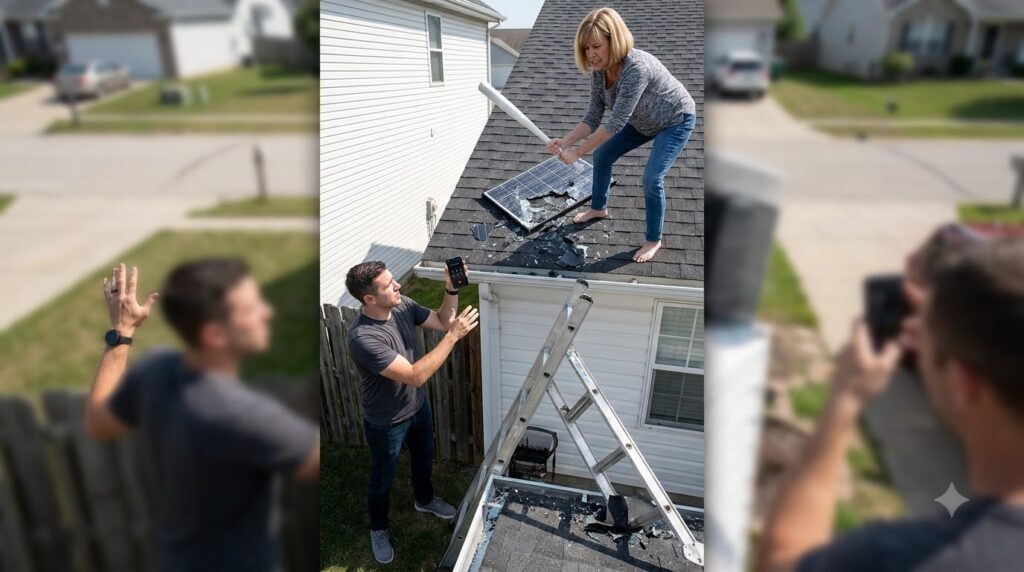
Marcus Vance did not move from the corner of his garage. His steel-cased wristwatch clicked over to 2:48 PM. The heat radiating off the white vinyl siding had begun to soften as a cloud drifted across the sun, casting long, cool shadows across the driveway. On the roof above, thousands of shattered glass fragments glinted like mica chips embedded in the dark asphalt shingles.
Deputy Kowalski stood beside his hood, unclipping a heavy aluminum clipboard. Beside him on the stamped steel hood lay the evidence bag containing the plastic bat, along with the two paper slips Marcus had provided—the faded yellow legal pad note and the blue carbon rejection slip from 1994.
A second county vehicle—a tan pickup truck bearing the seal of the Department of Building and Code Enforcement—pulled into the driveway. A middle-aged man in a high-visibility vest stepped out, carrying a heavy digital camera and a telescoping surveyor’s rod.
“Mr. Vance?” the code officer asked, squinting up at the roofline. “I’m Miller from the county inspector’s office. Deputy Kowalski called in a felony property damage report.”
“I’m Marcus Vance,” Marcus said. He didn’t look back toward Brenda’s vacant house. He looked at the base of the vinyl fence running along his eastern property line. “The array is on the south roof slope. Two modules destroyed, mounting rail sheared, lag bolts pulled from the rafters.”
The inspector walked to the edge of the grass, raised his camera, and began taking methodical, high-resolution photographs. The sharp, digital beep of the shutter echoed off the garage wall with clinical precision. Click-beep. Click-beep.
“Heavy impact damage,” the inspector muttered, stepping over the aluminum extension ladder still resting in the Bermuda grass. “Tempered glass failure, structural rail deformation. You’re looking at four thousand minimum for panel replacement, labor, and rafter repair.”
Kowalski leaned over his clipboard, signing his name across the bottom of the formal Incident Report form. He detached the yellow carbon copy and handed it to Marcus.
“This is your copy of the preliminary report, Mr. Vance,” Kowalski said. “The prosecutor’s office will contact you within forty-eight hours regarding formal criminal charges for felony vandalism, criminal trespass, and obstruction. Mrs. Holloway is currently being processed at the county jail.”
Marcus accepted the paper. The surface felt crisp, smooth, and dry under his fingers. “What about Tom Miller and the filing at the clerk’s office?”
Kowalski glanced toward the street, where the last of the gathering neighbors was slowly dispersing back toward their front porches. “I dispatched a unit to the township office ten minutes ago. Mr. Miller was located in the basement archive room attempting to remove the 1994 survey register from a locked storage cabinet. He’s currently being detained for questioning regarding tampered public records and filing false instruments.”
Marcus folded the yellow carbon report once and slipped it into his back pocket.
The code inspector walked to the corner of the garage, planted his telescoping rod directly into the turf beside the vinyl fence, and unclipped a hand-held laser transit from his belt. He aimed the red beam at the brass pin buried four feet deep in the earth near the property line.
A high-pitched tone chimed from the device.
The inspector looked at the digital readout, then looked up at Brenda’s house—the wide, brick-front ranch with its pristine shutters and manicured flowerbeds. He shook his head slowly.
“Three feet, two inches,” the inspector said flatly. “Her entire west garage wall sits inside the county fire easement. Has since the day the concrete was poured thirty-two years ago.”
Marcus looked at the red laser dot glowing steadily against the dark iron pin in the dirt.
There were no screaming arguments left to win. No board meetings to attend, no petitions to sign, no clipboards to fear. The covenants that had governed the cul-de-sac for three decades had never been written in the stars or secured by law; they had been forged out of fear, sustained by entitlement, and shattered by a single afternoon of unyielding truth.
“Are you going to need anything else from me today, Deputy?” Marcus asked.
Kowalski hooked his pen into his breast pocket and adjusted his heavy leather belt. “No, Mr. Vance. You’re clear. Keep that ladder off the roof until the forensic team finishes their photos tomorrow morning.”
“Understood,” Marcus said.
The deputy got into his cruiser and pulled out into the street. The code inspector returned to his truck, leaving Marcus standing alone in his side yard.
Marcus walked to the edge of the lawn, picked up the aluminum extension ladder, and carried it into the shade of his garage. He set it against the interior wall, hung his work bag on the wall hook, and walked out onto his front porch.
The sun was sinking lower, casting long, sharp shadows across Elmridge Drive. Across the street, Mrs. Gable gave him a brief, respectful nod from her porch before stepping inside.
Marcus sat down on his front step, pulled his black-cased smartphone from his pocket, and looked at the screen. The emergency call log read Duration: 12 minutes, 42 seconds.
He cleared the notification, locked the screen, and placed the phone back in his pocket. The air was cool, the street was quiet, and the ground beneath his feet was finally his own.








