
CHAPTER 5: THE STRANDED VERDICT
Deputy Kowalski’s heavy leather utility belt creaked with a dry, rhythmic strain as he rounded the front bumper of his cruiser. He was a thick-set man with sun-reddened forearms and graying sideburns, his duty boots crunching softly over the dry Bermuda turf. He didn’t unholster his sidearm, but his right thumb rested squarely over the retention snap.
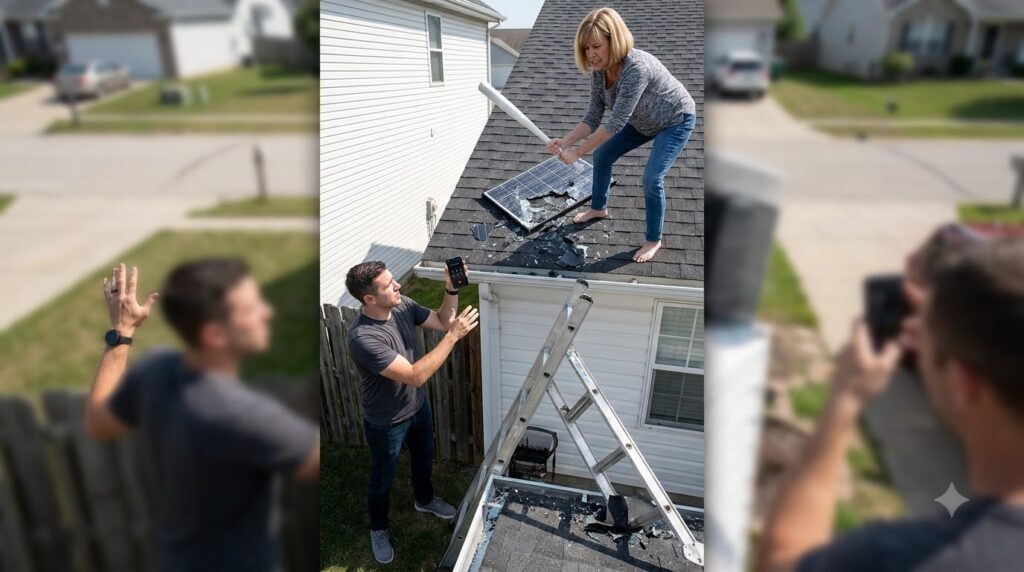
His eyes swept the scene in two seconds: the shattered glass glittering like salt on the dark shingles, the displaced extension ladder lying sideways in the weeds, and Brenda Holloway huddled beside the chimney, her white plastic bat wedged firmly in the aluminum gutter trough.
“Ma’am,” Kowalski called up, his voice gravelly and flat from twenty years of county calls. “I need you to stay exactly where you are. Don’t reach for that bat, and keep your hands visible.”
“Deputy, thank God,” Brenda stammered, her voice cracking as she leaned forward, her fingers digging into the hot asphalt. “He pulled the ladder! He trapped me up here! I was conducting an architectural assessment under board authorization, and he assaulted my access route!”
Kowalski didn’t look up at her again. He turned his head toward Marcus, taking in the clean charcoal T-shirt, the black wristwatch, and the calm, upright posture of a man who hadn’t raised his voice once.
“You the homeowner?” Kowalski asked.
“Marcus Vance. 1408 Elmridge,” Marcus said. He didn’t offer a handshake. He kept his hands at his sides, his right thumb hooked casually into his pocket near the folded carbon slip. “I pulled the ladder away from the siding after she struck the second panel with the bat. I dialed 911 immediately and stood here until your unit turned into the cul-de-sac.”
“Did you lay hands on her?”
“No,” Marcus said. “I moved the ladder five feet to the right and laid it flat on the grass. She has been in sole possession of the roof slope since two-fourteen PM.”
Kowalski glanced at the aluminum ladder lying in the turf. Then he looked up at the shattered glass panels. “Is that your property, ma’am?”
“It’s a violation of Section 4!” Brenda shouted, her voice rising into a sharp, hysterical register that echoed off the neighboring garage walls. “It’s an illegal structure! Tom Miller is at the clerk’s office right now getting the emergency injunction paperwork!”
“That’s a no,” Kowalski muttered under his breath. He reached down, unhooked his radio mic from his shoulder strap, and keyed the switch. “Dispatch, 204. I’m on scene at 1408 Elmridge. Requesting a second unit for traffic control and a code enforcement officer to document criminal property damage over fifteen hundred dollars.”
“Copy 204, second unit en route, ETA six minutes.”
Marcus took half a step toward the deputy, pointing toward the ground near the corner of his garage. “Deputy, before you set that ladder back up to bring her down, you need to look at the ground pin at the corner of the vinyl fence.”
Kowalski frowned, his bushy eyebrows knitting together as he looked at the base of the garage wall. “Why? What’s at the pin?”
“The boundary pin was driven four feet deep into the limestone in 1994,” Marcus said smoothly, his eyes shifting up to Brenda, whose face had gone completely gray under the harsh sunlight. “Tom Miller didn’t go to the clerk’s office to file an architectural amendment. He went there because Brenda’s late husband, Arthur Holloway, signed a boundary waiver thirty-two years ago that was never recorded on her deed. The HOA covenants don’t exist to protect neighborhood property values. They exist to hide the fact that her entire east wing sits on county land.”
Kowalski’s jaw set hard. He looked from Marcus down to the grass, then slowly up at Brenda.
“That’s a lie!” Brenda shrieked, scrambling two inches backward on the shingles, her soft-soled shoes kicking another shower of glass cubes down the slope. “Arthur built this house! Arthur was the board president! You can’t look at those records! You have no right to look at Arthur’s files!”
“I don’t need to look at Arthur’s files,” Marcus said, pulling the blue carbon slip out of his pocket and holding it up toward Kowalski. “The building department already rejected the lot in 1994. The forgery Miller tried to drop in the queue this morning wasn’t meant to stop my solar panels. It was meant to trigger a legal freeze so no inspector would ever walk this fence line with a transit.”
Kowalski took the blue carbon paper from Marcus’s fingers. He unfolded it slowly, his heavy eyes scanning the faded purple ink stamp from thirty-two years ago.
Across the street, two more front doors clicked open. Neighbors were stepping out onto their lawns—some carrying smartphones, others standing in silence with their hands on their hips, watching the neighborhood’s most feared rule-enforcer trapped on a sloped roof while a county deputy held the paper that unravelled her thirty-year reign.
Kowalski folded the blue paper, tucked it securely into his shirt pocket, and looked up at the roof with cold, unyielding authority.
“Ma’am,” Kowalski said, his voice dropping into a register that admitted no argument. “You’re going to sit right there until my backup arrives. And when you come down off that roof, you’re going into the back of my cruiser.”








