
CHAPTER 2: THE PAPER LAWSUIT
“Repeat your location, sir,” the dispatcher’s voice rasped through the smartphone speaker, thin and metallic against the wide, sun-drenched silence of the cul-de-sac.
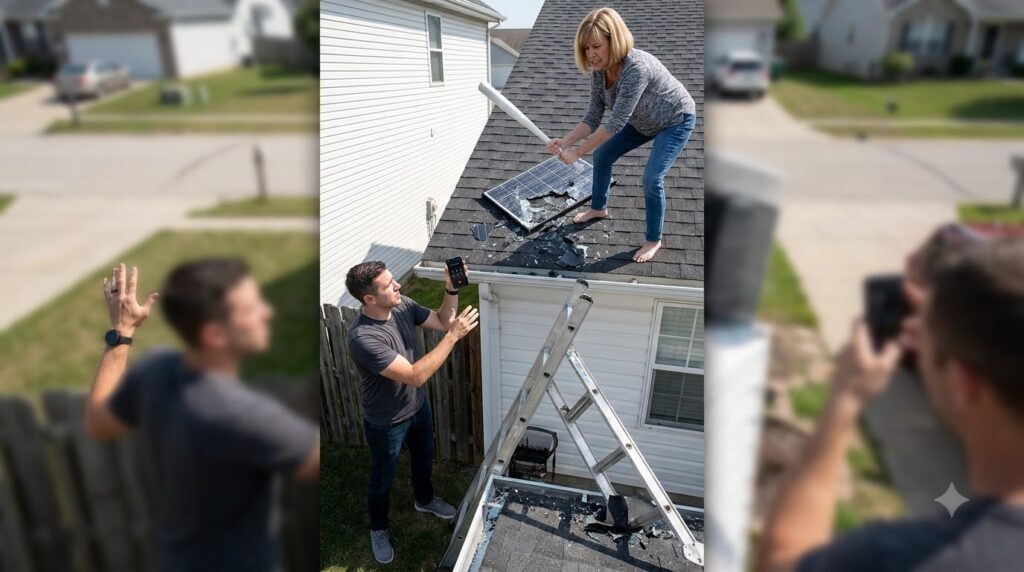
“1408 Elmridge Drive,” Marcus said, his voice flat, unhurried, anchored in the dirt. He didn’t take his eyes off Brenda. “White house, brick veneer front, dark trim. The suspect is on the roof slope above the garage. She’s wielding a plastic bat and has destroyed two solar modules.”
Above him, Brenda didn’t scream this time. The screaming was for when she had the upper hand, when a clip-board and a raised voice could force a tenant to pull a trash bin back from the curb three hours early. Now, stranded twelve feet up on thirty-degree asphalt shingles with dry glass crunching beneath her soft-soled shoes, her mouth worked without sound. She looked down at the aluminum ladder lying sideways in the dry Bermuda grass like a shed skin.
“Marcus,” she whispered, the edge in her tone fraying into something sharp and jagged. “Marcus, you put that up right now. You don’t know what you’re doing. You don’t know what this block was before we brought the covenants in.”
“Units dispatched,” the radio tone chirped from the phone. “Stay on the line if it is safe to do so.”
Marcus lowered the phone three inches, keeping the display lit, the red disconnect button resting under his thumb. He walked three steps toward his front porch, his sneakers kicking up fine gray dust from the edge of the expansion joint. Tucked into the gap between the white vinyl door frame and the deadbolt strike plate was a folded strip of yellow legal pad paper. It hadn’t been there when he left for the depot at seven this morning.
He pulled it free with two fingers. The paper was stiff, sun-baked, smelling faintly of old cedar and damp basement storage. Written in thick, black ballpoint ink that had bled through the cheap pulp were five words: REMOVE THEM OR THEY FALL. No signature. No HOA seal. No date.
He turned the yellow paper over. On the back, stamped in purple ink that had faded to the color of dried plum, was an old municipal recording mark: BOOK 402, PAGE 118 – COUNTY LAND RECORDS, 1994.
Brenda shifted on the roof. A cluster of glass granules skittered down the valley, pinging off the copper flashing before dropping onto the hood of his parked mower in the side yard. “That’s private correspondence, Vance! That was left for your landlord—”
“I own the parcel, Brenda,” Marcus said, folding the paper once, twice, until it was the size of a credit card. He slipped it into his breast pocket alongside his steel tire gauge. “Bought it outright from the bank receivership three years ago. The deed is warranty, clean title, no encumbrances except the primary utility easement along the rear fence line.”
“You think you bought a title,” Brenda hissed, her hands tightening around the black grip of the bat until her knuckles turned the color of lard. “You bought a file folder! You think because you sit in an air-conditioned room and look at spreadsheets all day that you own the ground under your boots? This subdivision was surveyed on a mistake, Vance! Every lot on the east side of Elmridge is six feet off the county benchmark!”
Marcus paused. The air between them tasted of dry dust, hot asphalt, and the sharp, ozone tang of cooked silicon from the ruptured solar cells baking under the two o’clock sun.
“The county surveyor marked the pins in April when the solar permit was pulled,” Marcus said, his voice dropping into the quiet register he used when a server rack went dark at midnight and every second cost five hundred dollars. “The pins are iron, driven four feet deep into the limestone base. Your fence is two feet inside my eastern boundary, Brenda. I let it sit because I don’t care about two feet of weed-choked clover. But if we’re measuring things by the inch today, we can start with the ladder.”
A dark sedan turned into the mouth of the cul-de-sac two hundred yards out—not a deputy’s cruiser, but a rusted white station wagon with a faded neighborhood watch decal slapped across the rear quarter panel. The driver slowed, tires grinding against the loose gravel near the storm drain, a arm resting on the door frame, watching.
Brenda saw the car. Her posture stiffened; the posture of a woman who had spent twenty years standing at the head of fold-out tables in the elementary school gymnasium, directing votes on lawn-height restrictions and exterior paint palettes.
“Tom!” she shouted toward the street, her voice cracking as she tried to project over the pitch of the roof. “Tom, call the board! Call Miller! Vance has locked me up here! He took the ladder!”
The station wagon didn’t accelerate. It idling at the curb, its muffler throbbing with a wet, uneven rhythm, its driver motionless behind the tinted glass.
Marcus didn’t turn around. He reached into his pocket, took out the yellow strip again, and unfolded it against his palm. The faded purple stamp from 1994 wasn’t an HOA mark. He recognized the font—old courier type from the county clerk’s old dot-matrix printer. BOOK 402, PAGE 118 was the old boundary adjustment register for the original homestead grant before the developer plowed the orchards under and laid down white vinyl and covenants.
Brenda wasn’t trying to save the neighborhood’s visual uniformity. She was trying to keep anyone from looking too closely at the dirt under the foundations.
“The deputies will be here in four minutes,” Marcus said, stepping back onto the grass, his shadow stretching long and thin toward the base of the wall. “You can come down when they set the ladder back up, or you can stay up there until the sun goes down. Either way, the report gets typed today.”








