
CHAPTER 4: THE PERMIT IN THE SHINGLES
The station wagon’s rear tires kicked up a spray of loose pea gravel that rattled against the vinyl gate behind Marcus. The red tail lights flickered once as Tom Miller reached the corner, took the turn without signaling, and vanished behind the tall cedar hedge at the mouth of Elmridge Drive.
Silence collapsed back over the driveway, heavy and stifling under the glare of the two o’clock sun.
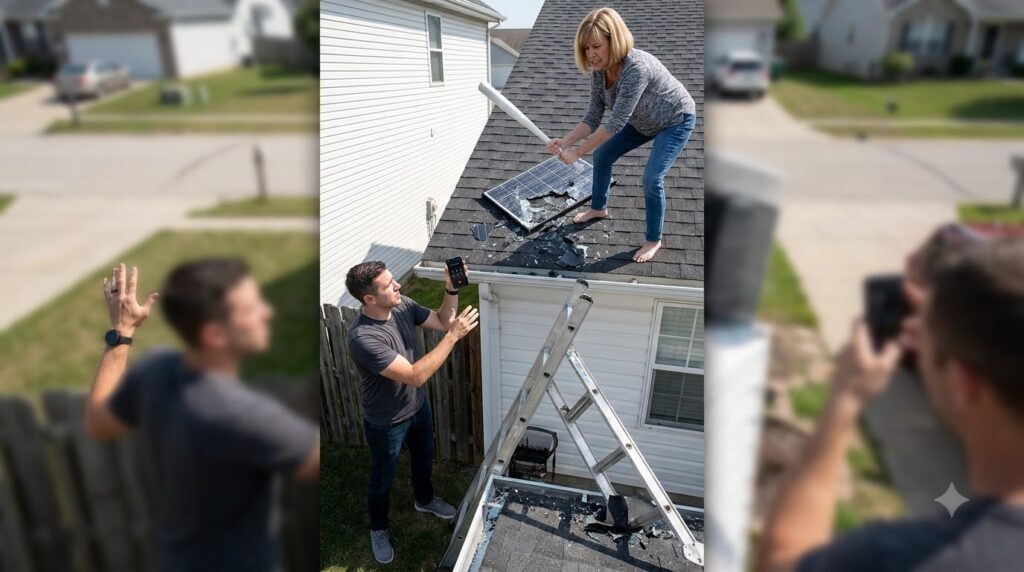
High above, Brenda lowered the white plastic bat until the black rubber tip rested against the dark asphalt shingles. Her knuckles, white and swollen from her tight grip, slowly flushed pink as blood returned to her fingers. Without Miller standing on the lawn to lend the weight of the board to her crusade, she looked smaller, her shoulder-length blonde bob disheveled, her gray patterned top damp with sweat across the shoulder blades.
“He’s going to the township office,” Brenda said, though the sharp, commanding edge in her voice had frayed into something thin, desperate, and defensive. She didn’t look down at Marcus; her eyes were fixed on the far end of the street where the siren’s warble grew louder, turning from a distant hum into a distinct, two-tone pulse. “Tom has the master key. He’s going to pull the original architectural file before your deputy even writes his name on the clipboard.”
Marcus didn’t answer. He stepped over the collapsed extension ladder resting in the Bermuda grass and stopped directly beneath the garage overhang. From this angle, he could see where the second strike of the plastic bat had sheared through the tempered glass casing of the lower solar module. The impact hadn’t just shattered the protective top layer; it had bent the anodized aluminum mounting rail, wrenching the lag bolt three-quarters of an inch out of the rafter beneath the decking.
Tucked into that newly opened gap—pushed under the lip of the third row of shingles right beside the bent mounting bracket—was a folded slip of blue carbon paper, yellowed at the edges and stiffened by decades of trapped attic heat.
Marcus reached up. His fingers grazed the hot aluminum frame of the panel, avoiding the sharp, glittering glass fragments, and pinched the edge of the blue paper.
“Don’t touch that!” Brenda gasped, taking a sudden, jerky step down the slope. Her soft-soled shoe skidded on a cluster of loose glass cubes, and she caught herself on the roof ridge with her free hand, the bat clattering noisily against the shingles before sliding three feet and wedging itself in the gutter trough. “That’s private board property, Vance! Leave it alone!”
Marcus pulled the paper free. It was an ancient, three-part municipal receipt slip, the kind used by the county building department before digitized land records replaced paper cabinets in the mid-nineties. The carbon ink had faded to a ghostly violet, but the block lettering stamped across the top line was still crisp enough to read under the harsh daylight: NOTICE OF BUILDING PERMIT REJECTION – LOT 14, BLOCK C.
Lot 14 was Brenda’s property. The house directly adjacent to his eastern fence line.
Marcus unfolded the receipt. The date at the bottom was June 12, 1994. Signed by the old township inspector whose signature appeared on every original deed on the block. The reason for rejection was circled twice in faded purple ink: STRUCTURE ENCROACHES ON UNRECORDED TOWNSHIP DRAINAGE EASEMENT. NO EXEMPTION GRANTED.
Marcus looked up from the blue paper to the woman perched on his roof.
Midway down the street, a white-and-gold county sheriff’s cruiser turned into the cul-de-sac, its overhead light bar flashing silent blue and red bursts against the bright white vinyl siding of the surrounding houses.
“This isn’t about my solar panels, Brenda,” Marcus said softly, his voice carrying clearly over the rumble of the approaching patrol car’s engine. “And it isn’t about the HOA architectural guidelines either.”
Brenda sat down hard on the pitch of the roof, her blue jeans smearing against the dark asphalt, her hands pulling her knees up to her chest as if the heat of the shingles no longer mattered. She didn’t look at the cruiser pulling into the driveway. She stared down at the blue carbon slip in Marcus’s hand.
“The board filed an architectural amendment thirty minutes ago,” Marcus continued, folding the carbon paper with precise, deliberate movements and placing it in his pocket alongside the yellow note. “You and Miller dropped a forged document into the clerk’s digital queue to create a paper trail. You wanted a legal dispute on record so the county inspector wouldn’t cross my property line to check the damage on these panels.”
The cruiser came to a stop ten feet behind Marcus’s sedan. The driver’s door opened, and a deputy stepped out onto the concrete, his hand resting casually over the leather retention strap of his sidearm as his eyes swept from the ladder lying in the grass up to the woman stranded near the chimney.
“Because if an inspector stands on my roof with a measuring tape,” Marcus said, keeping his eyes locked on Brenda, “he’s going to look down at your garage wall and realize your entire foundation sits three feet inside the township’s fire easement.”
Brenda didn’t yell. She didn’t offer a defense. She simply closed her eyes as the deputy cleared his throat and took his first step onto the lawn.








