CHAPTER 3: THE COLD ARCHIVE
The rusted white station wagon didn’t just idle. Its driver door swung open with a dry, ungreased groan that cut straight through the heat shimmer rising off the asphalt.
Tom Miller stepped out onto the gravel curb. He was a broad, stooped man in his late sixties, wearing an old canvas work vest smeared with dry joint compound and grease. He didn’t look up at the roof right away. He looked at Marcus’s hands, then down at the extension ladder lying flat in the grass beside the condenser unit.
“You ought to put that back up, Marcus,” Miller said. His voice had the dry, rasping drag of a heavy smoker. He slammed the car door shut behind him, the latch catching with a hollow thump. “You’re making this a police matter, and nobody on Elmridge wants patrol cars blocking the street on a Tuesday afternoon.”
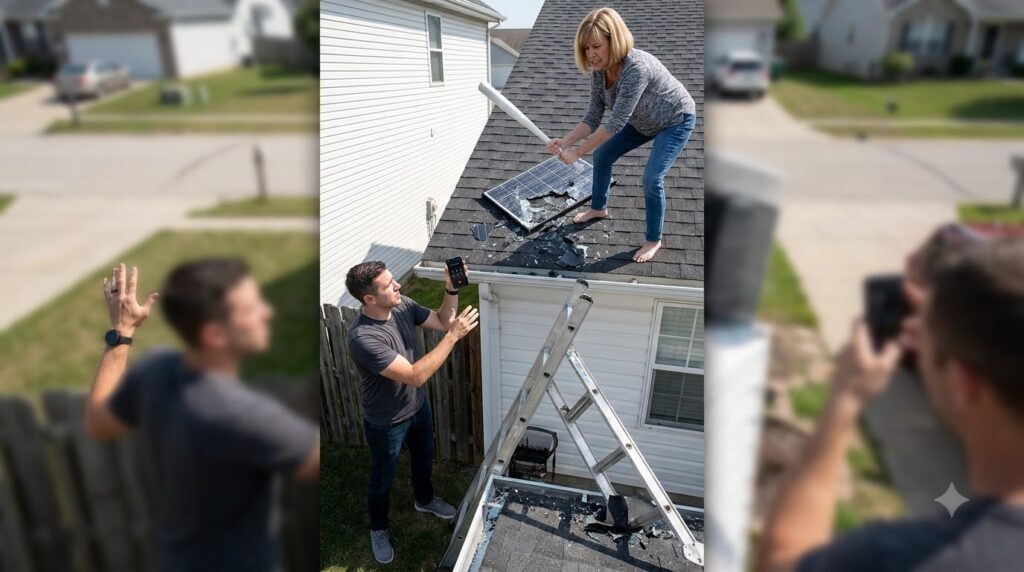
Marcus didn’t shift his stance. He kept his feet planted firmly near the corner of his garage, his thumb resting lightly against the edge of his phone casing. “She’s wielding a bat on my roof, Tom. She smashed two panels. That isn’t an HOA dispute—it’s felony destruction of property.”
“It’s a compliance action,” Brenda shouted down, her voice breaking into a harsh screech as she shifted her weight on the pitch. The white plastic bat trembled in her grip, its black rubber handle slick with sweat. “Tell him, Tom! Tell him what the board voted on at the executive session last Thursday!”
Miller reached into his vest pocket and pulled out a heavy ring of brass keys, flipping through them until his thumb settled on a wide, notched key stamped with crude, hand-punched block lettering: BOARD-REC-4.
Marcus’s eyes locked onto the metal tag. BOARD-REC-4 wasn’t a standard residential key. It belonged to the heavy steel filing cabinets housed in the annex behind the old township water office—the restricted repository where the subdivision’s original 1980s architectural filings and unrecorded covenants were stored under padlock.
“We filed the emergency architectural restriction this morning, Vance,” Miller said, taking two slow steps onto the grass. The turf groaned under his heavy boots. “Section 4, Paragraph B. Total ban on roof-mounted reflective glass arrays visible from the primary access road. It was submitted to the municipal clerk’s digital queue at eight-thirty AM. Retroactive clause included.”
“You can’t pass a retroactive covenant restriction without a ninety-percent quorum of deeded owners,” Marcus said, his voice dropping an octave into absolute, icy calm. “And you can’t file it electronically without a notarized affidavit from the county clerk. I checked the municipal queue before I left my desk at noon. Nothing was posted.”
“It’s in the queue,” Miller repeated, his jaw tightening as he gripped the key ring tighter. “It just hasn’t cleared the clerk’s index desk yet. The paperwork is valid, Vance. As far as the board is concerned, those panels are an illegal installation as of sunrise.”
A breeze swept down the cul-de-sac, carrying the acrid smell of hot asphalt and the faint, metallic tang of scorched silicon from the shattered solar cells above.
Marcus took a deliberate step toward Miller, closing the distance until barely three feet of dry grass separated them. Miller was taller, heavier, but Marcus stood with the centered, unyielding balance of a man who worked with iron beams and high-voltage conduit.
“Show me the affidavit,” Marcus said softly.
Miller didn’t flinch, but his thumb slipped off the brass key tag. “It’s filed.”
“Then why did Brenda bring a plastic bat instead of an injunction?” Marcus looked past Miller’s shoulder, up toward the roofline where Brenda stood frozen, her eyes darting frantically between the two men and the far end of the street. “You didn’t file an amendment, Tom. You dropped a forged draft into the clerk’s temporary holding inbox to buy yourselves forty-eight hours of leverage. You thought if you smashed the glass today, I’d take the insurance payout and cut my losses rather than spend six months in chancery court fighting a phantom rule.”
Up on the shingles, Brenda’s composure broke completely. “He’s not going to sign anything, Tom! Look at him! He’s calling the deputies! He doesn’t care about the board!”
“Shut up, Brenda,” Miller muttered under his breath, his eyes fixed on Marcus’s face.
Marcus reached into his breast pocket, pulled out the folded strip of yellow paper with the faded 1994 county stamp, and held it out between two fingers. He didn’t offer to hand it over; he simply held it in the harsh daylight where the faded purple ink was fully legible.
“Book 402, Page 118,” Marcus said smoothly. “This isn’t a covenant paper, Miller. It’s a land survey exception filed thirty-two years ago when the developer paved over the old drainage creek. You didn’t try to stop these panels because of architectural aesthetics or property values. You’re terrified of what the municipal inspector sees when he climbs up on my roof with a laser transit.”
Miller’s expression didn’t change, but his breathing shallowly shifted, his chest rising and falling against the heavy canvas of his vest. He didn’t look at the yellow paper. He looked at the phone in Marcus’s hand.
Far down the avenue, past the line of manicured lawns and matching vinyl fences, a faint, warbling siren cut through the midday heat.
Marcus didn’t smile. He took half a step back, maintaining his perimeter, keeping the extension ladder squarely behind his heels. “That’s the county unit turning off the highway. You have about ninety seconds to decide if you’re standing on my grass as a witness, or as an accomplice to felony vandalism.”
Miller stared at Marcus for three agonizing seconds, his fingers twitching against his key ring. Then, without saying another word to Brenda or looking back at the roof, he turned on his heel, walked back to the station wagon, and pulled himself into the driver’s seat.
“Tom!” Brenda screamed from the shingles, her voice cracking into a high, panicking wail. “Tom, don’t you leave me up here! Tom!”
The station wagon’s engine roared to life, exhaust coughing a pale blue cloud into the humid air as Miller threw the car into reverse and backed out into the middle of the street.