
The Measured Line Between Steel, Stone, and Unyielding Suburban Authority

CHAPTER 1: THE TASTE OF DRY MORTAR

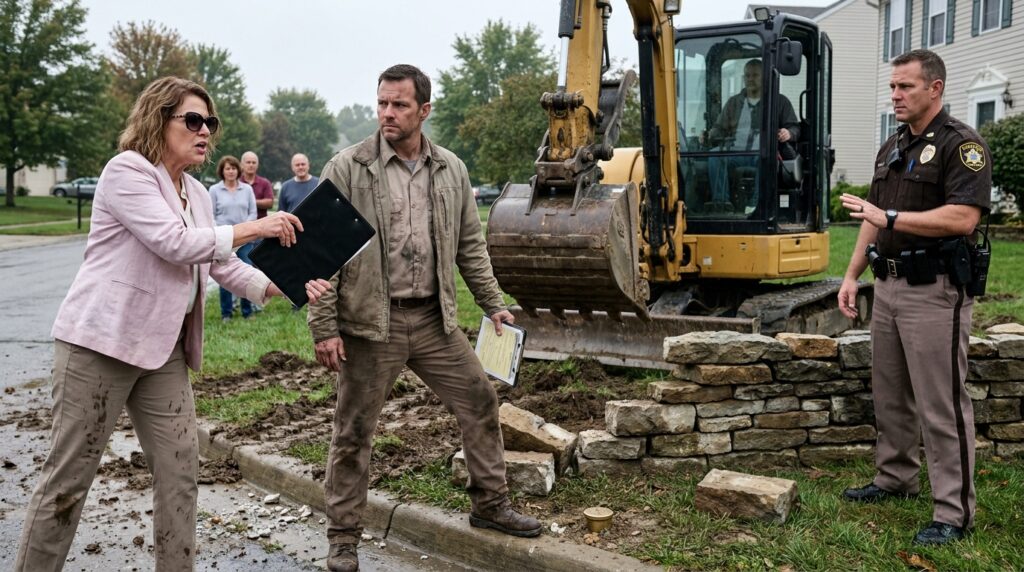
The diesel engine of the CAT 305 mini-excavator didn’t idle so much as rattle the morning air, vibrating the cold coffee in Marcus Delaney’s mug where he stood on his front porch. Steel teeth swung three feet over the dew-damp turf of Cedar Ridge Way, hovering directly above the sixty-year-old hand-stacked fieldstone wall he had spent three months rebuilding with dry-mortar compound. Along the curb, three neighbors held thermal travel cups, watching the arm drop.

Marcus set the mug on the cedar railing. He didn’t run. He didn’t raise his voice across the forty feet of wet grass. He adjusted the laminated manila folder tucked beneath his left arm, his thumb tracing the smooth, heavy plastic seal of the county land registry office.

“Bucket stays up, Gary,” Marcus said as he reached the edge of the tread path. His voice was low, flat, carrying the gravelly density of a man who spent ten hours a day directing steel framing crews on commercial pads.

The operator—a kid no older than twenty-four wearing a mud-splattered high-vis vest—flinched, his hand freezing on the right hydraulic joystick. The excavator’s arm twitched, diesel exhaust burping a blue plume into the autumn mist.

“Don’t you dare stop that machine!”

Brenda Caldwell stepped off the sidewalk, her heels sinking half an inch into the soft loam of the shoulder. Her pastel linen blazer was pristine, a stark contrast to the grease-stained steel behind her. In her right hand, she gripped a black leather clipboard like an officer’s baton, her silver pen clicking in rapid, neurotic quarter-inch bursts.

“Mr. Delaney,” Brenda said, turning her oversized sunglasses toward him. The reflection of the idling excavator glinted in the dark lenses. “Section 4.2 of the Silver Oak Estates covenant grants the board emergency clearing authority for common-area infrastructure. This trail loop was approved by the executive committee three weeks ago.”

Marcus didn’t look at her. He kept his eyes on the operator inside the cab. “You’re three feet over the line, Gary. Turn it off.”

“He takes his direction from the association, Marcus!” Brenda stepped directly between Marcus and the machine’s steel tracks, thrusting the clipboard within four inches of his chest. “You drive a work truck. You haul gravel. You do not dictate municipal easements to this board. We have a certified contractor here to clear the blighted wall, and every minute you delay this crew will be billed to your property deed as an administrative lien.”

Marcus stood still. The morning air smelled of crushed limestone, raw diesel, and wet earth. He could feel the vibration of the machine through the soles of his steel-toe boots—a steady, rhythmic pulse that meant metal was preparing to tear through stone.

Slowly, without breaking eye contact with the operator, Marcus reached into his jacket pocket. He pulled out a laminated eight-by-ten photograph and pressed it flat against the cab’s side window.

The image showed the rear bumper of Brenda’s silver Lexus backed into the tree line at dusk two nights prior, a pair of heavy-duty iron pry-bars leaning against the rear tire next to three pulled fiberglass survey stakes.

Inside the cab, the operator looked at the photograph, then looked down at the bright yellow fiberglass stake lying snapped in two beneath his left tread. The kid’s hand left the joystick entirely. He pulled his headset down around his neck.

“What is that?” Brenda demanded, her pen clicking faster. “That is an invasive privacy violation. I am the Vice President of this—”

“That’s a time-stamped exhibit for Sergeant Rivera,” Marcus said softly, his fingers tightening on the laminated manila folder. “He’s pulling up behind your Lexus right now.”

A white-and-black county sheriff cruiser turned the corner onto Cedar Ridge Way, its tires crunching quietly over the loose gravel near the mailbox.


CHAPTER 2: BRASS IN THE FROZEN DIRT

“Step back from the excavator, Mrs. Caldwell.”

Sergeant Tomas Rivera didn’t raise his voice, but the sound of his door latch catching against the frame carried a distinct, metallic weight across the driveway. He swung his boots out onto the loose limestone, his uniform crisp despite the humidity, his hand resting casually—not aggressively, but anchored—on his duty belt right above the taser holster.

Brenda didn’t retreat. She adjusted the leather clipboard against her linen blazer, her silver pen clicking three times in rapid succession. “Sergeant, I called the sheriff’s department forty-five minutes ago regarding an unauthorized obstruction on subdivision property. Mr. Delaney has placed illegal physical hazards on a dedicated community easement.”

“I have the county tax map right here, Tomas,” Marcus said, stepping around the CAT 305’s rubber tracks. He didn’t offer a hand. He didn’t need to posturingly offer one; he and Rivera had known each other since the county culvert rebuild on Route 9 six years back. Marcus held out the manila folder, its laminated edge dull with chalky concrete dust from his thumb.

Rivera accepted the folder, unspooling the heavy rubber band binding the top. “Morning, Marcus. Thought you were framing the medical center down in Marion this week.”

“Poured the slab yesterday,” Marcus replied, his voice raspy from the diesel fumes lingering in the cool morning air. “Came home to find three of my survey pins pulled and thrown in the ditch. So I brought out a certified team yesterday afternoon.”

Brenda let out a short, dry laugh—a sound like dry leaves scraping across asphalt. “An independent contractor hired by a homeowner does not override the Silver Oak Estates Master Association Charter, Deputy. Section 4.2 explicitly permits the board to clear unpermitted retaining structures for municipal drainage and foot traffic integration.” She reached into her blazer pocket and pulled out a folded white sheet bearing a faint red county seal. “This is a temporary municipal drainage exemption, issued by the county clerk’s office three weeks ago. The stone wall is legally classified as an unmapped obstruction.”

Marcus narrowed his eyes, staring at the paper. The emblem at the top was slightly offset—the red ink bleeding faintly into the fiber, the signature line sharp, clean, yet oddly thin. A tiny knot tightened in the pit of his stomach. He knew county permits; he spent half his life pulling them at the zoning desk in town. Exemption filings didn’t come on heavy linen stock, and they never bore the clerk’s red impression stamp without a formal engineering signature on the margin. But on its face, to an officer standing on a wet shoulder at seven in the morning, the document looked administrative. It looked legal.

Rivera took the folded paper from Brenda, holding it beside Marcus’s boundary plat. “Drainage exemption?” Rivera murmured, his brow furrowing as he scanned the paragraph. “This notes a culvert modification allowance.”

“Precisely,” Brenda said, her posture stiffening with triumphant precision. “Which means the HOA is fully within its rights to remove those fieldstones today. If Mr. Delaney interferes with contracted equipment under a municipal exemption, he is obstructing public works.”

The young equipment operator inside the cab looked between Rivera and the paper, his hands hovering uncertainly above the hydraulic controls. The machine’s engine gave a low, resonant rumble, shaking loose bits of dried clay from the bucket teeth onto the stone wall below.

Marcus felt the grit of dried mortar under his fingernails as he clenched his fist inside his jacket pocket. The law was supposed to be a straight line—measured in inches, stamped in brass, fixed in stone. Yet here was a piece of paper, typed up in some air-conditioned office, turning his private property into an open target for a heavy diesel bucket.

“Look at the ground, Tomas,” Marcus said quietly. He walked past Brenda, ignoring the sharp intake of her breath as his shoulder brushed hers. He stopped at the corner of the stone wall where the fieldstones met the ditch line.

He dropped to one knee on the damp turf, unmindful of the wet mud soaking through his Snickers work pants. With two calloused fingers, he scraped away three inches of loose black loam and dead pine needles until his knuckles hit something hard, cold, and solid.

He wiped the dirt clear. Embedded in a four-inch concrete footing was a heavy brass disk, three inches in diameter, its stamped registry numbers gleaming dull gold in the grey autumn light.

“State Survey Monument 402-B,” Marcus said, his voice flat, unyielding. “Driven three feet deep into bedrock by Miller & Associates yesterday at three o’clock. County record number 8849. You see that stamped star in the center, Tomas?”

Rivera walked over, crouching beside Marcus. He reached down, his thumb running over the crisp, unweathered engraving in the brass.

“The line runs from this brass cap straight to the oak tree on the north corner,” Marcus continued, pointing a dirt-stained finger down the fence line. “This wall sits eighteen inches inside my property boundary. That exemption paper she’s holding? It cites a culvert sixty feet down the road. If that bucket touches one more stone, it isn’t an HOA clearance, Brenda. It’s felony destruction of private real property over five thousand dollars.”

Rivera stood up slowly, wiping his thumb on his pant leg. He turned to Brenda, his expression darkening as he looked from the brass monument back to the paper in his hand.

“Mrs. Caldwell,” Rivera said, his voice dropping into an official tone that made the three neighbors on the curb lean in closer. “Where did you get this exemption document?”

Brenda’s jaw tightened, her silver pen finally stopping its neurotic click. “It was processed through the board’s legal liaison. It is an official municipal filing.”

“Then we’re going to wait right here while I call the clerk to verify the file number,” Rivera said, reaching for the radio microphone clipped to his shoulder.

Behind them, near the open door of the surveyor’s truck parked further up the gravel shoulder, Marcus noticed an unopened white county clerk envelope tucked loosely inside the surveyor’s leather transit bag sitting on the tailgate—a second document he hadn’t yet unsealed from yesterday’s filing.

CHAPTER 3: THE RUST ON THE PERMIT

“Dispatch, this is Unit Four. I need a verification on a county drainage exemption permit, document number 402-Delta-Nine.”

Sergeant Rivera’s radio mic clicked off, leaving a hollow hiss of static hanging between the idling excavator and the shoulder of Cedar Ridge Way. Beside him, Brenda Caldwell didn’t flinch. Her heels stayed planted in the damp loam, though the silver pen in her right hand clicked once, sharp and dry, against the leather frame of her clipboard.

“You’re wasting county resources, Sergeant,” Brenda said, her voice dropping into a smooth, practiced register that carried effortlessly to the three neighbors standing by the mailbox across the asphalt. “Section 4.2 was enacted by the board during the spring budget review. The municipal drainage exemption was granted specifically because the retention capacity of this ditch line affects the entire lower quadrant of Silver Oak Estates.”

Marcus didn’t answer her. He walked past the idling tracks of the CAT 305 toward the surveyor’s pickup truck parked thirty feet up the shoulder. The air smelled of burnt hydraulic fluid and wet limestone, a sharp, bitter tang that coated the back of his throat.

His boots crunched over the loose stone as he reached the tailgate. The surveyor’s heavy leather transit bag sat open against the bed liner, its brass buckles tarnished green from damp mornings in the field. Tucked into the side pocket, half-obscured by a roll of surveyor’s orange flagging tape, was the unopened white envelope from the county clerk’s office.

Marcus reached out, his calloused fingers catching the crisp paper edge. The envelope was heavy, stiff with the weight of official cardstock, sealed with a formal strip of moisture-activated glue. He didn’t tear it open immediately. He turned it over in his palm, his thumb running across the red ink stamp on the back corner: COUNTY ZONING & DRAINAGE ADMINISTRATION — RECORD DIVISION.

Behind him, the radio on Rivera’s shoulder crackled to life.

“Unit Four, be advised. File number 402-Delta-Nine is active in the county database. Record shows a temporary municipal drainage exemption issued to Silver Oak Estates Homeowners Association under Section 4.2.”

Brenda let out a small, satisfied breath, adjusting her sunglasses with her thumb. “As I stated. The exemption is legally binding.” She turned to the young operator in the cab. “Gary, lower the bucket. Resume clearing the fieldstone.”

“Hold the machine, Gary!” Marcus’s voice cut across the engine rattle like a steel cable snapping under tension.

He marched back to the edge of the excavation site, holding the white envelope in one hand while his other finger slammed down onto the sheet Brenda had handed to Rivera.

“Look at the file number, Tomas,” Marcus said, stepping into Rivera’s line of sight. “Read the full designation line.”

Rivera squinted at the folded paper in his hand, then at his shoulder mic. “Dispatch, confirm the full record header for 402-Delta-Nine.”

“Unit Four,” the dispatcher’s voice returned, flat and mechanical over the speaker. “Record header reads: Silver Oak Estates Phase Two Culvert Modification and Drainage Exemption, Municipal Drainage Basin Four.”

Marcus reached over, pulling the top edge of Brenda’s paper down so the sunlight hit the surface at an angle. Under the harsh morning glare, the subtle texture difference was obvious. The main body of the text was typed in crisp black toner, but the words Section 4.2 — Retaining Structure Removal were printed in a slightly different pitch, the ink setting flat on the surface rather than fusing into the cotton fibers of the paper.

“It’s an exemption, alright,” Marcus said, his voice dropping into a cold, steady rumble. “It’s a real county document. But it isn’t for my property line. Section 4.2 in the county record belongs to the retention pond on the south end of Phase Two. Someone took an official municipal drainage exemption for a culvert modification half a mile away, scanned the header, and grafted the words ‘retaining wall removal’ over the original parcel number.”

A sudden, sharp silence fell over the lawn edge. The neighbors on the curb stopped whispering. The excavator operator’s hand slid entirely off the joystick, his eyes shifting from Brenda’s face to the deputy’s badge.

Brenda’s jaw tightened, the color draining from her cheeks until the skin around her lips turned a pale, waxy yellow. “That is an absurd, ungrounded accusation. The board’s legal liaison provided that document directly from the county archives—”

“I have the unedited certified copy right here,” Marcus interrupted, tearing open the white envelope in his hand with a single, fluid jerk of his thumb.

He pulled out the sealed transcript from the county land registry office—four pages of heavy, watermarked paper stamped with an embossed state seal that caught the grey light. He held page two directly in front of Rivera’s face.

“County Record 402-Delta-Nine,” Marcus read, his voice cutting through the damp air. “Approved March 14th for municipal culvert clearance at Parcel 112, Phase Two retention basin. Explicitly forbids the alteration of private retaining walls, fieldstone boundaries, or structural masonry without individual owner consent under Penalty of State Civil Code 882.”

Rivera took the certified transcript. He spent ten seconds comparing the embossed seal on Marcus’s paper with the flat red ink on the sheet Brenda had handed him.

The physical reality was absolute. The decoy had collapsed under the weight of certified steel-stamped truth.

Rivera folded Brenda’s paper, sliding it into his chest pocket. Then he turned his body fully toward the HOA Vice President, his stance shifting into an unmistakable law enforcement posture.

“Mrs. Caldwell,” Rivera said, his hand resting firm against his duty belt. “I need you to step away from the equipment and step onto the public shoulder. Right now.”

Brenda’s fingers dug into the leather backing of her clipboard so hard the knuckles turned white. “Sergeant, you are making a grave procedural error. This entire trail project was authorized by the executive committee to correct a fourteen-thousand-dollar allocation from the community fund—”

She cut herself off abruptly, her eyes widening as the words escaped her mouth before her mind could catch them.

Marcus froze, his thumb still resting on the edge of his certified survey map. He looked at Brenda’s trembling hands, then at the glossy rendering of the proposed walking trail pinned to the top of her clipboard. The decoy exemption had fallen apart, but the real reason she was pushing heavy machinery onto his land at seven in the morning wasn’t about a simple neighborhood trail loop at all.

CHAPTER 4: THE THRESHOLD STANDOFF

“Fourteen thousand dollars,” Marcus repeated, his voice dropping into a register as flat and hard as a granite slab. He stepped forward, closing the six feet of wet turf between them until his shadow fell across the leather frame of her clipboard. “You didn’t forge a county permit to build a scenic walking path, Brenda. You forged it because the trail fund is missing fourteen grand.”

Brenda’s chest heaved once, a sharp, ragged intake of cold air. Her mouth opened, but no rehearsed corporate jargon came out. The silver pen slipped from her stiff fingers, dropping into the mud beside the CAT 305’s tracks with a soft, wet splash.

“That is a private board accounting matter,” she gasped, her voice thinning as she took a awkward step backward onto the asphalt shoulder. Her heels clicked unevenly against the loose limestone. “It has no bearing on this physical boundary.”

“It has every bearing on why you brought a heavy excavation rig onto my land at seven in the morning without a county permit,” Marcus said. He didn’t raise his hands. He didn’t reach for her. He simply stood on the exact edge of his property line, his steel-toe boots braced against the turf three inches behind the brass survey cap. “You needed the stone wall knocked down today. You needed dirt moving so the project would look active before the annual audit next week.”

Sergeant Rivera took two slow steps closer, his hand resting uncomfortably near his duty belt as his eyes shifted between Brenda’s pale face and the laminated rendering pinned to her board. “Mrs. Caldwell. What fourteen thousand dollars are you referring to?”

“It’s an internal reallocation!” Brenda snapped, her voice cracking as the composure she had maintained for six years as HOA Vice President crumbled into raw, defensive panic. She gestured wildly toward the three neighbors hovering near the mailbox across the street. “The board approved a preliminary site assessment! We had soft costs—surveying, soil samples, preliminary legal reviews—”

“Soft costs don’t require forged municipal drainage exemptions from the county clerk,” Marcus countered, his eyes locked on her face. “And they don’t require pulling three certified survey pins out of my driveway at dusk.”

Behind them, the landscape crew operator pulled his high-vis vest over his head, tossing it onto the hood of the excavator. He stepped down from the iron mounting plate, his boots hitting the mud with a heavy thud.

“We’re done here,” the operator told Rivera, raising both hands palms-out. “We were hired for an authorized HOA clearing with valid county permits. That’s what the work order said. I’m not putting steel on private dirt or getting dragged into a county fraud investigation.”

“You can’t walk off this job!” Brenda shouted, turning on the kid. Her pastel blazer was spotted with grey mud from the excavator’s tracks, the pristine crease of her trousers ruined by the wet grass. “You signed a vendor contract with Silver Oak Estates!”

“Contract’s void if the site authority is fraudulent, lady,” the kid spat back, unhooking his keys from his belt. “I’m loading the rig on the trailer. And you’re getting billed for the full transport haul.”

Marcus watched the kid walk toward the transport flatbed parked up the road. The machine engine died with a coughing sputter, leaving the street in a sudden, heavy silence punctuated only by the drip of rainwater from the oak leaves overhead.

Rivera stepped directly into Brenda’s line of sight, pulling a small black notepad from his tactical vest. “Mrs. Caldwell, I am halting all work on this parcel immediately. Furthermore, based on the altered county permit you presented to an officer, I am opening an official incident report for criminal trespass and utility record falsification.”

Brenda’s eyes darted past Rivera, looking toward the neighborhood road as if expecting the rest of the board to appear and back her up. But the sidewalk remained silent. The three neighbors on the curb didn’t step forward to defend her; instead, two of them raised their phones, recording the scene as Rivera unclipped his silver pen.

“I am the Vice President of this association,” Brenda whispered, though the words lacked their former weight. They sounded small, hollow, lost in the wide grey air of the subdivision.

“And this is private land,” Marcus said, pointing down at the gleaming brass disk set in the concrete beneath his boot. “The state of Ohio registered this line sixty years ago. My deed pays the taxes on every square inch of fieldstone sitting on this side of the mark.”

Brenda turned on her heel, her purse strap slipping down her shoulder as she stumbled over the edge of the curb toward her silver Lexus. Her car door slammed shut with a hollow, tinny sound that vibrated across the quiet street.

Rivera watched her vehicle idle for a moment before turning back to Marcus. “She’s going to claim the board authorized every dollar, Marcus. If that paper she gave me was altered, she didn’t do it alone.”

Marcus looked down at the clipped pages still resting in his own folder. On the back of the trail proposal sheet Brenda had dropped during the argument, half-hidden beneath a smudge of dark loam, was a penciled four-digit bank tracking code—a routing marker for a private commercial account, not the association’s public credit union line.

“She did it alone,” Marcus said, his eyes narrowing as he read the penciled numbers. “And the board doesn’t even know the money’s gone yet.”

Rivera unhooked his radio. “Stay on your porch, Marcus. I’m calling the county prosecutor’s office from my car.”

CHAPTER 5: THE FINAL BOUNDARY

“Mrs. Caldwell. Turn off the ignition.”

Sergeant Rivera’s voice didn’t carry anger, but it possessed the iron weight of six years on county patrol. He stepped off the curb, his boots crunching over the loose gravel near the rear tire of Brenda’s silver Lexus. The driver’s side window rolled down two inches, revealing her pale, rigid profile against the leather interior.

“I am leaving, Deputy,” Brenda said, her voice tight, strained to the breaking point. “I have a meeting at the management office.”

“You’re going to receive a summons first,” Rivera said, drawing a yellow citation book from his tactical vest. He rested his forearm against the roof of her vehicle, blocking the pillar. “Under Ohio Revised Code 2909.07, criminal mischief involving real property markers and unauthorized alteration of municipal zoning documents. You’re also being cited under Section 4511 for operating unauthorized heavy equipment across a private driveway threshold.”

Brenda’s hands trembled against the steering wheel. Across the street, the three neighbors had stepped fully onto the pavement, their phone cameras steady, recording every line written on the yellow duplicate carbon sheet.

Marcus didn’t watch her sign the paper. He turned his back on the silver Lexus and walked down the gentle slope of his front lawn to the corner of the fieldstone wall.

The heavy steel bucket of the CAT 305 had struck the top tier before Gary shut the engine down, dislodging three hand-stacked limestone blocks. They lay in the damp clover, raw grey faces exposed where the dry-mortar compound had sheared clean under the sudden impact.

Marcus crouched beside the stone. He picked up the largest block—a forty-pound slab of native Ohio limestone he had hauled out of the creek bed two summers ago. The stone was cold, wet, smelling of deep earth and mineral grit. He ran his thumb across the rough edge where the fresh fracture showed the white crystalline core of the rock.

Behind him, the heavy diesel engine of the transport flatbed roared to life as the landscape crew loaded the excavator onto the steel ramps. Steel chains clanked against the bed, binding the machine down, locking it fast for the haul back to the commercial yard.

“Marcus.”

Rivera walked over, the yellow carbon copy of the citation tucked into his clip folder. He stopped at the edge of the turf, his boots inches from the brass monument cap set in the concrete footing.

“County prosecutor’s office took the report,” Rivera said, watching the silver Lexus pull away from the curb, its tires kicking up a small spray of wet gravel before disappearing down Cedar Ridge Way. “Detective Miller’s opening a file on the board’s commercial bank account this afternoon. Based on that four-digit routing code on the back of her proposal sheet, the county auditor’s going to freeze the trail fund before five o’clock.”

“It was never about a trail,” Marcus murmured, setting the heavy limestone block back onto the fieldstone foundation. He fitted the jagged break against the dry mortar until the stone seated itself with a solid, unyielding thud. “It was about making enough noise on this corner so nobody looked at the ledger until the fiscal year closed.”

“She thought because you drove a work truck, you wouldn’t know how to pull a county deed,” Rivera said, a faint, dry smile touching the corner of his mouth.

“People who live on clipboards always think the people who work with their hands don’t know how to read the blueprint,” Marcus replied. He stood up, wiping his mud-stained palms on the sides of his utility pants.

He looked down at the brass disk embedded in the earth. The stamped numbers—State Survey Monument 402-B, County Record 8849—gleamed sharp and clear against the wet loam. No amount of HOA rhetoric, forged red ink, or diesel-powered muscle could move that disk an eighth of an inch. It was fixed to the bedrock of the county.

Across the street, the neighbors slowly turned and walked back toward their front porches, their thermal mugs cold in their hands, their quiet morning restored. The street was still again, filled only with the soft drip of rainwater falling from the wet cedar boughs onto the grass.

Marcus walked back to his porch railing, picked up his lukewarm mug of coffee, and took a slow sip. He looked out over the sixty-foot line of fieldstone separating his land from the subdivision road.

Tomorrow morning, he would mix a fresh batch of lime mortar, set the three displaced stones back into the top course, and strike the joints clean with a steel trowel. The boundary was marked. The survey was sealed. And the land belonged, inch for inch, to the man who built the wall.

Similar Posts

Leave a Reply

Your email address will not be published. Required fields are marked *






