
CHAPTER 3: THE RUST ON THE PERMIT
“Dispatch, this is Unit Four. I need a verification on a county drainage exemption permit, document number 402-Delta-Nine.”
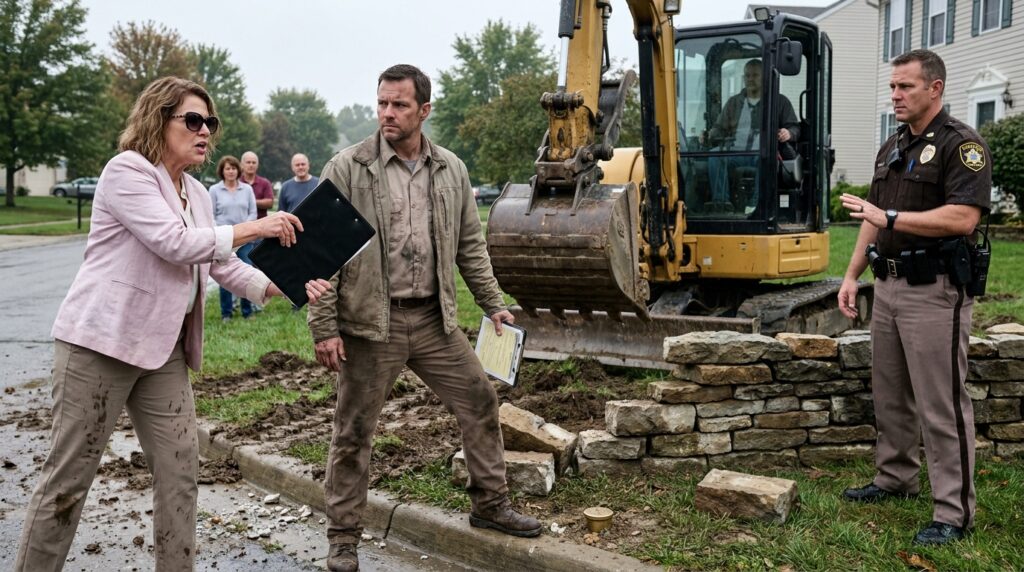
Sergeant Rivera’s radio mic clicked off, leaving a hollow hiss of static hanging between the idling excavator and the shoulder of Cedar Ridge Way. Beside him, Brenda Caldwell didn’t flinch. Her heels stayed planted in the damp loam, though the silver pen in her right hand clicked once, sharp and dry, against the leather frame of her clipboard.
“You’re wasting county resources, Sergeant,” Brenda said, her voice dropping into a smooth, practiced register that carried effortlessly to the three neighbors standing by the mailbox across the asphalt. “Section 4.2 was enacted by the board during the spring budget review. The municipal drainage exemption was granted specifically because the retention capacity of this ditch line affects the entire lower quadrant of Silver Oak Estates.”
Marcus didn’t answer her. He walked past the idling tracks of the CAT 305 toward the surveyor’s pickup truck parked thirty feet up the shoulder. The air smelled of burnt hydraulic fluid and wet limestone, a sharp, bitter tang that coated the back of his throat.
His boots crunched over the loose stone as he reached the tailgate. The surveyor’s heavy leather transit bag sat open against the bed liner, its brass buckles tarnished green from damp mornings in the field. Tucked into the side pocket, half-obscured by a roll of surveyor’s orange flagging tape, was the unopened white envelope from the county clerk’s office.
Marcus reached out, his calloused fingers catching the crisp paper edge. The envelope was heavy, stiff with the weight of official cardstock, sealed with a formal strip of moisture-activated glue. He didn’t tear it open immediately. He turned it over in his palm, his thumb running across the red ink stamp on the back corner: COUNTY ZONING & DRAINAGE ADMINISTRATION — RECORD DIVISION.
Behind him, the radio on Rivera’s shoulder crackled to life.
“Unit Four, be advised. File number 402-Delta-Nine is active in the county database. Record shows a temporary municipal drainage exemption issued to Silver Oak Estates Homeowners Association under Section 4.2.”
Brenda let out a small, satisfied breath, adjusting her sunglasses with her thumb. “As I stated. The exemption is legally binding.” She turned to the young operator in the cab. “Gary, lower the bucket. Resume clearing the fieldstone.”
“Hold the machine, Gary!” Marcus’s voice cut across the engine rattle like a steel cable snapping under tension.
He marched back to the edge of the excavation site, holding the white envelope in one hand while his other finger slammed down onto the sheet Brenda had handed to Rivera.
“Look at the file number, Tomas,” Marcus said, stepping into Rivera’s line of sight. “Read the full designation line.”
Rivera squinted at the folded paper in his hand, then at his shoulder mic. “Dispatch, confirm the full record header for 402-Delta-Nine.”
“Unit Four,” the dispatcher’s voice returned, flat and mechanical over the speaker. “Record header reads: Silver Oak Estates Phase Two Culvert Modification and Drainage Exemption, Municipal Drainage Basin Four.”
Marcus reached over, pulling the top edge of Brenda’s paper down so the sunlight hit the surface at an angle. Under the harsh morning glare, the subtle texture difference was obvious. The main body of the text was typed in crisp black toner, but the words Section 4.2 — Retaining Structure Removal were printed in a slightly different pitch, the ink setting flat on the surface rather than fusing into the cotton fibers of the paper.
“It’s an exemption, alright,” Marcus said, his voice dropping into a cold, steady rumble. “It’s a real county document. But it isn’t for my property line. Section 4.2 in the county record belongs to the retention pond on the south end of Phase Two. Someone took an official municipal drainage exemption for a culvert modification half a mile away, scanned the header, and grafted the words ‘retaining wall removal’ over the original parcel number.”
A sudden, sharp silence fell over the lawn edge. The neighbors on the curb stopped whispering. The excavator operator’s hand slid entirely off the joystick, his eyes shifting from Brenda’s face to the deputy’s badge.
Brenda’s jaw tightened, the color draining from her cheeks until the skin around her lips turned a pale, waxy yellow. “That is an absurd, ungrounded accusation. The board’s legal liaison provided that document directly from the county archives—”
“I have the unedited certified copy right here,” Marcus interrupted, tearing open the white envelope in his hand with a single, fluid jerk of his thumb.
He pulled out the sealed transcript from the county land registry office—four pages of heavy, watermarked paper stamped with an embossed state seal that caught the grey light. He held page two directly in front of Rivera’s face.
“County Record 402-Delta-Nine,” Marcus read, his voice cutting through the damp air. “Approved March 14th for municipal culvert clearance at Parcel 112, Phase Two retention basin. Explicitly forbids the alteration of private retaining walls, fieldstone boundaries, or structural masonry without individual owner consent under Penalty of State Civil Code 882.”
Rivera took the certified transcript. He spent ten seconds comparing the embossed seal on Marcus’s paper with the flat red ink on the sheet Brenda had handed him.
The physical reality was absolute. The decoy had collapsed under the weight of certified steel-stamped truth.
Rivera folded Brenda’s paper, sliding it into his chest pocket. Then he turned his body fully toward the HOA Vice President, his stance shifting into an unmistakable law enforcement posture.
“Mrs. Caldwell,” Rivera said, his hand resting firm against his duty belt. “I need you to step away from the equipment and step onto the public shoulder. Right now.”
Brenda’s fingers dug into the leather backing of her clipboard so hard the knuckles turned white. “Sergeant, you are making a grave procedural error. This entire trail project was authorized by the executive committee to correct a fourteen-thousand-dollar allocation from the community fund—”
She cut herself off abruptly, her eyes widening as the words escaped her mouth before her mind could catch them.
Marcus froze, his thumb still resting on the edge of his certified survey map. He looked at Brenda’s trembling hands, then at the glossy rendering of the proposed walking trail pinned to the top of her clipboard. The decoy exemption had fallen apart, but the real reason she was pushing heavy machinery onto his land at seven in the morning wasn’t about a simple neighborhood trail loop at all.








