
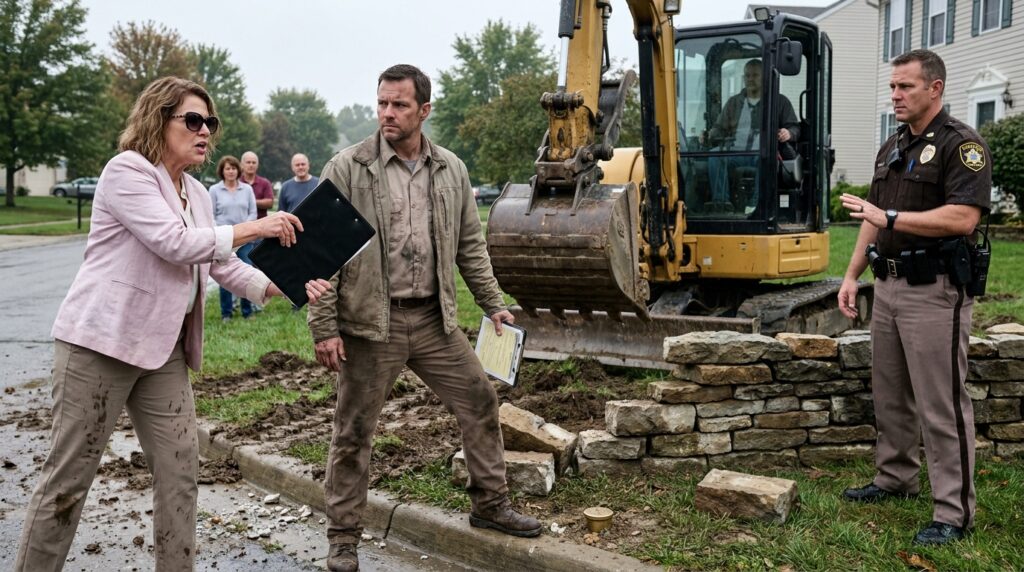
CHAPTER 2: BRASS IN THE FROZEN DIRT
“Step back from the excavator, Mrs. Caldwell.”
Sergeant Tomas Rivera didn’t raise his voice, but the sound of his door latch catching against the frame carried a distinct, metallic weight across the driveway. He swung his boots out onto the loose limestone, his uniform crisp despite the humidity, his hand resting casually—not aggressively, but anchored—on his duty belt right above the taser holster.
Brenda didn’t retreat. She adjusted the leather clipboard against her linen blazer, her silver pen clicking three times in rapid succession. “Sergeant, I called the sheriff’s department forty-five minutes ago regarding an unauthorized obstruction on subdivision property. Mr. Delaney has placed illegal physical hazards on a dedicated community easement.”
“I have the county tax map right here, Tomas,” Marcus said, stepping around the CAT 305’s rubber tracks. He didn’t offer a hand. He didn’t need to posturingly offer one; he and Rivera had known each other since the county culvert rebuild on Route 9 six years back. Marcus held out the manila folder, its laminated edge dull with chalky concrete dust from his thumb.
Rivera accepted the folder, unspooling the heavy rubber band binding the top. “Morning, Marcus. Thought you were framing the medical center down in Marion this week.”
“Poured the slab yesterday,” Marcus replied, his voice raspy from the diesel fumes lingering in the cool morning air. “Came home to find three of my survey pins pulled and thrown in the ditch. So I brought out a certified team yesterday afternoon.”
Brenda let out a short, dry laugh—a sound like dry leaves scraping across asphalt. “An independent contractor hired by a homeowner does not override the Silver Oak Estates Master Association Charter, Deputy. Section 4.2 explicitly permits the board to clear unpermitted retaining structures for municipal drainage and foot traffic integration.” She reached into her blazer pocket and pulled out a folded white sheet bearing a faint red county seal. “This is a temporary municipal drainage exemption, issued by the county clerk’s office three weeks ago. The stone wall is legally classified as an unmapped obstruction.”
Marcus narrowed his eyes, staring at the paper. The emblem at the top was slightly offset—the red ink bleeding faintly into the fiber, the signature line sharp, clean, yet oddly thin. A tiny knot tightened in the pit of his stomach. He knew county permits; he spent half his life pulling them at the zoning desk in town. Exemption filings didn’t come on heavy linen stock, and they never bore the clerk’s red impression stamp without a formal engineering signature on the margin. But on its face, to an officer standing on a wet shoulder at seven in the morning, the document looked administrative. It looked legal.
Rivera took the folded paper from Brenda, holding it beside Marcus’s boundary plat. “Drainage exemption?” Rivera murmured, his brow furrowing as he scanned the paragraph. “This notes a culvert modification allowance.”
“Precisely,” Brenda said, her posture stiffening with triumphant precision. “Which means the HOA is fully within its rights to remove those fieldstones today. If Mr. Delaney interferes with contracted equipment under a municipal exemption, he is obstructing public works.”
The young equipment operator inside the cab looked between Rivera and the paper, his hands hovering uncertainly above the hydraulic controls. The machine’s engine gave a low, resonant rumble, shaking loose bits of dried clay from the bucket teeth onto the stone wall below.
Marcus felt the grit of dried mortar under his fingernails as he clenched his fist inside his jacket pocket. The law was supposed to be a straight line—measured in inches, stamped in brass, fixed in stone. Yet here was a piece of paper, typed up in some air-conditioned office, turning his private property into an open target for a heavy diesel bucket.
“Look at the ground, Tomas,” Marcus said quietly. He walked past Brenda, ignoring the sharp intake of her breath as his shoulder brushed hers. He stopped at the corner of the stone wall where the fieldstones met the ditch line.
He dropped to one knee on the damp turf, unmindful of the wet mud soaking through his Snickers work pants. With two calloused fingers, he scraped away three inches of loose black loam and dead pine needles until his knuckles hit something hard, cold, and solid.
He wiped the dirt clear. Embedded in a four-inch concrete footing was a heavy brass disk, three inches in diameter, its stamped registry numbers gleaming dull gold in the grey autumn light.
“State Survey Monument 402-B,” Marcus said, his voice flat, unyielding. “Driven three feet deep into bedrock by Miller & Associates yesterday at three o’clock. County record number 8849. You see that stamped star in the center, Tomas?”
Rivera walked over, crouching beside Marcus. He reached down, his thumb running over the crisp, unweathered engraving in the brass.
“The line runs from this brass cap straight to the oak tree on the north corner,” Marcus continued, pointing a dirt-stained finger down the fence line. “This wall sits eighteen inches inside my property boundary. That exemption paper she’s holding? It cites a culvert sixty feet down the road. If that bucket touches one more stone, it isn’t an HOA clearance, Brenda. It’s felony destruction of private real property over five thousand dollars.”
Rivera stood up slowly, wiping his thumb on his pant leg. He turned to Brenda, his expression darkening as he looked from the brass monument back to the paper in his hand.
“Mrs. Caldwell,” Rivera said, his voice dropping into an official tone that made the three neighbors on the curb lean in closer. “Where did you get this exemption document?”
Brenda’s jaw tightened, her silver pen finally stopping its neurotic click. “It was processed through the board’s legal liaison. It is an official municipal filing.”
“Then we’re going to wait right here while I call the clerk to verify the file number,” Rivera said, reaching for the radio microphone clipped to his shoulder.
Behind them, near the open door of the surveyor’s truck parked further up the gravel shoulder, Marcus noticed an unopened white county clerk envelope tucked loosely inside the surveyor’s leather transit bag sitting on the tailgate—a second document he hadn’t yet unsealed from yesterday’s filing.








