
The Cold Brass Pin: A Veteran Stands His Ground Against Suburban Entitlement
CHAPTER 1: THE WET COPING
The water in the pool didn’t move until Miller cut through it. It was 6:15 AM, the sun still raw and pale over the pine tops, bleeding thin amber light across the concrete deck. The air smelled of chlorine, wet filter sand, and the damp earth of early August.
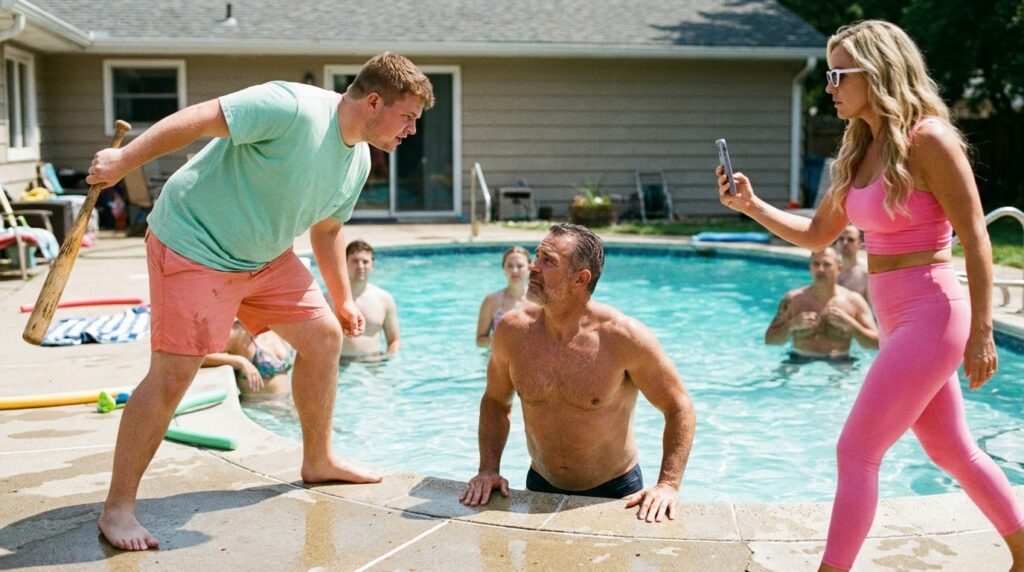
Miller took five long, deliberate breaststrokes, his shoulders working in steady, mechanical arcs. His skin was mapped with old silver lines—a jagged shrapnel entry above his left shoulder blade, the pale oval of a exit wound near his ribs—but in the cool blue water, the weight of thirty years in uniform lifted. He turned at the deep end, resting his calloused palms flat against the wet coping, the cold stone biting into his skin.
He didn’t hear her coming. He felt the change in the light first.
A shadow fell across the shimmering water, long and sharp. Standing at the edge of the blue-painted concrete was Brenda Vance, her white sunglasses perched like plastic insect eyes atop a mane of frosted blonde hair. She wore a bright pink crop top and matching athletic leggings, her arms crossed tight over her chest. In her right hand, she held a gray smartphone like a sidearm.
“You’re trespassing, Miller,” Brenda said. Her voice didn’t carry the slurred roughness of morning sleep; it was dry, practiced, and tight with suburban authority. “This pool belongs to the Oaks Subdivision Association. Non-members aren’t permitted on the deck before eight, and you aren’t a member.”
Miller didn’t blink. He wiped a stream of pool water from his gray-stubbled jaw, his eyes locking onto hers with the unhurried calm of a man who had spent two decades watching tree lines for motion.
“The deed transferred three weeks ago, Mrs. Vance,” Miller said, his tone low and even, devoid of friction. “Parcel 4B. The pool structure sits six feet inside my eastern line.”
Brenda let out a short, sharp laugh that rattled in the quiet morning air. A few lounger chairs away, a neighbor reading a tablet paused, looking up over the rim of his glasses.
“Your uncle let us run this amenity for twenty years because he couldn’t afford the maintenance,” she said, taking a step closer to the water’s edge, the rubber soles of her sneakers squeaking on the damp concrete. “You don’t just walk in here with a piece of paper from a probate judge and tell us who owns the water. We built this deck. We paid for the liner.”
She tapped the screen of her gray phone, her thumb clicking against the tempered glass with rhythmic precision.
“I’ve already called Brandon,” Brenda added, a thin, triumphant smile curling the edge of her mouth. “He’s coming down from the house now. And unlike me, he doesn’t care about being polite to squatters.”
Miller didn’t move a muscle. He kept his hands flat on the coping, feeling the rough aggregate stone under his fingers, watching the shadow of a young man in a mint-green shirt cross the grass toward the gate, carrying something long, heavy, and made of ash wood.
In the grass just three feet behind Brenda’s left heel, half-covered by creeping clover, a tiny square of tarnished yellow metal caught the morning sun—the flush brass head of a county surveyor’s pin, buried forty years ago and forgotten by everyone except the man in the water.

CHAPTER 2: THE ASH WOOD THREAT
“Put the phone down, Brenda,” Miller said, his voice flat as iron, still holding the wet coping of the pool. “You’re sending a kid to do something he’s not equipped for.”
The gate latch didn’t just click—it slammed against the aluminum fence post with a sharp, echoing ring that carried across the water. Brandon Vance didn’t walk through; he lunged through the opening, his sneakers slipping slightly on the damp Bermuda grass before catching traction on the wet concrete apron. He was twenty-two, stocky, with the thick, soft shoulders of a former high school lineman who had traded daily conditioning for energy drinks and easy local status. He wore a mint-green T-shirt, salmon swim shorts, and a face flushed red with unearned authority.
In his right hand, gripped tight enough to turn his knuckles the color of chalk, was a thirty-three-inch Rawlings ash wood bat. The varnish was chipped near the trademark, revealing the pale, dry grain beneath.
“Out,” Brandon barked, his voice cracking slightly on the peak of the vowel before he drove it lower to mimic an adult’s rasp. He planted his lead foot three inches from the blue-painted lip of the pool coping, right above where Miller’s knuckles rested. He jerked the barrel of the bat up behind his right shoulder, cocking it back in a short, tight arc. “Get out of the pool, Miller. Right now.”
Miller didn’t retreat. He didn’t drop his chin or shift his chest lower into the blue water. He simply tilted his head up two inches, locking his gaze on the trembling tip of the ash wood barrel. His internal clock, tuned by a decade of perimeter watches and defensive posture drills in places where air smelled like burning diesel, immediately broke the scene down into hard physics and distance.
Range: forty inches. Angle: oblique overhead. Trajectory: downward left to right. Target: clavicle or lateral skull. Weapon weight: thirty-two ounces. Recovery time after a missed swing on wet concrete: one point two seconds.
“Brandon,” Miller said quietly. He didn’t raise his voice to match the boy’s pitch. The calm was an anchor, heavy and dense. “You’re standing on wet concrete in flip-flops holding an ash bat over water. You swing that, you lose your footing, and you end up in the deep end with a felony assault charge before your aunt finishes her morning coffee.”
“Don’t talk to him!” Brenda snapped from six paces back. She advanced along the concrete lane, her pink leggings tight against her stride, holding her gray smartphone up like a shield. “He’s intimidating you, Brandon! Don’t listen to him! He thinks because he’s got that uniform in his closet he can just come in here and take what our family built!”
Brandon’s chest hitched. The encouragement from his rear flank acted like an ignition line. He took another half-step forward, his front toe hanging over the edge of the coping, crowding Miller’s vertical space. The shadow of the bat fell square across Miller’s wet face.
“I said get the hell out!” Brandon yelled, his face darkening as the blood surged to his ears. He rattled the handle of the bat in a nervous, rhythmic twitch. “My granddad poured the foundation for this clubhouse! You don’t own jack shit here, man! I’ll knock you clear to the bottom of the deep end, I swear to God!”
Miller kept his hands visible. He spread his fingers wide against the concrete coping, exposing his palms—no weapon, no tension, pure tactical immobility. He didn’t offer a target for panic, nor did he provide the boy with an excuse to trigger his swing reflex.
“Check the handle, Brandon,” Miller said softly, his eyes shifting down for a fraction of a second to the boy’s white-knuckled grip before snapping back to his eyes. “You don’t even have pine tar on it. Sweat’s running down your wrist right now. You swing, that wood flies out of your hand and hits the lounger behind you. Look at the man sitting five yards back.”
Brandon’s eyes flicked sideways for a microsecond—just long enough for his chin to drop half an inch. The neighbor with the tablet had frozen, his body pressed back against the mesh fabric of the lounge chair, his phone raised slightly as if recording the angle.
“He’s lying to you, Brandon! Don’t look at them!” Brenda shouted, her voice rising an octave as she stepped closer, her thumb furiously tapping the screen of her phone. She pulled up an old, digitized PDF from her local files—a scan of a faded 1998 document bearing a handwritten HOA seal. “I have the agreement right here! The easement is legally binding! He has no right to be in this water!”
“Then call the sheriff, Brenda,” Miller said without turning his head toward her. His voice remained anchored to the boy standing over him. “Call Deputy Miller. Tell him you’ve got a kid with a wooden bat threatening a property owner on his own parcel. Let’s see who he cuffs first.”
Brandon’s breath was coming in short, ragged hitches now. The bat stayed cocked over his shoulder, but the barrel began to trace tiny, involuntary circles in the humid morning air. The initial surge of adrenaline was giving way to the cold, exhausting realization of friction: the man in the water wasn’t flinching, wasn’t bargaining, and wasn’t giving him a reason to strike.
“I’m not asking again, old man,” Brandon whispered, though the volume had dropped, stripped of its earlier theater. “Get out.”
“I’m right where I’m supposed to be,” Miller replied, his voice as immovable as the cold brass pin buried three feet behind them in the dirt. “Check the survey before you swing that.”
CHAPTER 3: TACTICAL IMMOBILITY
The silence on the wet pool deck expanded like gas in a sealed chamber.
Brandon didn’t swing. His forearms trembled, the strain of holding thirty-two ounces of solid ash wood extended over his right shoulder sending a visible spasm down his triceps. Sweat pooled in the crease above his lip, mixed with the damp chlorine vapor rising off the water. His front sneaker was braced barely an inch from the slippery blue paint, his weight distributed too far onto his toes. A single sudden shift in Miller’s posture—even a flinch—would have triggered the boy’s panic reflex.
Miller gave him nothing to react to. He maintained zero-tension immobility.
His forearms remained flat against the aggregate stone, elbows submerged in the sixty-eight-degree pool water. His chest rose and fell in slow, three-second intervals, the silver scar tissue across his left shoulder remaining entirely still. He watched Brandon’s eyes—not the bat, not the hands, but the pupil dilation that precedes a violent physical commitment. The boy was losing his momentum, trapped in the dead space between a threat made and a blow delivered.
“Look at his hands, Brandon,” Brenda snapped, her voice cutting through the hum of the pool pump. She had moved up behind her nephew, her pink leggings swishing with fast, angry friction. In her left arm she clutched an accordion folder of faded blue cardboard, the top flap tucked under her arm. A corner of yellowed, sun-bleached plastic poking out from the paper edges caught the morning light—a notarized 1998 easement agreement, water-stained and dog-eared at the margins. “He’s trying to freeze you out! He thinks because he stood in a line overseas he can ignore a municipal covenants board!”
“Aunt Brenda, hold on a second,” Brandon muttered, his jaw working as he tried to swallow down dry panic. His grip on the ash wood shifted, the wood grain grinding against his sweaty palm. “He’s not moving.”
“Because he knows he’s trespassing!” Brenda thrust her gray smartphone forward, tapping the glass so hard the screen flashed white against her reflection. She held up the scanned image of the handwritten 1998 plot map, pointing a manicured nail at a faded red ink boundary line. “Look at it! Right here! Section 4, Paragraph B! The board assigned exclusive recreational access to the Vance estate in perpetuity! Your grandfather signed this document himself!”
Miller’s gaze flicked to the blue cardboard folder tucked under Brenda’s arm, then back to the boy. He recognized the paper style. It was the same private covenant draft his late uncle had kept in an iron box in the master closet—a proposed neighborhood draft that was never ratified by the county land office or recorded on the Master Deed.
“That paper was never recorded, Brenda,” Miller said softly. The tone was devoid of malice, carrying only the weight of cold, unvarnished fact. “Your father drew that map on a card table over beers thirty years ago. My uncle never signed the deed modification. He let you use the deck out of courtesy, not covenant.”
“That’s a lie!” Brenda’s voice hit a shrill octave that made the neighbor on the lounger wince and lower his camera phone. “He signed it! I have his signature on the notarized addendum right here!”
She reached down with her thumb to unclasp the rusty brass latch of the blue folder, intending to pull the physical document to slam against the wet concrete coping. But as she pulled the flap back, her fingers snagged on a second sheet buried behind the 1998 draft—a crisp, white, modern printout bearing the blue emblem of the County GIS Mapping Division, dated three days prior.
The corner of the page caught the breeze, turning over to expose a bold red warning stamp across the top header.
Brandon’s eyes drifted toward his aunt’s hand as she froze mid-motion. The momentum of his threat stalled completely. The tip of the baseball bat dropped two inches, dipping below his shoulder line, the heavy barrel no longer poised for a strike but swinging in an awkward, unbalanced arc.
“Aunt Brenda?” Brandon asked, his head turning slightly, his stocky shoulders uncoiling from their combat stance. “What’s that second page?”
“Nothing,” she lied instantly, her cheeks flushing a dark, mottled red beneath her oversized sunglasses. She tried to shove the crisp white paper back down into the accordion file, but her hand trembled, the stiff paper crumpling against the frayed cardboard dividers with a sharp crackle. “It’s just administrative garbage from the town clerk. Ignore it.”
“She can’t ignore it, Brandon,” Miller said, taking his first slow, calculated movement. He didn’t rise from the water; he simply shifted his right hand two inches along the coping, exposing the flat of his palm to show the complete absence of physical threat. “Ask her why the county surveyor came out on Tuesday morning while you were at work.”
Brandon looked down at Miller, then back at his aunt, the stocky young man suddenly looking small and terribly exposed on the open, sunlit concrete. The illusion of his authority was cracking, fractured by the quiet, unyielding presence of the man in the pool and the suspicious hesitation of the woman holding the reins.
“Put the bat in the grass, kid,” Miller added quietly. “Before your aunt gets you locked in a cell for a paper she knows isn’t worth the ink printed on it.”
CHAPTER 4: THE GIS REVEAL
Brenda didn’t put the folder away. Her fingers tightened around the frayed blue cardboard so hard the plastic-laminated notary seal bent with a dry, stiff snap.
“Don’t look at it, Brandon!” she snapped, her voice cracking under the glare of the morning sun. She pulled the folder back against her ribs, but her movement was clumsy, frantic with the sudden urgency of someone trying to hide a fire under a dish towel. “He’s bluffing! He paid some clerk at the courthouse to issue a temporary hold! It doesn’t mean anything!”
“Give me the paper, Aunt Brenda,” Brandon said.
His voice didn’t carry the high, raspy bark he had used five seconds ago. The adrenaline that had puffed his chest out and driven the ash wood bat up over his shoulder was draining fast, leaving his posture hollow. He didn’t drop the bat into the grass, but the head lowered until the wooden barrel hovered barely two inches above the wet coping, his knuckles pale and slick with sweat. He reached out his left hand, his thick fingers twitching toward the blue file folder.
“Brandon, I said no—”
“Give it to me,” he repeated, louder this time, stepping back from the pool edge. His flip-flops squeaked sharply against the damp aggregate. He grabbed the corner of the crisp white County GIS document poking from the file and yanked it free before she could pull away.
The white paper rattled in the humid air as Brandon held it up to the light. Across the top ran the official blue header of the County Assessor and Land Records Division, stamped with a dark red seal: PARCEL BOUNDARY VERIFICATION & RECORDED DEED INDEX — FINAL DETERMINATION.
Below the header sat a high-resolution aerial survey map. A thick yellow line encircled the pool, the concrete deck, and the pump house. Inside the yellow boundary, printed in bold black text, was the legal entity: ESTATE OF HAROLD MILLER TRUST / RECORDED DEED #2024-08912.
And taped directly to the bottom margin of the map was the decoy secret Brenda had spent two weeks trying to conceal—the physical scan of the original 1998 handwritten HOA agreement she had brought to enforce her authority.
Brandon’s eyes scanned down to the bottom corner of the scan, where his grandfather’s signature sat faded in black ballpoint ink. Right beside it, written in faint lead pencil thirty years ago, was a handwritten endorsement from the county clerk that Brenda had never mentioned to the neighborhood board: Provisionally filed under unratified Draft C. Subject to mandatory Master Deed consent. NOT RECORDED AT TITLE.
“What is this?” Brandon muttered, his forehead knotting as he stared at the red stamp. “Aunt Brenda… this says the 1998 agreement was never finalized. It says the whole pool deck sits inside his deed.”
“It was a clerical mistake from thirty years ago!” Brenda shouted, her cheeks burning bright crimson underneath her white sunglasses. She reached frantically for the paper, but Brandon held it out of her reach, his eyes fixed on the map. “Your grandfather built that fence! We paid for the concrete maintenance! Sweat equity gives us a legal easement! We have an adverse possession claim!”
“You don’t have adverse possession if the owner paid the property taxes every year, Brenda,” Miller said from the water. He still hadn’t moved. His arms rested calm and heavy against the coping, his shoulders square. “My uncle paid the county tax bill on Parcel 4B every December for twenty-eight years. He let your family use the pool because he didn’t care about swimming. But he never surrendered the title.”
A low murmur rippled across the lounge chairs behind Brenda. The neighbor with the tablet stood up, stepping closer to the fence line with his phone raised high, recording the white paper flapping in Brandon’s hand. Two other sunbathers at the far end of the deck paused, their chatter dying completely as they watched the matriarch of the Oaks Association stagger backward against the aluminum railing.
Brenda looked around the deck, her mouth opening and closing like a landed fish. The authority that had draped over her shoulders like an iron cloak for a decade was dissolving in the span of thirty seconds, stripped away not by fists or shouting, but by forty square inches of county paper.
“Brandon,” she whispered, her voice suddenly thin, stripped of its brassy ring. “Put… put the bat down.”
“You told me he was an illegal squatter,” Brandon said softly, staring at his aunt with a mixture of disbelief and mounting humiliation. His hand holding the paper began to shake. “You told me the police were waiting on me to clear the deck so they could serve the eviction.”
“I… I thought the board had the filing!” she stammered, stepping back toward the gate. “The lawyer said—”
“The lawyer told you three weeks ago that the title was clear, didn’t he?” Miller interrupted, his voice cutting through her panic like a cold steel blade. “He told you that if you sent someone onto this deck with a weapon to enforce an unrecorded paper, you’d be standing in front of a circuit judge by noon.”
Brandon let his left hand fall to his side. The crisp white paper slipped from his fingers, catching the damp morning breeze and fluttering down onto the wet concrete apron right at the edge of the blue coping.
The wooden bat hung uselessly in his right hand, the heavy ash barrel dragging through the grass as the young man took two slow, unsteady steps backward, away from the man in the water.
“Aunt Brenda,” Brandon whispered, his face pale as milk under his sunburn. “What the hell did you just make me do?”
CHAPTER 5: THE LEGAL PANIC
The wooden bat didn’t hit the concrete with a theatrical slam. It slipped from Brandon’s fingers, the ash barrel thudding softly into the damp Bermuda grass right at the edge of the apron. The kid took two fast steps backward, his flip-flops slapping against his heels as if the ground beneath him had suddenly turned white-hot.
“Brandon, pick that up!” Brenda hissed, her white sunglasses sliding down the bridge of her nose. Her fingers twitched toward her nephew’s shoulder, but he pulled away from her, his chest heaving under the mint-green T-shirt.
“No,” Brandon said, his voice flat, drained of every drop of his earlier bravado. “No way. You told me this guy was an illegal squatter. You said the board had a sheriff’s order.”
“The board does have authority!” Brenda shouted, but her tone rattled, thin and brittle against the open expanse of the pool deck. She spun on her heel toward the watching neighbors. The man on the lounger hadn’t lowered his phone; two women near the deep end were standing side-by-side now, whispering into their towels while staring directly at the white paper fluttering on the wet concrete. “Put those phones away! This is a private association matter! You do not have permission to record!”
Miller didn’t raise his voice. He reached up, placing both palms flat on the blue coping, and pulled himself smoothly out of the water. Water streamed down his chest, pooling around his bare feet on the aggregate stone. He didn’t rush. He picked up the crisp white GIS paper from the wet concrete, wiped a stray drop of pool water off the corner, and smoothed it against his forearm.
“You should listen to your aunt, Brandon,” Miller said, his eyes resting on the boy. “She knows exactly what happens when a sheriff responds to a call where a deadly weapon was produced over a civil property line.”
“It’s not a civil line!” Brenda stepped directly into Miller’s space, her pink crop top shaking with her rapid breathing. Her hand darted out toward the paper. “My father built this deck! The 1998 easement gives the HOA exclusive possession! You can’t just invalidate thirty years of neighborhood history with a probate transfer!”
Miller turned the paper over. Across the back of the county map was a secondary endorsement stamped in dark blue ink—a formal judicial entry dated six months before his uncle’s death: SPECIAL WARRANTY DEED & QUIET TITLE ENTRY #2023-1104. ALL PRIOR UNRECORDED EASEMENTS, RECREATIONAL COVENANTS, AND PROVISIONAL PERMITS DISSOLVED BY TRUST RESTRUCTURING.
Miller held the page steady, letting Brenda read the blue ink.
“He knew,” Miller said quietly. “My uncle knew what you were trying to do, Brenda. He watched you build the fence three feet past his line six years ago. He watched your board collect dues on land you didn’t own. So before he died, he didn’t just leave me the house. He cleared the title.”
Brenda’s mouth remained open, but no sound came out. The bright crimson flush on her cheeks faded into an ashen, sickly gray. Her eyes darted from the blue stamp to the watching neighbors, then to her nephew, who was already retreating toward the aluminum exit gate.
“You knew,” Brandon said, stopping near the gate latch, his face pale as chalk as he stared at his aunt. “You knew the easement was dissolved when the county surveyor came out on Tuesday. That’s why you gave me the bat, isn’t it? You wanted me to scare him off before he showed the board the quiet-title paper.”
“Brandon, shut your mouth!” Brenda cried, her voice cracking into a panicked squeak.
“She didn’t want you to scare me, Brandon,” Miller said, taking one deliberate step forward on the wet concrete, his voice cutting through the morning air like a cold blade. “She wanted me to swing back. Because if I hit you, it becomes an assault case instead of a property line. She was using you as a shield for her bad debt.”
The silence that followed was total. The hum of the pool filter sounded like a roar in the quiet morning air. Brenda looked around the deck, but every eye was locked on her. The neighbor with the tablet slowly lowered his device, his face set in a hard, disgusted line.
Brenda backed toward the gate, her hands clutching her blue cardboard folder to her chest like a broken shield, her authority entirely shattered in front of the community she had tried to rule.
CHAPTER 6: THE PUBLIC COLLAPSE
Brenda didn’t push through the aluminum gate; she backed through it, her pink sneakers dragging across the wet grass as if she were trying to pull herself away from the glare of the morning sun. Her white sunglasses had slipped down her nose, revealing wide, bloodshot eyes that darted frantically across the perimeter of the deck.
No one spoke up for her.
The neighbor on the lounger didn’t lower his tablet. He leaned forward, tapping his screen to lock the recorded video, his mouth set in a hard, disgusted line. The two women near the deep end stood motionless, their towels pulled tight around their shoulders, their eyes following Brandon as the young man shoved his hands into his salmon swim shorts and walked toward the parking lane without looking back.
“Brandon!” Brenda called out, her voice thin and raspy, stripping away the last remaining layer of her performance. “Brandon, get back here!”
The latch slammed shut behind him. He didn’t turn around. The rattle of his car keys echoed off the concrete retaining wall forty yards away, followed by the heavy, metallic clunk of his truck door shutting.
Miller stood tall on the wet apron, water trickling down his chest and dripping from his gray-stubbled jaw. He didn’t posture. He didn’t cross his arms or puff his chest. He stood with the unhurried stability of a man who had anchored himself to the truth long before the noise started. He folded the white GIS document twice, carefully placing it inside a waterproof plastic pouch he kept inside his gym bag on the bench.
“You left your bat, Brenda,” Miller said softly, pointing a calloused finger toward the raw ash wood lying in the damp clover near the coping.
Brenda stopped three paces past the gate. Her chest heaved under the bright pink top, her manicured fingers trembling around the blue cardboard file folder. The yellowed 1998 easement agreement hung half-out of the pocket, a crumpled relic of an authority that had evaporated in less than ten minutes.
“This… this isn’t over,” she whispered, though her voice lacked the friction to carry past the aluminum fence post. “The board will meet tonight. We have legal counsel.”
“Your legal counsel is the one who drafted the quiet-title response for my uncle’s estate, Brenda,” Miller replied, his voice dropping into a low, gravelly register that filled the quiet space between them. “If you call him tonight, he’s going to tell you to stop trespassing on Parcel 4B before the county assessor sends a formal code compliance team to inspect your fence line.”
She looked at him—really looked at him—for the first time since she had walked onto the deck. She didn’t see an outsider she could bully with a scanned PDF or a hot-headed kid with a baseball bat. She saw a man who had spent twenty years calculating distance, assessing leverage, and holding his ground under far worse than a suburban HOA spat.
Slowly, without saying another word, Brenda leaned over the low gate, reached down with two fingers, and pulled the wooden bat out of the grass by its handle. She dragged it behind her across the asphalt parking lot, the ash wood barrel scraping against the gravel with a dry, harsh rattle.
Miller watched her until her car door slammed shut and her engine turned over.
The pool deck fell into a deep, serene silence. The blue water shimmered under the rising sun, the morning haze lifting off the pine tops to reveal a clear, pale sky.
Miller turned back to the coping, picked up his towel, and wiped the moisture from his face. The neighbor on the lounger cleared his throat, setting his tablet on the side table.
“Miller,” the man said quietly, giving a brief, respectful nod across the water. “Good swim this morning.”
Miller looked at him, his expression calm and unreadable. He gave a single, tight nod in return, swung his legs back over the blue coping, and slid silently back into the water to finish his laps.
“We’re good,” Miller said toward the watching deck, his voice steady as the brass pin buried three feet away in the clover. “Everyone can back off now.”
CHAPTER 7: THE PERMANENT MARKER
“Hold that transit rod steady on the north corner, Dave. Three inches left.”
The voice belonged to Vance County Chief Surveyor Carl Miller—no relation to Miller, just forty years of dust on his leather boots and a brass-capped steel tape slung over his shoulder. The orange crew truck sat idling at the curb, its strobe light casting amber sweeps across the sun-bleached pine trunks along the property line.
Miller stood five paces back, his towel slung over his shoulder, a cold glass of tap water in his hand. The pool water on his skin had dried to a faint white haze of chlorine salts under the noon sun.
At the edge of the concrete deck, where the Bermuda grass met the blue aggregate coping, Dave drove a four-pound sledgehammer down onto a six-inch steel rod. Clang. Clang. Clang. The sound shattered the quiet suburban afternoon, metallic and uncompromising, vibrating through the soles of Miller’s bare feet.
Two doors down, behind the lace curtains of her front window, Brenda Vance stood motionless. She didn’t come out onto the porch. Her blue cardboard folder remained buried in her kitchen trash, and the mint-green truck her nephew drove was nowhere in the driveway. The neighborhood board had met informally at nine that morning over coffee on a neighbor’s patio; by ten, they had voted unanimously to dissolve the informal pool committee and formally acknowledge Parcel 4B as private real estate.
“That’s it,” Carl called out, wiping sweat from his forehead with a grease-stained forearm. He knelt in the clover, clearing away the dry thatch with a pocketknife until the flat, yellow brass cap gleamed flush with the concrete lip. “Corner stake set. Recorded under State Plane Coordinates. You can build a eight-foot iron fence right along this chalk line tomorrow if you feel like it, Miller.”
Miller walked over, his bare feet leaves-light against the concrete. He looked down at the brass pin. Stamped into the cold yellow metal was the official county registry number: PARCEL 4B — PERMANENT CORNER — DO NOT REMOVE.
“I don’t need a fence, Carl,” Miller said quietly.
“Suit yourself,” Carl grunted, picking up his sledgehammer and slinging it into the bed of the work truck. “Though after the noise your late uncle’s neighbors were making this morning, I figured you’d want six inches of solid cedar between you and the street.”
“They know where the line is now,” Miller said, looking across the quiet water of the pool. The surface was still as glass, reflecting the cloudless sky and the dark green canopy of the pines. “That’s all it takes.”
Carl chuckled, slamming the tailgate shut with a heavy iron latch that echoed down the quiet suburban cul-de-sac. “Yeah. Funny how a three-inch piece of brass can quiet down a whole neighborhood faster than a deputy with a court summons.”
The surveyor’s truck rumbled down the pavement, its amber strobe fading into the distance.
Miller walked to the edge of the pool deck. He looked down at the brass pin, then back toward the quiet water. The ghost of his uncle’s quiet battle—the thirty years of silent tax payments, the deliberate restructuring of the family trust, the refusal to surrender what was rightfully earned—rested inside that tiny brass disk in the dirt. It wasn’t about spite. It was about sanctuary.
He set his glass on the wooden bench, stepped to the blue-painted lip of the pool, and looked out over his land.
The water was cool, deep, and entirely his.
Without a sound, Miller dived into the blue.







