
CHAPTER 6: THE PUBLIC COLLAPSE
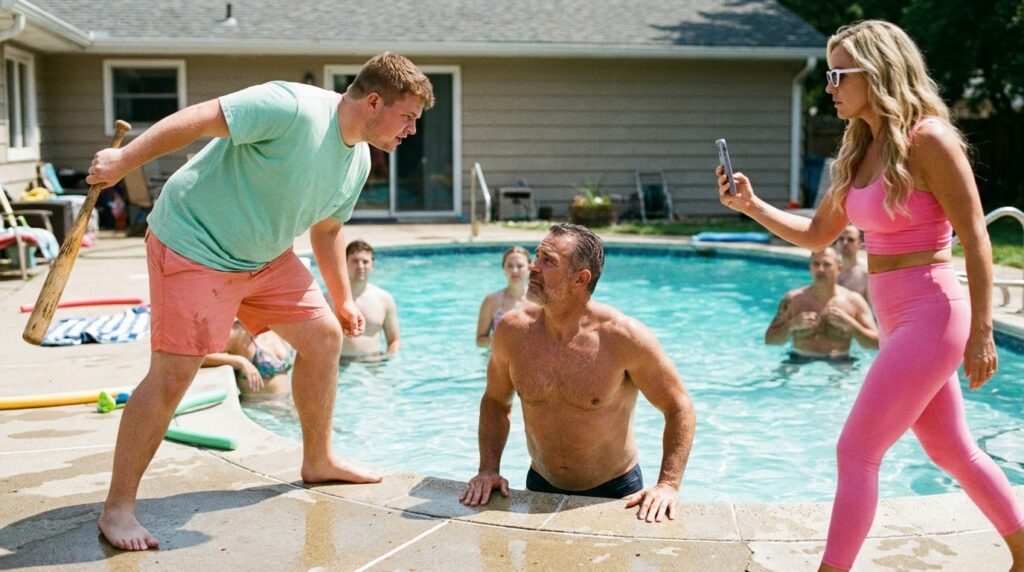
Brenda didn’t push through the aluminum gate; she backed through it, her pink sneakers dragging across the wet grass as if she were trying to pull herself away from the glare of the morning sun. Her white sunglasses had slipped down her nose, revealing wide, bloodshot eyes that darted frantically across the perimeter of the deck.
No one spoke up for her.
The neighbor on the lounger didn’t lower his tablet. He leaned forward, tapping his screen to lock the recorded video, his mouth set in a hard, disgusted line. The two women near the deep end stood motionless, their towels pulled tight around their shoulders, their eyes following Brandon as the young man shoved his hands into his salmon swim shorts and walked toward the parking lane without looking back.
“Brandon!” Brenda called out, her voice thin and raspy, stripping away the last remaining layer of her performance. “Brandon, get back here!”
The latch slammed shut behind him. He didn’t turn around. The rattle of his car keys echoed off the concrete retaining wall forty yards away, followed by the heavy, metallic clunk of his truck door shutting.
Miller stood tall on the wet apron, water trickling down his chest and dripping from his gray-stubbled jaw. He didn’t posture. He didn’t cross his arms or puff his chest. He stood with the unhurried stability of a man who had anchored himself to the truth long before the noise started. He folded the white GIS document twice, carefully placing it inside a waterproof plastic pouch he kept inside his gym bag on the bench.
“You left your bat, Brenda,” Miller said softly, pointing a calloused finger toward the raw ash wood lying in the damp clover near the coping.
Brenda stopped three paces past the gate. Her chest heaved under the bright pink top, her manicured fingers trembling around the blue cardboard file folder. The yellowed 1998 easement agreement hung half-out of the pocket, a crumpled relic of an authority that had evaporated in less than ten minutes.
“This… this isn’t over,” she whispered, though her voice lacked the friction to carry past the aluminum fence post. “The board will meet tonight. We have legal counsel.”
“Your legal counsel is the one who drafted the quiet-title response for my uncle’s estate, Brenda,” Miller replied, his voice dropping into a low, gravelly register that filled the quiet space between them. “If you call him tonight, he’s going to tell you to stop trespassing on Parcel 4B before the county assessor sends a formal code compliance team to inspect your fence line.”
She looked at him—really looked at him—for the first time since she had walked onto the deck. She didn’t see an outsider she could bully with a scanned PDF or a hot-headed kid with a baseball bat. She saw a man who had spent twenty years calculating distance, assessing leverage, and holding his ground under far worse than a suburban HOA spat.
Slowly, without saying another word, Brenda leaned over the low gate, reached down with two fingers, and pulled the wooden bat out of the grass by its handle. She dragged it behind her across the asphalt parking lot, the ash wood barrel scraping against the gravel with a dry, harsh rattle.
Miller watched her until her car door slammed shut and her engine turned over.
The pool deck fell into a deep, serene silence. The blue water shimmered under the rising sun, the morning haze lifting off the pine tops to reveal a clear, pale sky.
Miller turned back to the coping, picked up his towel, and wiped the moisture from his face. The neighbor on the lounger cleared his throat, setting his tablet on the side table.
“Miller,” the man said quietly, giving a brief, respectful nod across the water. “Good swim this morning.”
Miller looked at him, his expression calm and unreadable. He gave a single, tight nod in return, swung his legs back over the blue coping, and slid silently back into the water to finish his laps.
“We’re good,” Miller said toward the watching deck, his voice steady as the brass pin buried three feet away in the clover. “Everyone can back off now.”








