
CHAPTER 7: THE PERMANENT MARKER
“Hold that transit rod steady on the north corner, Dave. Three inches left.”
The voice belonged to Vance County Chief Surveyor Carl Miller—no relation to Miller, just forty years of dust on his leather boots and a brass-capped steel tape slung over his shoulder. The orange crew truck sat idling at the curb, its strobe light casting amber sweeps across the sun-bleached pine trunks along the property line.
Miller stood five paces back, his towel slung over his shoulder, a cold glass of tap water in his hand. The pool water on his skin had dried to a faint white haze of chlorine salts under the noon sun.
At the edge of the concrete deck, where the Bermuda grass met the blue aggregate coping, Dave drove a four-pound sledgehammer down onto a six-inch steel rod. Clang. Clang. Clang. The sound shattered the quiet suburban afternoon, metallic and uncompromising, vibrating through the soles of Miller’s bare feet.
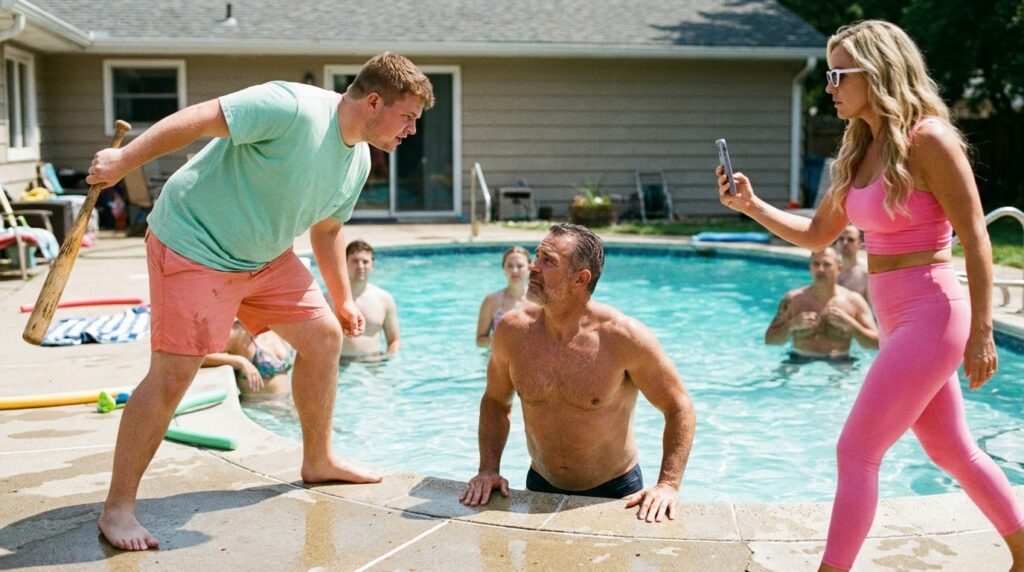
Two doors down, behind the lace curtains of her front window, Brenda Vance stood motionless. She didn’t come out onto the porch. Her blue cardboard folder remained buried in her kitchen trash, and the mint-green truck her nephew drove was nowhere in the driveway. The neighborhood board had met informally at nine that morning over coffee on a neighbor’s patio; by ten, they had voted unanimously to dissolve the informal pool committee and formally acknowledge Parcel 4B as private real estate.
“That’s it,” Carl called out, wiping sweat from his forehead with a grease-stained forearm. He knelt in the clover, clearing away the dry thatch with a pocketknife until the flat, yellow brass cap gleamed flush with the concrete lip. “Corner stake set. Recorded under State Plane Coordinates. You can build a eight-foot iron fence right along this chalk line tomorrow if you feel like it, Miller.”
Miller walked over, his bare feet leaves-light against the concrete. He looked down at the brass pin. Stamped into the cold yellow metal was the official county registry number: PARCEL 4B — PERMANENT CORNER — DO NOT REMOVE.
“I don’t need a fence, Carl,” Miller said quietly.
“Suit yourself,” Carl grunted, picking up his sledgehammer and slinging it into the bed of the work truck. “Though after the noise your late uncle’s neighbors were making this morning, I figured you’d want six inches of solid cedar between you and the street.”
“They know where the line is now,” Miller said, looking across the quiet water of the pool. The surface was still as glass, reflecting the cloudless sky and the dark green canopy of the pines. “That’s all it takes.”
Carl chuckled, slamming the tailgate shut with a heavy iron latch that echoed down the quiet suburban cul-de-sac. “Yeah. Funny how a three-inch piece of brass can quiet down a whole neighborhood faster than a deputy with a court summons.”
The surveyor’s truck rumbled down the pavement, its amber strobe fading into the distance.
Miller walked to the edge of the pool deck. He looked down at the brass pin, then back toward the quiet water. The ghost of his uncle’s quiet battle—the thirty years of silent tax payments, the deliberate restructuring of the family trust, the refusal to surrender what was rightfully earned—rested inside that tiny brass disk in the dirt. It wasn’t about spite. It was about sanctuary.
He set his glass on the wooden bench, stepped to the blue-painted lip of the pool, and looked out over his land.
The water was cool, deep, and entirely his.
Without a sound, Miller dived into the blue.








