
The Line We Draw on Oakridge Way: A Tale of Boundary, Privilege, and Calculated Retribution

CHAPTER 1: THE SILENT SOLVENT

The sound wasn’t a rustle or a footsteps on gravel. It was a sharp, pressurized hiss—the distinct, continuous rasp of fine chemical mist striking dry, porous stucco.

Mark Vance stopped at the edge of his back patio, his dark polo clinging to his shoulders in the muggy midday heat. The air down the eastern side path smelled instantly wrong: high-aromatic xylene and heavy enamel solvent cutting straight through the warm scent of cut grass.

He rounded the corner without sound.

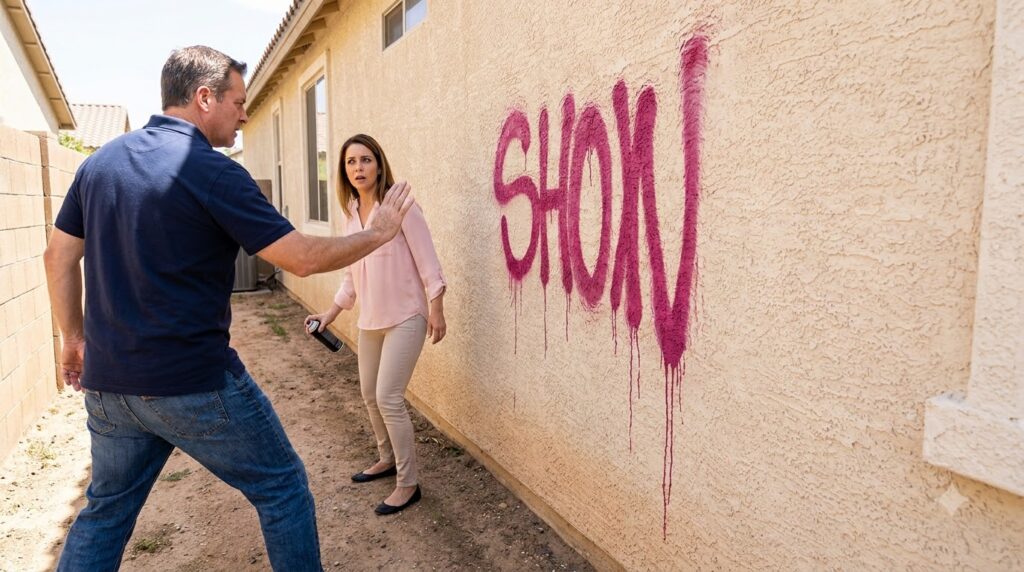
The passage between his home’s beige exterior and the neighboring dogwood fence was less than four feet wide. Standing two yards in, framed by the blinding glare of the noon sun, was Brenda Hollis. She wore a tailored pink blouse, pale trousers, and black leather flats now dusty from his drainage gravel. Her right hand was raised to waist height, her fingers locked around a heavy black aerosol cylinder.

Across the rough, hand-troweled stucco, a thick streak of neon magenta glistened wet in the sun. Aggressive, jagged lettering ran three feet wide, pigment actively running down the textured ridges in heavy, viscous tears that dripped onto the stone foundation below.

Brenda’s shoulder twitched as she released the nozzle. The final mist hung in the air, a faint pink haze floating between them.

Mark stepped into the mouth of the passage, his broad frame instantly cutting off the narrow slice of sunlight that illuminated her escape route to the street. He didn’t speak immediately. He took one long, deliberate step forward, planting his feet on the gravel, locking his weight into the bottleneck.

Brenda’s head snapped toward him. Her blonde hair whipped across her face, her large tortoiseshell sunglasses reflecting his silhouette against the narrow alley. Her composure didn’t crumble into guilt; it froze into the sharp, defensive rigidity of an official caught off-guard. Her fingers tightened around the dark spray can, dropping it down against her thigh as if the shadow of her trousers could make it invisible.

“What the hell do you think you’re doing to my house?” Mark’s voice wasn’t a roar; it was a low, heavy weight that vibrated off the hard masonry wall between them.

Brenda took a tiny, involuntary half-step backward, her heel pressing against the gravel, stopping just inches from the wet, running pigment. Her chest heaved once beneath the pink silk, her lips drawing into a tight, pale line before she forced her chin upward.

“Mark,” she said, her voice dropping into the practiced, measured cadence she used at annual budget meetings. “You need to calm down. I can explain, just hear me out.”

“You’re holding the can,” Mark said, his eyes narrowing as he mapped the tight space between her shoulder and the wooden pickets. “And my wall is dripping wet.”

“It’s not what you’re making it out to be,” she insisted, taking a tentative half-step forward, reaching out with her left hand as if to pat the air between them. “I was conducting a preliminary structural assessment. I noticed a massive color variance and a hairline stress fracture from the street. This is a temporary, water-soluble indicator pigment—”

Mark raised one thick hand, pointing a single, unyielding finger at her face, ignoring the lie without even pausing to dismantle it. “Don’t take another step, Brenda.”

She froze mid-stride, her black flat hovering an inch above the grey gravel.

“You’re going to stand right there,” Mark said softly, pulling his phone from his pocket with his left hand, his gaze never leaving her eyes. “Because if you move toward me, or try to wipe that off, we stop talking about property damage and start talking about something much worse.”

Brenda’s eyes darted past his shoulder toward the empty driveway behind him, her fingers twitching against the metal cylinder at her side. Down the narrow corridor, high above her head beneath the shadowed eave of the roofline, a tiny blue LED ring blinked twice—a clean, silent optic eye tracking every twitch of her jaw.


CHAPTER 2: THE ANGLE OF ATTACK

Brenda’s heels remained locked in the gravel, but her eyes shifted—a quick, calculated flicker from Mark’s shoulder down to the gap between his hip and the wooden pickets. She was running the angles. In her mind, she wasn’t a vandal caught on camera; she was an executive suffering an aggressive disruption in the field.

“Mark,” she said, her voice dropping an octave, tightening into the practiced, firm tone she used to cut off floor objections at board meetings. “You are making an immense tactical mistake. Let’s look at the reality here. You have an unregistered paint application on this wall. You’ve ignored three written formal inquiries regarding the texture sheen. As ARC Chair, I have an administrative obligation to record visual evidence for the county auditor.”

“With a can of pink enamel,” Mark said. His voice was flat, devoid of the anger she was clearly hoping to weaponize. He shifted his weight three inches to the left, shutting down the narrow angle between his body and the fence.

“It is an industrial indicator,” she snapped, her knuckles whitening around the dark metal cylinder. The paper label on the spray can had been aggressively scraped off, leaving behind a scarred silver surface where razor marks scored the tin. “It washes off with water. It’s standard protocol for marking non-compliant masonry before an official structural lien is filed. If you step aside right now, I will treat this entire altercation as a procedural misunderstanding. No security report. No escalation to the board’s legal counsel.”

Mark didn’t move. The chemical smell of the xylene was thick in the narrow alley, heavy and sweet, clinging to the back of his throat. He looked down at the aerosol can in her hand. A thick, viscous drop of magenta had gathered at the plastic nozzle, trembling, before detaching and falling onto the tip of her left leather flat.

She didn’t notice it. She was entirely focused on the leverage.

“You’re lying, Brenda,” Mark said softly. “Water-soluble chalk paint doesn’t smell like lacquer thinner. And it doesn’t run in tears like that.”

Brenda’s jaw set into a hard, white ridge. “You aren’t a chemical engineer, Mark. You’re a homeowner in continuous violation of covenant rules. You’ve dragged this out for six months because you think you’re above the neighborhood guidelines. You refused to use the approved restoration vendors. You thought you could just brush a fresh coat over a defective sub-base and nobody would notice.”

“Your brother-in-law’s firm,” Mark said.

Her expression didn’t flinch. “Excuse me?”

“The approved vendor,” Mark said, his voice quiet, carrying effortlessly down the tight concrete corridor. “Apex Restoration. Owned by Greg Hollis. The quote he sent me was six thousand dollars to strip and re-stucco a fifty-foot wall. When I used factory-matched acrylic from the original manufacturer for eighty bucks, you started dropping violation notices in my mailbox every Tuesday.”

Brenda’s eyes narrowed into dark, cold slits. The professional warmth she usually projected vanished completely, leaving behind a sharp, predatory friction. “Apex is a certified installer. They guarantee code compliance. You used unvetted material, Mark. You compromised the architectural integrity of this entire cul-de-sac. Do you have any idea what happens to property values when one house starts cutting corners on exterior finishes?”

“You’re standing on my property,” Mark repeated, his phone resting lightly in his palm, screen face-down, his index finger hovering over the side button. “You walked past a posted boundary sign, brought a concealed aerosol can into my side yard, and defaced private masonry.”

“This path is a designated access easement for utility and structural inspection!” she hissed, taking a sharp half-step forward, her shoulder almost brushing his chest as she tried to force her way past him by sheer posture. “Stand aside, Mark. Immediately.”

Mark didn’t raise his hands. He simply turned his broad torso sideways, locking his shoulder against the wooden fence post, creating an absolute dead end. The fabric of his navy polo brushed her pink blouse.

“You’re not leaving until the deputy gets here, Brenda.”

She froze, her face mere inches from his chest. The smell of her expensive floral perfume clashed sickeningly with the harsh, biting reek of the wet enamel dripping behind her. A sharp, rhythmic metallic clink echoed from the street—the distant, unmistakable sound of a heavy vehicle turning into the cul-de-sac, its suspension working against the speed bumps.

Brenda’s head snapped toward the driveway. The calm, bureaucratic mask shattered, exposing a sudden, violent flash of panic beneath the dark tortoiseshell lenses of her glasses.

“You called the police?” she whispered, the edge in her voice finally fraying.

“Five minutes ago,” Mark said. “While you were still shaking the can.”

CHAPTER 3: THE CURBSIDE JURISDICTION

The cruiser’s door slammed with a heavy, double-stage latching sound that echoed off the asphalt out on Oakridge Way.

Brenda’s shoulder twitched against Mark’s chest. The panic that had flashed across her face moments earlier didn’t turn into a retreat; it hardened into something far more dangerous. She adjusted her posture in the narrow alley, squaring her shoulders, her hands smoothing the front of her light pink blouse with sharp, frantic snaps of her wrists. She didn’t drop the spray can. She tucked it deeper along her outer thigh, using the flare of her pale trousers to shadow the silver cylinder.

“Mark,” she whispered, her voice tight, vibrating with an icy intensity. “This is your last opportunity to avoid a formal lawsuit. You step back, you let me address the officer, and we handle this as an administrative error.”

Mark didn’t answer. He turned his head toward the front yard as heavy, rhythmic boots crunched across the dry turf at the edge of his driveway.

Deputy Miller rounded the corner of the garage. He was in his late thirties, built broad across the shoulders with a faded utility belt that clinked softly as he walked. His eyes were already moving—taking in the narrow side path, Mark’s broad frame blocking the exit, Brenda’s stiff posture against the stucco, and the thick, unnatural magenta stain glowing in the harsh afternoon light.

Behind the deputy, at the mouth of the driveway, the neighborhood was beginning to gather. Jim from next door was standing by his mailbox in a faded gray t-shirt, his arms crossed over his chest, watching intently. Across the street, two women holding dog leashes had paused on the sidewalk, their eyes fixed on the narrow corridor.

“Afternoon,” Deputy Miller said. His voice was low, flat, and completely devoid of urgency. He stopped three feet from the entrance to the path, his hands resting naturally near his belt buckle. “Got a call regarding a disturbance and property damage.”

Brenda didn’t wait for Mark to speak. She took half a step forward, using the slight gap Mark opened as he turned toward the deputy, her voice projecting clearly over the fence line.

“Deputy! Thank goodness you’re here,” she said, her tone instantly shifting from the harsh whisper in the alley to the practiced, civic warmth of an elected official. “I am Brenda Hollis, Chair of the Architectural Review Committee for the Oakridge Way Homeowners Association. I was conducting an authorized property inspection when this resident physically cornered me in this service passage.”

Deputy Miller’s left eyebrow twitched up a fraction of an inch. He didn’t look at her face; his eyes dropped straight to the dripping magenta mark on the stucco wall behind her shoulder.

“He has been shouting at me, threatening me with physical force, and refusing to allow me to exit to my vehicle,” Brenda continued, her speech accelerating, the words tumbling out in a smooth, rehearsed cadence. “I was attempting to apply a temporary, water-soluble marking compound to highlight an unapproved structural repair—a standard procedure outlined under Article Four, Section Two of our neighborhood bylaws.”

“A marking compound,” Deputy Miller repeated neutrally.

“Yes,” Brenda said quickly, reaching down to her tote bag resting on the gravel near her feet. From the open canvas top, the corner of an official, blue-stamped county document was visible, folded neatly alongside a pair of heavy rubber work gloves. “It’s a chalk-based indicator. It washes off with rain. Mr. Vance has been in continuous violation of community standards for six months, and his refusal to comply with our certified restoration vendors has forced the board to prepare a formal county lien filing.”

Mark stayed silent, letting the sound of her voice carry out to the driveway where Jim and the gathering neighbors were leaning in over the wooden fence line.

Deputy Miller took a slow step into the mouth of the passage. The smell of the solvent hit him immediately, making his nostrils flare. He didn’t look at the paper in her bag. He looked directly at the aerosol can held against her trousers.

“Ma’am,” Deputy Miller said softly. “Set the cylinder down on the fence post.”

Brenda’s jaw tightened. “Deputy, I am the reporting officer for the HOA—”

“I didn’t ask for your title, ma’am,” Miller interrupted, his voice dropping into a quiet, unyielding register. “I asked you to set the can on the post.”

Brenda hesitates for a fraction of a second, her eyes darting to Mark, then to the deputy’s face, before slowly raising the dark, scraped tin cylinder and placing it on the flat wood of the fence picket. A single drop of bright pink pigment clung to the edge of the rim, wet, glossy, and distinctly oil-based.

“Mr. Vance,” Deputy Miller said, turning his head toward Mark. “Is this your property?”

“It is,” Mark said. “And that wall was painted forty-eight hours ago with factory-matched masonry paint. What she just sprayed is industrial enamel.”

Brenda let out a short, sharp laugh—a sound designed for the audience listening at the curb. “That’s absolute nonsense, Deputy. He’s fabricating an excuse to cover up his non-compliant work. I have the structural audit paperwork right here in my bag. I was acting entirely within my legal authority as a representative of the community corporation.”

Deputy Miller looked from the dripping wall to Brenda’s pale trousers, where a faint smear of pink had transferred onto the fabric near her knee.

“We’ll check the paint type in a minute, ma’am,” Miller said, reaching for his notepad. “Right now, I need to know why you’re on his private property without written notice.”

“Article Four gives us full easement access!” Brenda insisted, her voice rising an octave, losing its polished edge as she felt the perimeter of her authority begin to fray under the deputy’s cold, methodical gaze.

Mark didn’t argue the bylaws. He simply reached into his navy jeans pocket and pulled out his phone. “She didn’t come to inspect, Deputy. She came to ruin the wall so her brother-in-law’s company could charge me six thousand dollars to replace it.”

Brenda’s face went completely white. “That is a slanderous lie!”

“And I don’t need to argue about the paint type either,” Mark added, turning the phone screen toward the officer. “Because the whole thing is recorded in four-K.”

CHAPTER 4: THE GLASS OPTIC

Deputy Miller took one step closer, his eyes shifting from Brenda’s rigid posture down to the bright glass panel resting in Mark’s hand.

The screen flickered under the harsh glare of the midday sun, but the 4K resolution was crisp enough to cut through the light. Mark pressed his thumb against the glass. The local drive interface opened instantly, displaying a high-definition, wide-angle feed angled straight down the narrow side path from beneath the roof soffit.

“Timestamp is 12:14 PM,” Mark said quietly. “Seven minutes ago.”

Deputy Miller leaned in, his utility belt clinking softly. Behind him, Jim and three other homeowners took a collective step past the wooden fence post, leaning over the property line to watch the blue-tinted screen. Brenda stood frozen against the stucco, her throat working in tight, dry swallows, her hands remaining glued to the sides of her pale trousers.

Mark tapped play.

The audio came through first—a crisp, high-fidelity recording of the warm wind rustling through the dogwood leaves, followed by the faint crunch of gravel. Then, Brenda entered the frame from the front yard.

On the screen, her movement wasn’t that of an official conducting a cautious inspection. She walked briskly, her eyes darting toward Mark’s side window before she reached into her tote bag. Her hand emerged holding the dark, scraped aerosol can. She didn’t measure the wall. She didn’t examine a structural crack. She shook the can twice—a distinct, metallic clack-clack of the internal agitator ball echoing clearly from the phone’s speaker—popped the cap off with her thumb, and stepped within eighteen inches of the clean beige masonry.

The audio picked up a low, breathy sound—a short, satisfied chuckle—right before her finger depressed the nozzle.

Then came the hiss. The screen filled with a thick, violent cloud of neon magenta as her arm dragged the nozzle across three feet of textured stucco in an aggressive, sweeping zigzag.

A collective gasp rippled through the neighbors leaning over the fence line. Jim let out a low whistle, shaking his head. “Well, I’ll be damned,” he muttered loudly enough for the entire driveway to hear.

On the phone screen, the video continued in excruciating detail. Two seconds after the aerosol started spraying, the heavy thud of Mark’s boots sounded on the back patio. The camera captured Brenda’s head snapping around, her face twisting into sudden terror as she shoved the spray can down toward her thigh—the exact moment Mark rounded the corner and cut off her path.

Mark paused the playback, freezing the frame on Brenda’s face—a stark portrait of guilt, caught under bright sunlight with a dripping can in her right hand and fresh paint aerosol hanging in the air around her head.

Deputy Miller looked at the frozen frame for five long seconds. The silence in the side passage was absolute, broken only by the faint, rhythmic drip-drip of the wet magenta solvent sliding off the stucco onto the gravel below.

“Ma’am,” Deputy Miller said, his voice flat and heavy, turning slowly to face Brenda. “Is that you in this recording?”

Brenda’s lips twitched. Her cheeks burned a deep, blotchy red beneath her large sunglasses. She tried to maintain her posture, but her shoulders slumped an inch toward the wall behind her.

“Deputy, you have to look at the context,” she stammers, her voice losing its icy authority completely, cracking into a sharp, defensive shrillness. “This video is misleading! It doesn’t capture the months of non-compliance! I was under severe stress from board duties! He’s been harassing the committee—”

“Ma’am,” Deputy Miller interrupted, tapping his notepad against his knee. “The video shows you walking onto private property with a concealed spray can and deliberately defacing a residence. Did Mr. Vance give you permission to spray paint his home today?”

“It’s an HOA enforcement measure!” she cried, her hands making small, frantic gestures in the narrow air between them. “We can settle this internally! We have a board hearing scheduled for next Tuesday! I can have a professional crew here by tomorrow morning to pressure wash it!”

“This isn’t a board matter, Brenda,” Mark said, his voice quiet, his thumb locking the phone screen into dark glass. “This is felony vandalism.”

Deputy Miller looked over his shoulder at the gathering crowd on the driveway. Two neighbors had pulled out their own smartphones, recording Brenda as she stood trapped against the dripping wall.

“Ma’am,” Deputy Miller said, pulling a pair of blue nitrile gloves from his tactical pouch with a sharp snap of rubber. “Do not touch that can on the fence post. Step out of the side path and put your hands behind your back.”

Brenda’s eyes expanded in absolute, unadulterated panic. “You can’t arrest me! I live at 142 Oakridge! I’m the committee chair!”

“You’re a suspect in a property destruction crime exceeding five hundred dollars,” Miller corrected calmly, stepping into her space and taking her wrist. “You have the right to remain silent.”

As the deputy snapped the first metal cuff around her wrist, the corner of the blue-stamped document inside her tote bag slipped slightly on the gravel, unfolding just enough to reveal a handwritten sheet of lined paper tucked beneath the official county letterhead—a list of addresses, dollar figures, and the handwritten name Apex Restoration.

CHAPTER 5: THE EVIDENCE BAG

The single clack of the ratchet locking around Brenda’s left wrist sounded abnormally loud in the narrow alley.

She flinched, her body going stiff as a board. Her hands were pulled behind her back, the pale silk of her pink blouse straining across her shoulder blades. She didn’t scream, and she didn’t thrash. Instead, her posture completely collapsed into the awkward, bent-over tilt of a woman realization was crushing in real-time.

“Deputy,” she gasped, her voice barely a thread now, stripped of every shred of authority, every ounce of rehearsed corporate resonance. “Please. My neighbors are watching. You don’t have to put cuffs on me. I’ll walk to your car.”

Deputy Miller didn’t argue. He clicked the second cuff into place over her right wrist, adjusted the tension with a quick, practiced twist of his key, and stepped back to pick up her tote bag from the gravel.

“You’re under arrest for criminal mischief and intentional property damage, ma’am,” Miller said flatly. He reached down, carefully lifting the aerosol spray can from the top of the fence picket using a clean evidence bag. The heavy tin clinked softly against the clear plastic as he sealed the top zipper.

As he moved the tote bag, the folded paper inside shifted again. The blue-stamped county document slipped completely out of the side pocket, tumbling onto the dry gravel path right at Mark’s boots.

Mark knelt, his eyes scanning the page before picking it up by the dry corner to hand to the deputy.

It wasn’t an official county audit document at all. Below a forged county seal header was a handwritten grid—a meticulously kept ledger spanning eighteen months. Columns lined the page: home addresses along Oakridge Way, amounts ranging from $3,000 to $8,000, and a small, precise percentage calculation written in red ink next to each line: 15%—Greg/Apex.

Mark’s address was at the bottom of the list, circled three times with a thick red marker.

Deputy Miller took the paper from Mark’s hand, his blue-gloved thumb holding it open. His eyes ran down the columns, his jaw tightening slightly as he processed the numbers. He looked from the ledger up to Brenda, whose face had gone from deep red to an ash-gray paleness.

“Looks like the State Attorney’s financial crimes unit is going to want a copy of this,” Miller said softly, folding the paper carefully and sliding it into a separate document pouch on his belt.

“That’s private personal property!” Brenda choked out, her voice cracking as she tried to pull her hands around her hip, her black flats digging uselessly into the loose stone. “You have no right to search my bag!”

“It fell out on the victim’s driveway while you were committing a felony, ma’am,” Miller replied neutrally. He took her by the upper arm—firmly, but without unnecessary force—and guided her slowly out of the tight four-foot gap between the stucco and the wooden pickets.

As they emerged from the side passage into the bright sunlight of the front driveway, the quiet atmosphere of Oakridge Way fractured completely.

Jim was standing right at the edge of the lawn, his arms uncrossed now, holding his phone up at eye level. Across the cul-de-sac, three more homeowners had walked out onto their front porches. No one spoke to Brenda. No one shouted insults. The silence was far more damaging—a cold, collective gaze of a neighborhood watching its self-appointed tyrant being led to the back seat of a county cruiser.

Brenda kept her chin tucked down toward her chest, her blonde hair falling forward to cover her face, but her light pink blouse bore a stark, unmistakable marker: a tiny, quarter-inch fleck of bright neon-magenta aerosol paint had caught the edge of her collar during her frenzied attack on Mark’s wall.

Deputy Miller opened the rear door of the patrol car, placed his hand gently over her head to guide her inside, and shut the heavy door with a solid, echoing thud.

He walked back toward Mark, pulling off his blue gloves with two sharp snaps. “I’ve got the video link you sent, the spray can, and the physical ledger. A detective will follow up with you tomorrow morning for a formal written statement for restitution.”

“Appreciate it, Deputy,” Mark said, offering a firm, quiet nod.

Miller nodded back, stepped into his cruiser, and pulled away from the curb. The tires crunched slowly down Oakridge Way, leaving the street in a strange, profound quiet.

Mark turned toward his driveway. Jim walked over, stepping past the property line, looking down the narrow side path at the bright, dripping wall.

“Mark,” Jim said quietly, slapping a heavy hand against Mark’s shoulder. “I think you just freed this whole street.”

Mark looked at the wet magenta paint, then up at the dark glass dome of the camera mounted under his roof. “Not yet,” Mark said, his voice cold and steady. “I still have to wash my wall.”

CHAPTER 6: THE PURGE OF OAKRIDGE WAY

The stiff nylon bristles hit the wet masonry with a harsh, rhythmic rasp.

Mark dipped the heavy wooden handle of the scrub brush into his five-gallon bucket, swirling the sudsy, cold water until white foam slopped over the galvanized rim onto the gravel path. High-strength solvent degreaser cut through the hot evening air, mixing with the fading reek of xylene.

With every heavy, measured drag of his arm, the neon magenta pigment bled outward into soapy pink streams. It didn’t come off easily. The permanent industrial enamel had soaked deep into the micro-cracks of the textured stucco, binding to the lime and sand. It took raw leverage—his shoulder locked, weight leaning hard against the wall—to scrub the masonry back down to its factory beige finish.

Across the street, Brenda’s house was entirely dark. The blinds were drawn tight, the garage door shut, her pristine manicured lawn illuminated only by the pale amber glow of the streetlights. Word had traveled fast. By 4:00 PM, Jim had forwarded a copy of the driveway security footage to every homeowner on the cul-de-sac mailing list. By 5:00 PM, three separate board members had sent certified emails to the HOA legal firm demanding an emergency meeting.

The chime of Mark’s phone signaled a new notification. He wiped his dripping, chemical-slick hands on his faded blue jeans and pulled the device from his pocket.

It was an automated notification from the Oakridge Way Homeowners Association portal—a board-wide emergency broadcast sent directly from the vice president:

SPECIAL ANNOUNCEMENT: Effective immediately, Brenda Hollis has been formally suspended from all administrative duties pending criminal proceedings. ARC enforcement actions issued over the past 180 days are placed under official audit. A special meeting to elect a new board chair will take place Thursday evening.

Mark stared at the glowing screen for a moment. The false authority that had dictated hedge heights, paint sheens, and trash-can schedules for six months had dissolved in less than an afternoon. The strategic pursuit was over. The trap had closed cleanly, leaving no room for legal maneuver or social survival.

He slid the phone back into his pocket, gripped the wooden stock of the scrub brush, and splashed a fresh bucket of cold water high against the wall.

The remaining pink lather washed down the wall in a clear, fast-running stream, vanishing into the grey stone gravel below. The stucco beneath was slightly damp, slightly darker than the surrounding wall where the water lingered, but pristine—clean, original, and intact.

Mark stood back, breathing in the cooling evening air. The sun was dipping low over the rooflines of Oakridge Way, casting long, peaceful shadows across the manicured driveways. Up under the dark eave of his roof, the small blue LED on the security camera blinked once, quiet and vigilant, keeping watch over the narrow line he had drawn.

Similar Posts

Leave a Reply

Your email address will not be published. Required fields are marked *






