
CHAPTER 3: THE CURBSIDE JURISDICTION
The cruiser’s door slammed with a heavy, double-stage latching sound that echoed off the asphalt out on Oakridge Way.
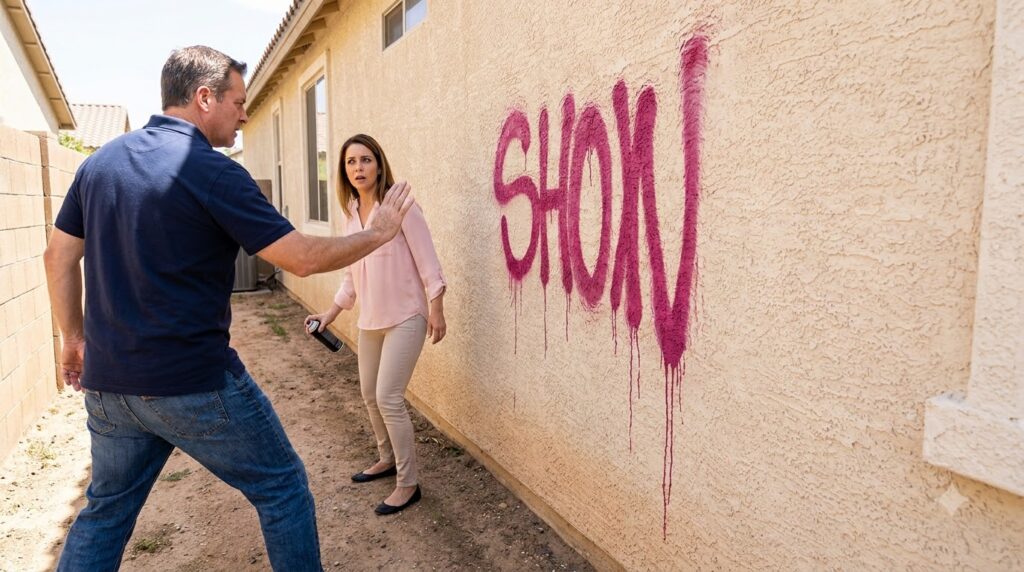
Brenda’s shoulder twitched against Mark’s chest. The panic that had flashed across her face moments earlier didn’t turn into a retreat; it hardened into something far more dangerous. She adjusted her posture in the narrow alley, squaring her shoulders, her hands smoothing the front of her light pink blouse with sharp, frantic snaps of her wrists. She didn’t drop the spray can. She tucked it deeper along her outer thigh, using the flare of her pale trousers to shadow the silver cylinder.
“Mark,” she whispered, her voice tight, vibrating with an icy intensity. “This is your last opportunity to avoid a formal lawsuit. You step back, you let me address the officer, and we handle this as an administrative error.”
Mark didn’t answer. He turned his head toward the front yard as heavy, rhythmic boots crunched across the dry turf at the edge of his driveway.
Deputy Miller rounded the corner of the garage. He was in his late thirties, built broad across the shoulders with a faded utility belt that clinked softly as he walked. His eyes were already moving—taking in the narrow side path, Mark’s broad frame blocking the exit, Brenda’s stiff posture against the stucco, and the thick, unnatural magenta stain glowing in the harsh afternoon light.
Behind the deputy, at the mouth of the driveway, the neighborhood was beginning to gather. Jim from next door was standing by his mailbox in a faded gray t-shirt, his arms crossed over his chest, watching intently. Across the street, two women holding dog leashes had paused on the sidewalk, their eyes fixed on the narrow corridor.
“Afternoon,” Deputy Miller said. His voice was low, flat, and completely devoid of urgency. He stopped three feet from the entrance to the path, his hands resting naturally near his belt buckle. “Got a call regarding a disturbance and property damage.”
Brenda didn’t wait for Mark to speak. She took half a step forward, using the slight gap Mark opened as he turned toward the deputy, her voice projecting clearly over the fence line.
“Deputy! Thank goodness you’re here,” she said, her tone instantly shifting from the harsh whisper in the alley to the practiced, civic warmth of an elected official. “I am Brenda Hollis, Chair of the Architectural Review Committee for the Oakridge Way Homeowners Association. I was conducting an authorized property inspection when this resident physically cornered me in this service passage.”
Deputy Miller’s left eyebrow twitched up a fraction of an inch. He didn’t look at her face; his eyes dropped straight to the dripping magenta mark on the stucco wall behind her shoulder.
“He has been shouting at me, threatening me with physical force, and refusing to allow me to exit to my vehicle,” Brenda continued, her speech accelerating, the words tumbling out in a smooth, rehearsed cadence. “I was attempting to apply a temporary, water-soluble marking compound to highlight an unapproved structural repair—a standard procedure outlined under Article Four, Section Two of our neighborhood bylaws.”
“A marking compound,” Deputy Miller repeated neutrally.
“Yes,” Brenda said quickly, reaching down to her tote bag resting on the gravel near her feet. From the open canvas top, the corner of an official, blue-stamped county document was visible, folded neatly alongside a pair of heavy rubber work gloves. “It’s a chalk-based indicator. It washes off with rain. Mr. Vance has been in continuous violation of community standards for six months, and his refusal to comply with our certified restoration vendors has forced the board to prepare a formal county lien filing.”
Mark stayed silent, letting the sound of her voice carry out to the driveway where Jim and the gathering neighbors were leaning in over the wooden fence line.
Deputy Miller took a slow step into the mouth of the passage. The smell of the solvent hit him immediately, making his nostrils flare. He didn’t look at the paper in her bag. He looked directly at the aerosol can held against her trousers.
“Ma’am,” Deputy Miller said softly. “Set the cylinder down on the fence post.”
Brenda’s jaw tightened. “Deputy, I am the reporting officer for the HOA—”
“I didn’t ask for your title, ma’am,” Miller interrupted, his voice dropping into a quiet, unyielding register. “I asked you to set the can on the post.”
Brenda hesitates for a fraction of a second, her eyes darting to Mark, then to the deputy’s face, before slowly raising the dark, scraped tin cylinder and placing it on the flat wood of the fence picket. A single drop of bright pink pigment clung to the edge of the rim, wet, glossy, and distinctly oil-based.
“Mr. Vance,” Deputy Miller said, turning his head toward Mark. “Is this your property?”
“It is,” Mark said. “And that wall was painted forty-eight hours ago with factory-matched masonry paint. What she just sprayed is industrial enamel.”
Brenda let out a short, sharp laugh—a sound designed for the audience listening at the curb. “That’s absolute nonsense, Deputy. He’s fabricating an excuse to cover up his non-compliant work. I have the structural audit paperwork right here in my bag. I was acting entirely within my legal authority as a representative of the community corporation.”
Deputy Miller looked from the dripping wall to Brenda’s pale trousers, where a faint smear of pink had transferred onto the fabric near her knee.
“We’ll check the paint type in a minute, ma’am,” Miller said, reaching for his notepad. “Right now, I need to know why you’re on his private property without written notice.”
“Article Four gives us full easement access!” Brenda insisted, her voice rising an octave, losing its polished edge as she felt the perimeter of her authority begin to fray under the deputy’s cold, methodical gaze.
Mark didn’t argue the bylaws. He simply reached into his navy jeans pocket and pulled out his phone. “She didn’t come to inspect, Deputy. She came to ruin the wall so her brother-in-law’s company could charge me six thousand dollars to replace it.”
Brenda’s face went completely white. “That is a slanderous lie!”
“And I don’t need to argue about the paint type either,” Mark added, turning the phone screen toward the officer. “Because the whole thing is recorded in four-K.”








