
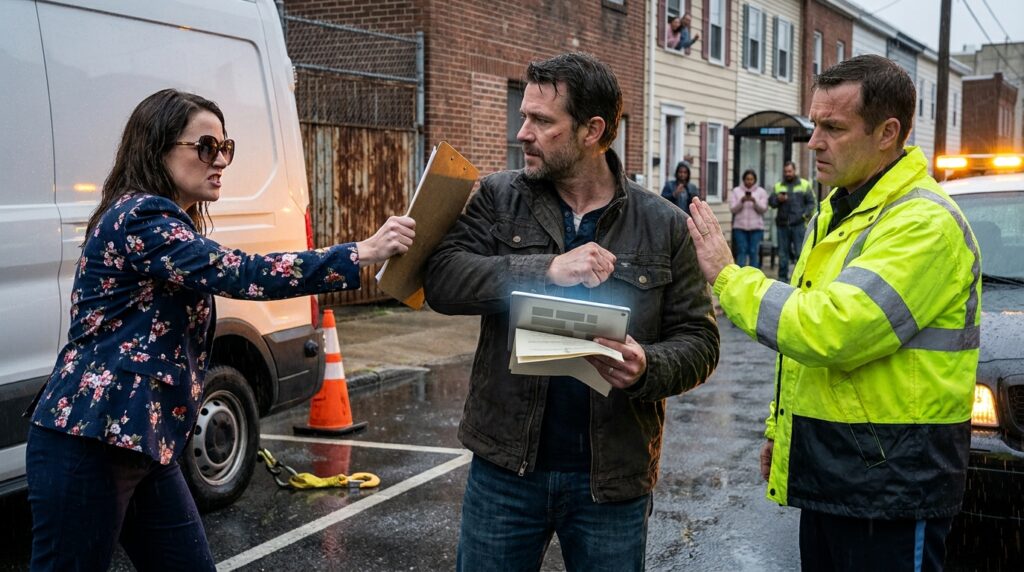
The Weight of the Curb: Defending the Last Free Boundary at Miller and Spruce Against the Quiet Tyranny of the Clipboard

CHAPTER 1: The First Notice

The oil stain on the asphalt beneath the transmission looked like a dark leaf pressed flat under heel. Julian let his hand rest on the steering wheel, his knuckles gray where old scars split the skin. Outside, the morning air smelled of burnt coffee from the bakery across the lane and the damp, iron tang of rusted iron gates.

“Mr. Vance,” the voice cut through the glass before he could turn the key. It was calibrated for school boards and municipal hearings—flat, clipped, and armored with certainty.

Julian rolled the window down two inches. The damp air of Miller and Spruce rushed in, carrying the scent of cut grass that didn’t belong to this patch of gravel. Brenda Gable stood three feet from his fender, her navy floral blazer buttoned tight against the chill. A brass-bound clipboard rested against her hip like a rifle stock, and her oversized sunglasses caught the gray glare of the overcast sky, throwing back his own distorted reflection.

“This loading zone,” Brenda said, tapping a red-tipped pen against the corner of her clipboard, “is restricted to accredited commercial vendors holding current District Three green permits. Your vehicle lacks the designated decal on the lower left windshield.”

Julian looked past her shoulder. Behind her, the row of identical beige townhouses marched down the street, their matching mailboxes gleaming with fresh enamel. They looked clean enough to belong to a brochure, sitting right on top of what used to be his grandfather’s tool shed.

“This isn’t a district stall,” Julian said. His voice was low, worn smooth by years of hauling freight over broken macadam. “It’s deeded to the corner parcel.”

Brenda smiled—a tight, bloodless stretching of the lips that didn’t reach her lenses. “Everything within eighty feet of the municipal curb line falls under the Maplewood Covenants, amended October twenty-first. You have seventy-two hours to clear the vehicle and pay the $300 administrative fee for unpermitted staging. Failure to comply results in daily liens.”

She didn’t wait for an answer. She reached into her blazer pocket, pulled out a thick, yellowed carbon-backed envelope, and slid it under his wiper blade with the practiced flick of a dealer tossing cards.

Julian watched her turn on her heel, her low heels clicking rhythmically against the broken gravel until she reached the safety of the paved sidewalk. In the rearview mirror, the old screen door of his grandfather’s shop hung crooked on its hinges, whining the exact same rusty note it had twenty years ago. The box of ledgers on the front passenger seat pressed against his thigh, heavy with old ink and forgotten taxes.

He reached up, took the yellow envelope from the glass, and slipped it into his jacket pocket without opening it. The weight of it felt familiar—the heavy, useless friction of someone else trying to draw lines around a world they didn’t build.
CHAPTER 2: The Morning Ledger

The yellow carbon paper smelled faintly of cheap glue and wet ink. Julian slid it across the laminate counter of the back room, right beside a chipped ceramic mug that still had his grandfather’s initials faded into the rim. Three hundred dollars. That was the price Brenda Gable placed on an oil stain that had been soaking into the municipal gravel since the Reagan administration.

Outside the narrow frosted glass of the office window, the twin beams of a digital camera swept across the front fence line. Through the gap in the weathered pickets, Julian saw the navy floral blazer cutting a sharp line against the neutral beige of the new townhouses. Brenda’s assistant—a young man with a brand-new high-visibility vest and an expensive DSLR hung around his neck—squatted by the corner post, snapping macro shots of a dandelion pushing through a crack in the concrete apron.

Julian did not rush to the door. He picked up a dry rag, wrapped it around his calloused thumb, and wiped down the casing of the cash register until the metal squeaked under friction. In his line of work overseas, freight didn’t move because you shouted at it; it moved because manifests matched seals, and weights were balanced down to the ounce. Brenda operated on a different kind of logistics—the math of exhaustion. She didn’t need to win a legal argument; she just needed to make the cost of staying higher than the value of leaving.

The front bell chimed, a high, brassy ping that had replaced the low, hollow thud of the old iron clapper.

“Julian?”

It was Susan, the woman from the adjacent lot who lived in the single remaining un-remodeled cottage with a porch roof that sagged three inches toward the east. She didn’t step past the welcome mat; she stood just inside the threshold, her hands buried deep in the pockets of an oversized wool cardigan, her eyes darting toward the street before closing the door behind her with a soft click.

“She’s logging the north fence today,” Susan said, keeping her voice low, raspy from years of inhaling the dust of neighboring construction sites. “The boy with the camera—he’s got a tape measure. Measuring the distance from your gatepost to the public right-of-way. They did that to the Andersons right before the surveyor’s stake appeared on their back lawn. Two weeks later, the lien notice arrived by certified mail.”

Julian set the rag down. The metal surface of the counter reflected the gray light coming off the alley. “The property line hasn’t moved since 1924, Susan.”

“Paper doesn’t weigh anything against a county stamp when the county belongs to the people who bought the zoning board,” Susan murmured, stepping closer, her fingers tightening around something metal inside her pocket. She laid a folded piece of lined notebook paper on the counter. It was torn from a spiral pad, the edges fuzzy. “My husband kept this before he passed. Every time Brenda’s people came by with a clipboard, he wrote down the badge numbers they flashed. Only… they aren’t municipal badges. I looked up the seal on the back of her clipboard last month when she left it on my porch by mistake. It’s a private LLC registry out of the county seat. Not town code. Development code.”

Julian looked down at the paper. The names written there were sparse, but the dates formed a clean, brutal line leading straight from the outer ring of the subdivision right to the edge of his grandfather’s loading dock.

Before he could unfold the note, a heavy, rhythmic pounding rattled the front window glass. Brenda’s silhouette loomed through the frosted pane, her fist striking the wood frame with measured, bureaucratic regularity, demanding immediate access to inspect the interior drainage pipes for unpermitted runoff.

Julian tucked Susan’s note into his breast pocket, feeling the crisp, sharp edge of the fold against his ribs. He walked out from behind the counter, his boots heavy and unhurried on the scarred floorboards, and reached for the latch.

CHAPTER 3: The Tin Box Ledger

The latch of the cellar door gave a dry, splintering pop under Julian’s palm, releasing a puff of stagnant air that tasted of dry rot and lime. He didn’t flip the overhead toggle immediately. Instead, he let his eyes adjust to the pale amber beam of sunlight slanting down the wooden steps, illuminating the floating motes of dust that danced above the concrete floor like fine gray ash.

Every house along this stretch of Miller and Spruce carried the ghosts of its previous layout, but his grandfather’s basement was a literal archive of friction. Stacks of yellowed lumber leaned against the damp concrete foundation; spare PVC pipes and rusted conduit fittings rusted together in sagging metal bins. But against the far western wall, sitting directly beneath the low-slung joists that supported the front parlor, sat the old green metal strongbox with its brass clasp tarnished to the color of wet straw.

Julian descended the stairs, his boots thumping heavily against the warped pine treads. The cold seeped up through the soles of his shoes, biting into his heels. He knelt on the gritty concrete, pulling the box toward him. It weighed heavy—not with gold or jewels, but with the dead, immutable weight of paper.

He didn’t need a key; his grandfather had never trusted locks that could rust shut in a damp cellar. The latch lifted with a dull, heavy scrape.

Inside, organized by decade in faded manila folders marked with grease pencil, lay the history of a silent war. Julian flipped past the receipts for corrugated roofing and seed grain until his thumb caught on a heavy, linen-weave envelope bearing the embossed stamp of the county planning office, dated October 1998. He pulled the documents out, carrying them toward the shaft of amber light.

The top sheet was a hand-drawn blueprint overlaid with official municipal survey lines. The parcel boundaries weren’t the neat, square boxes the new townhouses occupied; they cut across the modern blacktop like an uneven jagged tooth, proving that the entire side turning lane and the lower half of the Maplewood visitors’ parking strip sat squarely on land deeded in perpetuity to the original corner farmstead. Beneath it lay a stack of certified property tax statements, paid in full every single year up through his grandfather’s final months, showing assessments on acreage that the modern neighborhood association maps conveniently labeled as “common community space.”

A folded letter slipped from the back of the folder, landing face-up on the concrete floor. The handwriting was sharp, jagged, and unmistakably his grandfather’s, written in the frantic weeks before his death.

They aren’t trying to fix the neighborhood, Julian, the ink read, the lines pressing so hard through the paper they felt embossed from the reverse side. They’re starving out the title holders one fine at a time so the county tax auction can reclassify the whole strip as blighted commercial re-entry. Don’t pay them. Don’t argue with the clipboard. Make them show the original survey.

Julian stared at the words until the ink blurred at the edges. The cellar door overhead gave a sudden, sharp rattle as a heavy delivery truck rumbled past on the asphalt outside, sending a cascade of loose mortar dust down from the floorboards above. He folded the letter carefully, slid it into his inner jacket pocket alongside Susan’s list of fake badge numbers, and stood up from the cold floor. The math was simple now. Brenda Gable wasn’t an overzealous neighbor; she was the collection arm of a paper machine designed to erase everything his family had built.

CHAPTER 4: The Rain and the Winch

The drizzle on Thursday morning didn’t fall so much as hang in the air, a fine, greasy mist that turned the gravel of the side lot into dark, slick grease. Julian stood under the overhang of the side loading door, wiping condensation from the lens of a handheld pocket tablet. The screen glowed with the continuous-loop feed from the wide-angle camera he had mounted above the lintel two nights before.

At precisely seven-forty-two, the red utility truck turned off Miller Street and cut its engine without silencing the whine of its auxiliary hydraulic pump.

A municipal flatbed tow truck, its amber beacon flashing a sluggish, rhythmic pulse through the gray mist, backed halfway into the loading stall. Brenda Gable stepped out from the passenger side, holding an oversized black umbrella that she tilted just enough to keep her floral blazer dry. Behind her, a burly operator in an oil-stained canvas jacket stepped down, unhooking a heavy yellow tow chain from the flatbed rail.

Julian didn’t wait for her to rap on the glass this time. He stepped out from the shelter of the doorway, his boots splashing into the puddle at the edge of the asphalt.

“You’re off the property, Brenda,” Julian said, his voice carrying easily over the hiss of the idling truck engine.

Brenda lowered her umbrella an inch, her eyes narrowing behind her designer frames. She pointed her free hand toward his delivery van, which was parked square inside the painted lines of the loading bay. “This vehicle is an unpermitted commercial obstruction in a designated fire access lane. Under District Code Section Nine, any vehicle left unattended in a shared thoroughfare during active maintenance hours is subject to immediate impoundment.”

“There’s no maintenance scheduled on this lane,” Julian replied, walking slowly toward the rear bumper of his truck. His fingers brushed the pocket where Susan’s list and his grandfather’s 1998 survey deed rested. “And this isn’t a shared thoroughfare. It’s private commercial property deeded to this parcel.”

“We filed the variance notice three days ago,” Brenda snapped, her voice rising to a sharp edge that bounced off the brick walls of the adjacent bakery, drawing two curious faces to the second-story windows across the lane. “Your seventy-two-hour grace period expired at midnight. Hook it up, Frank.”

The tow operator didn’t hesitate. He tossed the heavy iron hook toward the axle of Julian’s van with a harsh, metallic clatter that rang against the pavement.

Julian didn’t shout. He didn’t lunge for the chain. Instead, he reached into his jacket, pulled out the small tablet, and tapped the screen twice. The display lit up with time-stamped, high-definition video recorded less than twenty minutes earlier. It clearly showed the tow operator—acting on Brenda’s direct hand signal—carrying an orange plastic traffic cone and placing it directly behind Julian’s legally parked vehicle to manufacture an artificial obstruction.

“You can tow the van, Frank,” Julian said, his tone flat and unyielding as he stepped between the operator and the vehicle’s rear bumper, his eyes fixed on Brenda’s face. “But the moment your winch pulls that cable, every frame of this high-definition recording goes straight to the county prosecutor’s desk as evidence of targeted civil extortion.”

The operator froze, his hand still gripping the cold links of the chain. Brenda’s breath hitched, her perfectly calibrated composure fracturing for a fraction of a second as she stared at the glowing blue light of the screen reflecting off the wet asphalt.

CHAPTER 5: The Standoff at the Bay

The sound of tires hissing against the rain-slicked asphalt cut short the heavy silence between the tow operator and the van’s bumper. A black-and-white cruiser bearing the county sheriff star turned the corner from Spruce Street, its rooftop light bar washing a pale, shifting amber across the brick façade of the bakery. Brenda recovered her footing instantly, her face tightening into an expression of aggrieved authority as she stepped around the puddles toward the approaching vehicle.

“Officer Reed!” Brenda called out, her voice pitching up with practiced distress as she waved her clipboard to flag down the cruiser. “Thank goodness. I need this commercial vehicle impounded immediately for aggressive obstruction of municipal maintenance and creating a public hazard.”

The cruiser door creaked open, and Officer Marcus Reed stepped out onto the wet asphalt. He pulled his high-visibility rain jacket tight across his broad shoulders, his boots splashing through the shallow standing water near the curb. He looked past Brenda’s floral blazer to where Julian stood motionless beside the back door of his delivery van, his hands tucked deep into his pockets, fingers curled around the smooth plastic of the tablet.

“What’s the situation here, Mrs. Gable?” Reed asked, his tone flat, exhausted by years of mediating neighborhood boundary disputes that should have stayed in civil court.

“Mr. Vance has ignored four consecutive administrative compliance notices and is currently blocking emergency access to the community loading zone,” Brenda said, stepping in close to block the officer’s direct line of sight to Julian. “He’s operating an uncertified enterprise on a shared easement without association clearance. I have documented every infraction for three weeks.”

Julian didn’t raise his voice as he stepped forward through the steady drizzle. “She hasn’t documented the easements, Officer. She’s manufactured them.”

He pulled the tablet from his coat and extended it, screen active, displaying the high-definition video sequence of the orange cone being placed behind his tires. Beside it, he held out the crisp, linen-weave paper of the 1998 municipal survey deed bearing the county clerk’s original embossing seal.

Brenda’s eyes flicked to the screen, and for the first time, a genuine tremor broke through her composed facade. She reached out with a manicured hand, trying to slap the device downward. “That’s a falsified digital file! He altered the timestamps to undermine community standards!”

Officer Reed held up a single heavy palm, stopping Brenda mid-motion. He took the paper deed, held it under the amber glow of his cruiser’s light bar, and traced his thumb across the raised seal before looking down at the tablet’s playback. The video ran silently: the precise timestamp, the clear angle of the tow operator setting the fake obstruction, and the unmistakable silhouette of Brenda directing the setup.

“Mrs. Gable,” Reed said slowly, his voice dropping into a register that brook no argument, “this parcel holds an independent commercial easement dating back twenty years. It doesn’t fall under Maplewood Association jurisdiction.”

For a long, tense second, the rain was the only sound in the alley. Brenda stood frozen, her floral blazer glistening with mist, her mouth opening to frame another protest before closing as she realized the baseline of her power had evaporated.

CHAPTER 6: The Resistance Beat

Brenda’s fingers curled tight into the fabric of her floral blazer, her knuckles whitening until the skin stretched taut over bone. For a heartbeat, the silence of the alley was absolute, broken only by the rhythmic thrum of the idling police cruiser engine and the heavy patter of raindrops hitting the roof of the tow truck. Then she stepped forward, her posture rigid, throwing off Officer Reed’s guiding arm with a sharp jerk of her shoulder.

“You’re falling for a forged document, Marcus!” Brenda’s voice lost its polished municipal cadence, cracking into a raw, defensive register that scraped against the wet brick walls. She pointed a shaking finger at Julian’s chest. “He’s an outsider. He came back here to disrupt the structural integrity of this district. That survey map is a relic from an era before regional planning codes were established. The association holds plenary authority over every square foot of this blacktop, and if you don’t impound that vehicle right now, I’ll file an ethics grievance with the commissioner before noon.”

The tow operator, his hands still hovering inches from the heavy steel tow chain, looked from Brenda’s flushed face to Officer Reed’s impassive expression. The threat of an ethics complaint usually worked like a charm on local patrolmen, but Reed didn’t flinch. He kept his eyes locked on the county registry seal pressed deep into the linen paper, feeling the distinct, unyielding ridges of the official embossment.

“An ethics grievance doesn’t override a twenty-year county easement, Mrs. Gable,” Reed said quietly, folding the deed once and sliding it into his breast pocket for safekeeping. He turned his gaze back to the tow truck operator. “Drop the line, Frank. The vehicle stays put.”

Frank didn’t wait for a second instruction. With a loud, metallic clank, he threw the winch lever into reverse, letting the heavy iron hook slide off the edge of the asphalt and crash into the wet gravel with a shower of rusted sparks. The cable went slack, coiling like a dead snake across the puddles.

Defeated by the simple weight of legal paper and a ten-second video clip, Brenda’s composure snapped entirely. She lunged forward, her nails clawing toward the screen of Julian’s tablet to swipe the evidence away, her desperation overriding all self-preservation. Julian didn’t flinch or strike back; he simply stepped half a pace to the side, letting her momentum carry her forward past his shoulder.

Brenda stumbled on her high heels against the uneven edge of the curb, her brass-bound clipboard slipping from her grip. It hit the wet macadam with a dull crack, the black cover flying open to scatter loose papers, fake citation pads, and a small corporate stamp bearing the logo of a regional land acquisition firm across the muddy water.

From the second-story window of the bakery across the lane, a window sash creaked open. Susan leaned out, watching the papers float in the greasy puddles, her expression cold and set. Down on the sidewalk, three morning shoppers paused by the bus stop, their phones out, recording the exact moment the clipboard broke open.

Brenda stood frozen in the center of the wet asphalt, staring down at the scattered leaves and ruined papers. For two decades, she had ruled this strip of Miller and Spruce through the quiet terror of arbitrary fines and forged authority. Now, with the rain soaking through her designer blazer and the neighborhood watching from behind every open window, the machinery of her control simply rusted apart in the open air.

CHAPTER 7: The Last Line on the Asphalt

The rain tapered off into a thin, gray mist that clung to the rusted wire of the chain-link fences along Miller and Spruce. Julian stood by the edge of the loading bay, his boots resting right on the invisible boundary line where the county easement met the modern subdivision blacktop. In the center of the wet asphalt, Brenda Gable’s brass-bound clipboard lay abandoned like a discarded tool, its black vinyl cover warped by moisture, its contents scattered across the gravel where the runoff had washed them into gray pulp.

Officer Reed had already rolled up his window and pulled away, the red tail-lights of the cruiser dissolving into the morning commuter smog. Frank, the tow operator, had unhitched his winch and driven off without a word, leaving the heavy steel cable coiled like a sleeping adder beside the curb.

Slowly, doors began to open along the block. First came the heavy, oiled squeak of the bakery’s delivery hatch as the head baker stepped out with a broom to sweep away the fallen leaves. Then, thirty feet down the lane, the front door of Susan’s weathered cottage clicked unhurriedly open. She didn’t look down the street toward where Brenda had vanished down toward the commercial district; she walked straight to her front fence line, unhooked her laundry basket from the porch peg, and began hanging white cotton sheets across the wire with slow, deliberate movements she hadn’t dared make in eight years.

Julian reached down, picked up the county survey deed from where it had fallen, and folded it twice before sliding it back into his inner coat pocket. The paper was cool and damp against his ribs, carrying the permanent weight of an archive that refused to be erased by committees, fake badges, or municipal code theater.

The front bell of the bookstore chimed behind him—the high, crisp ping of the modern replacement that still grated slightly against his ears. He turned and walked back inside, letting the screen door swing shut behind him with its familiar, rusty whine. The air inside smelled of dried paper, old ink, and the clean, untreated timber of the shelves he still needed to build. The street outside was quiet now, cleared of clipboards, cameras, and manufactured panic, leaving the old corner at Miller and Spruce to stand on its own ground, exactly where it had always belonged.

Similar Posts

Leave a Reply

Your email address will not be published. Required fields are marked *






