
CHAPTER 4: The Rain and the Winch
The drizzle on Thursday morning didn’t fall so much as hang in the air, a fine, greasy mist that turned the gravel of the side lot into dark, slick grease. Julian stood under the overhang of the side loading door, wiping condensation from the lens of a handheld pocket tablet. The screen glowed with the continuous-loop feed from the wide-angle camera he had mounted above the lintel two nights before.
At precisely seven-forty-two, the red utility truck turned off Miller Street and cut its engine without silencing the whine of its auxiliary hydraulic pump.
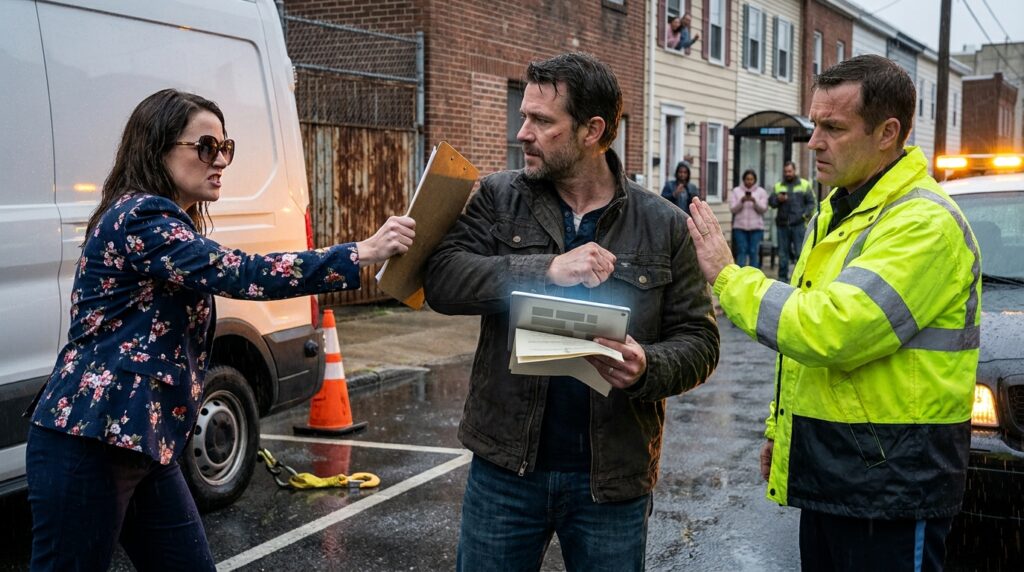
A municipal flatbed tow truck, its amber beacon flashing a sluggish, rhythmic pulse through the gray mist, backed halfway into the loading stall. Brenda Gable stepped out from the passenger side, holding an oversized black umbrella that she tilted just enough to keep her floral blazer dry. Behind her, a burly operator in an oil-stained canvas jacket stepped down, unhooking a heavy yellow tow chain from the flatbed rail.
Julian didn’t wait for her to rap on the glass this time. He stepped out from the shelter of the doorway, his boots splashing into the puddle at the edge of the asphalt.
“You’re off the property, Brenda,” Julian said, his voice carrying easily over the hiss of the idling truck engine.
Brenda lowered her umbrella an inch, her eyes narrowing behind her designer frames. She pointed her free hand toward his delivery van, which was parked square inside the painted lines of the loading bay. “This vehicle is an unpermitted commercial obstruction in a designated fire access lane. Under District Code Section Nine, any vehicle left unattended in a shared thoroughfare during active maintenance hours is subject to immediate impoundment.”
“There’s no maintenance scheduled on this lane,” Julian replied, walking slowly toward the rear bumper of his truck. His fingers brushed the pocket where Susan’s list and his grandfather’s 1998 survey deed rested. “And this isn’t a shared thoroughfare. It’s private commercial property deeded to this parcel.”
“We filed the variance notice three days ago,” Brenda snapped, her voice rising to a sharp edge that bounced off the brick walls of the adjacent bakery, drawing two curious faces to the second-story windows across the lane. “Your seventy-two-hour grace period expired at midnight. Hook it up, Frank.”
The tow operator didn’t hesitate. He tossed the heavy iron hook toward the axle of Julian’s van with a harsh, metallic clatter that rang against the pavement.
Julian didn’t shout. He didn’t lunge for the chain. Instead, he reached into his jacket, pulled out the small tablet, and tapped the screen twice. The display lit up with time-stamped, high-definition video recorded less than twenty minutes earlier. It clearly showed the tow operator—acting on Brenda’s direct hand signal—carrying an orange plastic traffic cone and placing it directly behind Julian’s legally parked vehicle to manufacture an artificial obstruction.
“You can tow the van, Frank,” Julian said, his tone flat and unyielding as he stepped between the operator and the vehicle’s rear bumper, his eyes fixed on Brenda’s face. “But the moment your winch pulls that cable, every frame of this high-definition recording goes straight to the county prosecutor’s desk as evidence of targeted civil extortion.”
The operator froze, his hand still gripping the cold links of the chain. Brenda’s breath hitched, her perfectly calibrated composure fracturing for a fraction of a second as she stared at the glowing blue light of the screen reflecting off the wet asphalt.








