
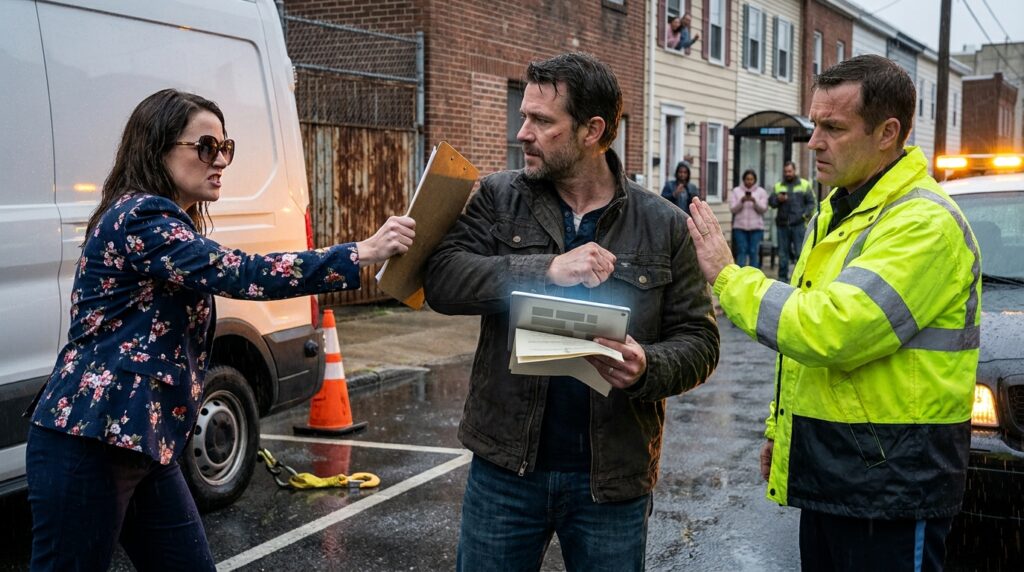
CHAPTER 7: The Last Line on the Asphalt
The rain tapered off into a thin, gray mist that clung to the rusted wire of the chain-link fences along Miller and Spruce. Julian stood by the edge of the loading bay, his boots resting right on the invisible boundary line where the county easement met the modern subdivision blacktop. In the center of the wet asphalt, Brenda Gable’s brass-bound clipboard lay abandoned like a discarded tool, its black vinyl cover warped by moisture, its contents scattered across the gravel where the runoff had washed them into gray pulp.
Officer Reed had already rolled up his window and pulled away, the red tail-lights of the cruiser dissolving into the morning commuter smog. Frank, the tow operator, had unhitched his winch and driven off without a word, leaving the heavy steel cable coiled like a sleeping adder beside the curb.
Slowly, doors began to open along the block. First came the heavy, oiled squeak of the bakery’s delivery hatch as the head baker stepped out with a broom to sweep away the fallen leaves. Then, thirty feet down the lane, the front door of Susan’s weathered cottage clicked unhurriedly open. She didn’t look down the street toward where Brenda had vanished down toward the commercial district; she walked straight to her front fence line, unhooked her laundry basket from the porch peg, and began hanging white cotton sheets across the wire with slow, deliberate movements she hadn’t dared make in eight years.
Julian reached down, picked up the county survey deed from where it had fallen, and folded it twice before sliding it back into his inner coat pocket. The paper was cool and damp against his ribs, carrying the permanent weight of an archive that refused to be erased by committees, fake badges, or municipal code theater.
The front bell of the bookstore chimed behind him—the high, crisp ping of the modern replacement that still grated slightly against his ears. He turned and walked back inside, letting the screen door swing shut behind him with its familiar, rusty whine. The air inside smelled of dried paper, old ink, and the clean, untreated timber of the shelves he still needed to build. The street outside was quiet now, cleared of clipboards, cameras, and manufactured panic, leaving the old corner at Miller and Spruce to stand on its own ground, exactly where it had always belonged.








