
CHAPTER 2: The Morning Ledger
The yellow carbon paper smelled faintly of cheap glue and wet ink. Julian slid it across the laminate counter of the back room, right beside a chipped ceramic mug that still had his grandfather’s initials faded into the rim. Three hundred dollars. That was the price Brenda Gable placed on an oil stain that had been soaking into the municipal gravel since the Reagan administration.
Outside the narrow frosted glass of the office window, the twin beams of a digital camera swept across the front fence line. Through the gap in the weathered pickets, Julian saw the navy floral blazer cutting a sharp line against the neutral beige of the new townhouses. Brenda’s assistant—a young man with a brand-new high-visibility vest and an expensive DSLR hung around his neck—squatted by the corner post, snapping macro shots of a dandelion pushing through a crack in the concrete apron.
Julian did not rush to the door. He picked up a dry rag, wrapped it around his calloused thumb, and wiped down the casing of the cash register until the metal squeaked under friction. In his line of work overseas, freight didn’t move because you shouted at it; it moved because manifests matched seals, and weights were balanced down to the ounce. Brenda operated on a different kind of logistics—the math of exhaustion. She didn’t need to win a legal argument; she just needed to make the cost of staying higher than the value of leaving.
The front bell chimed, a high, brassy ping that had replaced the low, hollow thud of the old iron clapper.
“Julian?”
It was Susan, the woman from the adjacent lot who lived in the single remaining un-remodeled cottage with a porch roof that sagged three inches toward the east. She didn’t step past the welcome mat; she stood just inside the threshold, her hands buried deep in the pockets of an oversized wool cardigan, her eyes darting toward the street before closing the door behind her with a soft click.
“She’s logging the north fence today,” Susan said, keeping her voice low, raspy from years of inhaling the dust of neighboring construction sites. “The boy with the camera—he’s got a tape measure. Measuring the distance from your gatepost to the public right-of-way. They did that to the Andersons right before the surveyor’s stake appeared on their back lawn. Two weeks later, the lien notice arrived by certified mail.”
Julian set the rag down. The metal surface of the counter reflected the gray light coming off the alley. “The property line hasn’t moved since 1924, Susan.”
“Paper doesn’t weigh anything against a county stamp when the county belongs to the people who bought the zoning board,” Susan murmured, stepping closer, her fingers tightening around something metal inside her pocket. She laid a folded piece of lined notebook paper on the counter. It was torn from a spiral pad, the edges fuzzy. “My husband kept this before he passed. Every time Brenda’s people came by with a clipboard, he wrote down the badge numbers they flashed. Only… they aren’t municipal badges. I looked up the seal on the back of her clipboard last month when she left it on my porch by mistake. It’s a private LLC registry out of the county seat. Not town code. Development code.”
Julian looked down at the paper. The names written there were sparse, but the dates formed a clean, brutal line leading straight from the outer ring of the subdivision right to the edge of his grandfather’s loading dock.
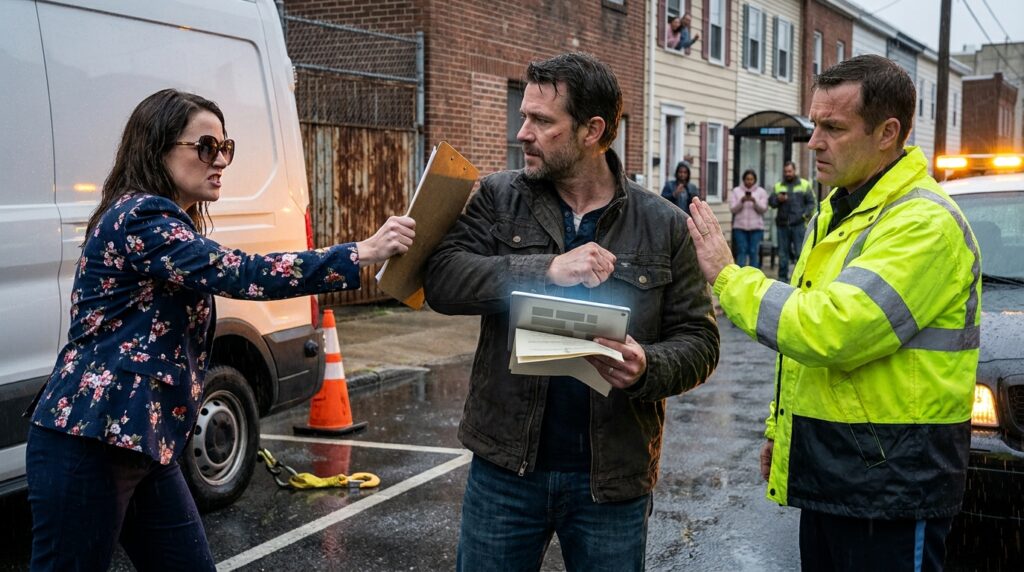
Before he could unfold the note, a heavy, rhythmic pounding rattled the front window glass. Brenda’s silhouette loomed through the frosted pane, her fist striking the wood frame with measured, bureaucratic regularity, demanding immediate access to inspect the interior drainage pipes for unpermitted runoff.
Julian tucked Susan’s note into his breast pocket, feeling the crisp, sharp edge of the fold against his ribs. He walked out from behind the counter, his boots heavy and unhurried on the scarred floorboards, and reached for the latch.








