
The Mechanics of Friction and the Cold Weight of Unyielding Iron
CHAPTER 1: THE COEFFICIENT OF DRAG
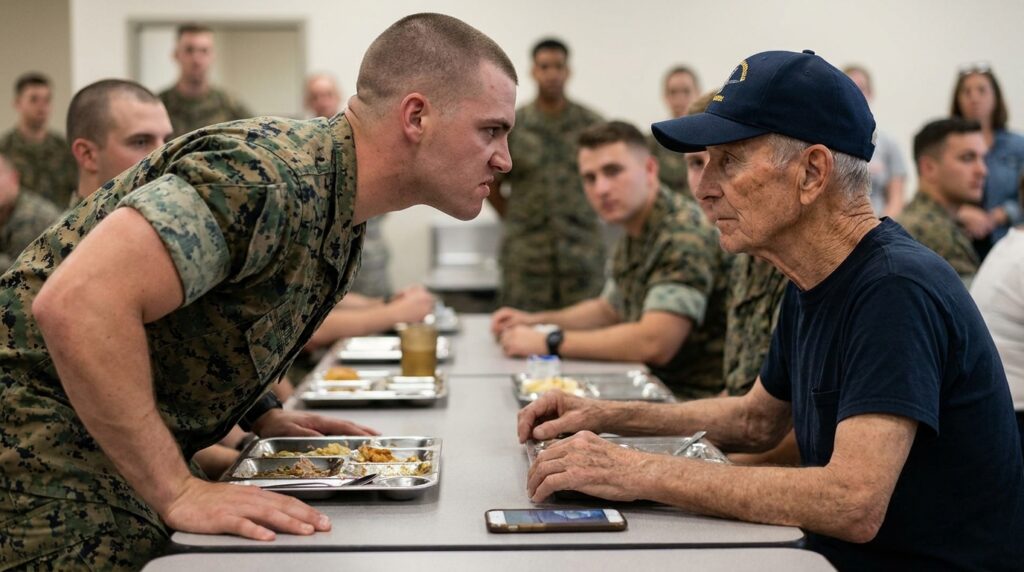
The laminate tabletop had been scrubbed down with low-grade institutional disinfectant until the original green pattern had faded to the color of wet river silt. Under the glare of the dual-tube fluorescent fixtures, every scratch in the plastic surface looked like a shallow trench on an aerial map. I kept both palms flat on the surface, matching the pressure of my hands to the cold steel rim of the tray frame. The tea inside the heavy ceramic mug had stopped steaming five minutes ago black, bitter, and smelling slightly of the copper pipes in the scullery.
Across the center aisle, the air carried the scent of hot ironed utilities and raw grease. The noise of three hundred recruits shifting on fiberglass benches ran through the concrete floor like a low-frequency motor. They were young, thick-necked, and loud in a way that only people who haven’t seen an engine failure are loud. They moved with the jerky, uncalculated speed of fresh hydraulics.
“You look across the row and you see it every Tuesday,” a voice said. It was louder than the mess hall’s ambient chatter, timed to hit the gap between the clatter of the dish-return slots. “The old guard comes back to look at the new paint. Like they’re trying to remember what a real day of labor feels like.”
I didn’t turn my head. If you look at an engine when it starts to click, you lose the ability to judge the timing by ear. I tracked the sound. Late twenties. A heavy, repetitive shift of weight from the left hip to the right. The leather of his new issue boots was stiff, unyielding, squeaking against the salt-pitted floor coating.
“Some people don’t know when the shift is over,” the voice came again, closer now. The shadow of a broad shoulder cut across the white glare on my laminate section.
My navy cap sat exactly three inches to the left of the tea mug. The insignia wasn’t bright gold anymore; the salt air of the yards forty years back had turned the wire thread into a dull, green-gray crust that looked like dry moss. To the kid standing there, it probably just looked like dirt.
A hand entered my peripheral view. It was large, the skin unmarred by grease scars or wire burns, the camouflage sleeve pinned to a sharp, stiff crease at the forearm. He didn’t drop it on the table yet. He held it four inches above the edge, letting his forward lean carry his center of gravity past his heels. An unstable configuration.
“Hey, Uncle,” the kid said. His breath smelled of the high-calorie protein bars they gave out at the supply cage. “I’m talking to you.”
The room didn’t go silent all at once. It died in sections, beginning with the table behind him where three other recruits sat with their forks suspended halfway to their mouths. The silence spread outwards, a drop of oil hitting a clean water surface, flattening the ripples until the only sound left was the mechanical thrum of the ventilator intake in the ceiling.
I looked up, letting my neck adjust slowly to the angle. His face was wide, the buzz cut so close the pink skin of his scalp showed through the dark hair. He had a small, white scar right at the corner of his jawline—fresh, probably from a careless razor or a snagged lanyard during basic training.
“You think experience matters here, prove it right now,” he whispered. He lowered his hand, his fingers spreading out across the laminate until his thumb grazed the plastic lip of my tray.
My left hand stayed flat, the fingers identifying the microscopic ridge where the steel border met the plastic core. My right thumb moved exactly one eighth of an inch, touching the crown of the old silver watch on my wrist. The glass face was scratched so deeply that the second hand seemed to disappear behind a gray veil every time it passed the nine. Behind the recruit’s shoulder, in the dark gap near the service doors, a face I hadn’t seen in nineteen years stood perfectly still, watching from the shadow of the supervisor’s cage.

CHAPTER 2: THE INTERACTION LANE
The silence in the mess hall was not a clean thing. It was thick with the smell of scorched lard from the galley vents and the damp, metallic tang of gray floor sealant that had been scrubbed raw by generations of green-stripping pads. My right thumb remained on the notched crown of the silver watch. Sixty seconds to the minute. The click inside the casing was a vibration I felt in the bone of my wrist rather than a sound, a faint, rhythmic drag that told me the mainspring was pitting.
The recruit’s hand didn’t move from the laminate surface. Up close, the white glare of the fluorescent tubes caught a smear of industrial lithium grease on the seam of his right sleeve cuff—a fresh mark, the specific heavy lubricant they used on the old hydraulic tracks down in the low-level supply channels. It was an unforced error. A trainee on this base should have been handling dry graphite or synthetic spray, not the old lard-thick compounds meant for obsolete iron.
“You’re crowding the tray, son,” I said. My voice didn’t carry past the third row of fiberglass benches, but in the dead air, it had the dry, abrasive quality of coarse emery paper sliding over a rusted plate. “The grease on your cuff is going to ruin the finish on that utility shirt.”
The kid’s fingers twitched, but his palm stayed anchored. His chest expanded, the stiff, unwashed cotton of his camouflage blouse rasping against his undershirt with a sound like dry grass under a boot. He didn’t look down at his sleeve. He couldn’t. To break eye contact now would be a failure of his own internal friction, a loss of the momentum he had spent three loud comments building across the aisle.
“I don’t care about the shirt,” the recruit whispered. The skin around his nostrils had turned a sharp, bloodless white. He shifted his weight again, his right boot heel grinding into a salt-pitted pockmark in the concrete floor. The leather groaned under the torque. “And I don’t take suggestions from people who are just waiting around for the afternoon bus. You didn’t answer the question.”
Behind him, the room had settled into a hard, competitive stillness. The junior soldiers at his table had stopped their forks completely. One of them, a kid with grease under his fingernails and an unbuttoned collar, slowly lowered his plastic mug until it hit the tray with a dull, hollow click. Nobody reached for their pockets. Nobody moved their feet. In an American mess hall under an unwritten rank structure, a challenge like this was an operational sequence that had to run its course until something broke or someone with silver on their collar stepped through the fire doors.
I kept my eyes on the small white razor scar at the corner of his jaw. The tissue was slightly raised, an imperfect heal that showed he had a habit of turning his head too fast while the blade was moving. He was relying on the mass of his shoulders—the raw, gym-built bulk that didn’t take into account the natural pivot points of a human frame when it’s anchored to a slick floor.
“The question,” I told him, keeping my arms loose against the cold steel rim of the tray, “was about proof. But you haven’t established the baseline yet. You’re leaning forward four inches past your boots. If the deck rolls five degrees to the port side right now, you’re on your face without me touching a finger to your shirt.”
A low rustle passed through the benches behind him—a micro-shift of boots against steel runners. Someone in the back cleared their throat, the sound sharp and short, like a dry stick snapping in winter.
The recruit’s face darkened, the pink skin under his buzz cut turning the color of raw brick. His fingers curled, his nails scraping a gray streak into the worn laminate pattern between our trays. “There aren’t any ships here, old man. This is dry dirt. This is the present day.”
“The dirt is never dry under a concrete slab,” I murmured. My hand slid one inch to the right, my fingers lightly touching the edge of the navy cap. The green-gray wire thread of the insignia felt rough under my skin, like frozen sand. “The water tables under these old coast batteries always find the seams. You can smell the rust in the floor drains if you know how to breathe through your nose.”
He didn’t take the warning. His shoulder dropped three inches, his center of gravity shifting deeper into the table lane as his elbow locked out. He was preparing to press his palm into the center of my tray, a classic service-entry flex meant to push an older man’s spine back against the bench support. It was a simple, mechanical calculation based on the assumption that seventy-eight years of age meant thirty percent less structural resistance in the lumbar vertebrae.
I watched the lithium grease mark on his sleeve move another half-inch closer to my cold tea. In the dark gap by the supervisor’s cage, the face from nineteen years ago didn’t move. The old man standing there just reached up and unhitched a brass key ring from his belt loop, the metallic rattle small but distinct across the dead space of the room. The sound was a trigger I didn’t need, but it confirmed the architecture. The lane was locked.
CHAPTER 3: THE TOLERANCE LIMIT
“The present day doesn’t change the coefficient of drag,” I said, my fingers remaining perfectly still against the lip of the tray. “You can put three hundred thousand tons of new superstructure on an old hull, but if the keel is pitted with oxidation, the sea still finds the math.”
The recruit’s shoulder dropped another quarter of an inch. His breath came faster now, a dry, rapid scraping through his nostrils that indicated his pulse had climbed past one hundred. Under the stiff camouflage utility cloth, his trapezius muscles were locked, white-knuckled under the skin from pure, unchanneled tension. He was committed to the forward lean, his boots so far behind his center of mass that his entire weight was riding on the friction of his right palm against my table section.
Across the aisle, the kid with the unbuttoned collar let his hand drop completely from his tray. The silence had deepened from an expectant lull into a dense, oppressive vacuum where the clank of the overhead ventilation fan sounded like an axe hitting dry timber. Every eye in the third row was fixed on the space between our trays—the specific four inches of scratched green plastic where the recruit’s grease-smeared sleeve cuff hung like a weight.
“You like the sound of your own clock, don’t you?” the recruit said, his voice dropping into a harsh, tight register that lacked the volume to clear the row but carried the full force of his insecure anger. “You talk about keels because you can’t touch the modern hardware. You don’t know what a digital hydraulic load looks like.”
“I know what the grease looks like,” I murmured, my gaze shifting precisely from the white razor scar on his jaw down to the dark smear on his cuff. “That’s lithium three. High-pressure marine compound. They haven’t used it on upper-tier base equipment since the nineties because it breaks down when the salinity hits four percent. If you’re pulling that off a modern hydraulic rod, someone in the machine shop is lying to your logistics officer.”
A small, rhythmic clank-clank sounded from the dark corridor near the supervisor’s cage—the deliberate, measured impact of a heavy brass key striking an iron door frame. It wasn’t an alarm, but it was a rhythmic signal, a sequence I had memorized during the winter of ninety-six when the sea-pipes froze in the lower gallery. The face in the shadow didn’t move, but the rhythm of the iron keys remained steady. Two strokes, then a three-second delay. A warning that the low-level pressure valves were hunting.
The recruit’s eyes drifted toward the sound for a fraction of a second—an operational error that cost him his remaining leverage. When his gaze snapped back to my face, his jaw was clamped so tightly the muscle below his ear looked like a knotted rope. “We don’t have a marine shop on this side of the ridge. You’re hallucinating, old man. You’re living in the old storage manuals.”
“The manuals are still printed on oil-paper because cotton rots when the drains back up,” I told him. My right hand remained loose, but my forearm adjusted its angle by three degrees, my elbow finding the structural seam where the bench frame was bolted directly through the concrete slab into the sub-deck iron. “You think this building is sitting on solid shale. You haven’t looked at the drainage manifests for the third tier.”
He didn’t listen to the architecture. His left hand came up from his side, his fingers hooking into a rigid curve as he prepared to grab the edge of my tray and jerk it six inches toward his chest—a classic leverage-breaking movement intended to drop my face forward into the cold tea. His weight shifted onto his toes, his heels lifting slightly from the salt-crusted floor. The stiff leather of his issue boots gave a short, high-pitched squeak against the gray sealant.
The room held its collective breath. A trainee three tables down slowly closed his fingers around his paper napkin, his knuckles turning white as he calculated whether to stand or stay behind his bench line. The unwritten rules of the base structure were clear: if a recruit initiated contact with an older civilian figure within the administrative perimeter, the entire unit shared the collective liability until the duty officer signed the daily log.
I let my shoulders sink an eighth of an inch, allowing the heavy wool of my old Navy t-shirt to absorb the residual vibration of the concrete floor. The watch on my wrist gave its faint, mechanical click. The time was precisely twelve minutes past the noon bell. The logistics manifest down in the sub-tier was already twelve minutes out of tolerance, the gray clearance card in my shirt pocket cold against my ribs.
“One more inch,” the recruit whispered, his face leaning down until I could see the individual broken capillaries around the bridge of his nose, the sweat beginning to gather in the fine stubble of his buzz cut. “One more line about the old days, and I’ll show you how we clear the deck in the current cycle.”
I didn’t answer with text. I merely loosened the thumb of my right hand from the watch crown, allowing my palm to turn upward, open and dry, against the scarred green laminate.
CHAPTER 4: THE FULCRUM AND THE VECTOR
The kid’s fingers reached the steel rim of the tray, his knuckles turning the color of lard under the strain of his leap. He didn’t pull back. He drove his center of mass down, his boots slipping three inches on the gray floor sealant as he tried to pin my forearms between the metal casing and his chest. It was a standard line-force entry, the kind they teach in the physical security course to isolate an uncooperative subject before the lock-irons are applied.
But he had already given away his leverage. By leaning four inches past his baseline, his vertical axis was completely dependent on the resistance of my tabletop.
I didn’t slide my chair back. I rose vertically, using the direct iron framing of the bench seat to lift my hips three inches before his left hand could lock under the lip of the zinc plate. My right hand, still open and dry against the laminate, didn’t fight his fingers. It went under his forearm—exactly two inches behind the wrist bone, where the heavy utility sleeve met the lithium grease stain on his cuff.
The physics of a seventy-eight-year-old skeleton are different from the physics of twenty. You do not use muscle against hydraulics; you use the angle of the pin.
I rotated my palm toward the light tubes, forcing his locked elbow to turn outward by five degrees. It was a minor mechanical adjustment, a single turn of a valve, but it shifted his forward momentum from a direct push into a lateral slide. His boots, already compromised by the salt-crust on the concrete floor, lost their remaining grip. The stiff leather gave a sharp, dry bark against the gray sealant.
The room didn’t move. The hundred pairs of eyes locked onto the row saw the recruit’s chest drop onto the table lane, his broad shoulders overextending as his balance disintegrated. He tried to correct by dropping his right hip into the table frame, but his mass was moving too fast down the vector he had chosen.
I kept my hand behind his wrist, not pulling, simply maintaining the pivot point until his own weight carried him past the edge of the laminate. His shoulder hit the iron bracket of the fiberglass bench with a hollow, metallic boom that sounded like a heavy hatch slamming in an empty hold.
The momentum took him down completely. His knees cleared the floor runner, his camouflage blouse catching on a loose zinc bolt under the table frame before his entire length flattened against the concrete deck. He landed on his side, his hands out to guard his face, his breath exiting his lungs in one short, wet rattle that killed the last remaining echo of the cafeteria chatter.
The silence that followed was different from the waiting quiet of two minutes ago. It was absolute. The mechanical thrum of the ventilator intake seemed to drop an octave, the cold air smelling suddenly of old bilge water and ancient, pressurized grease from the floor drains. Three rows over, a plastic fork slipped out of a junior soldier’s hand, hitting the fiberglass surface with a sound that felt as loud as a starter pistol.
I stood beside the table, my feet anchored to the seam where the concrete plates met the drainage line. My palms were cold, the skin dry, my heart rate steady at seventy beats. I looked down at the recruit. His buzz cut was three inches from my boot heel, his face turned toward the floor, the razor scar on his jaw dark red against his pale skin. He wasn’t bleeding, but his eyes were wide, staring at the grey floor sealant as if trying to calculate the mathematical error that had put him on the deck.
The navy cap had slid three inches during the shift, resting against the ceramic mug. From beneath the faded wire insignia, the edge of an old gray card protruded—a thick, laminated plastic corner showing a serial number printed in black indelible ink that had begun to bleed into the borders. It wasn’t an base pass. It was an old logistics identifier, the gray color reserved for the units that didn’t appear on the morning manifest.
Behind the recruit’s shoulder, the figure in the dark corridor near the supervisor’s cage took two steps forward, entering the fringe of the fluorescent glare. The brass key ring on his belt loop didn’t rattle this time. He held a small, heavy folder under his arm—the canvas binding rotted around the brass eyelets, the paper inside showing the gray edges of forty-year-old blueprint stock. He didn’t look at the kid on the floor. He looked at the watch on my wrist, his thumb tracing the iron latch of his supervisor’s gate.
“The seal on the third tier is down to twelve pounds,” the old man from the cage said. His voice was lower than mine, the words sliding across the dead space of the room like a heavy cable scraping over a fairlead. “They’ve been running the digital pumps since seven, but the lines are full of silt from the marsh drains. The kid didn’t read the manual.”
I reached down and picked up the navy cap, my thumb covering the gray card before the trainees at the nearest bench could identify the serial prefix. The wire insignia felt cold under my hand, the gray-green crust rough against my skin.
“They don’t print the manuals for silt,” I told him, looking down at the recruit who was slowly beginning to bring his hands under his chest to push his mass off the floor. His movements were slow now, his hydraulics leaking air. “They think the iron stays clean if you keep the grease off the shirt.”
CHAPTER 5: THE WEIGHT OF THE FOUNDATION
“Now sit down and eat,” I said.
My voice didn’t rise above the persistent hum of the ceiling intake, but it reached the edge of the row with the flat, unnotched weight of a dropped lead plumb. The recruit was still down. His large hand, the skin scraped raw along the outer knuckle where it had grazed the iron seat bracket, was pressed flat against the gray floor sealant. A patch of dark purple fluid was beginning to seep through the white grout line right under his thumb—not blood, but the thick, bitter hydraulic oil that ran through the low-level drainage gates.
He didn’t look up immediately. His broad shoulders remained curved over his ribs, his chest expanding in rapid, uneven jerks that smelled of salt-crusted canvas and dry protein meal. The three junior trainees at his table sat perfectly frozen, their forks suspended like small zinc teeth against the white light of the fluorescent tubes. The entire middle tier of the mess hall had become a dead lane.
“The manual doesn’t include the silt because the people who write the specifications don’t live on the lower tier,” I told the space between his ears. I pulled the navy cap down until the frayed edge of the brim cleared the line of my forehead. The gray laminated plastic card stayed tucked deep behind the wire anchor insignia, its sharp edge pressing against the knuckle of my index finger. “They assume the pressure stays steady because the gauge on the wall has a green light. But the light is just a bulb. It doesn’t clear the lines.”
The recruit slowly pulled his right knee under his hip, his boot leather giving a short, wet grunt as it slid through the purple grease patch. His face was gray now, the small razor scar at the corner of his jaw showing white and rigid against his skin. His arrogance had been redirected, but it hadn’t turned into respect yet; it had settled into the dull, defensive confusion of an animal that has run full-tilt into an iron stanchion.
“You’re done with the table lane, son,” I murmured, my hand returning to the edge of my tray. The black tea in the ceramic mug didn’t move. The mass of the building was too dense to allow local vibrations, but beneath the concrete slab, five yards down through the drainage vents, a heavy, dull thud-clank echoed through the iron piping—the unmistakable sound of an automated valve hunting for a seal that had been eaten away by salt water thirty years back.
Behind the recruit, the old man from the supervisor’s cage didn’t take another step. He stood at the edge of the light tier, his canvas folder clamped under his arm like a scrap of dry timber. He didn’t offer a hand to the kid on the deck. His thumb was busy tracking the notch on his largest brass key, his attention fixed entirely on the floor seam where the purple fluid was widening into a shallow pool.
“The duty officer is already past the second checkpoint,” the old man said from the shadow lane. His teeth were yellowed, his words carrying the flat, dry accent of the old yards down near the river mouth. “He’s got the computerized manifest on his tablet. He thinks the third tier is empty because the logistics register says the door was welded shut during the re-coring in ninety-eight.”
“The re-coring only went down to the zinc line,” I said, without turning my head toward the shadow. I looked at the junior trainees who were slowly beginning to lower their eyes back to their cold trays. “They didn’t replace the backing plates under the foundation bolts. They just painted over the scale.”
The recruit finally found his feet. He rose slowly, his right hand gripping the edge of the laminate table until the plastic groaned under the localized torque. He didn’t look at his squad mates. He stood three inches shorter than he had two minutes ago, his posture compromised by the bruise forming beneath his camouflage blouse where the iron bracket had intercepted his ribs.
“This isn’t an base station,” the kid whispered, his teeth clicking together once from the involuntary chill that follows a sudden loss of kinetic stability. He wiped his greasy palm against his leg, leaving a dark, wide smear across the crisp camouflage pattern. “You’re… you’re not on the roster. I checked the administrative manifest at the gate before the morning shift.”
“The morning shift is for the people who handle the paper,” I told him, my fingers tightening slightly on the ceramic mug. “The people who handle the iron don’t use the gate. We stay with the foundations until the weight shifts.”
A loud, metallic buzz cut through the dead air of the mess hall—the secondary warning horn from the main gatehouse across the quadrangle. It wasn’t the fire alarm; it was the specific, three-beat pattern that signaled a pressure drop in the high-pressure water mains that serviced the fire-suppression grid. To the recruits, it was just a noise that meant the next detail was delayed. To me, it was the sound of the marsh water finding the third seam in the underground ordinance silo right under our boots.
The old man near the supervisor’s cage turned his back to the room, his heavy work shoes clicking against the iron grate of his door runner as he stepped back into the dark. The brass key ring gave one short, final rattle before the latch clicked home, locking the blueprint folder inside the zinc-lined cabinet where the moisture couldn’t touch the paper.
I picked up my tray, my steady hands balancing the weight of the cold tea and the untouched meal remains. The recruit didn’t move out of the lane. He stood there, his chest still heaving slightly, his eyes fixed on the gray plastic corner that was now peaking clearly from the inner seam of my navy cap—a gray marker that didn’t match any security level taught in the current basic cycle.
“Sit down and finish the lard,” I said, stepping past his shoulder into the clear aisle. “You’ve got twenty minutes before the valves go to manual, and you’re going to need the grease on your hands before the afternoon is over.”
CHAPTER 6: THE DISCREPANCY IN THE MANIFEST
The grease on my boots left a thin, iridescent film across the steel floor plate of the dish-return alcove. I set the tray into the structural slot, the zinc surface scraping against the plastic rim with a short, high-pitched screech that cut cleanly through the lingering silence of the middle aisle. Behind me, the recruit hadn’t returned to his bench. His shadow stayed fixed against the white glare of the middle row, his broad shoulders slightly dropped, his posture holding the precise imbalance of a mechanical component whose casing has been warped by an unexpected load.
The fire doors at the north end of the hall swung open with a heavy, pressurized hiss. A master warrant officer entered, his utility blouse stiff with starch, the black leather of his clipboard holder tucked firmly into the pocket formed by his left elbow. His name tape read VANCE. He didn’t look at the trainees. He didn’t look at the purple hydraulic fluid slowly widening its perimeter along the center grout line. His eyes were fixed entirely on the small supervisor’s cage near the scullery doors, his boots striking the concrete with a quick, rhythmic cadence that stopped exactly six inches from my shoulder.
“The main line is down four pounds, sir,” Vance said. His voice was low, clipped, using the non-commissioned officer’s cadence that assumes the room is always listening for an operational error. He didn’t address me by name, but his eyes dropped to the navy cap in my left hand, tracking the green-gray thread of the insignia until his jawline tightened. “The automated system at the station gatehouse says the valve is locked out at the manual station. We’ve got an administrative discrepancy on the logistics tablet.”
The recruit took two steps toward the alcove, his boots squeaking against the wet gray sealant. His face was still pale from the structural drop, but the sight of the master warrant’s starch seemed to activate his residual training line. He straightened his spine, his hands pinning themselves against his seams, though his left side still hitched slightly from the contact with the table bracket.
“Sir,” the recruit barked, his voice cracking slightly before it caught the institutional frequency. “The civilian was… he was clearing the lane without an updated base pass. I attempted to enforce the administrative perimeter as per the morning briefing.”
Vance didn’t turn his head to look at the kid. He kept his clipboard flat against his ribs, his thumb lifting the heavy iron spring of the retaining clip by an eighth of an inch. “Stand down, trainee. Your detail hasn’t been signed off by the machine shop supervisor. You’re out of your assigned division.”
“But the card, sir,” the recruit pressed, his insecure pride forcing him to push past the warrant’s verbal boundary—an error that usually resulted in extra duty hours at the wash racks. “He’s got a gray ledger card in the cap liner. It’s an expired serial. It doesn’t match the current database.”
Vance finally shifted his gaze, his gray eyes locking onto the recruit’s face with the flat, unyielding weight of an anvil dropping into sand. “I said stand down, son. The database only covers the hardware that requires electricity to turn. If you’ve got grease on your shirt, you belong in the lower maintenance bay, not interpreting the manifests in the dining tier.”
The low clank-clank sounded again from the dark corridor behind the supervisor’s cage—sharper now, the metallic impact carrying the high-frequency ring of steel hitting cold water. The purple fluid in the grout lines was no longer stagnant; it was pulsing in small, rhythmic surges that indicated the return lines from the underground silo were backing up against the primary floor drains. The smell of old iron and sulfur was beginning to rise through the copper vents, heavy enough to turn the air inside the alcove cold and thick.
I reached into the cap liner, my fingers catching the smooth, heavy corner of the gray laminated card. I didn’t hand it to Vance. I merely held it flat against the zinc edge of the dish-return slot, letting the white fluorescent light hit the faded black indelible numbers stamped across the center: SYS-04-DECOM.
Vance looked down at the prefix. The starch in his collar seemed to hold his head perfectly rigid, but I felt the micro-shift in his weight as his boot heels cleared the wet grease patch on the plate. He didn’t touch the clipboard. His right hand came up slowly, the movement unhurried but exact, his fingers forming a stiff, level line against the brim of his utility cap. A formal salute inside a base cafeteria—a direct violation of the standard regulatory handbook, but a mandatory structural correction according to the older unwritten manual of the tier yards.
“The gatehouse didn’t receive the clearance log from the lower silo,” Vance said, his hand remaining fixed at his brow while the three rows of junior trainees behind him slowly began to slide off their fiberglass benches to see who owned the name on the gray plastic. “The duty officer thought the decommissioning manifest was completed in ninety-eight.”
“The paper was completed,” I told him, my voice flat against the hiss of the fire doors as they began to close behind us. “The iron is still down there. And it’s hunting for a ground.”
The recruit’s hands slowly slipped from his seams, his jaw dropping an inch as he watched the master warrant hold the salute against the background noise of the clattering dish slots. The white razor scar on his jaw looked thin and sharp against his skin, a small mechanical mark that had no value inside a room where the foundations were beginning to leak.
CHAPTER 7: THE CLOSING MANIFEST
The master warrant officer’s fingers remained locked against the sharp brim of his utility cover. He didn’t drop the hand. In the cold, desaturated glare of the alcove, his posture held the absolute rigidity of a cast-iron pillar supporting a dead load. Behind his shoulder, the junior trainees at the front benches had stopped shifting completely; their bodies were frozen in varying degrees of mid-movement, their faces turning toward the gray plastic card resting on the zinc ledge like men watching a crack open in a structural retaining wall.
The recruit’s breathing had slowed to a shallow, rhythmic wheeze. He stared down at Vance’s salute, his eyes traveling from the starch-stiff cuff of the warrant’s sleeve down to the dark purple fluid that had now reached the toe of his own boot. The liquid was thicker here, leaving a sticky, iridescent glaze over the pitted concrete. It smelled of fifty years of stagnant storage oil, a dense, metallic rot that had been sealed behind four feet of subterranean masonry until the automated pumps had forced the valves past their tolerance.
“Class dismissed, son,” I said to the recruit.
My voice didn’t rise, but inside the narrow tile lane of the dish-return, the words had the heavy, flat impact of an iron hatch dropping into a rubber seat gasket. The kid didn’t answer. He backed out of the table lane one slow inch at a time, his stiff leather boots sliding through the grease without a sound. His broad shoulders were curved forward now, the raw, gym-built mass of his chest collapsing under the weight of an institutional hierarchy he hadn’t known existed when he signed the morning detail log.
The watch on my wrist gave its final, muffled click. The time was precisely twenty-two minutes past the noon bell.
Beneath the deck, five yards down through the drainage vents, the mechanical vibration changed its frequency. The high-pitched whine of the digital system didn’t cut out all at once; it began to hunt, the pitch dropping into a low, guttering growl as the silt from the marsh drains completely choked the internal impellers. The concrete floor plate beneath my boots vibrated with a short, sharp shiver—a micro-settlement of the foundation plates that caused the black tea inside my ceramic mug to slosh over the rim, leaving a dark, circular stain on the green laminate table.
The old man from the supervisor’s cage stepped out fully into the light tier, his heavy work shoes clicking against the iron drainage grate. He didn’t look at the warrant, and he didn’t look at the trainees. He laid the canvas folder onto the table right beside my cap, his thumb pressing into the rotted twine of the binding until the weathered paper stock split open along the spine.
The top sheet wasn’t a modern digital layout. It was an original linen draft from nineteen fifty-two, the lines drawn in faded blue indelible ink that had begun to lift from the fibers. The title block in the lower corner was stamped in the same black ink as my card: SUB-TIER 3 – SPECIAL ORDINANCE BASE STRUCTURE. Across the center of the cross-section, a thick red line had been drawn by hand through the backing plates of the primary foundation bolts—a structural warning marker that indicated the existence of a permanent, uncorrectable shear fault where the shale slope met the concrete anchor block.
“The digital manifest only tracks what’s connected to the network,” I told Vance, my hand coming down over the edge of the canvas folder to keep the old paper from curling under the draft from the ventilation fan. “But the network doesn’t hold the weight of the hill. When the tide comes up through the marsh drains, the pressure doesn’t look at the tablet screen. It looks for the thinnest piece of iron.”
Vance slowly lowered his hand, his arm dropping to his side with a stiff, calculated mechanical precision. His gray eyes remained fixed on the red line on the blueprint, his jawline locked until the muscle beneath his ear showed white through the tan skin. He didn’t check his electronic tablet. He knew the math on the linen was absolute; he knew that the modern base infrastructure had been built directly over a cold-storage vault that had been officially forgotten because the truth was too heavy for the current administrative budget to carry.
“We have two divisions of recruits in the lower barracks section,” Vance whispered, his voice losing its clipped, non-commissioned authority, dropping into the raw, flat register of a soldier who has just recognized a fatal alignment on his map. “The duty officer has them on a four-hour maintenance hold.”
“Then you’d better move them to the upper tier before the afternoon shift begins,” I said, picking up the navy cap and sliding the gray laminated card back behind the wire anchor insignia until it was fully dark. “The silt isn’t going to wait for the machine shop supervisor to sign the log.”
I turned away from the alcove, my old work shoes finding the dry line along the outer wall where the purple fluid hadn’t yet reached the grout. The old man from the cage followed me into the exit corridor, his heavy brass keys giving one short, clean rattle as he swung the supervisor’s gate shut behind us.
Behind our shoulders, the mess hall remained completely silent. The hundred junior trainees stayed frozen behind their rows of green tables, their forks still suspended mid-air, their eyes tracking my navy cap until the heavy iron fire doors swung shut with a slow, pressurized hiss that locked the old architecture back into the dark.







