
The Static Weight of Iron and Ash: A Reckoning on the Desolate Asphalt Verge
CHAPTER 1: THE FRICTION OF EXILE
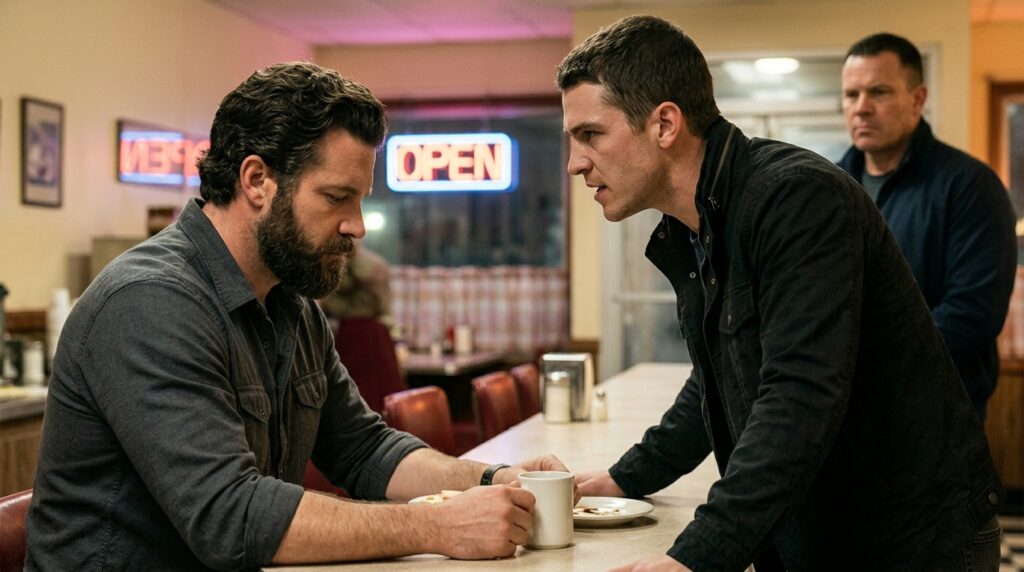
“Get the hell off the stool, old man.”
The words smelled of cheap menthols and stale adrenaline. The younger one leaned in so close his gold-plated chain rattled against the laminate edge of the counter. Elias didn’t look up from his coffee. The surface of the lukewarm liquid had a thin skin of grease reflecting the flickering neon outside—red, blue, dead space, then red again.
To Elias’s left, the older partner stood in the aisle, hands buried deep in the pockets of a stiff car coat, his weight shifted slightly onto his heels. He wasn’t a brawler; he was the anchor. He was the one tracking the exits.
“You’ve been occupying this vinyl for three weeks,” the young one said, his voice dropping an octave, trying to find the bottom of the room. “The manager’s too polite to tell you the smell of wet wool is bad for business. We aren’t.”
Elias let his thumb trace the ridged rim of the heavy ceramic mug. The silver pocket watch lay beside his saucer, its glass face scratched, the hands frozen precisely at 4:12. The metal was cold against the heat of his palm when he drew it closer. The grease on the counter left a gray smear where the watch had rested. Everything in this county had a film on it—dust from the limestone quarry five miles north, iron shavings from the defunct rail yard, the soot of people burning wood they shouldn’t be burning.
“I’m drinking,” Elias said. His voice was low, sand-scraped, transactional. He didn’t want the words to cost him more than they had to.
“You’re done drinking,” the young one shot back. A hand came down, fingers splayed across the Formica, inches from the ceramic mug. The knuckles were raw, bitten by the dry winter air. “Move.”
Elias stood.
He didn’t scramble or brace. He simply ceased to be sitting. The transition was a sudden, heavy expansion of mass that caught the younger man mid-breath. Before the kid could pull his hand back from the counter, Elias’s left palm took him by the chin, forcing the skull backward until the spine hit the edge of the adjacent booth with a hollow thud.
The older partner moved with the practiced economy of a man who spent his life in small rooms. His right hand came out of the car coat, the gray metal of a compact revolver catching the neon glare.
Elias didn’t try to clear the distance. He grabbed the heavy ceramic coffee mug by its handle and drove it laterally into the side of the older man’s jaw. The porcelain didn’t break—it was thick, institutional grade—but the sound of bone giving way was flat and wet. The revolver clattered against the checkerboard linoleum, spinning twice before stopping against the base of a vending machine.
The older man folded, his shoulder catching the corner of a stool before his bulk settled into the narrow aisle, his breathing turning into a ragged, wet whistle.
The younger one was on his knees now, clutching his throat, his face the color of old lard as he tried to pull air past a bruised larynx.
Elias stood in the center of the gap. His breath came in steady, deliberate cycles through his nose. His knuckles were gray from the counter-grime, the skin over his index finger split slightly, leaking a dark, sluggish red. He reached into his apron pocket—the one he wore out of habit, though he didn’t work here—and pulled out a stiff white kitchen towel. He wrapped it twice around his right hand, squeezing until the throbbing settled into a dull, manageable ache.
The diner was entirely silent now, save for the refrigerator compressor under the pie case, which kicked on with a dry, mechanical rattle. The cook wasn’t looking through the hatch; he’d gone into the freezer three minutes ago and locked the latch from the inside.
Elias looked down at the older man’s coat. A corner of stiff, yellowish paper protruded from the interior breast pocket—not a wallet, not a badge, but a folded vehicle registration certificate with a county seal that didn’t belong to this district. It belonged two counties over, where the water table was dead and the chemical plants ran twenty-four hours a day.
He didn’t pick it up. Not yet. He heard the gravel outside shift under the weight of an approaching chassis that didn’t have its headlights on.

CHAPTER 2: THE SEDIMENT OF DECEIT
The headlightless chassis ground against the deep gravel outside, the sound low and heavy like teeth chewing on dry bone. Elias didn’t blink. He kept his feet planted in the narrow aisle between the blood-speckled linoleum and the laminated booths. Beneath his boots, the older man’s breathing had devolved into a wet, rhythmic rattling, each exhale bubbling through a fractured jaw.
Elias knelt. The movement was stiff, his knees popping with the distinct crack of ungreased machinery. He didn’t look toward the glass door where the shadows were shifting. Instead, his wrapped fingers reached into the internal pocket of the car coat. The coarse wool rasped against his split knuckles as he tore the folded yellowish paper free.
The smell of old iron and damp cellar rot clung to the document. In the dim, red-and-blue strobe of the exterior neon, the ink looked almost black. It was a standard vehicle registration, but the header didn’t carry the crest of this municipality. It was stamped with the seal of Oakhaven County—fifty miles east, a place where the refineries had turned the soil into sour sulfur.
The name on the registry wasn’t the younger kid currently choking on his own saliva by the stools. It was registered to a holding company: Vanguard Land Management LLC.
A shadow cut the neon glare through the diner’s front pane. A man stepped onto the concrete apron, his boots leaving damp, grey paste on the threshold. He wore a dark canvas jacket, a standard-issue leather utility belt, and a tan Stetson pulled low enough to shade his eyes from the interior fluorescent glare. Deputy Miller.
Miller didn’t draw his weapon. He didn’t have to. His right hand rested casually on the butt of his sidearm, his thumb hooked over the retention strap with the lazy familiarity of someone who owned the county roads. He looked at the older man on the floor, then at the kid, and finally his gaze settled on Elias and the yellow paper gripped in his wrapped fingers.
“You make a hell of a mess for a man who doesn’t exist, Elias,” Miller said. The deputy’s voice had the dry, rhythmic drag of a locust in August. He didn’t sound angry; he sounded tired, like an accountant looking at a column of figures that refused to balance.
“They brought the mess with them,” Elias said. He didn’t rise from his knee. He stayed low, using the edge of the booth as a partial shield against Miller’s line of sight. “They’re using Oakhaven plates. Registered to a corporate outfit.”
Miller took a slow step into the diner, his heels clicking against the checkerboard tiles. He didn’t look at his fallen townspeople; he looked at the silver pocket watch sitting on the counter by the cooling coffee. “A lot of things are registered to corporate outfits these days. The rail yard. The limestone quarry. Even that stool you’ve been warming for three weeks. The world gets small when people start buying up the dirt under your fingernails.”
“They weren’t sent by the syndicate,” Elias noted, his voice flat, testing the weight of the assertion. He watched Miller’s eyes. “The old people I worked for didn’t use local paper. They didn’t hire kids who telegraph their weight before they swing.”
Miller reached out with his left hand, picked up the frozen silver watch, and turned it over in his palm. His thumb grazed the deep scratch across the casing. “The old people you worked for don’t have a vote anymore, Elias. Things change. People die. Structures get re-evaluated. The sheriff wants this county clean before the state inspectors come down to certify the new rail corridor. An old ghost sitting in a corner booth looks like a stain on the ledger.”
The younger kid on the floor made a sharp, gurgling sound, his fingers clawing at the base of a diner stool. Miller didn’t look down. He just pushed the silver watch into his jacket pocket.
“The sheriff didn’t send these two to talk,” Elias said. His eyes dropped to the floor, tracking a dark trail of fluid creeping from beneath the older attacker toward Miller’s boot. Beside the pool lay a small, tarnished metal token that had slipped from the kid’s pocket during the struggle—a rusted key tag stamped with the number 114.
“No,” Miller agreed softly. “They were supposed to put you in the back of that unlit truck and dump you over the county line where the lime pits are. Clean. Professional enough for government work. But you had to go and remind everyone why you were expensive in the first place.”
Miller shifted his weight, his leather belt creaking under the tension. His hand remained on his holster, his fingers twitching slightly against the leather. “Now I’ve got two broken citizens in a public establishment and a cook who’s going to have to testify to the circuit judge about who broke them. That makes my night very long, Elias.”
“Then let’s shorten it,” Elias said. He began to stand, his eyes never leaving the deputy’s shoulder alignment. The kitchen towel around his knuckles was already turning a muddy rust color where his own blood was seeping through. “Tell me what’s in room 114.”
Miller paused, his face hardening into a desaturated mask under the flickering neon. The lazy cadence of his posture vanished, replaced by the rigid stillness of a predator that had just realized the track it was following ended behind its own shoulder. He didn’t answer with words; instead, his thumb flipped the leather retention strap on his holster with a sharp, metallic click.
The front door behind Miller didn’t open, but the glass rattled as a second vehicle pulled into the lot, its heavy diesel engine vibrating through the floorboards of the diner, shaking the grease-filmed windows until the silence tore completely.
CHAPTER 3: THE HIGHWAY EXCHANGE
The diesel outside didn’t idle; it vibrated through the floorboards like a low-frequency hum in a failing turbine. The vibration traveled up through the cast-iron base of the diner stools, shaking the cold residue of Elias’s coffee until tiny concentric rings rippled across the grease-skinned surface.
Deputy Miller didn’t draw. His fingers remained wrapped tightly around the grip of his sidearm, but his shoulder blades went rigid under his khaki uniform. He was listening to the air brakes. The sharp hiss of pneumatic pressure outside signaled something heavy—something that didn’t belong to the county fleet.
“Get out,” Elias said. The words weren’t a plea. They were an assessment of weight.
“I don’t leave a crime scene when I’m the one holding the ink, Elias,” Miller spat back, though his gaze flicked toward the neon-streaked window. A white commercial transport truck, long and salt-crusted from the state interstates, was backing into the lot with a rhythmic, mechanical beep. Its mudflaps were caked with the gray mud of the Oakhaven industrial flats. “The sheriff told me to expect an escort if things went sideways. He didn’t say anything about an iron-sided hauler.”
Elias moved. His boots made no sound on the checkerboard linoleum as he bypassed the groaning kid and reached down to scoop up the small, tarnished metal token with the number 114 stamped into its brass face. It was cold against his split thumb. He slipped it into his palm, his fingers curling tightly around the edges until the ridges bit into his flesh.
He didn’t look back at the older partner who was now motionless, his breath coming in shallow, desperate gasps that smelled of iron. Elias walked straight past Miller, his shoulder brushing the deputy’s canvas coat. The scent of damp wool and gun oil lingered in the narrow gap between them. Miller didn’t swing his gun around. The transactional logic of the room had shifted; the threat wasn’t inside anymore.
The diner door whined on its rusted hinges as Elias stepped out into the midnight air. The temperature had dropped, turning the limestone dust from the quarry into a gritty, freezing fog that hung over the pumps. The diesel truck had stopped near the edge of the asphalt verge, its engine rattling like a sack of nails. The driver didn’t get out. The cab windows were tinted dark enough to look like blocks of solid obsidian under the single amber mercury lamp.
A man stepped out from the shadow of the garage bay adjacent to the diner—not the driver, but someone who had been waiting in the unlit office where the old tractors were left to rot. He wore a heavy rubberized slicker that crinkled with every movement, his face hidden beneath a grease-stained ball cap. He carried a clipboard with a rusted zinc clip.
“The sheriff said there’d be two packages to load,” the man in the slicker said. His voice was completely devoid of local inflection—flat, corporate, mid-western. He looked past Elias toward the glass front of the diner, where Miller was now visible, standing by the counter like a wax figure. “He didn’t say anything about you being on your feet.”
“The packages are broken,” Elias said, stopping ten feet from the transport truck’s massive rear door. The smell of raw fuel and burnt rubber was thick here, clinging to the back of his throat like a film. “And the paper they brought has a Vanguard stamp on it. That’s a corporate liquidation asset line, not a county warrant.”
The man with the clipboard paused. He didn’t reach under his slicker. Instead, he adjusted his grip on the zinc clip, the paper rustling softly in the freezing draft. “Vanguard owns the lease on the county line, friend. They own the road you’re standing on, they own the well under the diner, and they own the debt on Miller’s cruiser. The sheriff is just the asset supervisor. If he told you this was a local matter, he was lying to keep the price down.”
Elias looked at the side of the truck. In the dim amber light, he could see where the old lettering had been ground off with an angle sander, leaving jagged, bright silver whorls on the rusted sheet metal. Beneath the fresh black primer, the faint ghost-image of a serial code was still visible: CORP-LOG-04.
“The syndicate sold the contract,” Elias muttered, the truth settling like lead in his stomach. The realization didn’t bring anger; it brought the cold, analytical focus of a protector whose perimeter had just grown five times larger. “They didn’t retire me. They liquidated the division.”
“The syndicate doesn’t exist anymore,” the man in the slicker replied, his tone conversational, almost polite. He tapped his pen against the board. “The debt was restructured three months ago after the compliance audit. Old liabilities are being cleaned out by territory. We aren’t here for a feud, Elias. We’re here for the physical audit. The sheriff was supposed to handle the local discrepancies before the rail corridor transition, but he’s old. He thinks in terms of graves, not balance sheets.”
The passenger door of the diesel truck opened with a dry, pneumatic hiss. A sharp metallic click echoed from the interior of the cab—the unmistakable sound of a heavy bolt sliding home in a steel receiver.
Elias didn’t wait for the muzzle flash. He lunged laterally, his boots grinding into the coarse gravel as he hit the rusted fender of Miller’s parked cruiser just as a high-velocity round tore through the diner’s plate-glass window behind him. The sound of the explosion was flat and compact, swallowed instantly by the vast, empty night of the highway.
Inside the diner, the neon sign died with a loud, spitting pop, plunging the room into the absolute gray of the mountain fog.
CHAPTER 4: THE LIQUIDATION PERIMETER
The shockwave of the high-velocity round chewed a jagged semicircle out of the diner’s brick fascia, showering the gravel lot in a spray of freezing red dust and pulverized lime. Elias didn’t wait for the glass to finish falling. He crawled hard along the flank of Miller’s parked cruiser, his boots digging into the loose stone, his hands sliding over rusted iron chassis frames and cold, grease-slicked leaf springs.
Above him, the driver-side door of the cruiser swung open with a heavy metallic click. Miller didn’t look at Elias. The deputy dropped his heavy frame onto the seat, twisted the ignition key until the starter motor groaned in protest, and rammed the gear selector into reverse. The tires bit, throwing a rooster-tail of loose aggregate directly into Elias’s face, but the sudden movement provided the distraction Elias required.
He rolled clear of the grinding rear wheels, shifting his weight into the deep, weeds-choked drainage ditch that separated the diner lot from the perimeter fence of the county land development office next door. The metal links of the chain-girt barrier were orange with rust, flaking off in dry, rough scales under his grip as he hauled himself over the top rail. The iron bar bit into his ribs, cold and unyielding, a reminder of the borders he had spent three years trying to ignore.
Behind him, the diesel transport truck accelerated, its heavy tires roaring against the wet asphalt verge. It didn’t pursue the cruiser. It didn’t have to. The man in the rubberized slicker had already discarded his clipboard; it lay in the mud by the gas pumps, the paper soaking up a dark rainbow of spilled diesel.
Elias dropped onto the far side of the fence, his knees absorbing the impact against a concrete slab that once supported an industrial generator. The air here was thicker, smelling of oxidized copper and the dead, wet grass of early winter. He was inside the compound now. The local development office was an oblong brick box built during the rail boom forty years ago, its windows protected by iron bars that had rusted into their stone sockets until they looked like rows of rotted teeth.
He used the brass token—the one stamped 114—to scratch the corrosion off the latch of the basement utility door. The metal of the tag was softer than the iron bolt, its edges shaving down into tiny yellow curls of brass dust that mixed with the rust on his bleeding fingers. It wasn’t a key, but the mechanical interface was simple: the token’s thick flange matched the alignment groove of an old master-key padlock used by the county utility board before the restructuring. He slammed a heavy limestone fragment down onto the brass wedge, forcing the cylinder to shear with a dull, flat crack.
He stepped into the dark.
The interior didn’t smell like a government office. It smelled like dry-rotted paper, burnt transformer oil, and the sharp, vinegar tang of decomposing microfilm. Elias drew a pocket flashlight from his belt—its aluminum casing scratched down to the bright white metal—and clicked the switch. The beam was weak, yellowed by a dying battery, but it caught the rows of olive-drab filing cabinets stretching into the gloom.
He didn’t search for names. He searched for codes. He knew how corporate asset registers operated; they didn’t list people as targets, they listed them as capital liabilities under territorial headings.
He found the drawer marked District 7 – Infrastructure & Clearance. The handle was stiff, the iron sliders grinding against decades of accumulated grit before opening with a screech that echoed off the bare concrete ceiling. Inside, the manila folders weren’t organized by property deeds or names. They were stamped with the identical black logo he had seen under the primer on the transport truck: Vanguard Land Management LLC.
Elias pulled a thick ledger from the center of the stack. His wrapped fingers left dark smears across the crisp, legal-weight pages. He didn’t find the sheriff’s name on the title deed. He found something far more surgical.
The county hadn’t authorized a buyout. The county had been dissolved.
A localized civil corporate transition order, dated three months prior, detailed the transfer of all public infrastructure—including the sheriff’s department budget, the land registry, and the municipal waste sectors—to a blind trust managed by an automated liquidation system in the state capital. The sheriff wasn’t running an extortion scheme to protect his retirement; he was an independent contractor executing an automated eviction protocol generated by an algorithm that didn’t know Elias’s name, only his risk rating.
The decoy secret—the idea of a localized, corrupt lawman clearing out a competitor—crumbled into nothingness. The sheriff was just a cog that had already been replaced.
A footstep sounded on the floorboards directly above Elias’s head. It wasn’t the heavy, dragging heel of Miller, nor was it the quick, light step of the kid from the diner. It was the synchronized, rhythmic thud of double-soled tactical boots moving in pairs. The institutional cleaners had bypassed the diner entirely. They had followed the trail of his blood straight to the repository.
Elias clicked off the flashlight, the darkness swallowing him whole as the smell of ozone from a freshly cut security door began to drift down the stairs.
CHAPTER 5: THE LIQUIDATION HORIZON
The dark was an iron weight, thick with the rot of thirty-year-old municipal bond paper and the cold grease of decaying rollers. Elias froze behind the lip of the olive-drab cabinet, his weight shifted onto the balls of his boots. Above him, the stairs vibrated—a cold, rhythmic crunch of sand and limestone dust beneath heavy soles. Two pairs. They didn’t use flashlights. They moved with the clinical, unhurried certainty of men who owned the night because their equipment mapped the room in infrared sweeps.
“The registry drawer is unlatched,” a voice muttered from the baseline of the steps. It wasn’t the flat mid-western drag of the truck driver. It was neutral, crystalline, clipped by a radio headset filter. “Target has accessed the physical asset log. Layer 1 compromised.”
Elias didn’t breathe through his mouth. The taste of raw copper and burnt transformer oil clung to his teeth. He slipped the thick ledger under his left arm, his wrapped right hand trailing along the rusted side-rail of the shelving unit. The metal surface was coarse, pitting into his flesh like dry salt. His fingers found what he was looking for: a loose three-quarter-inch structural bolt holding the rack to the floorboard. It had rusted through its washer ten winters ago. He didn’t pull it; he just rested his thumb against the edge, waiting for the gap to narrow.
A thin green lattice of laser light flicked across the top of the filing cabinets, painting the peeling paint in sharp, glowing segments. The sweep was four inches above his head. They were clearing the lanes methodically.
“Confirming deletion parameters,” the second voice said, closer now. The sound of a nylon tactical vest scraping against an iron stanchion came from thirty feet to Elias’s left. “Corporate clearance code seven-dash-alpha. All local infrastructure assets are now designated as scrap. Proceed with mechanical liquidation of the district.”
Elias twisted his wrist. He didn’t strike out at the men; he threw his mass against the rusted vertical support of the third filing rack.
The structure didn’t just fall—it disintegrated. The iron frames, loaded down with five tons of dead-weight tax logs from the collapse of the rail era, groaned once before shearing their anchors. A cascade of oxidized metal, heavy cedar boxes, and thousands of compacted paper sheets slammed into the center aisle with a deafening, dry roar that filled the basement with a choking cloud of gray limestone silt.
The green laser lines vanished into the dust. A compact, muffled burst of automatic fire spat through the gray haze, the rounds thudding harmlessly into the backing of an iron safe forty feet away.
Elias was already moving through the ventilation tunnel behind the furnace. The concrete was rough, scraping the skin off his shoulders as he dragged his bulk through the narrow square conduit. The ledger under his arm was a stiff, unyielding slab, the edges curling against his ribs. He emerged into the freezing fog of the rear yard behind the development office, his chest heaving, his nose filled with the sharp stench of damp earth and diesel exhaust.
The lot was empty. Miller’s cruiser was gone, leaving only two parallel black ruts in the gray mud where the tires had spun out. The white commercial transport truck remained at the edge of the asphalt verge, its engine still rattling like a box of iron spikes, its black Obsidian windows reflecting the dead grey light of the approaching dawn.
Elias walked to the driver-side door. His knuckles were raw, the white kitchen towel now completely black with grease and dried red fluid. He didn’t draw a weapon because he didn’t have one. He reached up and pulled the handle.
The cab was empty. The keys were still in the rusted ignition barrel, the brass ring vibrating against the plastic steering column. On the passenger seat lay a small thermal printer, its paper roll still spitting out narrow strips of gray data.
Elias reached in and tore the latest strip from the serrated teeth of the machine. The print was cold, the ink purple and fresh. It wasn’t a list of names or an arrest warrant. It was a single automated log entry from the central server in the state capital:
DISTRICT 7 LIQUIDATION: 94% COMPLETE.
REMAINING DISCREPANCIES: ASSET 04-ELIAS.
RECONCILIATION METHOD: CIVIL AUTOMATION BYPROXY.
NEXT AUTO-UPDATE: 06:00.
The pocket watch in his coat—the one Miller had taken—lay on the dashboard, its scratched crystal catch-lighting the cold light of the horizon. Miller hadn’t kept it. He had left it here on the console like a marker on a fresh grave. Elias picked it up, his thumb running over the frozen hands set at 4:12.
He looked down the long, desaturated stretch of the highway. The fog was lifting, revealing nothing but miles of empty grey asphalt, telephone poles wrapped in rusted wire, and the distant, smoking stacks of the Oakhaven refineries. The syndicate hadn’t betrayed him. His old life hadn’t caught up with him. The world had simply grown too mechanical to let an unmapped man sit in a corner booth.
He climbed into the cab, his boots leaving gray limestone mud on the rubber matting. He didn’t turn back toward the diner. He rammed the heavy gear lever into first, the iron teeth of the transmission grinding in protest before locking into place, and drove out onto the empty verge as the mechanical clock on the server began its final descent toward six.
CHAPTER 6: THE REFINERY VEIN
The steering wheel of the salt-crusted transport truck lacked a leather grip; it was bare, hard vulcanized rubber that vibrated against Elias’s torn palms until his split skin felt numb. The dashboard clock didn’t work, but the thermal printer on the passenger seat continued its flat, dry hiss, spitting two inches of narrow purple tape into the footwell every time the vehicle crossed a grid sector line.
Elias didn’t look at the paper anymore. He kept his eyes fixed on the three skeletal silhouettes rising out of the lime fog five miles ahead—the fractionating towers of the old Oakhaven petrochemical complex. They looked like rusted spikes driven into the belly of the low-hanging gray sky. The air coming through the cracked driver-side wing vent changed within two miles, losing the dry, powdery trace of the limestone quarry and turning thick with the smell of sulfur, stagnant river water, and oxidized copper.
The road didn’t have lanes here. The asphalt had surrendered to thirty years of heavy chemical hauling, buckling into high, gray ridges that scraped against the truck’s undercarriage with a dull, industrial metallic rasp.
He didn’t slow down for the main gate. The chain-link barrier had already been flattened months ago, its iron posts bent flat into the mud like teeth knocked out of a jaw. The truck’s heavy steel bumper cleared the remaining wire with a sharp, dry ping that echoed across the empty asphalt marsh.
Elias steered the rig down the central conduit between two rows of dormant cooling basins. The water inside was green and dead, skin-filmed with petroleum scum that caught the dim morning glare like oil on a knife blade. He stopped the vehicle twenty yards from the base of Tower 3—the only structure in the five-hundred-acre grid that showed a sign of active current. A modern, gray fiber-optic line, entirely free of rust, was bracketed directly into the flaking iron shell of an old pump house, its clean plastic sheath looking like a parasitic vine feeding on a carcass.
He killed the ignition. The heavy diesel clattered twice before settling into a silence that felt heavier than the engine’s roar.
Elias reached over, took the ledger from the desk area, and tucked it beneath his canvas coat. His right hand was still wrapped in the black-streaked kitchen towel; the linen had stiffened as the fluid dried, turning into a rigid cast that kept his fingers fixed in a curved, transactional hook. He stepped down from the cab into four inches of iron-stained silt.
The pump house door didn’t have a handle. The lock barrel had been bored out and replaced with a black electronic proximity pad that blinked with a single, unhurried red pulse every three seconds. Elias didn’t look for a key card. He reached down to the base of the exterior cooling unit where a heavy copper ground pipe entered the foundation. The pipe was branded with a machine-stamped serial tag that matched the prefix on his printout: VANGUARD-SYS-07.
He didn’t pry the casing. He used his left hand to draw the silver pocket watch from his pocket and pressed its scratched steel back directly against the interface terminals of the low-voltage sensor line running parallel to the ground pipe. The watch didn’t tell time, but its internal mainspring was a tightly coiled strip of high-tensile steel. When he forced the metal casing down, bridging the gap between the live copper ground and the digital return loop, the watch casing grew hot enough to smell of old pocket lint, and the electronic pad on the door gave a soft, high-pitched click as its safety relay tripped.
The door drifted open two inches. The interior air was cold—unnaturally cold, chilled by a heavy-duty air conditioning unit that ran on an independent circuit somewhere behind the concrete wall. The sound inside wasn’t the rattle of old valves or the hiss of steam; it was the high, clean, aerodynamic whistle of forty server cooling fans running at twelve thousand revolutions per minute.
The server hub wasn’t hidden behind vault doors. It was housed inside a four-foot steel cage bolted directly onto the foundation where the old diesel backup generator used to sit. The rack was black, pristine, and automated, its face a solid vertical wall of blinking green and amber diodes that cast an artificial moss-like glare over the damp concrete floor.
Elias walked to the edge of the cage. He didn’t see an operator’s desk or a monitor. There was only a single stainless-steel tray where automated log books were dropped by the field teams before the system went completely autonomous. Inside the tray lay a single item: a fresh, white plastic hard hat with a name dymo-taped to the brim.
Sheriff Vance (Ret.) – Asset Supervisor.
A faint, dry cough came from the shadow behind the rack. It wasn’t the wet rattle of the kid Elias had broken in the diner, nor was it the radio-clipped bark of the tactical cleaners. It was a thin, dry sound—the rattle of paper-thin lungs that had spent forty years breathing the fumes of the Oakhaven marsh.
“You’re about twenty minutes behind the protocol update, Elias,” an old man said, stepping out from the gap between the server cage and the concrete wall. Vance didn’t wear his star anymore. He wore a gray canvas field jacket that was missing three buttons, his skin the color of old parchment under the green server light. In his right hand, he held a short, double-barreled shotgun, the blueing on the barrels worn down to the bare, white iron where his old thumb used to rest. “The machine’s already flagged your vehicle as an unregistered logistical variance. It’s writing the correction order right now.”
Elias didn’t drop his hands. He stood perfectly still, his eyes tracking the angle of the twin iron tubes in the old man’s grip. “The machine doesn’t have a vote, Vance. You told Miller this was a local clearance.”
“It is local,” Vance said, his voice dropping into a rhythmic, spent wheeze. He didn’t raise the weapon, but his finger stayed hooked inside the guard. “The county line is gone, Elias. If I don’t sign off on the physical liquidation of this grid before the six-o’clock script runs, the trust defaults the municipal pension fund. My people don’t get their checks because an old asset from the ninety-eight restructuring refuses to let go of his stool. You aren’t a man to them. You’re just a three-hundred-dollar-a-month clerical error.”
The server rack behind him let out a soft, mechanical beep, and the printer inside the cage began to churn, its high-speed needle scratching a new line of logistics data onto a continuous roll of white paper.
CHAPTER 7: THE RECKONING SPUR
The mechanical scream of the high-speed needle ceased with a clean, pneumatic snip. Vance didn’t look down at the fresh paper strip accumulating in the metal trough by his hip. His pale, cloudy eyes stayed fixed on the center of Elias’s chest, the rusted twin barrels of the twelve-gauge unwavering in his age-spotted grip.
“You always had a heavy footprint, Elias,” the old man wheezed, his shoulders sinking another inch into his canvas coat. The green glare from the server rack gave his skin the tint of river moss. “Even when you were working the collection routes out of the rail terminal. But a heavy foot doesn’t work when the floorboards are being torn up for scrap.”
“The old division didn’t leave a pension pool, Vance,” Elias said. His left arm pressed the thick ledger tighter against his ribs, feeling the cold, stiff covers through his shirt. He didn’t lift his hands from his sides. His wrapped right knuckles throbbed with a slow, heavy pulse that matched the cooling fan rotation behind the cage. “You aren’t protecting your people. You’re clearing the ledger for a buyer that’s already deleted your access code.”
Vance’s thumb moved over the exposed iron hammer of the shotgun. The metal was pitted, dark with decades of skin oil and mountain sweat. “The trust doesn’t need an access code to deposit the treasury warrants, son. They just need the district report to show zero liabilities. Every person who remembered the 1998 settlement is gone or signed off. Except you. You stayed in that corner booth like an iron post in a shifting sandbar.”
“Look at the log,” Elias said, his voice flat, dropping beneath the high whistle of the server fans. “Look at the stamp on the infrastructure order.”
The old man didn’t pivot his skull. He didn’t have to. He had spent forty years tracking movement by the scrape of leather on gravel. He extended his left hand toward the tray, his fingers catching the edge of the printed roll. The paper was thin, translucent, vibrating under the draft from the cooling vent. He held it up to the pale amber light filtering through the high, dirt-crusted transom window.
The paper didn’t list a signature line. It didn’t carry a state seal or a district clearance stamp. Where the county auditor’s validation should have been, there was only a repeated, alphanumeric sequence: VOID-LIQ-07-AUTO. Below it, a single line of automated system text read: All proxy retention fees terminated as of 05:45. Local field enforcement status: Revoked.
The blueing on the twelve-gauge barrels trembled slightly against the gray light. Vance’s face didn’t drop; it went completely blank, the hard, defensive lines of an old county official collapsing into the hollow indifference of an asset that had outlived its usefulness.
“They didn’t wait for six o’clock,” Vance whispered. The sound was like dry grass scraping across a concrete cistern. “Miller’s cruiser… they had a tracer on the radio band.”
“They cleared the line while we were talking,” Elias said. He took a single step forward, his boot sole grinding a thin layer of dry limestone dust into the iron grate. “The syndicate didn’t sell out to a competitor. They left the infrastructure to an unmonitored liquidation program because the cost of maintaining the records exceeded the real estate evaluation of the county. The sheriff’s office, the diner, the records—it’s all been quarantined into a single automated disposal file.”
A dull, heavy thump echoed from the rail spur outside the pump house—not the sound of an engine, but the flat, dead impact of an industrial hydraulic ram hitting a steel bumper. The air inside the small concrete room compressed suddenly, blowing a cloud of gray soot from the dead furnace flue.
The institutional cleaners hadn’t followed Elias’s truck. They had been dispatched directly to the hub by the system update.
Vance looked at the shotgun in his hand, then at the black steel cage where the green diodes were now turning a uniform, unblinking red. “The database sector for this district… it’s blanking, Elias. It’s deleting the land deeds from the bottom up.”
“Give me the gun,” Elias said.
The old man didn’t argue. He didn’t monologue. He simply let the heavy iron barrels drop into the palm of Elias’s wrapped right hand, the metal cold and greasy against his torn skin. Vance sat down heavily on an overturned oil drum, his canvas coat bunching around his knees like a shroud, his gaze fixed on the concrete floor where the purple ink of the printed log was already fading under the glare of the emergency lights.
Elias broke the action, checking the brass heads of the two paper-cased cartridges in the chambers, then snapped the iron tubes back into the frame with a solid, dry clack. He turned his back to the old man and walked toward the iron-plated door as the sound of pneumatic grinders cutting through the exterior utility fence began to scream against the morning fog.
CHAPTER 8: THE PROTOCOL CONTRADICTION
The iron plate of the door didn’t buckle; it vibrated under the scream of the diamond-edge wheel chewing through the outer hinges. A high-velocity fountain of white-hot sparks arced through the door gap, illuminating the grease-stained walls of the pump house in blinding, violent pulses.
Elias didn’t retreat into the basement cavity. He stood three feet from the frame, his boots anchored into the rust-fleshed iron floor grate. The twelve-gauge shotgun lay heavy across his wrapped right palm, the cold steel barrel absorbing the heat of his skin. Behind him, the old sheriff hadn’t moved from the oil drum. Vance’s chin rested against his collarbone, his breathing down to a thin, dry wheeze that was entirely drowned out by the mechanical shriek of the blade outside.
A single heavy boot slammed against the exterior plate. The top hinge sheared with a dry, explosive snap, the iron door tilting inward by six inches. Through the gap, the freezing mountain fog rolled in like smoke, carrying the sharp, chemical reek of burning primer and wet rubber.
Elias didn’t fire through the opening. He watched the green matrix of diodes on the server rack behind him. The lights were dropping from red to dead black, sector by sector, as the automated liquidation program completed its territorial wipe. The local real estate lines, the voter rolls, the old settlement files from ninety-eight—they were all dropping down into the same electronic grave.
The door tore completely free from its frame with a scream of twisting iron.
A figure stepped through the gray mist—not the flat-faced truck driver, but one of the tactical cleaners from the development office. His face was entirely hidden behind an insulated respirator mask, the twin glass lenses reflecting the pale amber glare of the emergency lights like the eyes of a great iron beetle. He carried a short-barreled carbine, its muzzle already aligned with the center of Elias’s throat.
Elias drove his left heel down onto the primary power conduit running from the floor grate into the base of the server cage. The copper line was thick, wrapped in rotting canvas insulation that split under his boot heel, exposing the bright, dangerous silver of the live wires beneath. The water from his boots—thick with the petroleum scum of the refinery basins—bridged the gap between the bare copper and the structural iron of the floor grate.
The room didn’t explode. It shorted.
A flat, blue arc of electricity snapped across the floorboards, hitting the lower receiver of the tactical cleaner’s carbine with a sharp, metallic crack. The electronic sight on the weapon died instantly, its red reticle vanishing into the gray dark. The cleaner didn’t drop the gun; his muscles locked for a single, micro-second as the current traveled up his synthetic sleeves, throwing his first burst high into the corrugated iron ceiling.
Elias fired.
The twelve-gauge blast was enormous in the small concrete space, a physical wall of iron shot that caught the cleaner in the center of his nylon chest protector. The force didn’t penetrate the heavy plate, but it lifted his weight completely off the threshold, throwing his bulk backward into the coarse gravel of the rail spur outside.
Elias didn’t rack the slide. He dropped the empty weapon onto the grate and lunged forward into the fog, his wrapped fingers catching the frame of the second cleaner’s weapon before the man could clear the door casing.
The struggle was silent, transactional, devoid of brawling energy. Elias used his weight—the thick, unyielding mass of a man who had spent three years waiting in a corner booth—to force the cleaner against the rusted flank of Tower 3. The iron plates of the tower groaned under the impact, flaking off chunks of deep red corrosion that pattered down onto their helmets like gravel.
He didn’t try to clear the weapon. He reached past the cleaner’s neck, his fingers searching for the main manual cutoff switch on the exterior terminal box—the old mechanical breaker that the corporate programmers hadn’t removed because it wasn’t listed on the digital schematic. His split skin scraped against the zinc casing, leaving a smear of dark red on the toggle.
He threw his entire mass against the iron lever.
The breaker went down with a heavy, hydraulic thud that felt like a closing cellar door.
Across the complex, the high-speed whistle of the server fans dropped an octave, then two, before dying into an absolute silence. The green and red diodes on the black rack didn’t blink; they went dark, the processing needles freezing mid-scratch on the continuous paper rolls. The automated eviction script, currently sitting at ninety-four percent, locked in place. The contradiction was absolute: the system could not delete the remaining asset without a physical confirmation from a terminal that no longer possessed an electrical pulse.
The cleaner beneath him stopped fighting. He didn’t draw a secondary weapon. He simply stepped back into the gray fog, his respirator filter hissing once as he looked at the dark pump house, then at the empty road where the morning light was finally breaking through the refinery chimneys. The corporate parameters had changed; without an active system connection, the liability wasn’t an asset to be cleared anymore—it was an unquantifiable cost code that exceeded the local budget.
Elias didn’t follow him. He walked back into the concrete room.
Vance was still sitting on the oil drum, his hands buried deep in the pockets of his canvas coat. He didn’t look up when Elias entered. The freezing gray light from the door frame fell across the old man’s shoulders, showing the frayed threads where his deputy badges had been torn away weeks ago.
“Is it off?” the old man asked.
“It’s stopped,” Elias said. He reached into his coat and laid the thick ledger down on the stainless-steel tray beside the dead printer. The silver pocket watch followed it, its scratched face reflecting the flat, neutral gray of the mountain dawn. The hands were still frozen at 4:12.
He turned toward the open threshold. The highway outside was a long, desaturated ribbon that stretched north toward the state line, empty of trucks, free of cruisers, bordered only by the rusted wire of the abandoned districts. The exile wasn’t over. The ghost hadn’t found a home. But the ledger was locked, and for the first time in three years, the silence of the night didn’t carry the hum of an incoming line.
Elias walked out onto the asphalt verge, his boots grinding the limestone dust into the gray mud as he turned his face toward the empty road ahead.







