
The Shadow in the Sand: A Novel of Strategic Retribution and Veteran Justice
CHAPTER 1: THE FAULT LINE
The lead-pencil tip snapped against the coarse yellow paper of the ledger. It was a clean, sharp sound, easily swallowed by the low, oily thrum of the auxiliary generators pulsing somewhere behind the supply sheds.
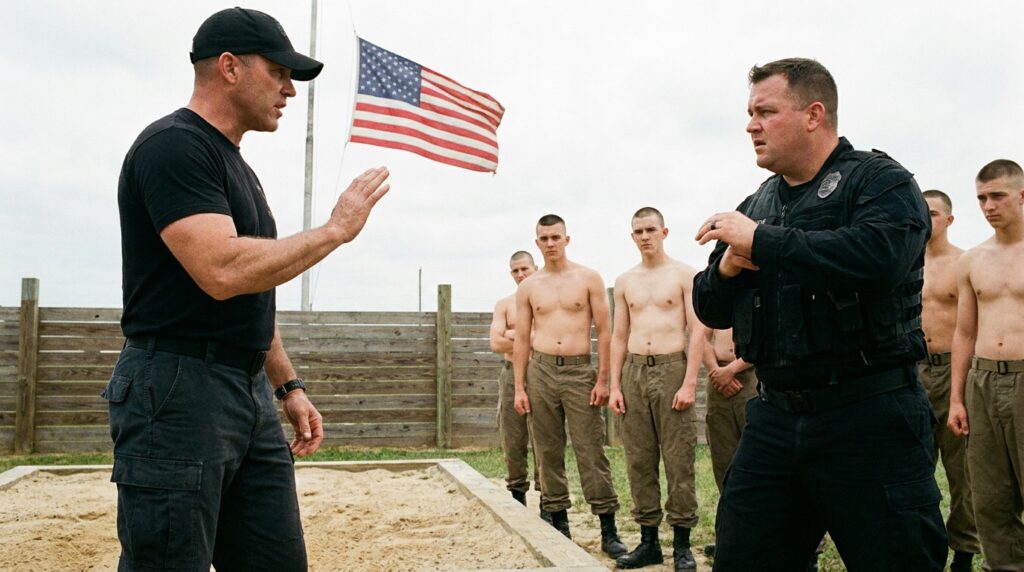
“Your contract isn’t an insurance policy,” Colonel Vance said. His voice carried the flat, metallic edge of a man who spent his mornings reviewing spreadsheets and his afternoons enforcing them. He didn’t look at the sand pit. He stood on the concrete lip of the briefing platform, his black tactical vest rigid, the crisp webbing unburdened by a single grain of red Georgia dust. “The Bureau of Land Management wants the western perimeter cleared by Friday. The Command wants a standardized metric for the tier-one recruits. What I don’t see on this sheet, Instructor, is a repeatable data point.”
Shane didn’t look up from the broken lead. He adjusted the brim of his unbranded black ballcap, the fabric faded to an industrial charcoal by three summers of standing in the open sun. His thumb rubbed the smooth, heavy steel of the mechanical stopwatch nestled in his palm. The metal was warm, exactly matching his skin temperature.
“The metric is standing,” Shane said. His voice was sparse, rhythmic, devoid of the gravel common among men who had spent their thirties shouting over helicopter rotors. “The ones who don’t understand the friction of the sand don’t stay upright when the weight shifts. You can’t chart that on a tablet, Colonel.”
Behind them, sixty yards out across the sun-baked clay, twelve recruits stood in a loose, shirtless semi-circle. They were twenty-two, twenty-three years old—dense muscle, short-cropped hair, skin turning pink under the midday heat. They had stopped breathing hard. They were watching the platform. They were measuring the distance between the crisp, unblemished black uniform of the active-duty commander and the plain, sweat-darkened cotton of the civilian contractor.
Vance took one step forward. The sound of his heavy combat boot striking the concrete was deliberate. A calculated display of mass. “The modern theater doesn’t have time for gray-zone mythology, Shane. I’ve seen your file. What’s left of it. The operations you survived were small-unit extractions using analog logistics. The new doctrine requires integrated network awareness. If a man can’t synchronize his biometric feed with the strike package, he’s a liability.”
Shane turned his head slightly. The movement revealed the deep, white line of an old fragmentation scar running beneath his jawline, disappearing into the collar of his black T-shirt. His eyes stayed in the shadow of the cap brim. “A strike package doesn’t pull a three-hundred-pound technician out of a flooded culvert when the batteries die.”
Vance’s face hardened, the skin over his closely shaved cheekbones tightening until it caught the glare of the sky. He reached out, his hand hovering inches from the wooden clipboard on Shane’s desk. It wasn’t a gesture of theft; it was an exercise in proximity. An occupation of space.
“By eighteen hundred hours,” Vance said, his voice dropping into a low, transactional hiss that barely carried past the desk, “you’ll have the digital logs transferred to my staff. Or I’ll have the gate guards reclassify your clearance to ‘visitor.’ We’re updating the system, old man. With or without your permission.”
Shane’s hand didn’t move from the stopwatch. But beneath the desk, his weight shifted three inches to the left, his boots finding the exact point of resistance in the loose gravel beneath his stool. He noticed the slight tremor in Vance’s left knuckle—the subtle, involuntary twitch of a bureaucrat who had mistaken institutional leverage for physical certainty.
“The gate has a manual override, Colonel,” Shane murmured.
Vance paused, his fingers curling slightly into a fist. Before he could answer, the heavy canvas of the garrison flag behind them gave a sharp, violent snap as a sudden thermal updraft tore through the valley, coating the ledger in a thin, pale layer of grit.

CHAPTER 2: THE FRICTION PARAMETER
The corrugated iron roof of the armory shed didn’t just reflect the three-o’clock sun; it sharpened it into a long, silver blade that cut straight across the gravel path toward the sand pit.
Shane stood inside the shadow of the equipment cage, his fingers hooked into the chain-link diamond mesh. The metal was cold despite the ambient heat, coated in a thick, preserving film of low-grade gun oil. Outside, twenty feet away, the recruits were hauling eighty-pound sandbags from the rear of a flatbed truck. They moved in an unpunctuated rhythm, their boots crunching into the dry clay, their chests slick with grey dust that stuck to their sweat like ash.
Vance stood by the truck’s tailgate. He wasn’t checking the cargo; he was checking his wrist. Every three minutes, his eyes dropped to the dull sapphire face of his tactical watch, the digital screen casting a faint, rhythmic green pulse against the inside of his wrist. Beside him stood a junior lieutenant, a kid named Harris whose uniform still smelled of laundry starch and dry-cleaning solvent. Harris held an administrative tablet, his stylus hovering above the glass screen like a needle over a record.
“Drop them six inches closer to the log line,” Vance said. He didn’t raise his voice, but the command cut through the groaning of the truck’s suspension. “The regulatory framework for the agility course requires a standardized four-meter approach. We’re striking the old boundaries.”
One of the senior recruits, a kid named Miller who had a jagged tattoo of an anchor fading into his bicep, paused. He had a sandbag balanced on his right shoulder, the rough burlap digging into his neck. He looked toward the equipment cage, his eyes searching the dark square behind the mesh where Shane stood. He didn’t drop the bag. He waited.
Shane didn’t give him a sign. He watched the way Harris’s fingers moved across the glass interface. There was an irregularity there. On the corner of the lieutenant’s administrative folder lay a three-part carbon receipt—an old, manual logistics form used for ammunition requisition before the network went digital. It had a hand-stamped serial number in purple ink: 00-98-ALPHA. Shane’s gaze lingered on the purple ink. It was faded, the edges of the numbers slightly blurred by damp storage. The Command hadn’t used manual stamps since the year the operations in the Balkans were scrubbed from the active registers.
“Lieutenant,” Vance said, his tone dry as bone. “Did I authorize a delay?”
“No, sir,” Harris muttered, his stylus tapping the screen twice with a sharp, plastic click. “The contractor’s inventory report is still missing the serial verifications for the training dummy rifles. The old M16 concrete-fills.”
“Strike them from the log,” Vance said. “They’re non-standard. If it doesn’t have an RFID tag, it doesn’t exist on the inventory. Dump them behind the latrines for scrap collection.”
Shane stepped out of the shadow. The transition from the cool grease of the cage to the white glare of the gravel made his pupils contract into tiny black points. His boots made no sound on the stones; he walked on the balls of his feet, his weight distributed so perfectly that his shadow didn’t bounce against the corrugated iron wall behind him.
“The concrete-fills are weighted to twelve pounds, Colonel,” Shane said, stopping five feet from the truck’s rear tire. He didn’t cross into Vance’s shadow. He stayed exactly on the line where the sun hit the gravel. “The standard issue M4 with a loaded mag and an optic is eight-point-five. If they train on the baseline weight, the real thing feels like balsa wood when they’re clearing a trench under pressure.”
Vance didn’t turn around. He kept his back to Shane, his hands resting on the olive-drab tailgate. His reflection in the truck’s side mirror showed his jaw shifting—a slow, grinding movement of the molars.
“The manual says eight-point-five, Instructor,” Vance said to the mirror. “We train to the manual. If the manual changes, the simulator updates the algorithm. We aren’t building lumberjacks; we’re conditioning system operators.”
“A system operator with a broken wrist is a corpse,” Shane said. He looked at Miller, who was still holding the sandbag, his knees beginning to tremble under the static load. “Drop the bag, Miller. Take the class to the pull-up bars. Five sets of twenty, dead hang. No kips.”
Miller looked at Vance. The Colonel remained motionless, his fingers still hooked into the truck’s metal tailgate. The silence between the three men became a physical weight, heavier than the burlap sack on the recruit’s shoulder. The junior lieutenant looked down at his tablet, his thumb twitching against the plastic bezel.
“The schedule calls for the obstacle run, Instructor,” Harris whispered, his voice cracking slightly under the glare of the noon light.
“The sand is too dry for the run,” Shane said, his eyes never leaving the back of Vance’s head. “The wind shifted north. It’s pulling the moisture out of the top three inches. They’ll blow out their Achilles tendons on the turns if they don’t have the forearm strength to hold their balance when they slip.”
Vance finally turned. His movement was abrupt, the stiff nylon of his vest scraping against his shirt with a dry, papery rattle. He stepped down from the platform, his boots striking the earth six inches from Shane’s toes. The edge of his shadow swallowed Shane’s chest.
“You’re hiding behind the terrain, Shane,” Vance said, his face inches from the brim of the contractor’s cap. His breath smelled of bitter coffee and commercial mints. “You’ve been in this swamp so long you think the mud is a strategy. It isn’t. It’s just dirt. And by the end of the week, I’m paving it over.”
Shane didn’t blink. He felt the cold casing of the stopwatch in his hand, the small metal ridge of the reset button pressing into his index finger. He could see the tiny silver pins holding Vance’s rank insignia to his collar—they were slightly bent, as if they had been moved from one uniform to another in a hurry.
“The mud doesn’t need a strategy, Colonel,” Shane said softly. “It just waits.”
Vance stared at him for four seconds, his eyes searching the grey lines around Shane’s temples, looking for a flinch, a twitch, a sign of institutional panic. Finding nothing but the flat, unreadable surface of old stone, the Colonel turned to Harris.
“Log the non-compliance,” Vance commanded. “And tell the transport detail to bring the steel posts for the perimeter fence tomorrow morning at dawn. We’re boxing this section in.”
Vance walked toward the command vehicle, his boots throwing up small, angry puffs of grey dust. Harris followed a step behind, his tablet clutched against his ribs like a shield.
Shane stood alone by the truck tire. He looked down at the gravel where Vance had been standing. In the dust, left behind by the lieutenant’s hasty departure, lay a small, discarded scrap of paper—the edge of the carbon receipt Harris had been holding. The purple ink of the stamp was torn in half, but the numbers 98-ALPHA were still visible, bleeding into the dry dirt.
CHAPTER 3: THE PIT AND THE BOUNDARY
The dust didn’t settle so much as it crystallized. By late afternoon, the heat bouncing off the red Georgia clay left a bitter, metallic tang in the back of the throat, the kind that reminded Shane of burning battery casings and damp wool blankets from ninety-eight.
He didn’t use the desk anymore. Instead, he took his seat on an inverted wooden crate at the exact southern edge of the sand pit, his back flat against the structural post that held up the non-branded garrison flag. The heavy canvas was silent now, hanging limp like a gray shroud under the weight of the cooling, stagnant air. His thumb traced the small bevel on the back of his mechanical stopwatch—three rhythmic strokes, pause, repeat. It was a muscle memory born in dark holds, calculating seconds when light was a luxury.
“Sir,” Miller said. The recruit had his boots off, sitting on the clay embankment five yards away. His socks were gray with dried sweat, the skin around his Achilles tendons white and swollen where the damp sand had chewed through the weave. “The Lieutenant didn’t log our pull-ups. I saw him skip the entry on the tablet.”
Shane didn’t shift his gaze from the far tree line, where the pines grew too close together, blocking out the light from the state highway. “The ledger doesn’t care about your grip, Miller. Your tendons do.”
“But if it isn’t in the system,” another recruit murmured from the shadow of the water buffalo trailer—a lean kid named Cross whose ribs looked like the slats of an old fruit crate—”Colonel says we don’t get the operational credit. He told the transport detail we’re unquantified data.”
“Let him talk,” Shane said. His voice was flat, dropping down into the sand where the heat still lingered. “A man who builds a wall around a pit usually forgets to check the depth. Focus on the stance.”
The sound of an ungreased axle cut through the pine line. It was a sharp, screeching groan that made every recruit stiffen, their eyes turning instantly toward the north gate. The vehicle wasn’t the regular supply truck. It was a short-wheelbase utility carrier, its flatbed packed with stacked bundles of gray iron posts, each one wrapped in heavy steel wire that rattled against the chassis like dry bones.
Colonel Vance got out before the engine died. He didn’t close the cab door; he left it swinging, its window glass catching the late sun and casting an aggressive, shifting glare across the sand. He didn’t have Harris with him this time. He carried his own clipboard—not the standard digital screen, but a stiff aluminum folder with a heavy spring-clip that held down three thick sheets of legal-sized cream bond paper.
“Clear the pit,” Vance said, walking toward the southern boundary with a rhythmic, heavy-booted stride that ignored the loose stones. He didn’t look at the recruits. His eyes were locked on the structural post behind Shane’s shoulder. “The survey team marked the new coordinates from the highway easement. This section is being re-binned for vehicle maintenance storage.”
Shane didn’t stand up from the crate. He let his arms rest across his knees, the black cap brim dropping down until Vance’s boots were the only visible anchor in his field of vision. “The sand requires sixty days of settling after a dry spell, Colonel. If you drop steel rails into the subsoil now, the drainage will backup into the lower bunker by November.”
“There won’t be a lower bunker by November,” Vance said, stopping two inches from the edge of the pit where the sand transitioned into hard clay. He tilted the aluminum clipboard up, the cold glare of the metal surface striking Shane’s face like a flat palm. “The administrative review came through from regional command at noon. This facility is being compressed to a three-acre footprint. The remaining acreage reverts to the state logistics pool.”
Shane’s fingers stopped moving against the stopwatch. The silence that followed was different from the afternoon stillness; it was the specific, vacuum-like quiet that occurs right before a pressure bulkhead gives way. Through the thin fabric of his T-shirt, he could feel the cold wood of the post pressing against his spine, vibrating slightly as the flag above caught a sudden, freezing draft from the valley.
“The state doesn’t have the clearance for the grid coordinates under the shed, Vance,” Shane said. His voice didn’t rise, but it grew denser, the words dropping like lead weights into the soft sand between them.
“The state has whatever clearance the Department signs off on,” Vance replied, his teeth clicking together as he leaned forward, his torso casting a wide, dark shadow across the entire circle of the pit. He reached down, his fingers tapping the edge of the cream paper inside the aluminum clip. “And right now, the signature at the bottom of this eviction protocol belongs to the only authority that matters. Your name isn’t on the roster, Instructor. It isn’t even in the index.”
Miller stood up. His bare feet dug into the clay, his chest still grey with dust. He looked at Cross, then at the other four recruits who were slowly stepping out from behind the water trailer. They didn’t speak, but their shoulders squared, their bodies forming a loose, defensive wall five yards behind the instructor’s crate.
Vance noticed the movement. His eyes flicked to the young men, a thin, patronizing smile pulling the corner of his mouth toward his ear. “I’d tell your boys to keep their socks on, Shane. By tomorrow morning, this whole ring is going to be under four inches of industrial gravel.”
Shane slowly stood up. The movement was deliberate, a smooth extension of his knees that didn’t require him to lean forward or use his hands for leverage. He stood six inches taller than the Colonel, his plain black T-shirt tight against his chest, his calloused thumbs hooking into the belt loops of his cargo pants. He didn’t look at the paper. He looked at the tiny, purple hand-stamped smudge on the very edge of the aluminum frame—the same ink that had been on Harris’s receipt.
“The gravel won’t hold,” Shane said softly.
“It will hold exactly as long as I tell it to,” Vance said. He took half a step forward, his chest almost brushing Shane’s sleeve, his face darkening with the sudden, uncontrolled rush of a man who had waited three days to see a legend break. “Now get your things off my post.”
CHAPTER 4: THE ANCHOR INCIDENT
The air inside the sand pit didn’t move; it crowded.
Colonel Vance’s right hand rose with an unpolished velocity. It wasn’t the clean, balanced jab of a combatives instructor, but the heavy, downward shove of a man accustomed to shifting mass by sheer administrative bulk. His fingers curved into a blunt rake, the stiff black nylon of his sleeve scraping against the edge of his armored vest with a dry, aggressive rattle that tore through the silence of the formation. His target was the center of Shane’s chest—the unbranded cotton of his black shirt, the physical threshold of the old man’s refusal.
Shane didn’t drop his center. He didn’t take the standard half-step backward that the manual prescribed for a civilian facing a physical threat from a commissioned officer. His left boot remained buried three inches deep in the coarse sand, the heel locked hard against the subsurface clay shelf he had mapped out that morning.
Before Vance’s fingers could hook into the fabric, Shane’s right forearm cleared the shadow of his hip.
The motion was minimal—an upward, mechanical sweep that tracked a forty-five-degree angle along the cold edge of Vance’s armored vest. There was no theatrical strike, no explosive crack of bone on bone. It was an interception based entirely on leverage and friction. Shane’s thumb and index finger formed an inverted clevis, striking the exact tendon junction behind Vance’s right wrist just as the Colonel’s momentum reached its apex.
Vance’s forward drive stopped.
The abruptness of the halt sent a physical shudder through the plates of his tactical vest. The aluminum folder slipped from his left arm, hitting the sand with a flat, muted thud that kicked up a tiny gray circle of grit. The sheets of legal bond paper didn’t scatter; they stayed pinned beneath the heavy metal clip, the white margins catching the harsh, lateral glare of the late afternoon sun.
Shane held him there. At arm’s length. The distance between them was precisely twenty-four inches—the exact length of a standard riot baton. His fingers were locked around Vance’s wrist bone, the calloused skin of his palm grinding into the Colonel’s sweat-slicked cuff. He could feel the rapid, high-frequency vibration of Vance’s forearm muscles trying to force the hand forward, trying to override the mechanical lock Shane had established.
“If that’s all you’ve got,” Shane said, his breath slow and even, barely disturbing the dust motes hanging between their faces, “then show me something better.”
Around the rim of the pit, the silence became total. Miller had frozen mid-stride, his bare feet gripping the clay edge, his jaw locked. Cross and the other four recruits remained stationary, their shirtless torsos slick with grey mud, their eyes fixed on the point of contact where the contractor’s hand had paralyzed an active-duty commander. The junior lieutenant, Harris, stood ten feet back by the utility carrier, his administrative tablet held at chest height like a dead weight, his screen reflecting nothing but the white sky.
Vance’s face transformed. The blood rushed to his cheekbones, turning the skin around his closely shaved head an angry, mottled purple that darkened the shadows beneath his ears. His eyes darted down to his trapped wrist, then back up to the flat, gray shade of Shane’s cap brim. He tried to rotate his radius bone to break the grip, but Shane shifted his weight an inch to the left, using the resistance of the buried clay shelf to drive the force directly back into the Colonel’s shoulder joint.
“Release the arm, Instructor,” Vance whispered. The corporate veneer was gone, replaced by a low, desperate hiss that didn’t carry to the recruits but vibrated against Shane’s shirt. “You’re touching a line you don’t survive.”
“The line is right here,” Shane said, his voice dropping into the sand. He didn’t release the pressure. He tightened his fingers another millimeter, feeling the small metal rivets of Vance’s watchband press into his own knuckle. “In the dirt. Where it’s always been.”
For two seconds, the entire facility remained suspended on that singular point of friction. The only sound was the far-off, rhythmic clanking of the utility carrier’s ungreased axle cooling in the shade. Shane kept his gaze level, watching the tiny, involuntary micro-tremors in Vance’s pupils—the realization that rank didn’t change the laws of physics, and that the sand didn’t recognize a signature.
With a slow, controlled deceleration, Shane opened his fingers. He didn’t push Vance away; he simply withdrew his hand, dropping his arm back to his side where his thumb found the familiar, warm steel casing of the stopwatch in his pocket.
Vance stumbled half a step backward, his boots churning through the top layer of sand, destroying the clean boundary line he had tried to establish. He didn’t reach for his clipboard. He stayed squared toward the instructor at arm’s length, his right hand twitching against his thigh, his chest heaving under the weight of his vest as the recruits watched him struggle to find his footing in the loose red earth.
CHAPTER 5: THE STANDOFF PARADIGM
Colonel Vance’s breathing was the loudest thing inside the perimeter fence. It came in short, jagged rattles through his nostrils, each exhale whistling slightly against the high collar of his stiff tactical vest. His boots remained sunk three inches into the loose upper crust of the sand, his heels pinned by the dead weight of his armor.
He did not reach down for his fallen clipboard. The aluminum folder stayed right where it had dropped, half-buried like an unexploded shell in the red grit, its cream bond pages collecting a fine, silver skim of dust from the northern draft. His right wrist, newly released from Shane’s grip, hung near his belt line. The skin there was already turning a deep, dark gray where Shane’s thumb had locked into the tendon line, the precise shape of a crescent moon bruising beneath his watch strap.
Shane did not lower his shoulder line. He kept his boots planted into the sub-base clay shelf, his posture completely vertical under the shadow of his cap. His hands went right back into the pockets of his dark cargo trousers, his fingers closing around the cold mechanical stopwatch. He could feel the small steel cylinder of the reset pin pulsing against his knuckle like an extra vein.
“The transport detail is still at the main gate, Colonel,” Shane said. His voice was too quiet to carry past the inner line of recruits, but it had a heavy, physical edge that seemed to anchor the air between them. “They’re running the diesel engines idle. That’s eight gallons an hour from your administrative allotment. If you don’t give them a work order by sixteen hundred, the driver logs a non-compliance report.”
Vance’s left eye twitched, a tiny, vertical tremor cutting through the gray line of his lower lid. He looked at the recruits. None of them had moved. Miller stood like an iron post on the embankment, his shirtless torso grey with clay dust, his bare toes curling into the hard dirt to keep his balance. Behind him, the others formed a solid, unblinking semi-circle—six young men who had spent three weeks learning the exact weight of a twelve-pound concrete rifle, now measuring the weight of an officer who had just been frozen at arm’s length.
“Lieutenant Harris,” Vance said. He didn’t turn his head toward the utility carrier. He kept his eyes fixed on the white line of the fragmentation scar under Shane’s jaw. His voice was thin, but the transactional iron was back, sharpened by the presence of the class. “Call the perimeter guard. Tell them to clear the civilian vehicles from the northern approach line. Every vehicle without an active Department base decal is to be towed to the county impound lot.”
Harris didn’t move for three seconds. He stood by the rear wheel of the carrier, his administrative tablet clutched against his ribs so hard the hard plastic casing groaned. His screen cast a flat, pale green glow across his chin, illuminating a sudden ring of white sweat that had formed around his collar line.
“Sir,” Harris whispered, his voice cracking against the dry air. “The gate logs… the instructor’s truck is listed under the permanent historical exemption register. Section four, gray-zone contractor allocation.”
Vance’s jaw shifted, his molars grinding with a distinct, wet click that Shane noticed instantly. “The section four allocation was repealed by the logistics review three cycles ago, Lieutenant. If it isn’t in the active network index, it doesn’t exist. Update the entry. Execute the order.”
Shane let his right thumb press the stopwatch button. Click. The mechanical sound was tiny, but in the absolute silence of the sand pit, it sounded like a hammer dropping on an empty chamber. He looked over Vance’s shoulder, past the rigid nylon of the vest, straight at the purple smudge on the corner of the lieutenant’s tablet. The numbers 98-ALPHA were fading into the blue shadow of the vehicle’s cab.
“The register wasn’t repealed, Vance,” Shane said softly. He took his hand out of his pocket, his index finger pointing down at the aluminum folder between Vance’s boots. “The signature on those sheets isn’t a regional command authorization. It’s an internal transfer receipt from the logistics annex at Fort Meade. You didn’t come down here to re-bin the easement. You came down here to scrub the warehouse files.”
The blood seemed to leave Vance’s face all at once, the purple mottling around his cheeks fading into a flat, chalky grey that matched the dust on the truck’s tires. He didn’t look down at the paper. He didn’t answer. He took one step back, his heel catching on the metal edge of the clipboard, his body performing a brief, involuntary balance correction that required him to throw his arms wide to stay upright in the loose sand.
“This is an active training zone, Instructor,” Vance said, his voice dropping into a register that was too low, too hollow to be convincing. “Any interference with an administrative officer during an authorized evaluation is a federal contract violation. I suggest you remember who pays for the sand in this pit.”
“The sand doesn’t have an auditor, Colonel,” Shane said. He didn’t follow the movement. He stayed exactly where he was, his cap brim casting a long, sharp triangle of shade across his own mouth. “And the men who died putting the coordinates under that shed didn’t use an index.”
Shane turned his back on the Colonel. It was a cold, calculated movement that ignored every rule in the manual regarding a hostile presence inside the defensive circle. He looked at Miller.
“Miller,” Shane said. “The class has three minutes left on the dead-hang. Get them back to the bars. If I see a single hip swing, the whole team starts over from zero.”
Miller didn’t hesitate this time. He didn’t look at Vance’s uniform or Harris’s tablet. He struck his bare heels against the clay embankment, turned on his heel, and led the shirtless formation away from the pit with a rhythmic, silent stride that completely bypassed the utility carrier.
Vance stood alone in the center of the sand, his shadow stretching out toward the fence line like a long black wedge. His right hand was still twitching against his uniform trousers, his fingers curled into a loose, useless fist as the grey dust from the truck’s engine began to drift across his boots, covering the polished leather in a pale, uniform skin of grit.
CHAPTER 6: THE DECOY DEPLOYMENT
The cooling block of the utility carrier’s engine gave off a sharp, metallic ping every eleven seconds. It sounded exactly like the trip-wire springs Shane had disarmed along the Drina River basin when Vance was still writing tactical reviews for West Point quarterlies.
Shane didn’t use his hands to clear the sand from the aluminum clipboard. He used the stiff, plastic edge of his broken lead pencil, scraping the grey granules away from the spring-clip until the black ink of the document was fully exposed to the cold, blue light filtering through the pine canopy. The paper was dry, the wood-pulp composition smelling faintly of chemical bleach and damp warehouse storage.
Vance had left the truck cab open. The key remained in the ignition barrel, its heavy brass teeth slightly worn from years of rattling against standard-issue key rings. But it wasn’t the ignition that held Shane’s gaze. It was the command tablet left flat on the passenger seat, its glass screen dark, but a small, rectangular block of black plastic protruding from its secondary data port—a hardware encryption override key used exclusively by non-networked logistics detachments.
“Miller,” Shane said without turning around. His voice stayed level with the metal edge of the truck’s bed.
The recruit stepped up to the cab door, his boots making a dry, crunching rasp on the stone path. His bare chest had dried completely, the grey mud turning into a white, cracked porcelain pattern that flaked away whenever he drew a breath. “Sir.”
“Take the team to the south gate,” Shane said, his eyes tracing the thin, copper wire embedded inside the plastic block of the encryption key. “The transport driver is still sitting on his clutch. Tell him the evaluation is suspended under section four protocol. He’s to dump his iron posts outside the fence line and log a structural delay.”
Miller looked at the dark tablet screen. “The Colonel didn’t give that order, sir.”
“The Colonel doesn’t have an active register on his terminal, Miller,” Shane said softly. He reached into the cab, his thumb and index finger pulling the black plastic key out of the data port with a dry, plastic click. The brass pins inside the key were pristine, completely free of the carbon dust that standard network assets accumulated. “He’s running a manual circuit. He doesn’t want the network to see where these files are going.”
Shane sat on the running board of the truck, the cold steel of the chassis pressing through his cargo trousers. He laid the aluminum folder across his knees, matching the hand-stamped numbers on the paper to the serial number etched into the side of the plastic key. They matched perfectly: 00-98-ALPHA.
The document wasn’t an eviction order from regional command. It was a fast-tracked administrative seizure request, signed by a mid-level bureaucrat named Vance Senior—the Colonel’s own father, who had spent his career managing the paper trails for discontinued training areas. The signature was legal, but the authority was a ghost. It was an internal loop designed to transfer the custody of the facility’s historical sub-bunker to a private liquidation firm before the active-duty command structure updated their satellite surveys.
The real failure wasn’t Vance’s arrogance; it was the precision of the timing. They were moving three days before the seasonal rains, the exact window when the facility’s manual storage logs were scheduled for shredding under the standard ten-year retention cycle.
“Harris,” Shane said, looking up as the junior lieutenant moved slowly along the side of the truck bed, his fingers trailing against the dusty green paint. “Who gave your office the coordinate markers for the lower bunker?”
Harris stopped near the front tire, the aluminum stylus in his hand shaking slightly as he tapped it against his thumbnail. The green light from his own screen had died, leaving his face flat and pale in the shadow of the hood. “The log came from the regional annex, Instructor. It was an automated archival pull. We didn’t query the specific field file.”
“An automated pull doesn’t use purple carbon ink from ninety-eight, Lieutenant,” Shane said. He tilted the plastic key toward the sky, the sharp glare of the twilight catching a tiny, secondary serial number stamped into the bottom of the casing—SF-EX-09. “This key belonged to the third extraction detachment. The one that didn’t come back across the border when the logistics lines were redrawn.”
Harris took half a step backward, his boot heel catching on an exposed pine root. He looked at the tablet in Shane’s hand, his lower lip tightening until the pink skin turned gray. “I don’t know anything about the detachment, sir. My orders were purely administrative. We were told the facility was an unquantified line item.”
“Your orders are an illegal eviction,” Shane said. He stood up from the running board, his body casting a long, hard shadow that completely swallowed the lieutenant’s boots. “The Colonel isn’t reclaiming this property for the state, Harris. He’s burying the inventory before the audit team arrives from Fort Meade on Friday.”
Shane didn’t wait for the lieutenant to answer. He dropped the plastic key into his pocket, letting it rest beside the warm casing of his stopwatch. He walked toward the sand pit, his boots finding the exact line where Vance had broken the boundary. The sand was already shifting back into the center under the influence of the cold evening wind, the edges of the confrontation blurring into the red dirt as if the conflict had never happened.
But beneath the top three inches, the hard clay shelf remained locked in place, holding the weight of the old secrets that Vance had tried so desperately to pave over.
CHAPTER 7: THE ARCHIVAL FAULT
“The gate sensors didn’t trip, Instructor,” Harris said. He was leaning against the heavy iron bumper of the utility truck, his uniform trousers dark with the red grease that leaked from the steering box. His fingers were locked around the edge of his tablet casing so tightly the plastic had begun to warp under the glare of the tactical floodlights. “But someone just authorized a command-level override at the eastern checkpoint. The system isn’t showing a standard registration plate.”
Shane didn’t take his hand out of his cargo pocket. His fingers remained curled around the cold, grooved rim of the mechanical stopwatch, counting the heavy mechanical beats of the facility’s master clock inside the supply shack. One. Two. Three.
“The eastern checkpoint doesn’t connect to the regional server, Harris,” Shane said. He stepped off the gravel path, his boots sinking an inch into the dry crust of the ditch line where the shadows from the pine canopy were thickest. “It’s a dead loop. It only rings if someone is using a hardwired terminal from the old ordnance bunker.”
Behind them, the twelve recruits had formed a silent, gray line along the edge of the tool shed. They weren’t wearing their boots anymore. They stood in the dust with their ankles wrapped in standard olive-drab utility tape, their bare shoulders glistening with a grey sheen of sweat and clay residue that had dried hard under the high-pressure sodium lamps. Miller had a cold, twelve-pound concrete rifle held flat across his thighs, his thumbs hooked into the cast-iron sling mounts.
A sharp, metallic hum vibrated through the corrugated siding of the main armory. It wasn’t the regular pulse of the auxiliary generators. It was a high-frequency carrier wave, the kind that used to fry the telephone lines in the valley whenever the deep-subsurface relays were opened for a manual data transfer.
“Colonel Vance didn’t leave the perimeter,” Shane murmured, his eyes tracking the thin, silver conduit line that ran from the base of the flag post down into the concrete foundation of the tool room. “He’s still inside the circuit.”
Shane moved toward the breaker panel at the back of the armory, his shadow stretching across the clay like a long, black needle. The metal box was cold to the touch, its grey enamel paint flaking off in thin, sharp scales that bit into his knuckles. He didn’t check the active switches. He slid his fingers behind the galvanized backing plate, feeling for the small, non-standard toggle switch that hadn’t been listed on any facility blueprint since December of ninety-eight.
The switch was thrown down. The override was live.
“He’s running the shredding program manually,” Shane said, his voice dropping into the gap between the building’s iron sheets. “He’s not clearing the land for storage, Harris. He’s pulling the old operational manifests out of the deep-storage array before the Department’s automated inventory script locks the files for the Friday audit.”
Harris’s tablet suddenly flashed once, a bright, pale blue glare that illuminated the frantic, vertical movement of his chin. “The logistics ledger just went flat, sir. The entire historical index for the SF-EX-09 detachment… it’s being re-classified as administrative waste. The terminal is deleting the line items chronologically.”
“He’s starting with the ninety-eight roster,” Shane said. He pulled his hand back from the breaker box, a thin line of black grease staining the white fragmentation scar across his thumb. He looked at Miller. “Miller. Take Cross and the rear element. Lock the grease-trap doors on the lower bunker. Nobody comes up through the drainage shaft.”
“Understood, sir,” Miller said. He didn’t check with the lieutenant. He swung the concrete rifle into a low-ready position, his taped heels striking the gravel in a synchronized, three-man sprint that disappeared into the darkness behind the latrine block.
The air inside the perimeter grew noticeably colder as the carrier wave died down, leaving nothing but the dry, parched rattle of the canvas flag above their heads. Shane walked toward the center of the sand pit, his feet tracking the exact micro-seconds of Vance’s earlier retreat. The sand was cold now, its heat fully spent, the red granules crunching under his soles with a sound like broken glass.
He knew what Vance was looking for in the dark. It wasn’t a paper manifest or a digital fingerprint. It was the original manual deployment log—the one with the hand-stamped purple serials that listed the twelve names of the men who had stayed on the wrong side of the river line when the political map changed. Vance’s father hadn’t signed an eviction order to save his son’s career; he had signed it to ensure those twelve names remained under four inches of industrial gravel forever.
“Instructor,” Harris called out, his voice shaking as he walked backward toward the command vehicle, his screen flickering with a row of red system-error warnings. “The gate override didn’t come from Vance. The terminal at the eastern checkpoint just logged a primary clearance card. It’s an active-duty command signature from the chief of staff’s office.”
Shane stopped at the very center of the pit. He looked toward the north gate, where the headlights of a heavy black utility vehicle were just clearing the pine line, their long, white beams cutting through the gray dust like twin scalpels, catching the silver edges of the iron posts stacked on the flatbed truck.
The trap hadn’t just sprung on Vance. It had sprung on the entire loop.
CHAPTER 8: THE HORIZON REVERSAL
The twin halogen beams of the approaching utility vehicle didn’t just illuminate the dust; they sliced it into vibrating, translucent panes of white glass. The glare struck the western face of the armory, casting the sharp, interlocking shadows of the chain-link equipment cage across the sand pit like a web of cold iron.
The black sedan stopped exactly four inches short of the sand’s northern lip. Its engine didn’t die with a vibration; it shut down into an immediate, mechanical vacuum that left only the high-pitched, metallic sizzle of its exhaust manifolds cooling in the night air.
Colonel Vance stepped out from the concrete entryway of the lower bunker’s drainage shack. His tactical vest was unbuttoned at the ribs, the heavy nylon panels flaring out like broken wings. He held his command tablet by its rubberized corner, the screen dead, its power supply drained by the manual file-deletion loop he had left churning in the dark. His face was entirely gray under the sodium lamps, his skin showing the fine, white tracking lines of sweat that had dried under the pressure of his haste.
“The terminal is locked,” Vance said, his voice carrying an empty, paper-thin resonance across the sand. He didn’t look at Shane. He looked at the rear bumper of the sedan. “The transmission code was verified by the regional server before the circuit went cold. The historical index is gone, Instructor. The registry is clean.”
The sedan door opened.
The sound of the latch was a heavy, precise click that Shane registered with the same part of his mind that timed the reset pin on his stopwatch. A single combat boot—old leather, polished until the surface reflected the blue twilight like wet coal—struck the gravel path.
The man who stepped into the light was in his late sixties. He didn’t wear a tactical vest or an administrative uniform. He wore a crisp, olive-drab utility jacket with four stars pinned to the collar points—insignia that were slightly tarnished at the edges, showing the dull, greasy patina of forty years of continuous command. His face was a map of deep, angular lines, his mouth set in a permanent, flat line that matched the stone foundation of the facility’s main gate.
General Albright didn’t look at Vance. He didn’t look at Lieutenant Harris, who had dropped his tablet into the dirt by the truck tire. His gaze moved across the twelve recruits, tracing the olive-drab utility tape wrapped around their bare ankles, measuring the stillness of their shoulders as they stood with their iron-weighted rifles held at the low-ready.
“The transport detail is holding at the outer mile marker, General,” Vance said, stepping forward, his boots dragging through the loose sand as he tried to perform a formal presentation posture. “The civilian contractor has been notified of his non-compliance under the administrative review. We are ready to begin the perimeter encasement.”
Albright stopped at the very edge of the pit, exactly where the sand met the hard clay shelf. He slowly lifted his right hand, his fingers straight, his palm striking the brim of his starched utility cap in a clean, sharp arc that cut through the lateral glare of the headlights.
He didn’t salute Vance. He didn’t address the active-duty command.
The General’s eyes were locked on the white fragmentation scar under Shane’s jaw. He held the salute for three full seconds, his body as rigid as the iron posts stacked on the flatbed behind them.
“The unit is assembled, Commander,” Albright said, his voice dropping into the sand with the heavy, unyielding mass of an operational directive from ninety-eight. “The Fort Meade audit has been moved up forty-eight hours. The manifests were retrieved from the redundant satellite array before your terminal executed the erase command, Colonel.”
Vance’s hand dropped from his belt line. His command tablet slipped from his fingers, hitting his boot before tumbling into the red earth, the glass face cracking into a dozen sharp, silver slivers that caught the light of the floodlamps. “The array… the array was decommissioned during the logistics review, sir. The index was scrubbed.”
“The index was duplicated,” Shane said. He took his hand out of his cargo pocket, his palm opening to reveal the black plastic encryption key with the SF-EX-09 serial etched into its base. The brass pins caught the halogen glare, gleaming like fresh copper against his calloused skin. “A system operator only checks the network lines, Vance. A soldier remembers where the backup wire is buried.”
Albright lowered his hand, his mouth tightening until the lines around his chin hardened into iron. “Take your lieutenant and report to the transport carrier at the gate, Colonel. Your administrative assignment is being re-binned to the regional personnel depot. In Alaska.”
Vance didn’t answer. He didn’t pick up his broken tablet. He turned on his heel, his boots churning through the sand, destroying the last remnants of the boundary line he had tried to draw. Harris followed two paces behind, his head down, his uniform smelling of cold sweat and administrative ruin as they disappeared into the blue shadow of the pine line.
Shane stood alone at the center of the pit. He looked down at the mechanical stopwatch in his palm, his thumb pressing the reset button one final time. Click. The silver hand snapped back to zero, perfectly still, perfectly quiet.
The evening wind rose from the valley, catching the heavy canvas of the garrison flag behind them. It gave one final, violent snap against the structural post—a sound like a single rifle shot echoing across an empty range—before settling into the cold, clean silence of the night.
CHAPTER 9: THE BERLIN TERMINAL
The heavy iron door of the sub-bunker didn’t swing; it unsealed.
The emergency release handle was cold, coated in a thick, industrial grease that smelled faintly of old lard and cosmoline. As Shane pulled it downward, the internal counterweights gave a low, hollow groan that vibrated straight through the concrete floor plates into the heels of his boots. Inside, the air was static, holding the dry, paper-thin chill of a space that hadn’t seen a ventilation draft since the Clinton administration.
General Albright entered first. He didn’t use a flashlight. He walked by the grey sheen of a single, low-voltage fluorescent tube that flickered over the central inspection table every four seconds with a sharp, plastic snap. On the zinc tabletop lay the retrieved command terminal—the manual unit from the eastern checkpoint, its casing scratched down to the bare aluminum where Vance had tried to pry the battery plate loose with a bayonet.
“The Fort Meade logistics team doesn’t have these logs on their master server, Shane,” Albright said. He stood with his hands tucked behind the small of his back, his four stars catching the green tint of the fluorescent tube. “When the sector was redrawn in ninety-nine, the entire data loop was routed through a blind relay in the old intelligence annex behind the Tempelhof airfield. It was supposed to be a dead drop.”
Shane stepped up to the table, his cap brim casting a long, clean shadow across the zinc surface. He reached into his pocket and pulled out the hardware override key he had taken from Vance’s carrier. The black plastic casing felt brittle in the cold basement air. He slid it into the side port of the terminal.
The screen didn’t boot with a logo. It produced four lines of raw, amber text that blinked three times before settling into a steady, flat glare.
REG-INDEX: 00-98-ALPHA
RELAY-PATH: T-HOF // BRLN-03
STATUS: ACTIVE // UNRESOLVED
Shane’s thumb traced the edge of the aluminum frame. His eyes skipped past the system metrics, zeroing in on the bottom of the log’s third page where a small, green-inked border stamp had been digitized into the file margin. The stamp was irregular—a double-bordered rectangle containing a five-digit numeric code: 40-20-NINE.
“That’s not a supply code, General,” Shane said. His voice was flat, hitting the concrete walls without an echo. “That’s the rail-head identifier for the old sector three storage yard outside of Magdeburg. The one the Germans closed down during the unification transition.”
Albright didn’t shift his posture. But the white scar along his left cheekbone tightened, the skin pulling toward his ear until his profile looked like it had been carved from grey slate. “The Magdeburg yard was cleared by the British in ninety-seven, Shane. The inventory was listed as surplus scrap.”
“A surplus scrap list doesn’t maintain a live carrier wave across the transatlantic cable,” Shane said. He tapped the terminal’s manual return key with his calloused index finger. Click. The amber text cleared, replaced by a columns-and-rows manifest that listed three names under the SF-EX-09 detachment marker.
The names weren’t grayed out. They didn’t have the standard KIA or DISCHARGED brackets next to their serials. They were listed under a green, high-priority operational code: STATIONARY // WAIT.
Behind them, the iron door rattled once as Miller stepped into the entry well. The recruit’s ankles were still wrapped in grey utility tape, his shoulders slick with the condensation that dripped from the bunker’s overhead water pipes. He held the concrete-weighted rifle at his hip, his bare chest showing a dark smear of graphite grease from the door lever.
“Sir,” Miller said, his eyes darting to the amber glow on the table. “The lieutenant’s staff vehicle is at the main gate. They’re trying to pull the facility’s fuel logs from the administrative box. The sergeant said the regional pool froze our allocation at noon.”
Shane didn’t look up from the names. “Tell Cross to hand-pump forty gallons from the emergency trailer into the diesel trucks. If the lieutenant asks for a receipt, give him a manual training slip with the ninety-eight serial.”
“They won’t accept a manual slip, sir,” Miller said. “The staff driver said they have a digital stop-order from the Department liaison.”
“The liaison is five hundred miles away behind a desk, Miller,” Shane said softly, his finger hovering over the third name on the screen—a name that had been scribbled out of his own deployment log with a black grease pencil twenty-eight years ago. “The trucks are here. In the mud. Move the fuel.”
Miller paused, his boots gripping the wet concrete of the threshold for two seconds before he struck his heel against the frame and disappeared back into the dark corridor.
Albright reached down, his heavy thumb pressing the terminal’s power toggle until the amber light died, leaving the zinc table in the flat, green shade of the flickering fluorescent tube. “If those three men are still inside the Magdeburg ledger, Shane, the Fort Meade team isn’t here to audit your sand pit. They’re here to ensure nobody digs deep enough to find the cable.”
Shane slid the black plastic key back into his pocket, his fingers finding the smooth, warm casing of his stopwatch. “The cable is already out of the ground, General. Vance just forgot to check who was holding the other end.”
CHAPTER 10: THE RATIONED FRICTION
The iron handle of the hand-pump was freezing beneath Shane’s palm, its rough casting biting through the thin grease on his skin with a sharp, calculated ache. Every downward stroke produced a wet, metallic gurgle from the belly of the emergency fuel trailer, followed by the pungent, chemical stench of winter-grade diesel slicing through the damp pine air.
“The secondary manifold is locked, Instructor,” Cross said. The recruit was knee-deep in the drainage ditch behind the truck, his shirtless torso slick with the oily sheen of cold condensation. He was using a flat steel file to prize open the brass inspection port on the truck’s fuel intake, his shoulder muscles knotting beneath the high-pressure glare of the sodium lamps. “There’s an unlisted mechanical block inside the line. A physical valve cut right into the pipe.”
Shane didn’t pause the rhythm of his arms. Down. Up. Down. The steel rod of the pump glinted under the lateral light, its silver surface showing a fresh, deep notch hand-etched near the base—the specific marking of a grease-trap bypass used to override automated fuel blockades.
“Vance didn’t just freeze the digital account, Cross,” Shane said, his voice level, tracking the mechanical clank of the handle. “He left a physical mechanical lock in the line before he walked out. He wanted the trucks stationary before his father’s private transport detail reached the county highway.”
Ten yards away, by the corner of the dark supply shack, General Albright stood with his eyes fixed on the main approach line. The black sedan’s halogens were still cutting through the pines, their white beams highlighting the steady, slow drift of grey dust settling over the iron fence posts stacked on the flatbed. He carried his old leather command folder tucked tightly under his left arm, his fingers resting on the heavy brass zipper.
“The Fort Meade detachment just cleared the highway junction, Shane,” Albright said without turning his head. “They have a three-vehicle escort from the state police. If the trucks aren’t clearing the perimeter before the gate guards register the arrival, the entire inventory falls under a secondary federal attachment order. We won’t be able to move a single crate of the ninety-eight documentation.”
“The trucks will move, General,” Shane said. He slammed the pump handle down one final time, the steel shaft hitting the collar with a flat, conclusive ring. “Miller. Get the manual crank from the tool shed. We’re bypassing the electric ignitions entirely. Strip the starter fuses from the dashboard.”
Miller emerged from the shadow of the trailer, his ankles still wrapped in the grey utility tape, his knuckles dark with raw graphite grease. He held a three-foot iron starter bar, its crank-end hooked into a heavy square clevis. “The boys are already tracking the fuse blocks, sir. We’re running the wiring raw.”
Shane dropped down into the ditch line beside Cross. The clay was cold, holding the sharp, gritty texture of subsoil that had never been turned by a plow. He reached his hand into the dark cavity of the truck’s intake manifold, his fingers finding the small, hand-notched brass valve Vance’s group had turned. It was locked down with an internal security wire—a thin, high-tensile copper strand that would snap the primary fuel needle if forced.
Shane didn’t use a tool. He aligned the flat edge of his mechanical stopwatch casing against the wire’s anchor loop, using the heavy steel bezel as a wedge. He drove his palm against the back of the watch.
Snap.
The copper strand gave way with a sharp, clean ping that rattled inside the pipe. The valve rotated three degrees to the left, and instantly, the dark, heavy smell of raw diesel rushed into the intake, filling the ditch with a cold, oily gurgle.
“The line is clear,” Shane said, pulling his hand back, a dark ribbon of fuel staining the white fragmentation scar on his thumb. He stood up from the mud, his eyes tracking a sudden, vertical flash of blue light crossing the northern pines—the first strobe of the state police escort clearing the boundary line two miles out.
Behind the tool room, the first truck engine caught with a violent, explosive roar that shook the corrugated siding of the armory. It wasn’t the smooth, computer-timed idle of a modern system; it was the raw, irregular hammering of an analog injection pump running on unmetered pressure, throwing a thick, grey cloud of diesel smoke into the glare of the sodium lights.
The private liquidation firm wasn’t trying to freeze the budget to audit the sand pit. They were starving the facility’s logistics to ensure that when the Fort Meade auditors stepped onto the hard clay shelf, the only thing left to inspect would be twelve empty concrete-filled rifles and an unread ledger.
“Miller,” Shane called out through the deafening thrum of the unmuffled engine. “Get the second vehicle turned over. If the police line blocks the main gate, we’re running the rear flatbed straight through the western wire.”
Miller didn’t answer with words. He jammed the iron starter bar into the secondary truck’s nose-clevis, his weight shifting forward as his bare feet dug into the hard clay, his entire frame bracing against the static resistance of the dead machine.
CHAPTER 11: THE MOUNTAIN SEAL
The frost did not melt under the truck’s low-slung oil pan; it crystallized into thin, brittle needles that cracked under the weight of the cooling tires.
Shane killed the headlights forty yards before the crest. The darkness that rushed to fill the gap was absolute, holding the wet, pine-soured density of the northern Georgia ridges at four thousand feet. He didn’t use the cab door handle. He slid cleanly through the open frame of the utility truck, his boots striking the frozen shale with a dry, muted rattle that didn’t travel past the nearest hemlock branch.
Behind him, in the bed of the flatbed, Miller and Cross remained fully stationary. Their shirtless skin had gone the color of gray slate under the starlight, their shoulder muscles knotted hard against the sub-zero draft. They didn’t have their concrete rifles unslung. They were holding three-foot iron pry-bars, their fingers wrapped in heavy, grease-darkened utility tape to keep their skin from freezing to the bare metal.
“The cabin doesn’t have an external power line, Instructor,” Miller whispered, his breath a short, grey cloud that vanished into the pines before it could rise. “But the chimney isn’t drawing air. The stone flue is sealed with a sheet-metal cap.”
Shane didn’t answer with words. He adjusted the brim of his faded cap, his eyes tracking a single, thin strand of copper wire that ran from the corner of the cabin’s cedar-shingle roof down into a rotting stump near the well-head. It was the exact same gauge as the security wire he had snapped inside the truck’s intake manifold—the manual signature of the third extraction detachment.
He walked toward the threshold, his weight distributed so perfectly across the ball of his foot that the frozen shale didn’t click beneath his soles. His right hand went into his cargo pocket, his thumb tracing the smooth, warm bezel of his mechanical stopwatch. One. Two. Three.
The door opened before his hand could clear his hip.
The man who stood in the narrow gap was eighty years old, but his shoulders were still pinned flat against the oak frame, his chest widening beneath an unbuttoned wool shirt until he blocked the entire interior view. His face was a jagged cliff of silver stubble and deep, angular folds that held the lateral shadows of the starlight like cuts in stone. His left hand rested on the iron latch. His ring finger was gone, stripped down to the knuckle where a smooth, white scar line had turned silver under the cold mountain sky.
“The signature on the gate log at Fort Meade was altered at noon, Shane,” the old mountaineer said. His voice didn’t have the military rhythm of Vance or the flat iron of Albright; it had the dry, scraping rasp of an ungreased winch. “The computer thinks the third detachment died in the river line. The computer thinks I’ve been buried in the state cemetery since ninety-nine.”
“The computer doesn’t run the manual override behind the breaker panel, Chief,” Shane said. He took the black plastic key from his pocket and held it up between them, the brass pins catching the cold glare of the stars. “Vance’s father left the duplicate in the terminal port. He was trying to execute the liquidation before the audit team reached the sand pit.”
The old man’s gaze didn’t drop to the plastic key. It stayed locked on the white fragmentation line under Shane’s jaw. He slowly withdrew his left hand from the latch, revealing a heavy, manual stamping block wrapped in a piece of oiled rag—the purple ink pad still damp enough to smell of vinegar and chemical bleach.
“The liquidation wasn’t Vance’s idea,” the Chief said, his chest rising once against the oak door frame. “He’s just the clerk they sent to clean the warehouse. The order to drop four inches of industrial gravel over the lower bunker came from the same desk that signed our extraction authorization twenty-eight years ago.”
Shane stepped onto the cedar sill. The interior of the cabin was dark, devoid of furniture, holding only a single, heavy green-painted field desk and a bank of manual, non-networked radio receivers whose amber tubes were cooling in the dark like dead coals. On the center of the desk lay a three-part carbon ledger—the original duplicate of the Magdeburg manifest, its pages stamped in purple ink with twelve numeric codes that had never been transferred to the active digital index.
“Albright is at the main gate with the sedan,” Shane said, his fingers tightening against the stopwatch casing in his pocket. “He intercepted the state police line. He saluted the cap, Chief.”
The old mountaineer let out a low, dry sound that might have been a laugh if his mouth hadn’t been set in a permanent stone line. “Albright saluted the weight of the file, Shane. Not the men inside it. He knows if those twelve names get logged into the active network on Friday, the Department has to explain why the third detachment’s tracking beacons were still pulsing from the sub-bunker three years after the evacuation was declared closed.”
Shane walked to the field desk, his boots making no sound on the bare pine boards. He laid his hand flat on the cream paper of the ledger, his thumb resting over the green-inked border stamp: 40-20-NINE. The physical ink was dry, but the indentation in the wood-pulp paper was deep, left behind by a heavy mechanical press that had been smashed with a sledgehammer before the troops cleared the yard.
The devastating reality didn’t come from a system error or a falsified eviction order. It was the structure of the timeline itself. The facility hadn’t been compressed to hide a theft; it had been kept active as a blind data-relay station for nearly three decades because the politicians who left the detachment behind needed a live carrier wave to monitor the silent graves they had built across the state line.
“Miller,” Shane called out through the open door, his voice dropping into the freezing draft that tore across the ridge. “Get the flatbed turned around. We aren’t moving the documentation back to the facility.”
Miller’s gray silhouette appeared on the threshold, his iron pry-bar clutched against his thigh. “Where are we taking it, sir?”
Shane didn’t look back at the recruit. He looked at the old Chief, whose silver-scarred hand was already wrapping the oiled rag back around the stamping block with the slow, rhythmic precision of a soldier cleaning a weapon after the final round had been spent.
“We’re taking it to the Friday audit,” Shane said softly. “Every single page.”
CHAPTER 12: THE FRIDAY AUDIT
“The primary convoy has cleared the outer tire spikes,” Harris said. He wasn’t tracking the data line on his tablet anymore. The glass screen had fractured down its vertical axis, reflecting the cold white glare of the sodium floods across his chin like a row of small, jagged teeth. He stood by the concrete rim of the sand pit, his hand resting on the rusted frame of the equipment locker to stop his fingers from shaking. “Three administrative utility vans, Shane. They’re running with full Department placards.”
Shane didn’t adjust his cap brim. He stood at the exact geographical center of the pit, his boots buried three inches into the loose, freezing red granules where Vance had stumbled the day before. The morning air was thin, carrying the dry, alkaline smell of concrete dust and unwashed grease from the drainage ditch. His right thumb pressed against the grooved crown of the mechanical stopwatch inside his cargo pocket. One. Two. Three.
The lead vehicle didn’t slow down for the perimeter line. It drove straight onto the hard clay shelf, its heavy black tires crunching over the loose stones with a flat, rhythmic growl that died the exact second the engine cut out behind the tool room.
A single civilian investigator got out of the passenger side. He didn’t carry a clipboard or a tactical folder. He had a slim, silver-finished ledger case locked to his left wrist by a thin strand of vinyl-coated aircraft cable, the metallic weave catching the first long, gray light of the dawn. Behind him, four ununiformed security personnel stepped into the circle, their black windbreakers pulled tight against the mountain draft, their eyes instantly fixing on the twelve recruits who stood in a solid semi-circle along the flag line.
The recruits hadn’t washed the sand from their chests. The dried clay had turned into a hard, cracked gray armor that split across their sternums whenever they took a breath. They stood without their boots, their taped ankles rooted into the frozen clay, their thumbs hooked into the cast-iron sling mounts of the twelve-pound concrete-filled rifles. Miller held his piece exactly level with the investigator’s tie clip, his shoulders pinned back, his breathing completely silent.
The investigator stopped three feet from the edge of the pit. He looked down at the rusted steel padlock that lay snapped flat in the sand between Shane’s boots—the manual lock Vance had tried to use to seal the sub-bunker drainage shaft.
“The registry for this facility was archived at midnight, Instructor,” the investigator said. His voice was flat, carrying the dry, institutional precision of a man who had spent thirty years evaluating ordnance storage bins. “The land has been reclassified under section four closure rules. Every line item on this footprint is now state property for liquidation.”
“The registry is thirty pages short,” Shane said. He didn’t take his hand out of his pocket. He let his eyes move from the silver case on the man’s wrist to the white, unblemished lettering on the side of the utility van behind him. “The automated inventory script you ran from Fort Meade didn’t check the redundant satellite loop in Berlin. It only checked the files Vance’s father signed out of the warehouse.”
The investigator’s expression didn’t shift. But beneath the dark fabric of his windbreaker, his right shoulder dropped an inch—the subtle, involuntary movement of a tactical operator realizing the target had already mapped the approach.
“The Berlin relay was closed during the unification transition,” the investigator said.
“The terminal is live right now under the shed,” Shane murmured. He stepped out of the pit, his boots making a clean, unhurried scraping sound on the concrete lip. “And the duplicate ledger from the third extraction detachment isn’t in the state pool. It’s on the flatbed behind the armory, signed by the man who held the Magdeburg yard before your office scrubbed the index.”
General Albright stepped out from the shadow of the garrison flag post. He didn’t render a salute this time. He held his old leather command folder open in both hands, the faded cream sheets of the original ninety-eight manifest exposed to the grey daylight. His four stars glinted under the sodium lamp, their edges catching a sudden, sharp glare from the sedan’s cooling headlights.
“The audit is closed, Inspector,” Albright said, his voice dropping into the sand with the heavy, unyielding mass of an operational veto. “The twelve recruits in this circle have been logged as active field personnel under the historical exemption register. Their metrics are certified. Their names are on the manifest.”
The investigator stared at the old General for five long seconds, his fingers tightening against the handle of his silver case until the vinyl-coated cable groaned against his wrist. He looked back at the recruits—at Miller’s gray, porcelain-patterned chest, at the rusted iron pry-bars clutched against their thighs, at the total, unblinking stillness of the formation.
He knew what the timeline meant now. The facility hadn’t been buried to hide a financial deficit or an administrative oversight. It had been kept alive as an active, analog fault line because the system couldn’t survive the truth of the twelve names Vance had tried to cover with gravel.
With a slow, deliberate deceleration, the investigator turned toward his vehicle. He didn’t sign a liquidation order. He didn’t check the inventory. He slid back into the passenger seat, his silver case clattering against the plastic console as the driver threw the utility van into reverse, throwing up a single, angry cloud of grey clay dust that drifted across the fence line.
Shane watched the vehicle clear the gate, his thumb releasing the stopwatch button inside his pocket. Click. The mechanical hand stopped, frozen on the exact second the audit line broke.
He looked down at the sand pit. The red earth was scarred with tire tracks and boot prints, the clean boundaries completely destroyed by the friction of the week’s cold war. But beneath the top three inches, the hard clay shelf remained unyielding, holding the weight of the old grey-zone legends who had finally come back across the border to claim their standing.







