
The Calibrated Threshold of the Cold Iron Shop Floor

CHAPTER 1: THE FRICTION LIKENESS

The air in Bay 4 always smelled of burnt oil, sulfur, and the cold, mineral dust of shaved iron. It was a heavy atmosphere, one that settled into the fabric of a gray fitted T-shirt and stayed there long after the shift whistle blew. Miller liked the weight of it. It was a predictable kind of friction, unlike the damp heat of the lowlands or the sharp, static hiss of a shipboard tactical deck he had left behind six winters ago. Here, if a piece of steel was warped, you knew exactly how many tons of hydraulic pressure it took to straighten the spine.

“The old man’s still counting threads,” a voice cut through the rhythmic, pneumatic thuds from the next bay.

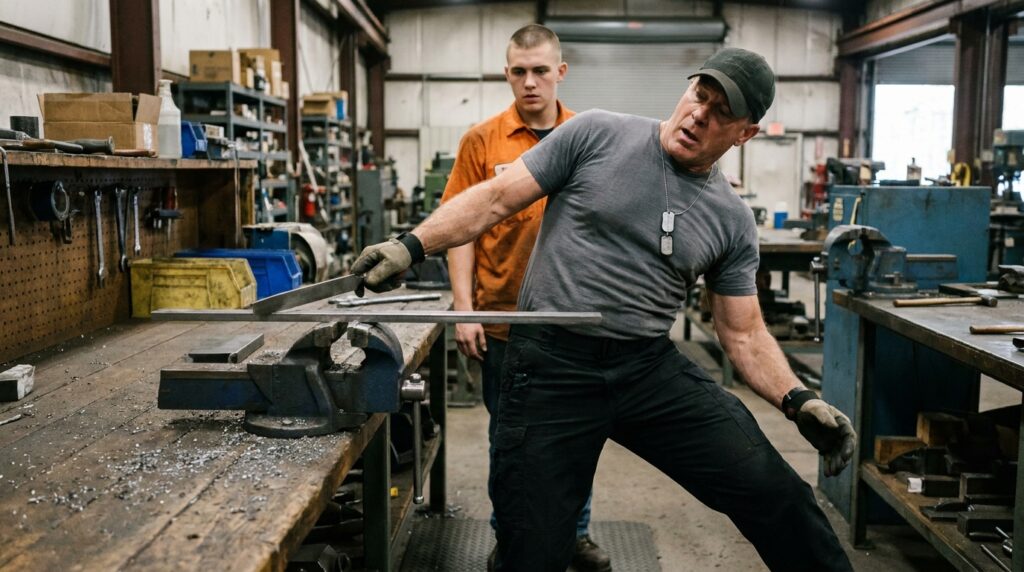
Miller didn’t pause his hands. He kept his scuffed leather gloves wrapped around the wooden handle of his fourteen-inch bastard file, his movements steady, his spine locked at a precise forty-five-degree angle relative to the iron workbench. To his right, three feet away, the young contract welder—the one the crew called Vance—was leaning against a rack of oxygen cylinders. Vance’s orange high-visibility shirt was pristine, free of the dark grease rings that marked the clothes of the men who actually worked the cold-rolling mills.

“We’re paid by the piece on this assembly, Miller,” Vance said, his athletic frame shifting as he tucked his thumbs into his tool belt. His fresh buzz cut caught the harsh glare of the overhead mercury-vapor lamps. “Every minute you spend checking the scale with that antique micrometer is a minute the crane operators are sitting on their hands. Some of us have production bonuses to hit.”

Miller drew the file back, the teeth making a clean, raspy shhhk against the hardened steel bar clamped in the bench vise. He didn’t turn his head. Internal calculation was an old habit; you didn’t waste oxygen or attention on low-yield variables. Vance was twenty-seven, clear-eyed, and fast with a MIG torch, but he lacked the internal rhythm that came from surviving machinery that didn’t care about human flesh. Vance thought speed was a virtue because the metal hadn’t pushed back against him yet.

“The tool works fine if you don’t rush the steel,” Miller said. His voice was sparse, leveled by years of giving commands that had to be heard over the roar of twin-propeller turbines.

He reached down to adjust the rusted micrometer calipre resting on the corner of the bench. As his fingers touched the cold, knurled adjustment knob, he noticed a minute discrepancy—a shadow beneath the heavy iron foot of the workbench where it met the concrete floor. The grade-eight anchor bolt looked flush, but there was a faint ring of bright, unoxidized silver metal around the washer, as if the threads had been backed out within the last hour. A fraction of an inch of play. In a shop where an impact wrench could rattle a three-ton frame off its blocks, that tiny gap was an intentional error.

Miller didn’t call it out. He simply shifted his footing three inches back, widening his base to account for the loose foundation before his next stroke. Before he could reset his grip on the file, the heavy iron door of the office rattled open, and the shop supervisor stepped onto the iron catwalk above.


CHAPTER 2: THE BACKED ANCHOR

“Miller! Vance! Kill the chatter and double up on Bay 4!”

The supervisor’s voice came down from the galvanized iron catwalk like a rusty shear through sheet metal. Arkwright was fifty-eight, his skin stained with forty years of cutting-fluid mist and the deep, permanent charcoal lines of embedded iron filings beneath his fingernails. He was clutching a leather-bound master clipboard against his oil-smeared canvas vest, his boots clacking hard against the open-toe grating as he came down the spiral stairs.

Vance didn’t drop his posture immediately. He allowed himself one long, deliberate second to exhale a stream of winter breath into the unheated air of the bay, his jaw tightening as he looked from Miller back to the catwalk. “We’re on it, boss,” Vance called out, his tone carrying that smooth, unearned confidence common to contract hands who knew they could pack their rigs and find another yard by Friday if the foreman got too loud. “Just making sure the old head’s calibrated for the titanium run. Don’t want him stripping the teeth on those premium blanks.”

Miller didn’t answer. He turned his back to Vance, his gloved fingers clamping down on the knurled locking dial of his dual-scale micrometer. The metal of the tool was ice-cold against his palm, a familiar, unyielding reference point. He slipped the instrument back into his tactical pants pocket, his thumb brushing the rough fabric edge of his hidden dog tags where they lay flat against his chest under his gray shirt.

The shop floor was vibrating. Thirty feet away, the heavy three-hundred-ton hydraulic press brake began its stroke, a deep, bone-rattling thug-chuuurn that sent ripples through the puddles of sulfur-base coolant near the floor drains. With that vibration came the shift. Miller watched the iron foot of the workbench. As the floor plates shuddered under the press’s stroke, the loose washer beneath the grade-eight anchor bolt did not just jiggle—it turned. It was a smooth, oiled rotation, moving counter-clockwise by less than half a millimeter.

An anchor bolt under standard shop vibration didn’t back out with that kind of greasy ease unless the threads had been thoroughly scrubbed with graphite spray and deliberately relieved of their torque. Someone had spent five minutes with an uninsulated slugging wrench during the pre-shift maintenance window, masking the noise behind the morning compressor blowouts.

“Listen up,” Arkwright said, dropping his heavy clipboard onto the corner of the iron workbench with a sharp slap that sent a small cloud of gray metallic dust into the air. The small circle of mixed-age laborers from the surrounding grinding stations began to drift over, dropping their safety shields onto their foreheads, their faces pale under the green-tinted mercury lamps. “Corporate just pushed the delivery schedule forward on the maritime stabilizer plates. The inspector from the shipyard is coming through the gate at fourteen-hundred hours. If these titanium-alloy edges aren’t hand-finished to a three-point-two micron tolerance, the whole lot gets red-tagged.”

“Hand-finished?” Vance scoffed, crossing his muscular arms across his orange shirt. “We’ve got two automated radial sanders sitting idle in Bay 2. Why are we wasting time with manual bastard files?”

“Because the sanders leave directional micro-grooves that cause stress fractures under forty tons of hydraulic shear,” Arkwright snapped, his eyes drilling into Vance’s fresh buzz cut. “The naval spec explicitly demands an cross-hatched, omnidirectional draw-file finish. It takes a steady hand, perfect leverage, and patience. That’s why Miller’s taking the lead on the sample piece. You lot watch his stroke, copy his angle, and don’t deviate by a single degree.”

Vance’s face darkened, the patronizing smirk vanishing from his lips as he felt the eyes of the older shop hands shift toward him. He looked down at the iron bench, his fingers twitching against his tool belt. “A file’s a file, Arkwright. You push, you take off metal. It’s not rocket science.”

“It’s material science, kid,” Arkwright said flatly. He turned to Miller, his expression softening into the guarded, professional deference he only showed to the few men in the yard who didn’t complain about the tolerances. “Whenever you’re ready, Chief. Show ’em how we clear the mill scale without glazing the core.”

Miller stepped up to the bench. His boots found the familiar oil-slicked grain of the concrete floor. He reached out and verified the vise pressure on the hardened steel alloy bar; it was clamped tight, four inches of dark, unpolished metal protruding from the hardened serrated jaws. He knew the bench was compromised. He knew that the moment he leaned his full eighty-five kilograms of frame into the forward stroke, the loose back leg would give way, transferring the kinetic energy of his thrust back into his own spine and destroying his center of gravity.

He could stop. He could point to the silver ring around the washer and expose the sabotage right now in front of Arkwright and the entire crew. But in the environment of the yard, an unproven accusation was just text; it didn’t carry the weight of a physical fact. Vance would claim ignorance, the crew would see it as an old man being paranoid about his footing, and the structural tension on the floor would remain unresolved.

Miller drew the file back, his left hand cupping the tip of the steel blade, his right hand locking around the wooden handle. He looked across the iron bar, his eyes locking directly onto Vance’s intense, unblinking stare. The young welder was leaning forward slightly, his tactical boots planted, his chest rising and falling with a shallow, expectant breath. He was waiting for the drop.

“Watch the wrist orientation,” Miller said to the gathered crew, his voice low, steady, and entirely devoid of hurry. “If you don’t lock the forearm bone to the tool spine, the metal will fight you back.”

He tilted the file exactly twelve degrees, verified the friction against the rough mill scale, and prepared to strike.

CHAPTER 3: THE PRECISION RUN

The first stroke was purely a diagnostic measurement. Miller pushed the fourteen-inch file forward with a steady, deliberate translation of weight from his back heel through his locked shoulder, keeping his forearms parallel to the unpainted iron workbench. The heavy steel file grated against the unpolished crown of the titanium-alloy bar, producing a dry, rhythmic shhhk that vibrated through the dense meat of his palms.

It didn’t feel right.

The resistance was too soft. True naval-grade titanium-alloy met a bastard file with an unyielding, glass-like stubbornness that glided before it bit, requiring a constant adjustment of manual pressure to avoid glazing the tool’s teeth. This material gave way with an oily, granular compliance, shedding fine gray curls that clotted the grooves too quickly. It was the characteristic signature of cheap, high-sulfur structural steel—re-rolled commercial stock masquerading under a military certification tag. Miller didn’t change his expression, but his fingers registered the tolerance anomaly to the millimeter.

“See how he controls the drag?” Arkwright’s voice boomed above the persistent whistle of the shop’s primary air lines. The supervisor stepped closer, his heavy leather clipboard tucked beneath his armpit, his spectacles catching the low, green hue of the mercury lamps. “He isn’t bouncing the heel. He’s utilizing the center five inches of the blade to ensure an even thermal distribution across the grain. Vance, look at his posture.”

Vance didn’t move from his position by the oxygen rack. His muscular arms remained tightly crossed over his bright orange high-visibility shirt, his clean tactical boots planted square on the grease-stained concrete. His jaw worked on a piece of tobacco, his eyes tracking the slight, rhythmic movement of Miller’s shoulders with a hard, calculative focus. He wasn’t looking at the finish on the steel. He was watching the bottom left leg of the workbench, waiting for the oscillation of the third stroke to catch the unseated thread of the backed-out anchor bolt.

“Looks like a lot of slow motion to me, Arkwright,” Vance said, his voice flat, carry-over bravado from the younger shift hands who had gathered behind him. “The mill schedule is dropping three more pallets into Bay 4 by noon. If we spend twenty minutes per block performing a manual cross-hatch, the night shift is going to be buried under dead weight. The automated sanders would have cleared that scale in sixty seconds.”

“And the automated sanders would have introduced micro-fractures that fail a magnaflux test the moment the inspector hooks up the current,” Miller said, his tone low and level. He didn’t break his stroke. He drew the file back on the recovery path, his left thumb clearing the clotted metal filings from the tool’s face with a single, practiced swipe of his leather glove. “Speed without calibration is just an efficient way to manufacture scrap iron, son.”

A faint murmur went through the grinding hands behind Vance. An older millwright named Henderson cleared his throat, nodding toward the workbench, but Vance’s face flushed a deep, unvarnished crimson beneath his fresh buzz cut. The young contract welder took a step into the active safety lane, his hands dropping to his tool belt, his chest swelling beneath his orange shirt.

“I’m not your son, old head,” Vance hissed, his voice dropping into a quiet, territorial register that bypassed the supervisor entirely. “And my welds don’t fail inspection. You spend more time staring at your rusted micrometers than you do running production. The only reason Arkwright keeps you on the lead line is because you’ve been drawing a paycheck since the foundation plates were poured.”

Arkwright stepped between them, his clipboard coming up like a barrier. “That’s enough, Vance. Back off the lane. Miller’s got thirty years of specialized naval spec work behind his belt. You’re here to absorb the instruction, not litigate the quota.”

“He’s thirty years past his prime,” Vance muttered, but he stepped back an inch, his eyes dropping back to the base of the workbench.

Miller ignored the heat in the younger man’s voice. His attention remained fixed on the mechanical feedback coming through his boots. The floor was vibrating harder now; the distant three-hundred-ton press brake had increased its cadence, sending long, low-frequency harmonics through the concrete plates. With every pulse, the unseated washer on the rear leg shifted another fraction of a degree. The workbench was beginning to lean, its entire dead weight resting on the three remaining points of contact.

Miller adjusted his grip for the fourth stroke—the heavy, definitive cut intended to smooth the structural bevel. He knew the bench would shift the moment he applied forty kilograms of forward torque. He could feel the latent imbalance through his locked left knee. But beneath that immediate physical hazard, a larger discrepancy was mounting in his mind. He looked down at the gray shavings accumulating on the unpainted iron surface. They were too dark, too brittle.

He reached into his pocket, his fingers brushing past the cold metal dials of his micrometer to touch the worn edge of a master blueprint fold tucked into his belt. There was something wrong with the material delivery codes Arkwright had received from corporate. The specs didn’t match the iron on the bench. If he allowed himself to be distracted by Vance’s small-time shop sabotage, he would miss the larger failure currently moving through the yard’s logistics line.

He tightened his jaw, locked his spine at forty-five degrees, and pushed the file into the center of the bar.

CHAPTER 4: THE ANCHOR INCIDENT

The fourth cut began with seventy pounds of manual pressure. Miller leaned his weight forward, his back boot driving down into the oil-dark grit of the floor plates to anchor his skeletal alignment. The fourteen-inch file bit into the unrated alloy bar, the teeth singing a high, shrill note over the distant thudding of the yard’s rolling mills. It was the exact frequency of metal reaching its structural limit under manual shear.

Then the foundation dropped.

Under the rhythmic pulse of the press brake in the next bay, the unseated grade-eight bolt on the rear leg finally rolled past its remaining thread. The three-hundred-pound unpainted iron workbench lurked three-eighths of an inch to the left. It was a minute displacement, but at the apex of a heavy draw-file stroke, a fraction of an inch is a structural chasm. The unyielding resistance against the tool’s edge dissolved into a greasy, sliding void.

The kinetic energy built up in Miller’s shoulders had nowhere to go. The steel file slipped sideways, the hardened teeth skittering across the jaw of the vise with a spraying shower of blunt orange sparks. The unexpected shift threw his center of gravity completely outside his base of support. His front boot slid through a thin film of sulfur-base coolant, and his frame went back, hard and flat against the unyielding concrete floor.

The impact was a dull, heavy thud that rattled the tools inside his tactical pockets and sent his faded black twill cap spinning into the shadow of the material racks. He lay there on his back, the coarse gray metal shavings scattered across the floor biting into the skin of his bare forearms. His wind was gone, a sharp, cold knot of industrial air lodged tightly in his chest, but his eyes remained unblinking, tracking the ceiling beams above Bay 4 until the blurred green glare of the mercury lamps re-centered.

No one spoke. The immediate circle of grinding hands froze, their handles dropping, their breath caught in the unheated air of the bay. The only sound was the high, mechanical whine of an idling automated sander three bays over and the wet, heavy slap of coolant dripping from a nearby feed line.

Vance didn’t move to help. He remained standing by the oxygen rack, his muscular arms locked tight across his clean orange high-visibility shirt. A thin, slow circle of tobacco juice hit the concrete near Miller’s boots. The young contract welder tilted his chin upward, letting a broad, slow smirk spread across his features under the green glare of the lamps.

“Look at that,” Vance said, his voice carrying an unearned, cutting resonance that bounced off the corrugated steel walls of the bay. “The master instructor just took a seat. Guess those thirty years on the line finally caught up with your knees, old head.”

Miller didn’t answer. He lay flat, letting his pulse settle, his internal sensors evaluating the damage. No broken bone, no torn ligament—just the deep, thrumming ache of impact against uninsulated slab. He could feel the cold metal of his hidden dog tags pressing hard against his breastbone, a small, flat reminder of harder falls in heavier seas. His eyes shifted toward the bottom of the workbench leg. The loose bolt was lying on its side, the bright, unoxidized silver of its threads fully exposed to the room.

“Arkwright,” Vance called out, turning to the supervisor with a loud, short laugh that drew the attention of two millwrights from the next bay. “You see that? We’re holding production for a guy who can’t even maintain his footing on a level floor. The naval inspector’s going to be at the gate in two hours, and our lead hand is down there taking a nap in the shavings.”

Arkwright stepped forward, his leather clipboard clutched tight against his canvas vest, his face tight with a mixture of professional panic and confusion. “Miller, you alright? Talk to me, Chief.”

Miller slowly planted his right glove against the grease-stained concrete. He didn’t look at Arkwright, and he didn’t look at the small group of onlookers whose safety shields were now fully raised to watch the display. His focus remained locked on Vance’s boots. The young man had stepped out of the safety lane, crossing into the active demonstration zone, his shadow falling long and dark over the displaced cap on the floor.

“He’s done, Arkwright,” Vance said, taking another step closer, his voice dropping into that aggressive, territorial register that contract bullies used to clear old wood out of a shop. “Get him his coat and let a man with some real muscle finish this titanium run before we lose the yard’s certification. Step away from the iron, Miller, before you hurt yourself permanent.”

The veteran didn’t answer with a word. He simply drew his left knee inward, planting his boot heel flat against the slab, and began to sit upright without a single sound of exertion.

CHAPTER 5: THE SEATED COMPOSURE

Miller planted his left gloved hand flat against the cold concrete slab. The grease-darkened surface was rough, scored with decades of heavy equipment tracks, and the coarse steel filings bit hard into the leather of his palm. He didn’t rush. He adjusted his posture, drawing his right heel back until his center of mass re-aligned over his base of support. He sat upright, his spine straightening into a rigid, deliberate line under the green glare of the mercury-vapor lamps.

His dark twill cap lay upside down three feet away near the base of the material racks, its inner rim white with salt lines from long summer shifts. Miller didn’t look at it yet. He looked at the bottom edge of the iron workbench frame where his fingers had slipped during the fall. Smeared along the unpainted lower flange was a thin, oily trace of black graphite grease—not the standard amber lithium compound used by the yard’s morning maintenance crew. It was a friction reducer, applied precisely to the anchor seating to ensure the bolt would break torque under heavy vibration without making an uninsulated squeal.

“Look at him,” Vance said, his voice dropping an octave as he moved deeper into the active safety lane. He crossed his arms over his unsoiled orange high-visibility shirt, his tactical boots crunching into a small pile of mill scale. “Arkwright, the guy can barely sit up straight. His eyes are glassy. If you let him stay on this line, he’s going to drop a five-hundred-pound alloy blank on his foot and sue the company before the week is out.”

The surrounding grinding hands remained motionless at their stations, their faces shadowed beneath their raised safety shields. None of them spoke. The unwritten etiquette of the yard was brutal but simple: when a lead hand went down, you didn’t interfere until the power dynamic re-stabilized. But the silence in Bay 4 was growing heavy, thick with the smell of sulfur coolant and the persistent, low-frequency rumble of the rolling mills in the next building.

Miller picked up his cap, shaking a small cluster of gray shavings from the peak before slipping it back over his clean-shaven head. He pulled the bill down low, casting his eyes into a deep shadow. “The bench didn’t slide because of my knees, Vance,” he said. His voice was quiet, completely clear of the mechanical panic that had gripped the supervisor. “The grade-eight anchor gave way because the threads were cleared of their friction coefficient.”

Vance laughed—a short, sharp bark that lacked any real weight. He stepped closer, his forward-leaning posture crowding the small pocket of space between the workbench and the floor drains. “Oh, I get it now. It’s the equipment’s fault. The concrete’s crooked, right? The air lines are leaking? Come on, old man. Just take your pension and clear out your locker so the guys who can still pull a tool can hit their numbers.”

Arkwright moved into the gap, his fingers trembling slightly as he held the leather-bound master clipboard. “Vance, shut it. Miller, if you need to go down to the medical trailer to get checked out, I’ll have Henderson run the sample piece. We can’t have the shipyard rep see a lead machinist sitting on the slab.”

“I don’t need the trailer,” Miller said, his gloved hand reaching out to grasp the cold, unpainted iron leg of the workbench.

He drove his heels into the concrete, his leg muscles locking into an efficient, biomechanical lever system that brought his entire frame up from the floor in one smooth, unhurried motion. He stood at his full height, his broad shoulders squared against the glare of the lamps, his gray fitted T-shirt damp with oil rings but his posture entirely centered.

As his tactical pants settled, his fingers brushed against the thick, crisp fold of the blueprint documents tucked inside his pocket. The paper was stiff, a different weight than the standard digital prints Arkwright usually generated from the office terminal. The material codes listed at the bottom of the ledger—the ones Vance had signed out from the yard’s central warehouse at six-thirty this morning—contained an extra alphanumeric suffix. A code that didn’t exist in the naval defense sub-contract specifications.

Vance took another step forward, his chest inches from Miller’s face, his face flushing red under his buzz cut as he realized the older man wasn’t retreating toward the office. He raised both hands, palms flat and fingers extended, initiating a heavy, intimidating shove designed to force the veteran back down against the iron frame.

“I told you to step away from the iron,” Vance hissed.

Miller’s eyes didn’t widen. He watched the younger man’s shoulders lean into the thrust, his internal tracking systems calculating the velocity, the leverage, and the lack of balance in the contract welder’s forward drive before the palms could even touch his shirt.

CHAPTER 6: THE MEASURED RESTRAINT

“Don’t lean your weight into a strike you aren’t prepared to carry,” Miller said.

The words left his mouth before Vance’s palms even made contact with his gray T-shirt. The younger welder’s drive was heavy but overextended, his hips trailing behind his chest in a desperate, short-sighted play for physical dominance. It was the kind of uncalibrated aggression Miller had spent twenty years parsing on crowded military decks—predictable, top-heavy, and entirely reliant on the target remaining static.

Miller didn’t take a step back. He didn’t drop his center of gravity into an aggressive fighter’s crouch. Instead, his left boot slid a mere three inches outward on the grease-grained concrete, widening his skeletal base just enough to alter the angle of entry. As Vance’s right wrist locked to deliver the thrust, Miller’s gloved left hand intercepted the forearm. It was a precise, defensive connection—not a violent strike, but a heavy manipulation of momentum using the rigid, unyielding bone of his own locked forearm.

With a split-second rotation of his hip, Miller caught Vance’s lead wrist in a secure, leather-clad grip. He didn’t punch; he shifted his mass backward by an inch, absorbing the kinetic energy of Vance’s rush and redirecting it downward toward the cold iron foot of the compromised workbench. The physics of the movement were clean, economic, and completely non-graphic. The young man’s forward acceleration became his own trap. Miller’s thumb found the nerve cluster between the welder’s radius and ulna, applying a steady, mechanical compression that forced the joint to lock up to the shoulder.

Vance’s torso buckled forward instantly. His chin dropped, his tactical boots skittering across the unpainted shavings on the floor as his balance evaporated into a painful compliance hold. He was completely immobilized, his arm pinned at an unnatural, unyielding angle across his own chest, his face turning a dark, mottled purple beneath his fresh buzz cut. He tried to pull back, to wrench his frame out of the mechanical vise of the veteran’s grip, but the more he struggled, the deeper the torque settled into his shoulder joint.

The entire bay plummeted into a profound, suffocating silence.

The three-hundred-ton hydraulic press brake in the next building finished its stroke with a distant, hollow thug-chuuurn, but within Bay 4, every grinding wheel and automatic sander cut out one by one. The surrounding crew members stood entirely frozen, their tools held dead at their sides, their eyes wide beneath their raised safety shields as they watched the loud-mouthed yard bully held completely motionless by a single hand. Miller’s gray shirt shifted slightly with his breath, allowing the dull silver edges of his hidden dog tags to slip from his collar, catching the harsh, green mercury glare above.

“Let go of me,” Vance choked out, his arrogance crumbling into a dry, panicked rattle as his boots lost traction against the slick sulfur-coolant film near the floor drain. “Arkwright—get this psycho off me!”

Arkwright didn’t move. He stood three feet away, his leather-bound master clipboard clutched against his canvas vest like a shield, his jaw slack as his eyes moved from the loose bolt on the floor to the flawless discipline of the veteran’s posture. He had seen bar fights in the yard before, but this wasn’t a fight. This was a clinical calibration—a total containment of a threat performed without a single blow being thrown.

Miller kept his grip tight, his eyes tracking Vance’s shoulder position to ensure no structural injury occurred. He wasn’t looking for vengeance; he was holding a line. But as his fingers maintained the lock, his right hand reached into his tactical pocket, pulling out the crisp, heavy fold of the blueprint orders he had pulled from the shift desk earlier.

The paper crinkled in the silence. He dropped the sheets onto the unpainted iron surface of the workbench, directly beside the loose anchor bolt. Under the green light, the bottom margin of the ledger was now fully visible to Arkwright. The master stamps from the corporate logistics office weren’t standard ink; they were raised, glossy blue line imprints—the kind used to override naval defense specifications during warehouse material swaps.

Vance’s eyes darted toward the papers on the iron bench, the panic in his expression sharpening into something older and far more dangerous than simple shop floor embarrassment. He knew what those extra alphanumeric suffixes meant.

Miller leaned in slightly, his voice dropping into a register that only Vance could hear over the low hum of the ventilation units. “The benchmark isn’t the only thing you loosened this morning, kid. Let’s see what Arkwright thinks about the grade-three iron you signed out under a naval hull designation.”

CHAPTER 7: THE SILENT VOW

“Let go,” Vance rasped again, but the syllables were cut short as his heel slipped through another inch of grease-darkened sludge near the floor drains. His athletic frame was completely unweighted now, pinned by the deliberate, biomechanical geometry of Miller’s hold. Every twitch he made to free his shoulder simply drove the compression deeper into the joint.

Miller didn’t answer with words. He didn’t tighten his grip beyond the exact number of pounds needed to hold the status quo. His eyes remained hooded beneath the bill of his black twill cap, his internal sensors locked onto the physical reality of the room. The grinding crew had pulled back into a semi-circle, their pale faces illuminated by the green mercury lamps, their safety shields raised like iron vizors. They were watching the absolute collapse of the shop’s social hierarchy in real time, and the weight of that observation was a tangible pressure in the bay.

“Arkwright,” Miller said, his tone retaining that sparse, command-level flatness that had carried over from naval bridge wings. He didn’t look at the supervisor. His focus stayed on the base of Vance’s neck. “Pick up the ledger on the bench. Look at the shipping manifest suffix.”

Arkwright hesitated, his fingers adjusting his thick spectacles as he stepped over the fallen anchor bolt. The unpainted iron surface of the workbench was cluttered with gray metal shavings, but the heavy, crisp blueprint papers Miller had dropped were impossible to ignore. The supervisor reached out, his oil-stained canvas vest rustling as he tilted the pages toward the light.

“What is this?” Arkwright muttered, his eyes tracking the raised blue line imprints at the bottom of the ledger. He shook his head, his face turning an ash-gray color that matched the mill scale on the floor. “This isn’t the delivery batch I authorized from the main office terminal. This suffix—X-seven-four-zero—that’s a commercial structural grade. It’s unrated structural plate for warehouse frames. It’s not maritime titanium.”

“He knew it when he hauled the pallet into Bay 4 this morning,” Miller said, his voice entirely steady as he maintained the lock on Vance’s wrist. “The file didn’t glide because the metal was hard. It bit because it’s soft, cheap iron. He altered the spec sheets in the shift desk to look like my manual tolerances were ruining the stock, so when the shipyard inspector red-tagged the lot, the failure would land on the old man’s station.”

A low, collective hiss went through the grinding hands. Henderson, the senior millwright, took three steps forward, his leather work gloves tightening into balls. “Vance, you swap the material tags? We’ve got forty structural plates already loaded onto the transfer flatbed for the naval defense run. If those pieces hit the hull assembly with an unrated core, they’ll shear apart under fifty pounds of sea-state pressure.”

Vance didn’t answer. He couldn’t. His breath was coming in shallow, ragged gaps as the weight of his overextended shoulder forced his cheek down against the cold edge of the bench vise. His gaze was locked onto the blue imprints on the paper, his mouth open but dry, the arrogance completely wrung out of him by the indisputable evidence of the metal shavings beneath his eyes.

“Arkwright,” Miller continued, his thumb applying one final, calculated ounce of pressure to the radius bone to freeze Vance’s remaining leverage. “The contract welder didn’t invent this code on his own. A twenty-seven-year-old yard hand doesn’t get access to corporate logistics stamps without a secondary hand clearing the terminal from the top.”

Arkwright’s clipboard rattled against his vest. He looked up from the blueprint, his eyes darting toward the heavy iron doors of the central office trailer at the far end of the facility. The lights inside the administrative deck were still on, casting long, pale squares across the dark gravel yard outside the bay. The true depth of the fraud was widening, breaking past the shop floor and moving toward a structural corruption that the yard’s old management had never anticipated.

Miller slowly eased the torque on Vance’s wrist, shifting his weight back three inches to restore an honorable distance between them. He didn’t release the hold entirely; he simply converted it into a firm, professional escort grip, waiting for the supervisor to bring down the final authority.

The younger man didn’t try to strike back. The moment the physical pressure relented, he slumped against the workbench, his pristine orange high-visibility shirt smeared with the grease of the loose anchor bolt, his face hollowed out by the sudden, absolute certainty of his own professional ruin.

“Class is over,” Miller said to the room, his voice cutting through the remaining hum of the ventilation system. “Keep your tools clear until the supervisor runs the numbers.”

CHAPTER 8: THE RECOGNITION AUTHORITY

The high-pitched hydraulic screech of the main yard gate rolling open cut through the dead silence of Bay 4. Outside, a dark gray government-issued sedan rolled past the material flats, its tires crunching heavily over the wet gravel before coming to a stop directly outside the bay’s open sliding doors. The engine cut out, replaced by the wet, rhythmic hiss of air brakes from a nearby flatbed.

Arkwright’s hands shook so violently that a stack of yellow loose-leaf inspection slips slipped from his leather clipboard, drifting down into the damp grease near Miller’s boots. He didn’t bend to gather them. His eyes were locked on the three men who stepped out of the vehicle. Two wore dark, insulated windbreakers with the block letters of the Defense Contract Management Agency stamped across the shoulders. Between them walked an older man with silver hair and a heavy canvas trench coat, carrying a ruggedized aluminum digital caliper case.

“That’s the shipyard acceptance team,” Arkwright whispered, his throat so dry the vowels clicked. “They’re twenty minutes early.”

Vance attempted to straighten his spine against the unpainted iron workbench, his breath still coming in ragged, shallow gaps. The bright orange high-visibility shirt was twisted at the collar where Miller’s grip had anchored his mass. “Arkwright,” he muttered, his voice cracking as his eyes darted toward the administrative trailer at the back of the lot. “We need to clear the floor. We can’t have them testing the unrated flats while we’re standing around a broken workbench.”

“The flats stay exactly where they are,” Miller said. His voice was low, carrying an iron-plated authority that stopped Vance from reaching for his tool belt. He released his containment grip completely, stepping back three inches to restore a cold, professional distance. He didn’t look at the welder. He reached down, picked up his scuffed leather work gloves from the iron bench, and pulled them back over his fingers, smoothing the seams with his thumbs.

The silver-haired inspector entered the bay first, his heavy leather boots making a distinct, hollow thud against the concrete plates. He stopped five feet from the workbench, his gray eyes scanning the raised safety shields of the grinding crew, the loose grade-eight bolt lying on the floor, and finally the dark alloy bar secured in the heavy bench vise. He didn’t look at Arkwright. His gaze stopped directly on Miller’s face.

“Miller,” the inspector said, his voice deep and leveled by thirty years of maritime yards. He set the aluminum caliper case down on a clean wooden crate near the lane line. “I heard you were pulling shifts out here in Ohio, but I didn’t believe the master registry until I saw the signature on the pre-inspection manifest.”

Arkwright blinked behind his thick spectacles, his glance shifting between the government representative and the quiet machinist who had spent six winters clearing mill scale in his shop. “Commander Vaughan? You two… you know each other?”

“Knowing him isn’t the term, Arkwright,” Vaughan said, pulling a pair of thin inspection glasses from his trench coat pocket. He didn’t smile. “This is Master Chief Miller. He spent twelve years running the hull validation trials for the Atlantic Fleet submarine construction program at Newport News. If a weld had a micro-fracture within three hundred miles of his deck, the navy didn’t pay for the iron. He literally wrote the omnidirectional hand-draw specification you’re supposed to be executing on these stabilizer plates.”

A heavy, absolute drop in room temperature seemed to pass through the grinding crew. Henderson, the senior millwright, let out a slow, low whistle, his eyes dropping to the dull silver dog tags that were still visible beneath the collar of Miller’s gray shirt. Vance’s face went entirely white beneath his fresh buzz cut. His hands dropped flat against his tactical pants, his fingers trembling against the seam as he realized the old man he had spent three weeks mocking as an obsolete laborer had spent decades training the instructors who certified his own trade school licenses.

“Arkwright,” Miller said, his tone entirely devoid of personal triumph as he pointed a gloved finger toward the heavy blueprint sheets lying near the vise. “The shipyard team doesn’t need to hook up the magnaflux current to these plates. The delivery batch from warehouse four is commercial structural grade iron—suffix X-seven-four-zero. The contract hand signed it out at dawn using a raised corporate logistics stamp.”

Commander Vaughan’s expression hardened instantly. He didn’t touch the file or the bar in the vise. He stepped directly to the workbench, picked up the crisp blueprint document, and held it to the green light of the mercury lamps, his thumb running over the glossy blue imprint line at the bottom.

“This is an unrated steel batch,” Vaughan said, his voice dropping into a dangerous, institutional register that bypassed the shop floor completely. “Who authorized the warehouse release for a primary naval defense assembly using an uncertified material stamp?”

Arkwright’s clipboard slipped from his armpit, hitting the concrete with a loud, ringing slap that caused two of the younger grinders to jump. He looked toward the corporate administrative trailer, where a dark silhouette was now visible against the lit office window, watching the bay through the horizontal blinds.

“I… I have the personnel ledger in my office,” Arkwright stammered, his face completely drained of color as he took two steps backward toward the exit line. “Vance signed the pull order. I didn’t see the suffix.”

“Vance didn’t generate the blue line override stamp from a field terminal,” Miller said, his eyes locking onto the dark silhouette in the distant office window. “The signature on the master log belongs to the regional director who cleared the procurement ledger last night. The welder was just the hand that loosened the bolts to make sure the verification failed on my shift.”

Vance sank against the iron frame of the bench, his chin tucked into his chest, unable to look the government inspector or the veteran in the eye. The silence of the bay was absolute, broken only by the cold, steady drip of sulfur coolant from the machine lines, as the true scale of the corporate fraud began to crack the facility wide open.

CHAPTER 9: THE CALIBRATED HORIZON

“Class is over. Get back to work,” Miller said.

The words left his mouth with the finality of an anvil drop. He didn’t raise his voice to cut through the hum of the ventilation units, but every man in Bay 4 heard the baseline shift. He reached over the iron bench, picked up his bastard file, and laid it smoothly back into the custom velvet slots of his canvas tool roll. The motion was slow, rhythmic, and perfectly calibrated.

Commander Vaughan stepped into the active lane, his heavy canvas trench coat brushed with gray grit as he faced the back of the bay. He looked at the two federal agents behind him, then back toward the dark window of the administration trailer. “Arkwright, freeze those flats on the transfer beds,” Vaughan commanded, his voice echoing off the high corrugated steel walls. “No one moves a single ounce of iron out of this yard until we pull the master procurement server logs. This facility is under immediate security lock.”

Arkwright let out a high, ragged breath, his leather clipboard slipping completely from his fingers to clatter face-down against the oil-stained concrete. He didn’t try to retrieve it. He simply turned, his boots dragging through the metal shavings as he led the federal agents out of the bay toward the office stairs. Behind them, Vance remained slumped against the iron framework of the workbench, his pristine orange shirt dark with graphite grease, his face completely empty of the swagger that had driven his shift since dawn.

The surrounding grinding crew didn’t speak. They raised their safety shields all the way up, their pale faces illuminated by the green mercury glare as they stood in a silent, respectful line. Henderson, the senior millwright, stepped out of his station first. He didn’t look at Vance. He stopped three feet from Miller, his broad shoulders squaring into a sudden, unprompted military posture before he offered a slow, deliberate salute to the quiet machinist who had held their floor in check.

Miller adjusted his black twill cap, pulling the bill low to drop his eyes back into shadow. He didn’t return the salute with a flourish; he gave a brief, tight nod—the acknowledgment of an old chief who valued an even tolerance over an unearned medal. He picked up his canvas tool roll, tucking the heavy bundle firmly under his left armpit, his leather-clad fingers feeling the cold, familiar outline of his hidden micrometers inside his tactical pockets.

He looked down at the unpolished steel alloy bar still secured tightly in the bench vise. The metal was dull, marked by the four deep, cross-hatched draw-strokes he had executed before the anchor gave way. It was an incomplete finish, but the baseline truth of the core had already been exposed to the room. The cheap structural iron beneath the surface couldn’t sustain the load of a naval defense run, and everyone in the bay knew it now.

“Henderson,” Miller said, his voice level as he turned his back to the workbench. “The yard’s going to be dark for a few days while the acceptance team clears the warehouse. When the presses start rolling again, make sure the junior hands check the floor bolts before they pull their files. A tool’s only as good as the foundation beneath your heels.”

“Understood, Chief,” Henderson said quietly, his boots crunching back into his lane as the rest of the crew began to shut down their equipment for the federal inspection.

Miller walked out of Bay 4 without a second glance at the fallen welder or the compromised iron bench. He stepped through the sliding bay doors, crossing the threshold onto the open gravel yard where the cool Ohio wind swept the scent of burnt oil and sulfur away from his shirt. The dark gray government sedan sat idling near the gate, its exhaust pipe puffing thin white rings into the unheated sky. The horizon was still dusty, grey, and heavy with the promise of more labor, but the boundary of disciplined authority had been completely re-established on the concrete floor.

He pulled his cap tighter against the wind, his boots making a steady, even rhythm against the stones as he moved toward the exit line.

Similar Posts

Leave a Reply

Your email address will not be published. Required fields are marked *






