
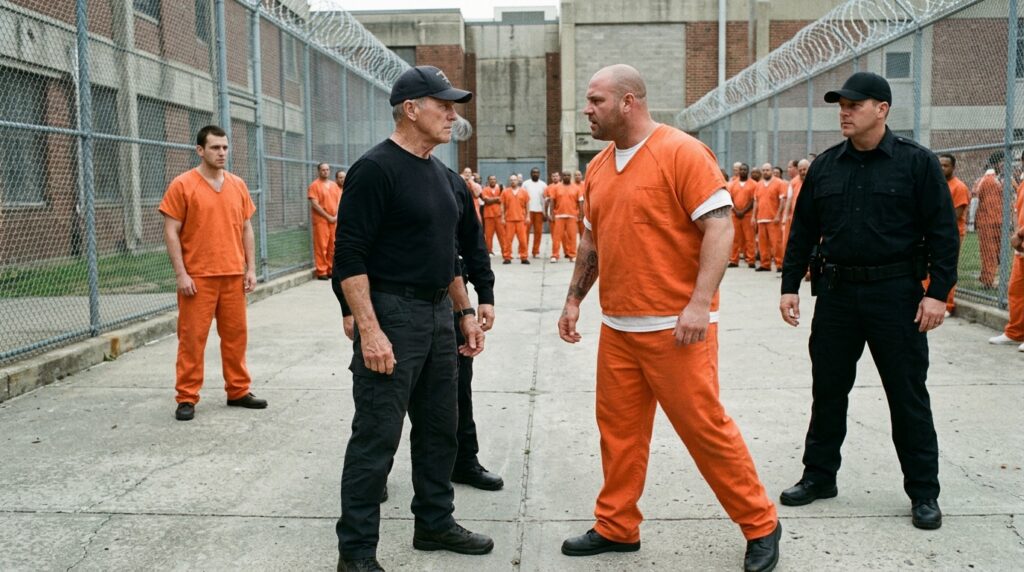
The Weight of Salt and Iron Behind the High Gray Walls of a Closed Horizon
CHAPTER 1: THE FIRST RUPTURE
“Get your hands where I can see the knuckles, old man,” the guard said.
The leather of the officer’s duty belt creaked, a heavy, transactional sound that filled the six inches of dead space between them. The air in the lane still tasted of hot iron and the chalky dust their boots had kicked up from the concrete. Two feet away, the large inmate stayed down, his orange jumpsuit dark with sweat at the shoulder blades, his breath coming in ragged, wet rattles against the stone. He wasn’t moving his legs yet. He was just counting his teeth with his tongue, his tattooed forearms twitching where they pressed into the grit.
The veteran did not look down at him. He kept his eyes leveled at the center of the guard’s throat, right where the cheap zinc badge sat slightly crooked on the black uniform fabric. He didn’t drop his hands completely; he just turned his palms outward, fingers loose, showing the lack of iron or glass in his grip. His knuckles were dry. Thirty years of handling salt water and hydraulic steel had left his skin like tanned hide, impervious to the minor scrape of a jawbone.
“He tripped,” the veteran said. His voice was low, flat, completely devoid of the theatrical gravel common to the cellblocks. It was the tone of a man reporting fuel ratios on a logistics log.
“He tripped into three short ribs and a fractured orbital,” the guard muttered. His hand remained wrapped around the grip of his heavy chemical iron canister, but he didn’t unclip the retention strap. His eyes shifted down the lane, where the rest of the orange uniforms had flattened themselves against the chain-link barrier. The crowd was a dense, vibrating wall of gray skin and bright nylon, their silence heavier than any riot he’d pulled duty for. “You don’t talk. You don’t look back. You move toward the intake tunnel now.”
The veteran stepped forward. His boots made a dry, rhythmic click on the concrete lane. Every surface here was rusted or scaling. The vertical iron bars blocking the auxiliary corridors had three coats of lead paint bubbling over black oxidation. It smelled of old grease, high-pressure steam, and the damp, sour rot of cabbage from the lower mess hall.
As he reached the shadow of the intake arch, where the hard institutional daylight gave way to the yellow sodium glare of the interior tiers, he felt the shift in the air. The younger inmate witness—the one who had stayed back by the razor-wire boundary—was gone from his post. In his place, sitting on an overturned plastic laundry crate near the cellblock entrance, was a man who didn’t belong in the yard. He wore the standard denim of the facility, but his fingernails were clean, and his posture lacked the defensive hunch of a man who slept with one eye on the gallery.
The man looked up as the veteran passed under the guard’s escort. He didn’t smile, but his hand moved to his chest, tapping the small, distinctive silver pin pinned to the inside of his collar—the precise insignia of the naval screening office that had processed the veteran’s final discharge papers five years ago.

CHAPTER 2: THE FRICTION COUNT
“Keep moving, old man,” the guard barked, his fingers twitching against the plastic casing of the chemical iron canister. “He didn’t give you permission to look at the laundry bins.”
The veteran didn’t alter the length of his stride by a fraction of an inch. His heels struck the concrete floor with a heavy, predictable rhythm that resonated off the narrow iron-reinforced walls of the intake corridor. His mind was already cataloging the anomaly. The silver pin—three-sixteenths of an inch across, the anchor fluke slightly blunted from a bad stamping run in 2021—was only issued to the regional processing officers at the amphibious training command in Coronado. It wasn’t a civilian trinket. It wasn’t something a street-level dealer traded for two cartons of menthols in the lower tiers.
“Who’s the man on the laundry detail?” the veteran asked, his voice remaining flat, keeping below the echo threshold of the vaulted corridor ceiling.
“That’s nobody you owe money to,” the guard said, pushing a heavy steel door inward. The hinges screamed, a dry metal-on-metal scrape that vibrated through the floorboards. “That’s tier four business. Tier four stays out of your mouth if you want to keep breathing this air.”
The door clanged shut behind them, locking out the dim yellow sodium glare of the yard tunnels. The transition into cellblock C brought a different kind of pressure—the desaturated, cold dampness of underground stone that had spent fifty years absorbing the sweat of six hundred men. The vertical iron bars lining the main gallery were thick with layered, industrial gray paint that had begun to split and bubble away from the rusted structural metal beneath. Every vertical lane was a tight choke point. Every corner smelled of damp laundry, cold lard, and the sulfurous sting of cheap institutional coal burned in the auxiliary heating pipes.
The guard led him up the second tier catwalk, where the iron grating underfoot vibrated with the collective low hum of the cells. It was the afternoon lockdown count. Men stood at their grates, their faces reduced to pale slivers behind the rusted crossbars, their eyes tracking the veteran’s black long-sleeve shirt like hawks watching a strange predator move through an established thicket.
“Cell eighty-four,” the guard said, pulling a heavy brass key from his duty belt. He dropped it into the mechanical lock with a sharp, heavy thud. “Get inside. Hands on the back wall until the bar drops.”
The veteran stepped into the space. It was four paces deep, two paces wide. The walls were rough-cast concrete, green with moisture bloom near the floor where the plumbing lines leaked into the foundation. A single iron bunk was bolted directly into the stone, its canvas mattress support sagging like an old hammock.
Sitting on the lower edge of that iron frame was a small man with graying hair cut down to the scalp and arms covered in old grease scars from a motor pool detail. He didn’t look up when the door slammed shut. He didn’t move his hands from his knees. Between his thumb and forefinger, he was holding a small, flat piece of slate, rhythmically drawing the edge against the iron corner of the bunk frame.
Scritch. Scritch. Scritch.
The sound was tiny, sharp, and perfectly metered. To an untrained ear, it was the nervous tic of an old convict wearing down the hours. To the veteran, the interval was exactly twelve hundred milliseconds—the standard timing signature for a manual radio check in a contested operational theater.
“The yard was loud today,” the cellmate said without stopping the slate. The gray dust fell from his thumb, settling into the cracks of his scarred skin like dry earth.
“The yard is always loud when people don’t know who owns the lane,” the veteran replied, standing near the opposite wall. He didn’t sit. He didn’t drop his baseball cap. His eyes scanned the corners of the cell—the weld points on the bunk, the drainage grate in the corner, the tiny gap where the ventilation pipe entered the concrete ceiling. There were no wires, no hidden cameras, but the air felt too thick, like a room where the atmospheric pressure was being adjusted from the outside.
“The big man from tier two will be out of the infirmary by tomorrow evening,” the cellmate said, his voice dropping into the low register of weaponized silence. The slate scraped one more time, then stopped. He turned the stone over, revealing a single, rough number scratched into the dark surface: 043-A. “He has friends in the laundry detail. People who handle the heavy crates that come through the rear dock from the supply depots.”
The veteran looked at the number. 043-A was the prefix for deniable logistics manifests—the paperwork used by the naval special warfare command to move unlisted equipment across borders without triggering maritime customs logs. It was the code for his old kit.
“Where did you see that manifest?” the veteran asked, his posture shifting into a tight, calculating stance.
“It came in on the bottom of a soap crate this morning,” the cellmate whispered, his eyes finally lifting to meet the veteran’s with a cold, pragmatic clarity. “Signed by someone using your old field name. The gang isn’t trying to kill you because you walked their yard, old man. They’re trying to kill you because your old people just sold them your location, and they’ve already paid for the delivery.”
From the end of the tier corridor, a heavy iron clanging began—the three-beat warning for the evening mail call, the sound of a guard’s baton striking the rusted gallery rails with deliberate, warning force.
CHAPTER 3: THE BROKEN MANIFEST
The iron door of the commercial extractor didn’t slide; it ground against its housing, shedding flakes of reddish-black scale onto the wet concrete floor. The air inside the basement laundry tier was thick enough to coat the throat in a film of lime and stale fat. Overhead, the main high-pressure steam line rattled against its wire hangers, leaking a steady hiss of sixty-psi vapor that left everything slick, warm, and smelling of boiled canvas.
The veteran didn’t use the iron handle to lever the barrel open. He jammed his palm against the reinforced zinc rim, feeling the structural heat vibrate through his old calluses. His assignment was the noon rotation—four hours of feeding sixty-pound bundles of stained prison denim into the churning maws of the industrial washers. It was heavy, dirty labor designed to break a man’s posture, but his arms moved with the mechanical precision of an oil derrick. He wasn’t watching the cloth. His focus remained anchored two yards to his left, where a massive, grease-coated shipping crate sat on a heavy timber pallet.
The crate was different from the standard plastic bins used to haul state-issued soap. It was built from reinforced fiberglass with a rusted steel band reinforcing the seams. The corner rivets were set in a distinct three-point clustering pattern—the exact design specification used by naval logistics for secure field storage containers.
“You’re behind on the tier-four sheets,” a voice muttered from behind the central boiler stack.
The veteran didn’t turn his head. He recognized the slouching build of the inmate witness from the yard, the younger man who had watched the confrontation from the backline. The man was working a hand-cranked wringer, his movements slow, his eyes darting toward the iron gate where the floor guard sat with a newspaper and a tin cup of chicory coffee.
“The crate came from the northern depot,” the younger inmate whispered, his hands continuing to feed a gray sheet through the twin rubber rollers. Squeak. Squeak. The sound was small, rhythmic, masked by the larger thud of the extractor barrels. “It wasn’t manifested through the main administrative dock. The warden’s office didn’t sign for the cargo weight. A private transport company dropped it at the kitchen gate during the four-o’clock shift change.”
The veteran reached into the tub of the extractor, his fingers sinking into the hot, tangled mass of wet fabric. He pulled three heavy jumpsuits out, dropping them into a rolling wire basket, then used the motion to mask a step toward the fiberglass container. His hand brushed the side of the container hull. The texture was rough, pitted by exposure to salt air, the material displaying the faded stenciling of military surplus gear.
“The seal is already popped,” the witness said, his voice dropping an octave as the guard at the gate shifted his boots against the iron rails. “Look under the shipping label on the dry side.”
The veteran didn’t hesitate. He slipped his fingers beneath the yellowed plastic invoice pouch glued to the crate’s lid. The adhesive was old, dry, and caked with gray laundry dust. His fingernails caught the edge of a thick, non-standard cardstock slip hidden beneath the official state routing form. He pulled it free with a single, practiced twitch of his wrist, sliding the paper into the long sleeve of his black shirt.
The texture of the cardstock was instantly recognizable. It was waxed ledger paper, chemical-treated to resist fuel spills and sea spray. As he smoothed it against his thigh beneath the cover of the wire basket, the desaturated light from the single overhead sodium bulb revealed the clean, typewritten lines.
There were forty serial numbers listed in chronological blocks. The first twenty matched the weapon receivers of his old detachment—the gear that had been officially logged as destroyed during the deniable extraction operation in the Persian Gulf six years ago. Below that list, typed in the same clean font, was his own internal service number, followed by a destination routing code: FACILITY-C-CORE-EVALUATION.
At the bottom of the ledger, where the commanding officer’s authorization stamp should have been, there was only a clean, crisp purple ink signature from his former operational handler—a man who had been dead on paper for forty-eight months.
A sharp, metallic click cut through the steam. The guard at the gate had stood up, his leather holster popping open as he let the heavy iron baton slide into his palm with a low, deliberate thud.
“Step away from the pallet, old man,” the guard said, his boots clicking in a slow, aggressive line across the wet concrete. “The laundry boss didn’t give you authorization to audit the inventory.”
The veteran kept his hands loose, the cardstock manifest hidden against his forearm. He looked at the guard, then glanced at the heavy fiberglass crate. The trap wasn’t just close; it was already sprung. His old team’s gear hadn’t been destroyed; it had been shipped here ahead of him, repurposed into contraband to provide the perfect legal justification for his permanent elimination inside these walls. The gang in the yard weren’t independent operators; they were the cleanup crew, executing a contract that had been drafted long before he ever walked onto the concrete lane.
“Just checking the seals,” the veteran said, his voice level, completely flat as he stepped back into the steam. “The water’s leaking through the bottom.”
“You don’t check anything unless I tell you to,” the guard barked, his face tightening as he gestured toward the tier-three entrance with his baton. “The shift is over. Get your line formed against the wall. The block’s going to total lockdown in five minutes, and you’re going to be the first one in the dark.”
CHAPTER 4: THE CLOSED THRESHOLD
“The primary breaker just dropped,” the cellmate whispered from the dark.
The absolute blackness of tier C didn’t fall slowly; it slammed down like an iron shutter. The persistent, low-frequency thrum of the ventilation fans died instantly, leaving a vacuum of silence that allowed the distant, metallic scraping of sixty cell latches to echo up from the basement level. The smell of wet wool and boiled lard dissipated, replaced by the sharp, bitter sting of ozone coming from the auxiliary terminal boxes down the catwalk.
The veteran didn’t slide his back down the concrete wall. He stood perfectly still in the dead center of the floor space, his knees slightly flexed, his feet tracking the minute vibrations traveling through the cold iron floor plates. A standard power failure left the emergency secondary system online within three seconds. Six seconds had passed. The emergency lights remained dead, save for a tiny, rhythmic pulse of dull red illumination coming from the casing of the high-wall optical cluster above the tier door.
It wasn’t a standard blackout. It was an isolation protocol.
“They’re not using the central gallery stairs,” the cellmate muttered, his fingers clicking nervously against his slate stone in the dark. Scritch. “They’re coming up the service shaft behind the laundry chute. Three men. Heavy boots.”
The veteran reached down, his fingers brushing the coarse fabric of his trousers until they located the hidden ledger sheet from the laundry crate. He didn’t try to destroy it. He folded the waxed cardstock into a tight, dense square and jammed it into the hollow drainage pipe beneath the iron sink basin, locking it behind the rusted internal threading. If they were clearing his sector, they would search the body first.
A sudden, mechanical click sounded at their cell threshold. The heavy master bar didn’t slide with its usual warning rattle; the lock actuator dropped with a muted, hydraulic hiss. The door swung inward six inches, its iron frame scraping against the concrete lintel.
“Move,” the veteran said.
He slipped through the opening before the door could hit the bumper block. The catwalk was an empty lane of desaturated shadow, illuminated only by the faint, crimson pulse of the security lenses along the ceiling line. As his eyes adjusted to the narrow corridor, he noticed something that shattered the logic of the decoy manifest. The red light wasn’t a battery backup signal. It was an active optical sensor, its tiny glass aperture panning smoothly across the floor plates, tracking his precise physical displacement in real time.
At the end of the gallery, near the auxiliary security cage, three figures emerged from the steam-pipe corridor. They didn’t wear the standard bright nylon of the yard factions or the mismatched protective gear of the night guards. They moved in a tight, three-man tactical wedge, their bodies covered in matte-black impact suits without identifying insignia or state badge numbers. Their movements were clean, silent, and perfectly balanced—the unmistakable signature of active-tier contractors trained for close-quarters counter-insurgency.
The lead operator didn’t pause to offer an administrative warning. He brought a short, composite defensive baton up to his centerline, his weight shifting into a low, aggressive forward lunge designed to fracture the veteran’s collarbone before he could establish a guard.
Time expanded into a cold, clinical sequence of spatial calculations. The veteran didn’t step back into the narrow cell. He drove his center of mass directly into the operator’s leading hip, slipping his left forearm under the incoming weapon arm to intercept the kinetic force at the pivot point. The impact was dead, heavy, and metallic. He could smell the clean oil on the operator’s gear and the sharp, chemical scent of professional grade synthetic fiber.
With a compact, three-inch rotation of his shoulders, the veteran delivered a short counterstrike to the operator’s jaw, right where the helmet strap met the lower mandibles. The man’s head snapped back, his boots losing their tracking on the iron grating, his body dropping into the auxiliary railing with a muted, metallic ring.
The veteran didn’t follow the body down. He caught the fallen weapon before it struck the floor, his fingers wrapping around the checkered synthetic grip. But as he rolled his weight to face the remaining two operators, his eyes caught the tiny display screen mounted to the back of the lead operator’s tactical wrist unit.
The screen wasn’t showing a tactical map or a manifest of inmate names. It was displaying a scrolling waterfall of real-time biometric metrics: SUBJECT-01_HEART_RATE: 72_BPM. RESPIRATORY_DEPTH: OPTIMAL. COMBAT_EFFICIENCY: 94.2%. Below the data stream, a small, system-generated prompt was blinking in amber text: ALGORITHM UPDATE: CONVERTING BEHAVIORAL PROFILE TO DEFENSE-GRID-PREDICTIVE-LOGISTICS.
The realization hit him with the weight of a physical blow. The prison wasn’t a disposal site. His former handler hadn’t sold his location to a gang for retribution or profit. The entire facility was a functional laboratory—a highly organized, deniable testing ground where legacy special operations assets were systematically pitted against engineered stress environments to train an automated, predictive behavioral system for private military applications. Every yard fight, every calculated counterstrike, and every hidden manifest was a piece of proprietary data being fed into the ceiling lenses.
The remaining two operators didn’t advance. They held their defensive line, their weapons lowered slightly, their eyes fixed on the veteran as the red optical sensors along the ceiling line ceased their panning and locked onto his chest with a synchronous, mechanical hum.
At the far end of the tier gate, the iron security door opened with a heavy, administrative hiss. Standing in the threshold, framed against the sudden, brilliant white light of the main corridor, was the unauthorized man from the laundry detail—the one who had worn the silver naval screening pin. He wasn’t in denim anymore. He wore a crisp, dark civilian suit, and in his hand, he held a small, black interface tablet that showed the identical biometric feed.
“The simulation is complete, Commander,” the man said, his voice echoing cleanly down the dead silent shaft of concrete and iron. “Your data has just initialized the next generation of the grid. Let’s talk about your second deployment.”







