
The Weight of Constant Friction: A Study in Steel, Dust, and Broken Boundaries
CHAPTER 1: THE TERMINAL LINE
The brass-plated mechanical watch against Miller’s wrist didn’t tick loud enough for the airport to hear, but he felt the gear-teeth bite through his skin every second the departure board stayed red. Delayed. The air in Terminal 4 tasted of recycled carpet dust, scorched espresso beans, and the sour sweat of three hundred people stranded at a dead end. Every surface was rusted by the gray, unfeeling grease of a million passing hands.
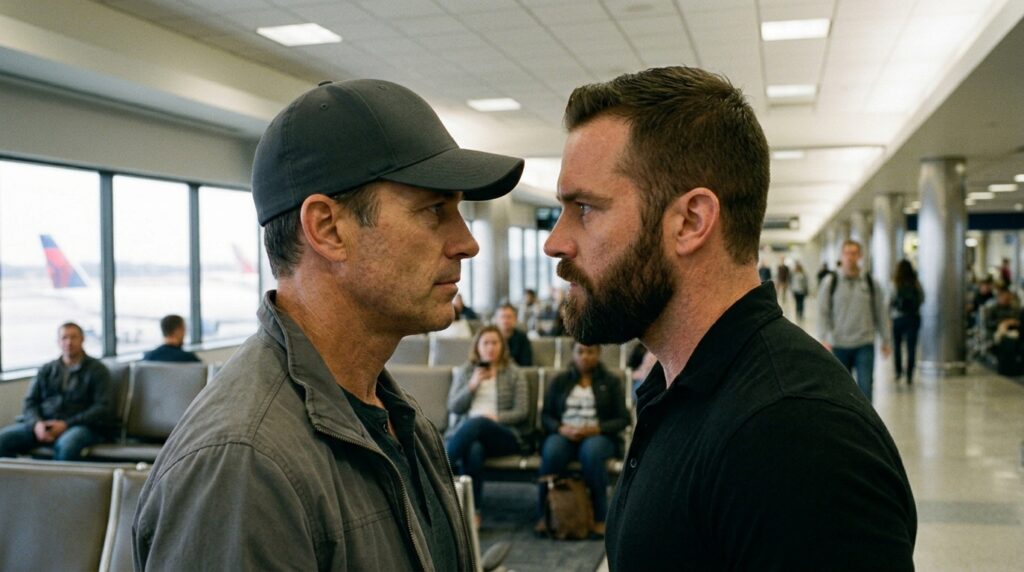
Miller kept his bill low. The dark, unbranded baseball cap cast a triangular shadow down to his throat, cutting off the fluorescent glare from above. He sat at the absolute lip of the aisle-end, his worn gray travel jacket unzipped just far enough to clear his ribs. He was forty-eight, graying at the temples, and looked precisely like the kind of man who repaired industrial refrigeration units for a living—thick-wristed, unhurried, and perfectly invisible.
Then came the boots. Heavy, thick-soled leather scuffing hard against the commercial linoleum, rhythmic and performative.
“You’re in my way, old man. Move out of the lane.”
The voice belonged to a man ten years younger and thirty pounds heavier, his chest stretching the seams of a tight black fitted shirt. His beard was trimmed with aggressive geometric precision, his forearms corded with the cheap, superficial strength of a gym built for vanity. He was leaning forward, his shadow swallowing Miller’s knees, using the public weight of the crowded gate as a lever to pry loose some small piece of significance for himself.
Miller didn’t look up immediately. He watched the man’s reflection in the scuffed steel base of the seat opposite them. The crowd in the rows behind them went thin and quiet, the collective drop in chatter sharp enough to hum. People lowered their branded coffee cups. A woman mid-stride down the terminal corridor paused, her rolling suitcase clicking to a halt. They were waiting for the old man to shrink.
“I’m standing right here,” Miller said. His voice was flat, dry, carrying the desaturated grit of a man who hadn’t used his throat for anything but logistics in five years.
He rose. He didn’t explode upward; he uncoiled, keeping his center of gravity low and his weight distributed evenly across the soles of his boots. He squared his shoulders, presenting a blunt, unyielding trunk of gray canvas and denim. The distance between them was less than twelve inches—close enough for Miller to smell the cheap wintergreen gum the younger man was chewing to mask his adrenaline.
The bully’s jaw tightened, the bearded skin shifting as he took the bait of Miller’s silence. “I told you to move.”
A thick, calloused hand came up, fingers splaying to plant a heavy, humiliating shove against Miller’s chest.
The contact never formalized.
Miller didn’t strike. He shifted his left hip back three inches, a micro-correction that let the bully’s forward dynamic slide into empty air. His right hand came out like an iron clamp, catching the bully’s lead wrist, while his left forearm drove hard into the crease of the younger man’s elbow, capturing the lever. It was pure physics—mass meeting an unexpected vacuum. Miller pivoted on his heel, using the bully’s own rushing momentum to lift him off his heels.
The floor took the bully with a heavy, hollow thud that shook the bolted rows of metallic seats.
The terminal froze. The bearded man lay flat on his back, the air driven from his lungs in a wet, ragged gasp. His tight black shirt had ridden up, his elbows scraping raw against the grit of the linoleum. He stared up, his eyes wide and glassy with the sudden, catastrophic loss of coordination.
Miller stood directly over him, his posture unbroken, his breathing as even as the ticking under his skin. His cap hadn’t even shifted. He looked down at the grounded shape, his eyes cold and unblinking beneath the brim.
“Don’t cross that line again,” Miller said.
As he reached down to retrieve his canvas duffel, his thumb brushed the back of his own brass watch. The crystal face was cracked—not from the fall, but from an old scar—and beneath the glass, the second hand had stopped completely.

CHAPTER 2: THE WITNESS SHIELD
The silence didn’t break; it merely hardened, settling over Gate B12 like lime dust on a warehouse floor. The large, bearded man stayed down on the linoleum, his breath returning in short, rhythmic wheezes that sounded like a torn bellows. No one moved. The everyday travelers, frozen with their rolling carry-ons and half-empty coffee cups, formed an accidental ring around the seating row—a human wall built entirely out of modern hesitation.
Miller didn’t check his knuckles. He kept his hands low, fingers loose, his right shoulder slightly dropped to hide the split seam under his arm. He could feel the cold draft of the terminal air conditioning seeping through his gray jacket. His eyes remained fixed on the space two inches above the fallen man’s forehead, watching the rapid, involuntary twitch of the bully’s eyelids. That was the adrenaline peak. The realization of vulnerability.
“Hey! What the hell is going on over there?”
The voice came from fifty yards down the concourse—sharp, authorized, and accompanied by the heavy, rubber-soled squeak of airport security issue boots. Two TSA officers were cutting through the crowd near the duty-free shop, their blue shirts bright against the dull, desaturated background of the terminal.
The bully shifted, a low groan scraping past his teeth as he tried to roll onto his side. As he moved, his heavy leather carry-on bag—slung loosely over his shoulder during the initial approach—slid off his arm, the brass zipper bursting open against the corner of a fixed metallic seat. A cascade of personal items spilled across the floor: a travel shaving kit, a pack of wintergreen gum, and a thick, blue-bound paper folder with an industrial plastic spine.
Miller’s gaze dropped to the folder. Even from three feet away, under the yellowing fluorescent tubes, his eyes locked onto the header block printed on the top sheet. It wasn’t an airline itinerary. It was a standardized personnel manifest, its margins stamped with a three-letter defense contractor logo he hadn’t seen since the deployment in the Karakoram range six years ago.
Before he could process the print, the crowd closed the gap. The passengers weren’t looking at the bag; they were looking at the blue shirts rushing toward them.
“He targeted him,” a woman in a beige trench coat said, her voice rising to cut through the approaching authority. She stepped forward, physically placing herself between Miller and the first guard. “The big guy came straight out of the boarding queue. He was looking for a fight. The older gentleman didn’t even move until he was touched.”
“She’s right,” a man with a laptop case chimed in, nodding aggressively. “I saw the whole thing. The guy in the black shirt shoved him first. It was unprovoked.”
The witness layer was hardening into a protective shell, a collective defense mechanism that civilian crowds used when they recognized an absolute boundaries-crossing. They didn’t see Miller’s grip; they didn’t see the tactical pivot that used the big man’s weight against him. They only saw a quiet traveler in a plain baseball cap being crowded by an entitled bully.
The first security officer, a heavy-set man with a radio humming on his shoulder, slid to a halt between the two men. “Everyone stay back. Sir, don’t move,” he directed at the man on the floor, before turning his eyes to Miller. He took in the faded jacket, the unbranded cap, and the complete lack of sweat on Miller’s face. “You okay, pal?”
“I’m fine,” Miller said. He kept his tone small, cooperative, matching the profile of an exhausted technician who had simply defended his personal space. “He wanted the seat. I didn’t want any trouble.”
“He’s lying,” the man on the floor wheezed, his fingers clutching at the metal support beam of the seating row as he hauled his bulk upward. His face was a mottled, angry purple, the geometric beard smeared with a gray streak from the floor polish. “He… he broke my arm. Look at him. He knew exactly what he was doing.”
The officer looked at the bully’s arm, which was fully intact but trembling with a mixture of shock and exhaustion, then back at the crowd, which was already murmuring in collective disapproval of the bully’s claim. “Sit down, sir. We’ve got the police coming up from the main checkpoint. Just stay where you are.”
Miller used the distraction. He didn’t look like he was moving, but his left boot slid six inches to the side, his toe catching the edge of the blue-bound folder that had spilled from the leather bag. With a practiced, heavy drag, he drew the document back toward the shadow of his own seating row, out of the direct line of sight of the guards.
The texture of the paper was crisp, expensive—the kind of high-rag content stock used by logistics firms that didn’t exist on public registries. He knelt down, pretending to check his own canvas duffel bag, his hand sweeping low to gather the spilled papers before the security team could begin logging the scene.
His thumb hit the first page of the manifest. His eyes scanned the row items in the three seconds he had before the second officer turned around.
It wasn’t a standard corporate roster. It was a regional tracking log for active personnel transit through the Pacific Northwest corridor. And halfway down the page, highlighted in a faint yellow marker that looked green under the terminal lights, was a name he hadn’t used since the contract in Kabul went dark.
AL_COOPER / STATUS: IN TRANSIT / GATE B12.
Miller closed his hand over the paper, the dry stock crunching into his palm with a low, metallic rasp. His heart didn’t accelerate; his vision simply narrowed until the entire airport terminal felt like a painted backdrop. The bearded man wasn’t a frustrated traveler venting impatience. He was a marker. A spotter.
The second security guard turned back to Miller, his notepad out. “Sir, I need to see your ID and your boarding pass for the flight to Seattle.”
Miller reached into his jacket, his fingers moving past the folded document hidden in his inner pocket, his touch brushing against the cold, broken crystal of the brass watch on his wrist. The second hand was still dead, but the internal gears felt like they were spinning under his skin.
CHAPTER 3: THE FLICKER LANE
“The system is running slow today, Mr. Cooper,” the second TSA officer muttered, his thumb tapping the edge of Miller’s laminated driver’s license against his handheld terminal. The plastic casing of the scanner was chipped and scratched, its screen emitting a low, sickly green hue that matched the desaturated lighting of the gate.
“The grease gets into everything,” Miller said softly. He stood with his knees slightly bent under his denim jeans, a loose posture that hid the tension locking his lower back. His left hand remained buried deep inside his gray canvas jacket pocket, fingers resting against the heavy, fiber-textured stock of the stolen manifest sheet. “The heat from the runway doesn’t help.”
The officer didn’t answer. He turned the scanner toward the glass partition of Gate B12, looking for a clearer signal. Through the triple-paned acrylic window, the Boeing 737 sat motionless at the jet bridge, its metal skin looking like dull lead under the low, iron-gray clouds of the Pacific Northwest afternoon. Fuel trucks crawled across the concrete below like beetles in grease, their yellow strobe lights rhythmic and mechanical.
Then, the background hum died.
It wasn’t a sudden explosion; it was an extraction of weight. The heavy, omnidirectional thrum of the terminal’s main climate control fans clicked off, followed instantly by the high-frequency whine of the terminal display boards. The red arrival times blinked twice, shifted to a jagged string of nonsensical symbols, and then dissolved into dark gray glass.
A collective murmur passed through the seating rows—the familiar, heavy sigh of three hundred travelers being told without words that their delay had just become indefinite.
“Power drop,” the first guard said, his hand moving automatically to the radio on his shoulder. He clicked the toggle three times. The only response from the small speaker was a dry, high-pitched squelch that sounded like sand being thrown against a tin roof. “Comms are down. Davis, check the corridor link.”
The light didn’t vanish entirely. The emergency strips along the baseboards flickered to life, casting an amber, desaturated glow that caught the dust motes rising from the commercial carpet. The shift in illumination completely altered the geometry of the space—deepening the shadows between the fixed metal chairs, turning the glass corridors into long, reflective mirrors.
Miller didn’t move. He felt the cold iron of the seating rail behind his leg. His focus was three yards to his left, where the large, bearded bully had been sitting under guard. The man was gone. In the sudden twilight of the blackout, his seat was empty, the heavy leather carry-on bag missing from the linoleum. Only a stray strip of plastic binding spine remained, glinting in the low orange light.
“Hey, pal, stay right where you are,” Davis, the second officer, said, turning his face back toward Miller. His hand wasn’t on his sidearm, but his forearm was tense, his fingers hovering near his belt. The green screen of his handheld terminal was black now, a dead piece of glass.
“I’m right here,” Miller murmured.
He didn’t look at the officer’s face. He looked at the floor. In the desaturated amber light, a dark, rhythmic trail of oily wet prints was leading away from the gate counter—not toward the main exit checkpoint where the crowd was beginning to bottleneck, but toward the narrow, gray-painted utility door behind the boarding desk. The door was marked with a weathered brass plate: Maintenance Logistics – Authorized Personnel Only.
The lock on that door was a mechanical deadbolt, independent of the terminal’s electronic grid. And the latch was swinging loose.
“Davis, we’ve got a situation at the main line,” the heavy-set officer called out, his boots already scuffing toward the center of the concourse where twenty passengers were beginning to push against the security stanchions. “The automated gates locked down when the grid dropped. They’re trapping people in the corridor.”
Miller took one step back, letting his shoulder melt into the thick shadow of a structural concrete pillar. The gray canvas of his jacket was an exact match for the unpainted aggregate of the pillar. To the frantic guards, he was simply another shape dissolving into the background of a broken airport.
He pulled the stolen manifest sheet from his pocket, his fingers feeling the deep creases in the rag stock. The name AL_COOPER was a ghost—a marker meant to draw an asset out of isolation. The rolling blackout wasn’t a failure of the local grid. It was an environmental partition, designed to separate the target from the witness shield that had protected him five minutes ago.
He turned his body away from the main terminal flow, his eyes tracking the loose maintenance door. The hinge gave off a faint, metallic hiss as it swung an inch wider in the draft. Someone had just gone through, and they hadn’t used a key.
Miller gripped the strap of his canvas duffel bag, pulling it high against his ribcage to eliminate any swaying momentum. He didn’t run; he slid through the gap in the stanchions with the quiet, efficient labor of a man walking a fence line in the dark.
As his boot crossed the threshold into the unlit concrete maintenance corridor, the heavy steel door clicked shut behind him, the latch catching with a dry, mechanical thud that severed the low roar of the terminal crowd completely. The darkness inside smelled of old hydraulic oil, wet copper, and cold, damp stone.
Miller reached down, his fingers checking the brass watch on his left wrist. The metal was cold against his skin, but as his thumb pressed the knurled crown, he felt a sharp, microscopic vibration inside the casing—a tiny, rhythmic pulse that had nothing to do with the keeping of time.
CHAPTER 4: THE FALSE EVACUATION
The concrete corridor didn’t expand; it narrowed into a low-clearance arterial lane choked with rusted galvanized pipes and bundles of dead insulation. The only illumination came from the spaced intervals of emergency exit fixtures, their amber lenses throwing long, skeletal ribs of shadow across the unpainted walls. Miller moved with his hand flat against the cold concrete, tracing the structural seams to measure his pace. Every breath tasted of stale zinc and old compressor grease.
A boot heel clicked fifty paces ahead. It was a clean, sharp sound—not the heavy, dragging sprawl of the bearded man Miller had put on the floor at the gate. This stride was measured, unhurried, carrying the light weight of someone who owned the layout.
Miller stopped. He dropped his mass into his heels, his gray jacket blending flat against the grease-stained masonry.
“Mr. Cooper,” a voice called out. It was a woman’s voice, pitched low to prevent the sound from carrying down the bare corridor walls. It carried the crisp, transactional cadence of a public affairs officer, entirely out of place in the dark underbelly of the terminal. “The gate concourse is compromised. We are executing an expedited extraction via the ramp lane.”
A figure stepped out from the recess of a high-voltage breaker panel. Under the amber safety light, she wore the navy-blue blazer and silver lapel wings of an airline gate supervisor, but the uniform was too crisp, lacking the typical wear and friction lines that came from a twelve-hour shift at an American airport. Her hair was pulled back into a severe, tight knot that didn’t leave a single strand loose. In her left hand, she held a laminated terminal access badge; her right hand was buried in the deep pocket of her blazer, the fabric pulled taut against an angled, heavy weight.
“The grid drop wasn’t part of the protocol,” Miller said. He didn’t move from the shadow. His fingers remained tucked into his jacket pocket, pinning the stolen manifest sheet against his ribs. “Who authorized the diversion?”
“The regional desk,” she said smoothly. She stepped closer, her leather shoes making no sound on the damp concrete—a detail that didn’t match the standard-issue rubber soles required for airline ground staff. She lifted the laminated credential, presenting the face-sheet toward Miller. “The contractor at the gate was a tracking asset, nothing more. He exceeded his mandate when he initiated contact. We’re clearing the lane before TSA establishes a physical perimeter.”
Miller’s gaze fixed on the badge. The plastic was pristine, devoid of the microscopic scuffs and grease smudges that accumulate when a gate worker slides their card through a hundred electronic readers a day. The name printed below the bar code read V. VANCE, but the security hologram across the seal didn’t reflect orange under the emergency lamp; it stayed a dull, flat gray.
A false bottom. She was offering a clean exit, an administrative rescue to draw him away from the public eye of the terminal where three hundred witnesses had just seen his face.
“I have a seat on the 737,” Miller said, his voice flat, dropping into the deadened space between the low pipes. “My bag is cleared for Seattle.”
“The aircraft isn’t leaving the blocks, Mr. Cooper. You know how these infrastructure failures settle. By the time they reset the breakers, the gate will be locked down by federal investigators checking the manifest.” She tilted her head, her unblinking eyes catching the yellow glare of the safety lamp. “Your seat doesn’t exist anymore.”
She was moving her left foot back, a slow, micro-adjustment to shift her center of gravity—the exact opening movement of a close-quarters restraint. She wasn’t trying to escort him out; she was trying to fix his position until the backup element could close the distance from the maintenance door behind him.
“The watch is still running,” Miller murmured, his voice dipping lower as he shifted his hand inside his gray jacket.
“The watch stopped five years ago in the valley,” she replied without breaking her rhythm. “Move toward the ramp door. Now.”
The right pocket of her blazer shifted as her thumb cleared the lip of the fabric. Miller didn’t wait for the metal to clear the line. He didn’t lung forward; he dropped his weight straight down into a hard crouch, his canvas duffel bag swinging outward like a lead-weighted pendulum. The heavy strap caught her across the shins with the dull, wet crack of canvas meeting bone.
The supervisor’s balance fractured. Her right hand came out of the pocket, the dark, desaturated steel of a subcompact automatic glinting in the amber light, but her forward momentum was already broken. She hit the concrete with her left hip, her elbow striking a rusted iron pipe with a hollow ring that vibrated down the entire length of the corridor.
Miller didn’t stay to secure the weapon. He rose from the crouch, his boots catching the wet floor with precise friction as he turned into the dark secondary branch of the utility lane, the heavy sound of his own breathing the only marker left in the corridor.
CHAPTER 5: THE MAINTENANCE STRAIN
The turn into the auxiliary pipe chase was too tight for a clean pivot. Miller’s left shoulder caught the raw edge of an uninsulated steel structural beam, the gray canvas of his jacket tearing with a dry, screeching hiss that bit straight through to the skin. The impact didn’t stop his feet, but his left arm went instantly cold, the muscle group locking up from a deep, grinding strain that radiated from his shoulder blade down to the brass rim of his wristwatch.
He didn’t check the damage. He forced his breathing down into a slow, rhythmic rasp, using the cold iron utility pipes overhead to pull his weight forward through the dark. The air down here was thicker, saturated with the smell of wet soot and dead air filters. The terminal hum above him had changed completely; the concrete ceiling vibrated with a rhythmic, heavy thrumming that felt like the pistons of a massive engine working under water. They were cycling the auxiliary fuel pumps.
He had three minutes before the woman in the blue blazer found her footing, or before the secondary element behind her mapped the branch lines.
Miller’s boots ground down on a patch of wet lime dust, his tracks leaving clean, gray shapes on the unpainted floor. He stopped beside a multi-tiered electrical sub-station panel, its metal doors rusted along the bottom track from decades of condensation. The emergency safety lights didn’t reach this far down the line; the only illumination was a dim, green status indicator on a backup battery box that cast long, sickly lines across the masonry.
A sharp, distinct drop in temperature hit him as he passed the panel. It wasn’t the standard drafts of the airport ventilation shafts; it was an artificial, focused chill that smelled intensely of industrial freon and soldered copper.
He paused, his back pressed flat against the unistrut frame supporting the main conduit lines. With his functioning right hand, he reached into his jacket pocket, his fingers finding the edge of the stolen personnel manifest. His skin was wet with grease and his own cold sweat, the heavy stock of the paper absorbing the moisture until it felt soft, like cloth. He didn’t need to look at the highlighted line again. AL_COOPER. The name was a homing frequency. By entering the gate lane at Terminal 4, he had tripped a mechanical tripwire he thought had been dismantled in the mountains six years ago.
Behind him, a low, metallic scraping echoed down the utility pipe chase. It was the dry, deliberate slide of a heavy steel door clearance latch being turned slowly to prevent a click.
They weren’t tracking him with cameras anymore; the blackout had taken care of the network. They were tracking him by his weight, by the specific friction of his boots on the lime-dusted floor, by the small trail of torn gray canvas and oil left behind his left shoulder.
Miller didn’t turn back toward the sound. He calculated the distance to the main baggage handling system by the increasing frequency of the overhead vibrations. If he stayed in the maintenance arterial, he was bounded by two straight lines of unyielding aggregate. He needed the broader chaos of the baggage drop—a space filled with moving rubber belts, industrial sorting arms, and three miles of low-ceilinged mechanical labyrinths where raw physical mass mattered more than corporate oversight.
He forced his injured left arm down, tucking the thumb hard into his denim belt loop to pin the shoulder in place and reduce the sway. The pain was a dull, rusted ache that tasted like copper at the back of his tongue, but the bone was whole.
He stepped over a low-slung hydraulic line, his right hand gripping the iron handle of a heavy fire-separation shutter. The metal was pitted, the orange primer flaking away under his fingers like dried scabs. He pulled the lever down with an unhurried, heavy lean, using his full body weight to mask the inevitable screech of the rusted counterweights inside the wall.
The shutter lifted six inches—just enough for a man to slide underneath flat on his belly. As he lowered himself into the dark gap, his brass watch struck the bottom guide rail with a faint, hollow ping. Inside the casing, the microscopic vibration he had felt minutes before didn’t stop; it grew steadier, a tiny, internal heartbeat pulsing against his wrist in the dark, completely independent of the dead second hand above it.
CHAPTER 6: THE RUSTED UNCOUPLING
The dust under the fire shutter tasted of zinc powder and decades of dead skin cells. Miller dragged his frame out from the six-inch crawlspace, his boots scraping dry across the pitted floor iron of a secondary baggage sorting platform. The air was entirely different here—colder, sharper, dominated by the heavy, sweet stench of industrial rubber vulcanization from the endless miles of intersecting luggage belts that twisted through the darkness like blind subterranean rivers.
He sat back against a massive steel junction frame, the rusted angle-irons biting straight through the tear in his gray jacket. His left shoulder was a solid knot of dull heat, but he forced the arm up, clamping his elbow against his chest to compress the joint. Under the desaturated amber hue of an isolated terminal maintenance light, he pulled the stolen manifest from his inner pocket. The paper was heavily creased now, damp with the oily residue of his palms.
He unrolled it using only his right hand, flattening the coarse sheet against the cold, rust-scaled side of a dead conveyor motor.
His eyes didn’t stop at the name AL_COOPER. He forced his focus downward, tracking the small, tightly packed alphanumeric strings printed along the bottom margin—the data rows the TSA officers had been waiting for their handheld scanners to clear. There was a secondary stamp across the base of the page, applied with an old ink-pad that had run dry during the impression. The purple ink was faded, oxidized into a dull brown, but the geometric shape was unmistakable.
It was an administrative discharge seal from the Department of Defense Logistics Agency, dated three months prior. But it wasn’t stamped over a list of active military assets. It was stamped over a corporate liquidation ledger.
Miller’s fingers tightened on the edge of the sheet, the paper tearing slightly at the margin. The bearded bully at the gate hadn’t been an active operative sent by an active command structure. The tracking manifest wasn’t a live surveillance log. It was an archived manifest of private security personnel who had been cut loose from the payroll after the Kabul liquidation—men whose contracts had been voided, whose clearance levels had been zeroed out, and whose tracking data had been dumped onto the private market.
The realization settled like cold lead in his throat. His retirement hadn’t been breached by a pristine, state-level network designed to bring a soldier back into the cold. It had been sold. The bearded man at the gate was a rogue contractor working for a scrap-tier data broker, using old operational logs to hunt down former field names for an entry-level payout. The elaborate setup—the confrontation, the crowding—wasn’t a strategic trap. It was the clumsy, desperate move of an unemployed mercenary trying to verify a face before his target slipped across state lines.
“You’re reading the old ledger, Miller.”
The sound came from the high catwalk above the primary conveyor belt. The voice was thin, dry, and punctuated by the mechanical, rhythmic click of a manual safety selector being switched off.
Miller didn’t look up immediately. He stayed in his lean against the motor casing, his eyes remaining on the faded brown stamp on the paper. The name of the firm listed below the liquidation mark was Vanguard Global Risk Management—the same parent entity that had leased the security detail to the airport authority.
“The uniform belongs to the gate,” Miller said, his voice dropping into the grinding resonance of the nearby sorting arms. “But the contract belongs to the scrap pile.”
A man stepped into the edge of the halogen beam on the platform ten feet up. It wasn’t the supervisor, and it wasn’t the bully. He wore the gray utilitarian coveralls of a terminal baggage handler, but his hands were steady on the receiver of a heavy, parkerized pump shotgun, the barrel pointed directly at the center of Miller’s chest. His face was identical to Miller’s in the ways that mattered—weathered around the eyes, skin dried out by high-altitude wind, and the posture of someone who had spent thirty years learning how to occupy a space without leaving a footprint.
“The company went under in April,” the man on the catwalk said. He didn’t drop the barrel an inch. “The digital keys were sold to three different recovery groups out of Boise. We aren’t here for the agency, Miller. We’re here because your old alias is the only thing attached to the unliquidated hardware accounts.”
“The accounts are empty,” Miller murmured.
“The bank accounts are,” the handler replied, his boots shifting slightly on the metal grating of the catwalk, the iron giving off a low, sharp ring. “But the cold-storage ledger isn’t. The broker wants the serial numbers from the deployment. He thinks they’re still moving through the domestic terminals.”
Miller’s thumb remained pressed against the knurled crown of his brass watch. The internal vibration hadn’t stopped; it had grown sharper, more intense, the microscopic pulse beating against his wrist like a buried wire trying to ground itself. The decoy secret—the idea that his old command had tracked him down to bring him back into the gray lane—was gone, shattered by the dry ink stamp on a piece of stolen corporate paper. He wasn’t being hunted by an empire. He was being scavenged by the survivors of a dead one.
But the final reality—the reason the watch on his wrist was still generating a rhythmic, physical pulse through its cracked crystal—remained hidden from the men on the catwalk. They thought they were hunting for bank records. They didn’t know what was actually sealed inside the casing.
A sudden, violent lurch shook the entire baggage platform. Fifty yards down the line, the main sorting carousel hummed back to life as the primary electrical sub-station auto-shunted its power to the secondary circuit. The massive rubber belts jerked forward with a high-pitched, screaming screech of friction that filled the room with the smell of burning tire code.
Miller didn’t look at the light. He used the instantaneous explosion of noise and movement to roll his mass to the right, his body disappearing beneath the heavy steel skirt of the primary sorting carousel just as the first blast of buckshot tore through the dead motor casing behind him, showering the iron floor with white-hot sparks and rusted metal flakes.
CHAPTER 7: THE DESATURATED UNDERBELLY
The concussive slap of the twelve-gauge blast tore through the upper housing of the sorting conveyor, showering Miller’s low-profile position with a stinging rain of oxidized iron chips and melted rubber fragments. The sulfurous stink of burnt powder instantly fouled the damp, cold air of the lower pit. Miller didn’t look back to check the spread. He dragged his frame deeper into the trough beneath the carousel, his jeans scraping over grease-slicked guide channels where the massive structural belts turned on their iron rollers.
His left shoulder screamed—a deep, tearing ache as he used his right elbow to heave his mass under a low-slung steel crossbeam. The entire mechanical framework around him was vibrating now, a deafening, metallic roar as the restarted baggage system ground its massive gears to force thousands of pounds of dead weight through the sorting loops.
A pair of heavy work boots hit the iron grating of the platform six feet behind him. The footsteps were slow, deliberate, shifting with the heavy cadence of a hunter who knew his target had limited room to move.
“There’s no transit out of this sector, Miller,” the man in the coveralls called down, his voice muffled by the low clearance of the structural concrete overhead. The sound of a fresh shell being racked into the chamber was a clean, mechanical click that punched straight through the industrial rattle of the belts. “The automated exits are hard-locked from the main panel. We don’t need the manifest. We just need the hardware.”
Miller didn’t answer. He lay flat in the grease, his cheek pressed against the cold, unyielding iron of a structural support plate. Through the open gaps in the framework, he watched the handler’s shadow stretch long and skeletal across the rusted concrete floor. The man was tracking the dark grease smudges left by Miller’s torn jacket sleeve.
The logic of the environment was simple, transactional, and brutal. There were no clean angles here, only the constant friction of machinery designed to grind down anything that didn’t fit the tracks.
Miller reached down with his functioning right hand, his fingers checking the base of the structural belt tensioner directly above his hip. It was a massive, rusted assembly held together by a two-inch steel pin—an old-style counterweight design meant to absorb the sudden torque of a jammed sorting line. The iron was scaled with orange corrosion, the grease around the threads dried into a hard, black crust that smelled of old sulfur.
The handler’s boots stepped into the narrow gap between the primary motor housing and the lower conveyor frame. He was leaning forward, his weapon lowered, searching the dark crawlspace beneath the skirt.
Miller didn’t draw a tool. He braced his heels against the concrete footer behind him, reached up, and drove his full body weight against the emergency release lever of the tensioner assembly. The lever didn’t move easily; it required the blunt, unhurried impact of his entire torso to break the calcified rust holding the latch.
The metal gave way with a dry, screeching crack that sounded like a structural failure.
The massive rubber belt, released from its three-ton tension load, snapped backward with a violent, snapping hiss. The sudden, uncoiling kinetic energy caught the handler’s extended shotgun barrel, twisting the steel tube sideways against the concrete frame before the man could clear his grip. The force of the impact ripped the weapon from his hands, the parkerized receiver clattering down into the dark, flooded sump below the sorting pit.
The handler stumbled, his boots losing friction on the slick grating as the loose belt whipped across his shins. He didn’t scream; he let out a short, ragged grunt as his mass hit the structural ironwork, his hands instantly reaching out to stabilize his weight against the vibrating frame.
Miller was already moving. He didn’t stand up into the line of fire; he dragged himself forward through the clearance gap, using the mechanical chaos of the snapping belt to mask the scraping of his boots. He emerged from beneath the carousel skirt twenty yards down the line, near the base of the vertical lifting lift that carried heavy luggage up to the main sorting floor.
He hauled his weight onto the platform, his left arm hanging loose and numb against his side. His gray canvas jacket was completely ruined now, smeared with black machine grease and white lime dust from the walls. He looked down at his left wrist.
The brass-plated watch casing had split slightly along the seam near the crown from the physical impacts under the carousel. Through the thin fracture in the metal, a tiny, dull green emitter light was pulsing in perfect synchronization with the rhythmic vibration against his skin. It wasn’t an internal counterweight mechanism. It was a hardware cold-storage drive, its low-power beacon triggering the moment the airport’s main terminal grid dropped and isolated the sector.
The handler on the catwalk was right about one thing: the company was dead. But they were wrong about the ledger. The drive inside the watch didn’t contain bank records or personnel rosters. It contained the active routing keys for the entire regional black-budget logistics system—the invisible network of unflagged aircraft and unmarked fuel stops that had kept operations moving through the territory for a generation.
Miller reached the secondary exit door, his hand gripping the cold, unpainted steel of the emergency push-bar. He didn’t look back at the dark sorting room behind him, where the handler was still recovering his footing among the loose, snapping rubber lines. He slammed his weight into the bar, the door opening out onto a low, desaturated concrete concrete ramp that led toward the terminal’s lower parking structure.
CHAPTER 8: THE HORIZON REVERSAL
The emergency door didn’t just swing; it buckled against the damp pressure of the exterior squall, its ungreased hinges giving off a sharp, high-pitched screech that was immediately swallowed by the gray noise of the storm. Miller stepped out onto the slick, desaturated concrete of the lower parking tier. Rain swept sideways under the low-set structural beams, fat drops spitting against the oil-stained pavement with the flat, rhythmic sound of small stones hitting tin. The air was a clean shock after the stale zinc dust of the tunnels—cold, saturated with sulfurous exhaust, and tasting heavily of wet iron.
His left arm was completely non-functional now, pinned tight against his ribs by his denim belt loop to stop the grinding pull in his shoulder blade. Every shift of his weight required a heavy, conscious lean from his hips. He kept his right hand clamped over the canvas strap of his duffel bag, his boots tracking gray lines of lime dust across the slick, wet grit of the asphalt.
The garage was mostly empty, a cavernous grid of unpainted concrete columns marked with rusted stall numbers. Fifty yards ahead, a solitary white utility van sat idling near the exit ramp, its twin exhaust pipes sending plumes of thick, gray-white vapor curling into the damp air.
Miller didn’t accelerate his pace. He maintained the steady, unhurried stride of a laborer clearing a shift. He could feel the cold water soaking through the torn shoulder seam of his gray jacket, flattening the fabric against his skin. With his right thumb, he touched the split side of his brass wristwatch. The casing was warm now, the tiny green emitter light beneath the cracked crystal pulsing with a fast, heavy rhythm that vibrated straight through his wrist bone.
The hardware wasn’t dead. It was transmitting its local handshakes to the unlogged receiver inside that utility van.
He stopped five feet from the driver-side door. The glass was heavily tinted, sheeted with sliding runs of rainwater that distorted the reflection of his plain baseball cap. The window didn’t drop with a smooth electronic whine; it ground down manually, three inches at a time, until a narrow band of dark interior air was exposed.
There was no weapon protruding from the gap. There was only a hand—thick-fingered, scarred across the knuckles by an old battery explosion, holding a plain plastic key card with a magnetic strip that had been worn down to a dull, gray line.
“The flight to Seattle just cleared the tarmac,” a voice said from the dark cab. It was flat, transactional, completely free of the frantic panic that had broken the security layers inside Gate B12. “The manifest has been wiped. The name AL_COOPER isn’t on the regional ledger anymore. You’re listed as an unassigned maintenance contractor who walked off the terminal perimeter three hours ago.”
Miller took the plastic card with his right hand, his fingers feeling the deep friction marks along the edge. “The scrap buyers from Boise are still in the sorting pit.”
“They’ll stay there until the port authority resets the main breakers,” the driver replied, the engine of the van giving off a low, uneven skip that vibrated through the floorboards. “They were hunting for an expired corporation. They didn’t have the clearance to know the hardware was already active. Move toward the secondary exit. The truck is parked in Sector G.”
Miller looked down at his wrist one last time. The internal heartbeat inside the broken watch casing suddenly dropped its frequency, the green pulse fading back into the deep shadow behind the dial until the crystal looked like ordinary, dead glass. The routing keys had completed their transit. The invisible logistics line—the shadow network of fuel dumps and unflagged airstrips across the northern line—was locked behind a new set of digital encryption walls, completely out of reach of the mercenaries who had tried to scavenge his past.
He didn’t say thank you. He didn’t wait for the window to roll back up. Miller turned his back to the idling van, his boots clicking across the wet, stone-filled asphalt as he walked toward the desaturated gray mouth of the garage exit.
The rain came down harder now, washing the machine grease and concrete dust from his torn sleeve, leaving only the clean, cold weight of a man who had successfully defended his boundary line. The ultimate final reality—the names of the entities currently pulling the strings of that logistics network—remained locked inside the drive, untouched and unrevealed. The horizon was still open, dark, and entirely unmapped.
CHAPTER 9: THE OUTSIDE LINE
The truck didn’t sit right on the concrete. Even under the desaturated twilight of Sector G, where the commercial terminal gave way to the heavy industrial cargo bays, Miller saw the unnatural, heavy tilt of the rear axle. The vehicle—a faded blue Ford flatbed that smelled of old fertilizer and wet pine—was slumped against the oil-stained pavement like a beast with a broken leg.
Miller stopped ten paces away, his right hand gripping his canvas duffel bag hard against his ribs. The rain was steady now, fat drops bouncing off the rusted iron headache rack of the truck with a sharp, metallic rattle. He didn’t rush forward. He scanned the dark space beneath the high-clearance wheel wells, his eyes tracking the specific geometry of the failure.
It wasn’t a slow leak from a rough road. The sidewalls of both heavy-duty rear tires were split wide open—clean, horizontal gap-lines that exposed the white nylon cords inside the rubber. The cuts were uniform, deep, and executed with a thick-backed utility blade in a single, heavy stroke that required two hundred pounds of downward pressure.
A systematic isolation. The white van from the parking structure had cleared his manifest, but the ground team had already mapped his secondary fallback positions.
“Miller,” a voice hissed from the gap between two rusted shipping containers behind the flatbed.
Miller didn’t turn his head. He dropped his weight into his heels, his boots catching the wet asphalt grit as he pivoted his torso three inches to clear his line of sight. From the dark space between the corrugated iron walls, a man in a greasy high-visibility vest stepped forward. It was the logistics runner who had dropped the keys at the garage, but his vest was torn at the shoulder, the yellow fabric stained with a dark, wet smudge that looked black under the amber security lights.
“The lane is blocked,” the runner said, his breath coming in short, wet gasps that smelled of stale coffee. He was holding his left ribs with a bloody palm. “They didn’t use the terminal network. They had a separate chase vehicle sitting on the perimeter fence. Three men. They knew the truck profile before I even cleared the gate.”
“Where are they?” Miller asked. His voice was flat, dry, dropping beneath the heavy thrum of a cargo jet taxiing on the outer runway half a mile away.
“The industrial spur,” the runner whispered, his eyes rolling toward the high chain-link perimeter fence that separated the airport’s shipping zone from the regional rail line. “They’re setting a physical picket along the road. If you stay on the blacktop, you walk straight into the sweep.”
The logic of the escape had completely broken down. The false bottom of the administrative wipe had lasted less than ten minutes. Miller didn’t look at the ruined truck again. He reached down with his right hand, his fingers checking the split seam of his brass watch. The metal casing was cold now, the green emitter light dark, but he could feel the microscopic weight of the internal hardware drive pressing against his skin like a buried splinter.
He didn’t have three minutes before the chase vehicle circled back to confirm the immobilization.
“Go back to the terminal,” Miller told the runner, his voice a low, desaturated rasp against the sound of the rain. “Tell them the contract is uncoupled. Clean your lane.”
“And you?”
Miller didn’t answer. He turned his face toward the outer perimeter line. Two hundred yards across a field of crushed gravel and rusted scrap machinery stood the high fence—twelve feet of heavy-gauge cyclone wire topped with three strands of oxidized outriggers. Beyond that wire lay the dark, unlit ballast of the freight tracks, a desaturated landscape of moving iron and diesel smoke where a man could disappear if he had the mass to break through the wire.
He adjusted his grip on the canvas duffel bag, pulling the strap tight across his good right shoulder. His left arm remained tucked into his denim belt loop, a dead weight that throbbed with every heavy step. He didn’t run; he moved across the open gravel lot with the heavy, calculated momentum of a machine, his boots crunching loud against the stone as he headed straight for the wire.
Behind him, the sudden, low rumble of an unmuffled V8 engine erupted from the throat of the cargo access road. The headlights swept across the flatbed, casting long, skeletal shadows of the ruined tires straight toward the fence line where Miller was already reaching for the rusted steel mesh.
CHAPTER 10: THE LOGGERS NODE
The cedar wall didn’t yield when Miller leaned his mass against it; it merely groaned, the dry, unpainted tongue-and-groove boards releasing a small cloud of fragrant, resinous dust that mixed with the sour tang of his wet denim jacket. He sat on a three-legged milking stool inside the abandoned logging shack, three miles north of the industrial spur. The structure smelled of dry rot, ancient engine oil, and old iron stoves long since hauled away for scrap. Outside, the rain had turned into a rhythmic, heavy thrumming that muffled the distant rumble of the logging highway.
His left shoulder had locked completely into a cold block of concrete ache. He kept his right hand loose across his knee, fingers resting near the split side of his brass wristwatch.
“The fence didn’t slow them down,” Miller said. His voice was a thin, dry scratch in the cramped room, falling dead into the exposed fiberglass insulation between the studs.
Across the bare plywood floor, the supervisor from Terminal 4 sat on an overturned crate. Her navy-blue blazer was missing, her white uniform shirt shredded at the right forearm where she had cleared the barbed wire of the rail spur. Her severe hair was partially undone, a single strand plastering itself against her mud-streaked jaw line. She didn’t have her weapon anymore; her right hand was busy holding a weathered hand-crank military generator unit, its dull green steel casing pitted with oxidation.
“They aren’t looking for the perimeter anymore, Miller,” she said, her breath clicking in her throat as she gave the handle a slow, heavy turn. The gears inside the box whined—a high, thin screech that sounded like a dry bearing on a conveyor belt. “They know the hardware didn’t clear the terminal grid. It didn’t need to.”
She pointed a dirt-crusted finger toward the base of the shack’s wall. Beneath a loose length of cedar wainscoting, an old, grease-slicked communications junction box sat exposed. It was a leftover piece of the logging company’s private microwave relay network, its copper terminal lugs furred with blue-green oxidation.
But the wire connected to the main terminal wasn’t old. It was a fresh, shielded gray coaxial cable, its insulation marked with a clean white serial number that matched the government issue stock Miller had handled during his deployment in the Karakoram range.
And from the center of the terminal block, beneath a piece of clear acrylic paneling, a small red diode was pulsing.
It wasn’t the slow, exploratory handshake of a data broker’s local beacon. It was a steady, high-frequency cadence—a hard, repeating ping that vibrated in exact, micro-second intervals with the pulse inside Miller’s split watch face.
Miller didn’t stand up. He leaned forward from the stool, his right hand reaching out to touch the shielded gray line. The plastic casing was cold, but beneath the insulation, he felt the high-frequency vibration of a live data stream.
“The scrap buyers from Boise didn’t install this,” Miller murmured.
“The company didn’t either,” the supervisor replied, her hand slowing on the generator crank until the machine’s whine dropped an octave, settling into a low, metallic growl. “The microwave relay isn’t dead, Miller. It’s been shunted. The signal isn’t bouncing through the regional cellular towers. It’s hitting the satellite array over the Cascades, routed directly to an unlisted automated terminal inside the basement of the ring.”
The ring. The Pentagon’s internal communications branch.
The ultimate reality broke through the remaining layers of the decoy manifest like an iron wedge split-testing old timber. The hardware drive hidden inside his brass watch wasn’t a dead ledger of unliquidated corporate funds. It wasn’t an archive of old contracts meant to be sold to the highest bidder on the private market.
It was a live transponder keyset. The moment the main airport grid went down, the watch had initiated an automated, high-level emergency query—not to find his old team, and not to alert the scrap-tier hunters who had been sold his identity logs. It was checking in with the primary command console that had managed the black-budget logistics system since the day the Kabul station went dark.
His retirement hadn’t been compromised because of a data leak or an administrative error by a dead firm. The firm had been liquidated because the command structure wanted the hardware keys to return to the center. They had left his name on the tracking logs as a deliberate piece of bait, knowing the scrap hunters would push him hard enough to activate the emergency sequence.
“They used the big guy at the gate to make you jump,” the supervisor said, her voice dropping down until it was nearly lost beneath the sound of the rain against the roof. “They needed the physical friction to crack the seal on the casing. The moment you turned the crown in the tunnel, the terminal in Washington started logging the transit line.”
Miller watched the red light on the junction box. It didn’t look like a warning; it looked like a small, unblinking eye staring at him through the dust of the logging cabin. He reached down with his right hand, his thumb catching the edge of the split watch casing. He didn’t try to pry the metal apart; he simply pressed his palm flat over the glass, smothering the faint green glow that was still trying to find the gray coaxial line through the floorboards.
The second hand of the watch remained dead, frozen at the same micro-second where it had stopped five years ago in the valley. But the machine around them was still working, its rusted cogs turning silently in the dark, driven by a hand that had never truly let go of the lever.
“We have twenty minutes before the satellite pass completes the download loop,” the supervisor said, her fingers letting go of the generator handle completely. The gears gave one final, ragged click and stopped. “Then the line is permanent.”
Miller looked toward the low, sagging doorway of the cabin. The gray, rain-slicked trunks of the second-growth hemlocks stood outside like iron stanchions, closing off the road, keeping the horizon locked inside the gray lane.
CHAPTER 11: THE SYSTEM CUT
The red light on the microwave terminal box didn’t blink; it grew solid, a dense, unyielding prick of crimson that seemed to drain the remaining amber warmth from the logging cabin’s damp corners. The air inside the small cedar room had grown thick, smelling intensely of old wire lacquer, overheated copper plates, and the wet, rotten pulp of the framing timbers. Miller felt the tiny green emitter inside his split watch casing vibrate one last time—a sharp, mechanical sting that traveled straight up his numb left forearm like an electric needle.
The download loop was closing. The countdown had reached zero.
“It’s finishing, Miller,” the supervisor muttered from the overturned crate. Her right hand remained clamped onto the steel crank of the dead generator, her fingers white-knuckled and trembling from the sudden drop in tension. “The keys are clearing the satellite buffer. Once that stream prints to the ring terminal, the shadow network is theirs. They’ll have the unflagged routes for the next ten years, and our names are the only markers left on the waste ledger.”
Miller didn’t move his boots. He kept his heels planted firm into the soft, rotting plywood floor, his low center of gravity absorbing the rhythmic shudder of the storm outside. His ruined gray canvas jacket hung loose off his left shoulder, the raw canvas stiff with grease and dried lime dust from the airport tunnels.
He didn’t look at her face. He looked at the gray coaxial cable connecting the junction box to the floorboards. It was the only line left that tied him to the entity that had manufactured his entire life.
“The contract was already voided,” Miller said. His voice was a flat, desaturated rasp that barely carried across the three feet of empty space between them. “They just wanted the signature.”
He didn’t draw a tool. He didn’t have the three minutes required to trace the circuit or pry the copper lugs from their terminal housing with his fingers. He shifted his mass three inches to the left, his right hand reaching down to grip the heavy iron handle of the manual line-separation switch mounted to the side of the junction box. The iron was heavily oxidized, flaking away in small, orange scales that crunched under his calloused palm like dried bone.
The switch was built for industrial logging equipment—a brutal, spring-loaded bar designed to sever a high-voltage circuit instantaneously in case of a cable snap.
A heavy boot heel hit the low cedar step of the cabin door behind them.
The frame didn’t give way, but the door panel groaned as a shoulder hit the latch from the outside. The rusted iron hinge pins squealed—a sharp, high-frequency scream that cut straight through the gray noise of the rain. The handler from the baggage pit stood in the opening, his gray coveralls soaked black, his face desaturated and hollow beneath the dripping brim of a dark cap. He didn’t have the shotgun anymore, but his right hand was buried inside his utility pocket, the heavy, blocky outline of a compact pistol tracking toward the center of Miller’s ribs.
“Step away from the line, Miller,” the handler said, his breath whistling through his teeth in short, cold plumes of gray vapor. “The terminal is locked. The download is verified. If you break the loop now, the encryption drops into a hard-cycle wipe. Nobody gets the routing keys.”
“That’s the idea,” Miller murmured.
He didn’t look back to check the alignment of the barrel. He didn’t try to execute a cinematic defensive pivot with his locked left shoulder. Time dilated, slowing down to the precise, heavy rhythm of the gear teeth inside his watch. He felt the cold iron of the switch handle against his palm, the texture of the rust scale biting into his skin, the sharp, oily scent of the generator grease rising from the floorboards.
He threw his full physical weight onto the lever.
The iron bar didn’t slide; it snapped down with a violent, concussive crack that released thirty pounds of stored spring tension inside the box. A blinding blue arc-flash erupted from the copper terminal block, filling the narrow shack with the sour, chemical smell of ozone and vaporized insulation. The red diode on the panel blinked once, turned a dull, smoky black, and dissolved into dead glass.
The compact pistol fired from the doorway—a sharp, metallic pop that sounded small against the roar of the machinery and the storm. The round tore through the cedar siding two inches above Miller’s right shoulder, showering his face with sharp splinters of dry wood and oxidized lacquer.
But the line was severed.
The green emitter beneath the split crystal of his watch went cold, its internal heartbeat stopping completely as the hardware drive sensed the absolute vacuum on the receiving terminal. Across the state line, inside the deep basement of the ring, the monitor screen would be showing a flat gray baseline—the encryption keys scrambled into an unreadable string of zero-value code that could never be reclaimed by the system.
The handler dropped his arm, the weapon lowering toward the floor as the small red light vanished from the junction box. His face was identical to Miller’s in the final twilight of the cabin—just as tired, just as gray, and completely empty of the corporate logic that had brought them to the same dead end.
“The tracking lane is closed,” Miller said, his voice dropping into the absolute silence that followed the electrical pop.
He didn’t wait for the handler to rack the slide or chamber another round. He gathered his canvas duffel bag with his right hand, his fingers checking the cracked brass watch face one last time. The crystal was broken, the steel casing split, but the skin beneath it was whole. He stepped past the supervisor, past the quiet shape in the doorway, and walked out into the cold, open-air friction of the logging road, his boots sinking into the wet mud as the gray horizon opened up before him, completely clean.







