
The Price of a Quiet Meal: A Story of Restrained Power and Rusted Truth Along the Interstates
CHAPTER 1: THE INTRUSION ON FORMICA
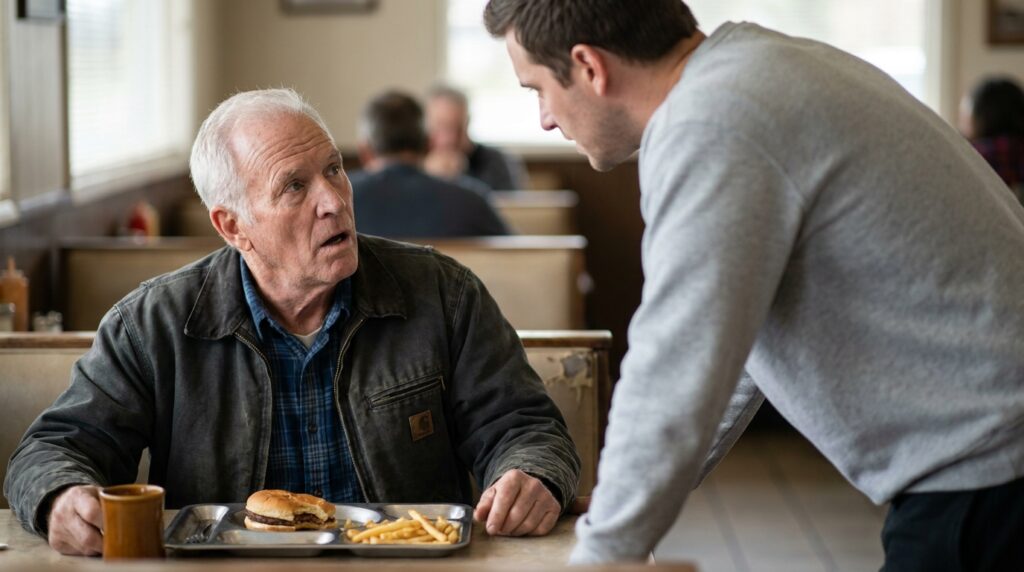
“You’re sitting in my way, old man,” the voice said, thick with the unearned weight of a small-town lineage that had never been crossed.
Marcus did not lift his chin from the steam rising off his ceramic mug. The coffee was bitter, scorched by six hours on a commercial burner, but it was warm against his palms. The Formica tabletop beneath his tray was scarred with gray circular burns from long-forgotten cigarettes, its faux-wood grain rubbed thin by decades of cheap rags and harsh bleach.
The shadow fell over his plate first, cutting through the yellowed grease-film on the diner window. A light grey sweatshirt, smelling faintly of stale sour mash and wet dog, pressed into the narrow gap between the laminate benches. The kid couldn’t have been more than twenty-eight, his knuckles thick and raw from small-town boredom, his boots clicking hard against the cracked green linoleum. He leaned down, placing two flat palms on the edge of the table, shaking the grease-soaked paper liner beneath Marcus’s untouched fries.
Marcus let his thumbs rest flat against the dull plastic handle of his butter knife. His left thumb carried the slight, rhythmic twitch it always held when the humidity dropped below thirty percent—a vibration left behind by an old mortar baseplate in a valley whose name had been redacted from the public records forty years ago.
“Move your tray before I move it for you,” the kid muttered. His breath was too hot, his teeth showing gray around the edges. At the counter, three rows back, the scrape of a fork against a stoneware plate stopped entirely. The low, heavy thrum of the double-door pie cooler filled the sudden void in the room.
Marcus looked up. His eyes were the color of stagnant river water, hooded by heavy, cross-hatched lids that had squinted through iron sights before the kid’s father had been drafted. He didn’t shift his weight. He didn’t pull his boots back under the booth. He simply watched the small, pulsing vein just beneath the kid’s jawline.
“I came here for a quiet meal, don’t make trouble today,” Marcus said. The words came out dry, flat, and perfectly level, devoid of the theatrical anger the kid was clearly looking to collect.
The kid grinned, a quick, ugly twitch of the lip that signaled his decision before his muscles could execute it. He reached out, his thick fingers hooking into the collar of Marcus’s faded dark work jacket, intending to drag the old man’s spine against the rigid backrest of the booth.
The movement was too slow. To Marcus, it lacked friction.
Before the kid’s fingers could cinch the denim, Marcus’s left hand rose three inches. It wasn’t a punch; it was a simple, administrative rotation of the wrist. His thumb caught the soft meat between the kid’s index finger and thumb, twisting downward into the bone with the precise weight of an industrial clamp. The kid’s posture broke instantly, his center of gravity shifting forward into the hard edge of the table. With his right hand, Marcus didn’t strike—he merely guided the kid’s descending shoulder into the narrow aisle, using the momentum of the youth’s own aggression to slide him off the Formica and onto the hard, grease-slicked floor.
The impact was a hollow, heavy thrum that vibrated through the diner’s floorboards. The kid lay on his side, his breath expelled in a sharp, wet whistle, his cheek pressed flat against the lime-scaled base of the booth pedestal.
Marcus stood up. His knees made two dry clicks, but his balance remained perfectly centered. He reached into his pocket, his fingers brushing past three loose brass casings before finding a single, crisp twenty-dollar bill. He dropped it onto the table, right next to the cooling grease of the fries.
He didn’t look down at the floor. He turned toward the counter, where the short-order cook stood frozen with a stainless-steel spatula held mid-air.
“Take care of him,” Marcus said to the room.
He pulled his cap down, the stiff bill casting a sharp shadow over his nose as he pushed through the heavy glass door into the blinding, high-noon heat of the parking lot. His fingers went to his keys, but as the door clicked shut behind him, his eyes caught a reflection in the chrome of his side mirror: a small, silver-plated shield insignia pinned to the inside of the kid’s discarded sweatshirt, glinting from the floorboards.

CHAPTER 2: THE CALCIUM OF THE ASHPHALT
The heavy plate-glass door didn’t slam; it settled back into its weathered aluminum frame with a soft, magnetic sigh that smelled faintly of old lard and hot ozone.
Marcus stepped out onto the gravel apron of the parking lot, the midday heat hitting his dark work jacket like a damp wool blanket. The air out here was thick with the scent of unburned diesel and the dry, metallic tang of the drainage ditch running parallel to Route 9. He didn’t rush. A rushed man drew eyes, and eyes in this corridor of the county were dangerous. He walked with his hands loose at his sides, his left thumb rhythmically tapping against the seam of his trousers—the twitch still humming from the friction of the kid’s wrist bone.
Behind him, through the grime-filmed glass of the diner window, the silhouette of the short-order cook was motionless, still holding the grease-blackened spatula like a dead bird.
Marcus reached his vehicle—a faded brown sedan with pitting chrome trim along the quarter panels and a thin coat of limestone dust standard to the valley roads. He didn’t look back at the diner aisle where the youth in the grey sweatshirt was currently discovering how hard it was to draw oxygen into a collapsed lung. Instead, Marcus opened the door, the hinges screaming with a dry, iron-on-iron rasp that set his teeth on edge. He climbed in, the vinyl seat cracking under his weight, releasing a small puff of dry horsehair and ancient tobacco smoke from the seams.
He turned the key. The starter didn’t purr; it groaned twice, a heavy, mechanical struggle against cold oil before the block caught, settling into a low, asymmetric rattle that vibrated through the floorboards and up into the soles of his boots.
Marcus shifted into reverse, his eyes scanning the three mirrors with an old, systematic efficiency. In the side mirror, the glint from the diner floor stayed with him—that tiny, silver-plated shield insignia pinned inside the kid’s sweatshirt. It wasn’t a standard department badge. It was too small, the edges stamped out of cheap nickel instead of cast brass, the kind of token a man gave his boy to keep him out of the county drunk tank. A sheriff’s deputy badge had weight; this thing had a pedigree. It meant the kid didn’t just have a cousin on the force—he had the house.
Marcus backed the sedan out onto the soft shoulder, the rear tires crunching through broken beer bottles and grey river stone before he dropped the linkage into drive.
The road ahead was a straight, desaturated ribbon of cracked bitumen, the tar strips melting under the June sun until they looked like long black scars. Marcus drove forty-five in a fifty-five, keeping the sedan exactly three inches inside the white fog line. He watched the rearview. Every half-mile, a telephone pole passed, its creosote timber bleeding dark grease in the heat, the wires overhead sagging between the crossarms like dead vines.
Two miles down, where the timber gave way to scrub pine and abandoned gravel pits, the first sign appeared. It was a plywood board nailed to a rusted iron post, the letters hand-painted in dull red: THE WILLOWS — WEEKLY RATES.
Marcus pulled the sedan into the lot. The surface here wasn’t asphalt; it was packed slag, grey and sharp enough to chew through cheap rubber. The office was a flat-roofed cinderblock cube painted the color of dried liver. Behind it sat six identical units, their screen doors patched with gray duct tape that had curled and yellowed at the corners until it looked like old skin.
He left the engine idling for three minutes, his hands loose on the wheel, listening to the cooling rhythm of the manifold. Nothing moved in the ditch. No dust tails rose on the highway behind him.
Marcus cut the ignition, grabbed his small canvas duffel from the floor mat, and stepped back into the sun. The air here smelled different—deeper, like rotting pine needles and the sour dampness of a low-lying swamp that never fully dried. He walked up to the screen door of the office, his boots kicking up small, chalky clouds of lime dust.
An old woman sat behind the laminate counter, her skin the texture of a turnip left too long in the cellar. She didn’t look up from her crossword puzzle, but her hand moved automatically toward a row of brass keys hanging from a pegboard behind her. The pegs were rusted, leaving dark red stains against the green drywall.
“Single,” Marcus said. His voice was lower out here, stripped of even the flat cadence he’d used in the diner.
“Thirty-five a night. Fifty if you want the linen changed before Friday,” she muttered, her pencil scratching a heavy lead mark across the newsprint. She didn’t ask for a name. In this county, a name was a liability on a tax ledger, and the Willows didn’t keep ledgers that went to the courthouse.
Marcus laid two tens and a fifteen on the Formica. The paper was crisp—the last of the cash he’d drawn from the terminal three counties back before he’d torn the card into four pieces and dropped them into separate trash receptacles along the interstate.
She slid Key 4 across the counter. The brass was thin, the notches worn down to smooth, rounded hills by thirty years of transients, laborers, and men who didn’t want their license plates recorded.
“Ice machine’s broke,” she said as he reached for the doorknob. “Trucks from the quarry take the water pressure down around five. Don’t try the hot tap after six unless you like brown rust in your soap.”
Marcus nodded once, his fingers hooking the key. He didn’t tell her that he hadn’t used hot water since the winter of seventy-four, or that the smell of iron in a pipe was the only thing that kept him from dreaming about the valleys. He walked down the concrete walkway, his shoulder brushing the pink cinderblock walls of the units until he reached Number Four.
The door smelled of cedar shavings and damp carpet. He stepped inside, letting the screen click shut with that same hollow, dry snap he’d heard all his life. He didn’t turn on the overhead bulb. He stood in the gray shadow of the room, his eyes adjusting to the dim light filtering through the yellowed plastic shades.
He set the canvas bag on the edge of the mattress—the springs groaning once in protest—and walked straight to the window facing the road. He didn’t pull the shade back; he used two fingers to create a half-inch gap between the plastic and the casing, his eyes dropping to the highway.
Five minutes passed. Then ten.
The sun began its long, flat descent behind the pines, casting three-mile shadows across the slag lot. And then, through the haze of the heat riser coming off the bitumen, Marcus saw it: an unmarked white utility truck, its grill coated in dried grasshoppers, pulling onto the shoulder exactly two hundred yards north of the Willows entrance. The engine cut, but the parking lights stayed on, two small amber eyes glinting through the dusty gray weeds of the ditch.
Marcus let the plastic shade click back against the frame. His left thumb started to twitch again, a small, steady throb against the seam of his dark jacket. He reached into his duffel, his hand closing over a small, cylindrical aluminum tube with a faded government stencil near the cap. It was time to clear the perimeter.
CHAPTER 3: THE WEIGHT OF A BADGE AT MIDNIGHT
The cheap hollow-core wood of the door frame didn’t shatter; it gave way with a dry, splintering crack that sounded like old winter ice snapping over a creek bed.
Marcus didn’t jump from the mattress. He had been sitting on the edge of the springs for two hours, his boots laced tight, his fingers resting light against the ribbed aluminum surface of the canister. When the lock cylinder tore out of the rotted pine frame, sending a small shower of rust-colored dust across the linoleum, Marcus simply pivoted his weight onto his heels. His center of gravity remained perfectly low, his knees bent slightly to absorb the kinetic shock of the floorboards as the door swung wide against the concrete walkway outside.
The beam of a high-intensity tactical flashlight cut through the dark of Room Four first, its glare bouncing off the yellowed window shades and catching the floating dust motes in sharp relief. Behind the light stood a silhouette wrapped in a stiff nylon patrol jacket, the metal snaps along the wind flap clicking against a heavy leather duty belt.
“Don’t reach for the bag, old man,” a voice barked from behind the lens. It wasn’t the youth from the diner. This voice had the jagged edge of bureaucratic exhaustion—thicker, colder, hardened by fifteen years of writing tickets and ignoring county line discrepancies.
Marcus didn’t move his hands toward the duffel. Instead, he dropped the aluminum tube back into the side pocket of his work jacket, his left thumb coming to rest flat against the seam of his plaid shirt. The tremor in his hand was entirely gone now, replaced by the heavy, familiar stillness that always arrived when a room became small and tight.
“The lock was already ruined,” Marcus said. His voice didn’t rise above a low, gravelly drone, matching the steady thrum of the quarry trucks passing half a mile away on Route 9. “You could have knocked.”
The light didn’t waver. It shifted downward, focusing directly on Marcus’s boots, then on the worn cuffs of his dark trousers. A second figure stepped over the broken threshold—a younger man, walking with a pronounced limp that caused his right heel to drag across the green linoleum with a heavy, rubbery rasp. He was wearing a fresh shirt, but the skin around his left cheekbone had already begun to turn the color of an old plum, swollen tight from the impact with the diner pedestal.
“That’s him, Miller,” the kid from the diner spat, his fingers hooking nervously into the belt loops of his jeans. His face was pale under the flashlight beam, his jaw set in a rigid, fragile line that didn’t hide the twitch in his throat. “That’s the bastard who broke my ribs.”
The older deputy—the one named Miller—didn’t draw his sidearm. He left his right palm resting on the molded plastic grip of his holster, his thumb unhooking the leather retention strap with a soft, metallic click that echoed clearly against the cinderblock walls. He used his left hand to lower the flashlight beam, allowing the ambient glow to illuminate his own face. His eyes were small, rimmed with gray grease from the highway air, his jaw thick and weathered like a piece of untanned cowhide.
“You’ve got a habit of making a mess out of a simple lunch, old man,” Miller said, his boots crunching on the loose wood chips near the door. He didn’t look at the kid beside him; his attention remained locked on Marcus’s shoulders, measuring the distance between the booth-honed frame and the narrow escape lane of the window. “The boy says you used a weapon.”
“I used his weight,” Marcus replied. He didn’t shift his gaze from the deputy’s badge—a real one this time, five-pointed and stamped from heavy chrome, pinned slightly crooked over the left pocket of the utility jacket. “He didn’t know how to carry it.”
The kid stepped forward, his boots clicking hard against the linoleum, his hand rising to point an index finger within six inches of Marcus’s nose. “You’re done talking, old man. My old man runs this entire valley from the river to the state line. You think you can just dump me on the floor of a diner and walk away into a thirty-dollar motel room?”
Marcus didn’t flinch from the finger. He noticed the small, silver-plated token from the diner floor was missing from the kid’s sweatshirt now, likely tucked back into a glove box or an office drawer at the courthouse. He also noticed that Deputy Miller’s expression hadn’t changed at the mention of the sheriff. If anything, the older man’s shoulders dropped half an inch—not with pride, but with the heavy, unglamorous burden of a man who spent his nights clearing up the structural failures of his superior’s bloodline.
“Get the bag, Jimmy,” Miller said quietly, his voice cutting off the youth’s tirade without a glance. “Go sit in the truck.”
“The hell I am,” the kid muttered, his fingers tightening. “I want to see him in the back of the cruiser.”
“I said get the bag,” Miller repeated. The cadence of the words was flat, empty of anger but entirely solid, the tone an experienced officer used when the administrative tolerance for an amateur had reached its absolute perimeter.
The kid hesitated, his boots grinding into the lime dust on the floorboards, before he snatched the canvas duffel off the mattress springs. He didn’t look inside. He carried it by the strap, dragging his right foot through the broken doorway and out into the gravel lot, his shadow stretching long and distorted against the pink cinderblock facade of the Willows.
Marcus remained seated, his back straight against the wall. Through the gap in the broken door, he could see the unmarked white utility truck idling on the highway shoulder, its amber parking lights casting two dull, rusted reflections across the stagnant water of the drainage ditch.
Miller waited until the wet crunch of the kid’s boots died out against the slag lot. Then, he reached back with his heel and pushed the splintered door until it clicked against the remaining iron latch, sealing the two of them into the gray, cedar-scented shadow of the room.
“He’s an idiot,” Miller said, his flashlight finally cutting out, leaving the room to the dim orange wash of the highway lights outside. “But he’s the sheriff’s idiot. And that means you’re an administrative problem for me until the morning shift comes on.”
Marcus let his fingers drift back to the seam of his dark jacket, his thumb tracing the faint, rectangular ridge of the government stencil hidden inside the lining. “An administrative problem usually has a price, Deputy. I left twenty on the table for a burger I didn’t finish.”
“The burger’s paid for,” Miller said, his boots shifting slightly on the linoleum. “But the sheriff’s boy has an eye for things that don’t belong in this valley. He found something else in your car before we walked up here.”
Miller reached into his jacket pocket and pulled out a small, heavy object, dropping it onto the Formica nightstand beside the bed. It landed with a dull, iron-on-wood clatter that made the lamp shade rattle.
Marcus didn’t need the light to know what it was: the spare ignition override block from his sedan’s steering column, its casing stamped with the same high-level military distribution codes as the canister in his pocket. The decoy secret was out—they thought they had caught a high-value thief or a disgraced black-market runner with government clearance. They didn’t know that the block wasn’t stolen; they didn’t know that touching it had just opened a digital tripwire that was already clearing its path through the federal relays three states away.
“You’ve got until the gravel trucks start rolling at five,” Miller said, his hand dropping back to his duty belt. “After that, the paperwork goes to the county seat, and I stop being the only one looking for you.”
CHAPTER 4: THE OVERRIDE DISCREPANCY
The metal nightstand didn’t echo when Marcus swept the heavy override block back into his coat pocket; the cheap iron legs merely groaned against the unwashed linoleum, leaving a small gray track where the corrosion had scraped away.
Marcus waited exactly ninety seconds after Deputy Miller’s boots ceased crunching across the outer slag lot. The low, oily rumble of the county cruiser’s engine drifted from the shoulder of Route 9, its exhaust pipe rattling against a rusted hanger before the tires bit into the loose gravel and accelerated south toward the county seat. They had his duffel bag. They had the kid’s bruised ego. Most importantly, they had the wrong assumption.
He moved toward the door, his boots stepping over the splintered remains of the casing without touching the white pine shives. The night air was turning thin, carrying the heavy smell of the black shale quarry to the north and the bitter, burnt-copper scent of his sedan’s overtaxed alternator.
When he reached the brown sedan, the door latch didn’t pop; it dragged against the frame with a stubborn, heavy screech. Marcus slid behind the wheel, his hand moving automatically to the hollowed-out space beneath the steering column where the plastic shroud had been hacked away with a dry utility knife. He reached into his coat, pulled out the heavy block Miller had dropped on the nightstand, and jammed it back into the secondary wire terminal.
The starter caught on the first crank, but it didn’t hum. It whined with a high, mechanical scream—a raw, metallic friction that told him the battery was bleeding juice through a short circuit he hadn’t yet cleared.
He dropped the linkage into drive. The tires didn’t spin on the slag; they ground into the sharp stones with a dry, rhythmic crunch as he rolled past the darkened cinderblock office. The woman behind the desk didn’t look up from her crosswords, but the small, battery-operated television on her counter flickered with a dull green light, casting long, fractured bars across the window pane.
Marcus pulled onto the bitumen, heading north away from the county line. He didn’t turn on his headlights. The moon was high and flat, casting a desaturated, zinc-colored sheen over the long tar patches that scarred the asphalt. He kept his speed at forty, his right eye fixed on the temperature gauge as the needle crept steadily toward the red marker. The electrical short from the override block was cooking the harness from the inside out.
Two miles down, where the scrub pines gave way to the low, concrete arches of the old Blackwater spillway, the rearview mirror filled with a sudden, dirty white glare.
It wasn’t a county cruiser. The lights were high, spaced too far apart, bouncing with the heavy, ungreased spring-action of a commercial chassis. It was the white utility truck Marcus had seen idling near the Willows entrance, its flatbed shaking as it cleared the rise behind him. It didn’t flash an emergency bar; it didn’t give a warning siren. It simply accelerated, the massive steel bumper catching the sedan’s rear quarter panel with a loud, tearing screech of sheet metal.
The impact didn’t spin the sedan. The heavy iron block under Marcus’s column kept the electrical relays locked, but the rear axle buckled with a dry, splintering crack, the left wheel well grinding directly into the rubber tire until the cabin filled with the gray, suffocating stench of burning vulcanized rubber.
Marcus kept his hands dead center on the wheel. He didn’t pump the brakes; he let the friction of the buckled rim drag the vehicle along the concrete guardrail of the spillway bridge, the sparks flying past his window like a swarm of angry orange hornets. The utility truck didn’t back off. It lunged again, the steel grille pressing hard into the sedan’s trunk lid, crushing the metal until the latch popped, throwing his spare tire out into the dark water thirty feet below.
The sedan’s engine sputtered once, twice, and then died with a loud, wet pop as the wiring harness finally melted through its fire wall.
The vehicle came to a dead stop exactly three feet before the northern end of the concrete span, its frame wedged tight against the heavy limestone abutment. The utility truck braked ten yards back, its air brakes hissing in the midnight air like a nest of copperheads. The high-beam lamps stayed on, pinning Marcus inside the smoke-filled cabin like a specimen under glass.
The driver’s side door of the truck opened with a heavy clatter. A figure stepped down into the gravel—not Miller, and not the sheriff’s boy. This man wore a heavy, gray canvas coat with no insignia, his face completely shadowed by the low bill of a standard oil-field cap. He carried an iron tire iron in his left hand, the metal scraping against the road surface with a steady, intentional ring that counted down the seconds between the vehicle’s failure and the perimeter’s total collapse.
Marcus reached into his pocket, his fingers wrapping around the small aluminum tube with the faded government stencil. The decoy secret had failed him; this wasn’t a local county shakedown over a bruised son. The truck hadn’t come for the stolen goods they thought he had. They had come because the override block wasn’t a thief’s tool—it was a federal signal flare, and someone had just answered it with a tire iron.
He cracked his door, the metal popping off its bent hinges as his boots hit the cold, oil-stained concrete of the bridge.
CHAPTER 5: THE BOTTLENECK STRATEGY
The buckled rim of the brown sedan didn’t drop into the river; it hung up on the lower flange of the limestone wall with a sharp, structural shriek that rattled through the steering column.
Marcus planted his left boot on the cold pavement, his weight leaning hard into the resistance of the door frame. The door didn’t slide open smoothly; the lower hinge had been sheared flat by the utility truck’s steel grille, requiring a full skeletal thrust from his shoulder to clear enough clearance for his frame. Above him, the zinc-colored moon cast a stark, white glare across the concrete arches of the spillway, silhouetting the cloud of gray, acrid steam rising from his split radiator.
Ten yards back, the high-beam headlights of the flatbed truck remained locked on his spine. The man in the canvas coat moved forward with a measured, heavy stride, his boots clicking rhythmically against the stone aggregate of the road deck. The iron tire iron in his left hand swung in a tight four-inch arc, its tip catching the low curb every third step with a dull, bell-like ring.
“You should have stayed in the room, old man,” the man said. The voice didn’t belong to the valley. It had the clipped, flat neutrality of an interstate contractor—someone who spent his life moving between logistics hubs without ever changing his license plates.
Marcus didn’t answer. He turned to face the approach lane, his heels finding the narrow three-inch drainage gutter that ran parallel to the guardrail. The positioning was deliberate: it narrowed the width of the bridge to a six-foot bottleneck, forcing the attacker to commit his weight along a single line of sight. Marcus kept his hands out, fingers loose, his left thumb completely motionless against his hip. The aluminum canister remained tucked deep inside his lining, its flat base cold against his ribs.
The operator didn’t posture. He lifted the iron bar three inches, his shoulder dropping into a defensive forward lean as he closed the remaining five feet of distance.
The swing was clinical. The tire iron didn’t target Marcus’s head; it came in at a flat, horizontal trajectory designed to crack the knee joint and pin him against the concrete wall. The movement lacked small-town anger; it had the cold, mathematical efficiency of an asset retrieval protocol.
Marcus didn’t step back. A backward step on a bridge was an exit from the boundary system.
Instead, Marcus dropped his hips two inches, his center of gravity settling directly into the trajectory of the strike. He let the flat of his dark work jacket absorb the initial wind-shear of the iron bar, his right hand rising in a brief, elliptical sweep that didn’t attempt to stop the force of the swing. He caught the operator’s wrist bone exactly an inch below the leather cuff of his glove, using a simple lever-action rotation to redirect the iron bar into the limestone masonry.
The impact tore a three-inch chunk of lime mortar from the wall, sending a sharp spray of grey grit across the pavement.
Before the operator could reset his stance, Marcus used his left palm to drive upward into the soft meat beneath the man’s jawline—not an explosive strike, but a heavy, unyielding hydraulic push that used the operator’s own forward momentum against his cervical spine. The man’s heels left the concrete for a fraction of a second, his canvas coat billowing like a dead sail as his center of mass shifted over the outer rail. Marcus didn’t pursue the advantage; he merely stepped lateral, his boot catching the man’s trailing ankle to ensure the descent onto the slag shoulder was uncoordinated.
The operator hit the aggregate face-first, the tire iron clattering into the dark weeds of the drainage ditch below the abutment. He didn’t groan. He rolled once, his gloved hand moving automatically toward the inside seam of his coat where the bulk of a secondary defensive tool was clear beneath the canvas.
Marcus was already moving. He didn’t look at the fallen driver; his eyes were fixed on the truck’s idling engine.
The cab of the utility truck smelled of cold vinyl, industrial adhesive, and the sharp chemical odor of a high-frequency communications array mounted beneath the dashboard. Marcus slid into the driver’s seat, his hand instantly finding the heavy iron linkage of the split-axle transmission. He didn’t look for an ignition key; the unit had been modified with a commercial toggleswitch array wired directly into the master electrical bus—the classic mark of a vehicle intended for rapid deployment across multiple grid sectors.
He slammed the lever into low gear. The commercial diesel didn’t whine; it growled with a deep, subterranean thrum that shook the glass panes of the windshield as he backed away from the crumpled remains of his brown sedan.
In the side mirror, the silhouette of the man in the canvas coat was already upright, his hand holding a small, black transceiver against his jawline. The red indicator light on the device blinked twice through the steam of the bridge, a tiny, synthetic eye that signaled the next perimeter was already closing.
Marcus swung the truck hard onto the northern access ramp, the massive tires chewing through the loose shale of the ditch before leveling out on the two-lane state highway. He didn’t check the rearview for local cruisers. The county sheriff’s network was no longer the primary agency in this lane; the presence of the toggle-switched flatbed meant the administrative clock had already run out.
He reached down, his fingers tracing the cold metal of his own canvas bag, which the kid from the diner had left sitting on the utility truck’s passenger floor mat. The zipper was still sealed, but the faded government stencil on the lining was warm from the engine’s heater vent, its code waiting for the final checkpoint at the state line.
CHAPTER 6: THE STATE LINE CHECKMATE
The heavy iron bumper of the utility truck didn’t clear the limestone mile marker cleanly; it scraped the zero-point post with a long, concussive shriek that sent a spray of white calcium dust across the dual rear tires.
Marcus kept his eyes dead center on the illuminated asphalt three hundred yards ahead. The dashboard array of the flatbed was whistling now—a steady, high-frequency digital squeal from the high-frequency communications console that told him the localized tracking beacon had already crossed the outer zone line. The oil pressure needle had dropped below twenty, the block under his boots radiating a wet, iron-heavy heat that smelled of fried gasket sealer and scorched grease.
Behind him, across the long, flat stretch of the Blackwater bottoms, three distinct sets of headlamps had materialized through the ground fog. They weren’t spacing themselves for a pursuit; they were running three abreast across the two-lane bitumen, their cherry-and-blue roof bars throwing long, jerky strobes against the wet timber.
The county sheriff’s office had finally mobilized its primary motor inventory.
Marcus didn’t push the accelerator pedal into the fire wall. A machine under administrative stress didn’t respond to panic; it responded to the preservation of momentum. He kept the flatbed locked in third gear, the transmission howling like a circular saw hitting a pine knot as the grade began to level into the wide, concrete apron of the old interstate weigh station—the absolute legal boundary of the county’s authority.
The roadblock wasn’t a surprise. Two county cruisers were parked nose-to-nose across the white fog lines, their spotlight beams crossing to create an overlapping glare that completely blinded the approach lane.
Standing in the gap between the bumpers was the thick, blocky frame of Sheriff Callahan himself, his tan winter stetson pulled low against the high-beams, a standard twelve-gauge pump gun held at an aggressive forty-five-degree slant across his utility belt. Beside him, Deputy Miller stood loose near the fender, his hand resting on the open door of his vehicle, his posture devoid of the sheriff’s performance. Jimmy, the kid from the diner, was stuffed into the rear cage of the secondary cruiser, his plum-colored cheek pressed flat against the wire mesh as he waited for the execution of his lineage’s leverage.
Marcus didn’t touch the air brakes. He adjusted his grip on the cold steel spoke of the wheel, his left thumb completely steady now, the persistent twitch buried beneath thirty miles of grease and iron vibration.
He guided the seven-ton flatbed directly down the center yellow line, the massive radiator grille aimed squarely at the narrow six-inch gap between the cruisers’ front push-bars. He didn’t blink as the spotlights hit his eyes. He reached down into the open canvas duffel on the passenger seat, his fingers passing the loose brass casings to find the cold, cylindrical aluminum tube with the faded government stencil. He unscrewed the cap with his teeth, dropping the threaded metal plug onto the floorboards, and pulled out a single, narrow strip of gray laminated cardstock—the master logistics clearance manifest issued by a department that hadn’t officially existed since the Berlin wall came down.
Sheriff Callahan didn’t fire. At fifty yards, the sheer kinetic mass of the oncoming flatbed chose the outcome for him.
The sheriff lunged lateral, his boots slipping on the dew-slicked grass of the median as his pump gun clattered uselessly against the concrete curb. Deputy Miller had already pivoted, stepping back into the safety pocket of the drainage ditch before the truck’s iron bumper caught the first cruiser’s front quarter panel. The impact was a massive, low-frequency boom that sheared the steering knuckles off the patrol car, spinning the vehicle three hundred and sixty degrees across the bitumen like a thrown coin.
The flatbed didn’t stall. It shuddered, the front axle alignment groaning as Marcus drove the vehicle through the debris and across the thick, rusted brass plate embedded in the asphalt—the state line.
He brought the truck to a controlled stop forty yards past the marker, the engine dying with a heavy, wet hiss as the remaining engine oil turned to blue smoke against the manifold. The silence that followed was absolute, broken only by the rhythmic, click-click-click of the truck’s cooling exhaust pipe and the distant, tinny squeal of the radio coming from the wrecked cruiser behind him.
Marcus climbed down from the cab, his boots striking the concrete of the new jurisdiction with a clean, solid thud. He didn’t reach for a weapon. He held the gray laminated cardstock in his left hand, his work jacket open to reveal the faded stencil inside the lining.
Sheriff Callahan was already over the brass line, his face the color of raw liver, his boots kicking through the broken glass of his own vehicle’s headlight lens as he strode toward Marcus with his handcuffs drawn. “You’re done, old man. You’re going under the county courthouse if I have to carry the concrete myself. Auto theft, assault on an officer, fleeing across—”
“Callahan,” a voice called out from the dark.
It wasn’t Miller. A black sedan—an unmarked model with no chrome trim and long, government-issue registration plates—had pulled out from the shadow of the abandoned weigh station office. The driver’s door didn’t creak; it swung open on grease-silent hinges, and a man in a dark, tailored topcoat stepped onto the shoulder. He didn’t carry a sidearm, and he didn’t have a badge pinned to his lapel. He carried a small, leather-bound briefing folder with a silver secure-link seal along the zipper.
The sheriff stopped five feet from Marcus, his cuffs dangling from his index finger. “The hell is this? This is a local warrant. This bastard near killed my boy in a diner three hours ago.”
The federal agent didn’t look at Callahan. He walked directly up to Marcus, his eyes dropping to the gray laminated cardstock held between the old man’s fingers. He didn’t take the card. He simply verified the five-digit stenciled routing number stamped along the upper margin, then looked at the faded dark denim of Marcus’s jacket collar.
“The stencil is forty years out of date, sir,” the agent said quietly. His voice had the cold, pristine clarity of an underground vault. “The automated tripwire cleared the relay through Fort Meade twenty minutes after the column block was turned over. The current directive says your perimeter is to remain unrecorded.”
Marcus let his hand drop, the gray card disappearing back into the deep pocket of his plaid shirt. “The local authority has an administrative discrepancy regarding a lunch bill.”
The agent turned his head three inches toward the sheriff. “Callahan, your office is currently operating seven miles outside its funding allocation. The flatbed belongs to a commercial transport contractor under federal receivership. The override block was government property. If you write so much as a parking citation within this sector, the compliance audit on your county’s asset forfeiture fund begins at eight o’clock tomorrow morning.”
Sheriff Callahan’s mouth opened, then closed with a sharp, dry click of his teeth. He looked at the wrecked cruiser, then at his boy Jimmy, who was still staring through the wire cage of the secondary car with his mouth hanging open. He looked at Deputy Miller, but Miller was already leaning against the guardrail, lighting a cigarette with his back turned to the entire state line.
“He’s a transient,” Callahan muttered, his voice losing its small-town authority, falling into the flat, beaten cadence of a man who had just run into a concrete retaining wall. “He doesn’t even have a name on the ledger.”
“He doesn’t need one,” the agent said. He stepped aside, opening the rear door of the black sedan with a soft, magnetic click. “Your truck’s engine is ruined, sir. We have a logistics transport waiting at the airfield ten miles up.”
Marcus didn’t look back at the diner’s valley, or at the kid who had thought an old man in a faded jacket was an easy target for a Tuesday afternoon. He adjusted his cap, his fingers steady, and stepped into the rear seat of the sedan. The door closed with a solid, pressurized seal that shut out the sound of the highway entirely, leaving only the quiet, rhythmic thrum of a machine built for the long, silent spaces between the maps.







