
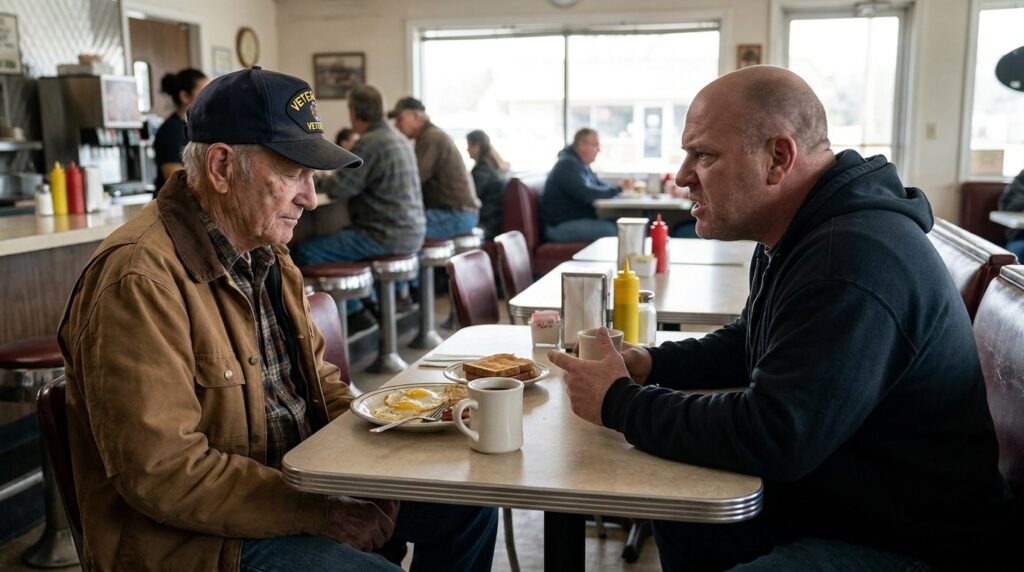
The Salt of the Earth Remains Heavy When the Surface of the World Rusts Away
CHAPTER 1: THE COLD GREASE
“You think that cap means something, old man?”
The voice didn’t belong to the room. It was too thick, smelling of sour damp cotton and the sharp, industrial tang of diesel exhaust from the highway outside.
Arthur didn’t look up from his hash browns. The yellow of the egg had already cooled into a thin, waxy film against the rim of the thick ceramic plate. He kept his left thumb firmly anchored on the loose brass rivet at the back adjustment strap of his cap, his skin identifying the rough, pitted edge of the metal by memory alone. The diner was small, three miles off the interstate, where the air smelled permanently of old lard and the floor tiles had been scuffed down to the gray backing by sixty years of work boots.
The stocky man in the dark hoodie leaned down farther. His palms flattened against the edge of the laminate table, forcing the Formica to groan under his weight. Arthur observed the fingernails—split, caked with dry orange clay, the knuckles scarred from a loose wrench or an uncalculated swing.
“I’m talking to you, blue-cap,” the man muttered. His breath was warm, smelling of cheap tobacco and stale mints. “My taxes pay for your monthly voucher down at the clinic. My back’s broken from hauling rebar while you sit here in a free jacket looking like a museum piece. You think you’re better than the rest of this town because you took a boat ride fifty years ago?”
Across the narrow aisle, Mrs. Gable’s fork stayed suspended two inches above her rye toast. The low hum of the double-door refrigerator behind the counter clicked off, leaving a sudden, ringing void in the air. The fry cook, a boy named Toby whose grandfather had died in a dry dock, stopped his scraping tool against the flat-top grill. The metal-on-metal screech died instantly.
Arthur didn’t blink. He watched a drop of condensation slide down the side of his water glass, cutting a clean path through the film of dust and grease on the outside. His hands remained flat, fingers spaced precisely two inches from his silverware. His pulse was a steady, rhythmic thud in his ears—forty-eight beats a minute, exactly where it had been when the alarms used to sound on the lower decks. Panic was an expensive luxury. It required oxygen he didn’t care to waste on a man who wore his anger like a rented suit.
“You’ve got a tear in your sleeve,” Arthur said. His voice was gravelly, dry from the morning air, lacking the high pitch of an old man’s defense.
The stocky man’s jaw twitched. His left hand drifted slightly backward toward the heavy pocket of his hoodie, his shoulder dipping an inch. “What did you say?”
“Your sleeve,” Arthur repeated, his eyes finally shifting from the congealing egg to the man’s face. He noted the slight yellowing in the whites of the bully’s eyes—a liver that didn’t like liquor, or a life spent sleeping in trucks. “You’re catching it on the booth screws. It’s going to split open if you keep leaning.”
The bully’s chest expanded, his face darkening to the color of wet brick as his fingers bunched into fists against the Formica. He didn’t look at the small, square tattoo peeking out from the cuff of Arthur’s brown jacket—a faded blue anchor that had lost its flukes to forty years of sun. Instead, his eyes fixed on the silver eagle pin pinned just above the cap’s visor, its wings bent slightly from an old drop on a concrete pier.
Arthur moved his weight forward, his heels coming into contact with the grease-slicked rungs of the stool beneath him.

CHAPTER 2: THE SCALE OF FRICTION
The silence in the diner didn’t just settle; it clamped down like an ungreased vise.
Arthur’s boots found the rusted iron ring near the base of the stool, his heels digging into the familiar notched metal until his spine cleared the edge of the booth. He didn’t rise with the sudden, theatrical jerk of a younger man looking for a fight. He rose with the slow, heavy leverage of an old crane, his joints clicking behind the low hum of the refrigeration unit that had just kicked back to life.
The stocky man didn’t move his feet, but his shoulders gave up three inches of their width. His palms remained flat against the pitted Formica, the yellowed skin over his knuckles turning a bloodless gray. Up close, the dark hoodie was stiff with dried mortar dust and the faint, bitter stink of transmission fluid. This wasn’t a soldier; it was a man who worked the gravel pits near the river, his muscles built from short, repetitive lifts that left the lower back vulnerable to a quick rotation.
“You’ve got grease on your collar,” Arthur said, his voice flat as a timber line. He didn’t look at the bully’s eyes anymore. He looked at the hollow just below the man’s ear where the pulse was jumping against the dirty fabric of the hood. “And your left knee is leaning inside the booth frame. If I touch the table, you’re going over the benchmark.”
The bully’s fingers bunched, but they didn’t lift. A small, blue-inked tattoo—clumsily executed, three fading letters over a blurred silhouette—was visible on the side of his thick neck, mostly hidden by the salt-and-pepper scruff of his beard. J.V.R. The letters were old, the ink bleeding into the grain of his skin like oil into dry pine.
“You’re Miller,” the stocky man muttered. The tone had changed. The mocking edge had rusted through, replaced by something old and wet, like a basement floor after a freeze. “Arthur Miller. They said you came back here to rot. They said you kept the logbooks.”
Arthur’s thumb pressed harder into the brass rivet of his cap. The cold metal bit into the calloused pad of his skin. The name didn’t belong in this diner. In this county, he was just the old man who lived behind the grain elevator and took his meals at the counter when the morning log trucks cleared out. The logbooks were three thousand miles away, rotting in a gray canvas bag inside a cedar chest that smelled of damp wool and dead silverfish.
“The eggs are five dollars,” Arthur said, pointing a single, steady finger toward the plate between them. “And the coffee has been sitting since six. If you’re staying, buy a cup. If you’re working the haul road, the grader’s already three miles past the bridge.”
The fry cook, Toby, moved his hand beneath the counter. The dry scrape of a heavy plastic telephone receiver against its cradle sounded loud in the corner booth. The off-duty deputy in the corner didn’t lift his eyes from his local paper, but his thumb had unlooped the leather retention strap over his sidearm, the small snap clearing with a distinct, metallic click that everyone in the room ignored with perfect discipline.
The stocky man looked down at the table. A grease-smeared work order from the county sand-and-gravel yard was sticking out of his front pocket, the corner torn where a signature should have been. His mouth opened, his jaw shifting as if trying to clear the taste of lime dust from his teeth.
“My old man didn’t get a cap,” the bully said. The words were small, transactional, dropped onto the congealing grease of the plate like dropped washers. “He didn’t get the flag either. Just an insurance voucher from a warehouse in San Diego that didn’t cover the cost of the limestone.”
Arthur didn’t shift his gaze. His mind didn’t drift to the gray water or the smell of burning diesel in the berthing compartments of 1972, but the skin around his jaw tightened until the old scar beneath his chin—the one he’d caught on a broken hatch lever during the standard sea watch—turned a sharp, chalky white. He recognized the shape of the nose now. It was the same flat, crooked bridge he’d seen through a red emergency lens while the air pumps were failing.
“The yard closes at noon on Thursdays,” Arthur said, his hand moving to his pocket to draw out three crumpled single bills. He laid them beside the cold hash browns, his movements rhythmic, unhurried, matching the slow rotation of the ceiling fan above the counter. “The rain’s going to turn the silt into grease by the river. If you’re driving that triple-axle, you’ll want your chains on before you hit the grade.”
The stocky man took a slow step backward. His boots made a dry, scraping sound against the salt-pitted linoleum. He didn’t reach for the money, and he didn’t look back at the booths where four sets of eyes were tracking the oil stains on his hoodie. His right hand remained inside his pocket, his fingers locked around something heavy and square—a small leather wallet or an old service medal with the ribbon rotted off—that didn’t belong in a gravel yard.
“He said you were the one who signed the detail,” the man said from the threshold of the booth. His voice was low, almost lost behind the rattle of a diesel truck shifting gears on the grade outside. “He said you were standing right by the ladder when the hatch dropped.”
Arthur reached down, took his water glass, and drained the last half-inch of tepid, iron-tasting water. He let the heavy glass bottom drop back onto the laminate with a clean, dull thud that signaled the end of the shift.
“The ladder was clear,” Arthur said.
The bully didn’t answer. He turned, the screen door rattling against its wood frame as he stepped out into the yellow fog of the gravel lot. The rain was starting now, heavy drops hitting the tin roof of the diner with the sound of scattered gravel. On the table, right where the man’s left palm had been resting, a small, triangular piece of red plastic—a broken reflector from an old navy-issue flashlight—remained embedded in the gray grease of the laminate.
Arthur reached out, his thick fingers picking up the plastic fragment, his skin registering the sharp, broken edge before he slid it into his pocket beside his keys.
CHAPTER 3: THE BROKEN LINE
The screen door didn’t settle until Arthur was already three feet into the gray downpour. The cold rain hit the stiff, faded canvas of his brown jacket with the sound of dry beans dropping into an empty bucket. Beneath his boots, the gravel yard had already begun to dissolve, the white limestone slurry mixed with the iridescent sheen of old crankcase leaks to form an unyielding, milk-colored grease that coated the sides of his soles.
He didn’t check the road. He knew the sound of the triple-axle Kenworth shifting its air brakes down by the culvert without needing to watch the tail lamps. The engine was missing on the third cylinder, a heavy, wet mechanical wheeze that echoed off the corrugated metal walls of the grain elevator across the county line.
Arthur reached his truck—a twenty-year-old Ford with a rusted-through tool box bolted behind the cab—and slid his hand into his pocket. His calloused fingers bypassed his brass keys, brushing against the sharp, jagged corners of the red plastic reflector fragment he had cleared from the diner table. Beside it lay a strip of damp paper the bully had dropped when his hand cleared his hoodie pocket. It was a pink carbon duplicate of a county weight receipt, stained with hydraulic oil at the margin.
Arthur didn’t open it until he was behind the wheel, the cold vinyl seat groaning under his frame as the windshield began to opaque with the damp fog of his breath. The air inside the cab smelled of dry horsehair and stale tobacco. He held the pink slip up to the weak, gray light leaking through the water-streaked glass.
The signature at the bottom wasn’t the stocky man’s name. It belonged to the hauling contractor: Vance Hauling & Logistics. But beneath the corporate stamp, written in the frantic, ballpoint scrawl of a yard clerk who hadn’t cleared the ink margin, was a driver’s name and an old military payroll identification prefix.
Driver: Raymond Vance (Jr.) — Ref: V-1972-DIS.
Arthur’s thumb drifted automatically to the brass rivet on his cap, pressing until his nail went white. The prefix wasn’t county code. It was the specific administrative shorthand used by the Bureau of Naval Personnel during the final pull-out from the western Pacific. The DIS didn’t stand for discharge. It stood for Disciplinary Segregation—the legal quarantine used for men whose final service records were stripped of their honors before the hull paint could dry in San Diego.
He smoothed the wet paper against the cracked dashboard, his palm registering the deep indentation of the pen. The boy outside hadn’t just been angry about a free jacket or a voucher at the clinic. He had been carrying the specific, inherited rot of a man who believed his family name had been stolen by the person holding the logbooks.
Outside, the rain intensified, drumming against the truck’s cab with the rhythm of distant anti-aircraft fire on a night watch. Arthur pumped the throttle once, the starter motor turning over with a dry, metallic screech before the straight-six caught, its rusted leaf springs vibrating against the frame as the exhaust pipe rattled against the bumper.
He didn’t turn back toward his cottage behind the elevator. Instead, he dropped the transmission into low gear, the gear teeth grinding through a layer of old, burnt fluid before locking into place. The truck slithered through the white lime mud of the diner lot, its tires hunting for traction along the edge of the ditch where the gravel ended and the river silt began.
Through the rear-view mirror, he saw the off-duty deputy step out onto the porch of the diner, his Stetson tilted forward against the rain. The deputy wasn’t looking at the highway; he was looking down at the white slurry where the Kenworth’s triple tires had dug deep into the county roadbed, leaving two parallel trenches that filled instantly with muddy water.
Arthur knew where the sand-and-gravel yard kept its old records. It wasn’t in the new metal office by the scales. It was in the pre-war lime kiln at the base of the bluff, where the Vance family had kept their equipment since the day they stopped hauling stone with mules. If the boy had his father’s old Navy-issue flashlight in his pocket, he had the rest of the locker down in the valley where the river didn’t clear till August.
The truck’s wipers left two greasy arcs across the glass, the rubber split at the center, leaving a thin line of water that split Arthur’s vision in two as he turned the vehicle down toward the bottomland. His left hand remained on the wheel, but his right hand reached down, his fingers tracking the cold, metallic shape of an old grease gun beneath the seat—not for defense, but for the weight of something solid and heavy when the air turned sour.
He knew what the logbooks said about Raymond Vance. He had written the entry himself under a red light while the bulkhead was still hot to the touch. But the boy didn’t know about the second log—the one that never made it to the canvas bag because the executive officer had burned the carbon sheets in the galley oven before the tugs met them at the mouth of the bay.
Arthur slowed the truck as the road changed from asphalt to crushed shale. The smell of wet river willow and sulfur from the old lime pits came through the floorboards, thick and flat. He killed the headlights fifty yards before the gate, letting the vehicle’s momentum carry it through the weeds until the bumper brushed the rusted chain-link fence of the yard.
The Kenworth was parked near the hopper, its diesel block ticking as it cooled in the wet dark. A single yellow light was burning inside the lower office windows, casting a long, jaundiced reflection across the standing water of the scale pit.
CHAPTER 4: THE FILE DRAWER
The door to the lime kiln office didn’t have a latch left; it was held shut by a length of rusted rebar wedged against the rotted cedar frame. Arthur applied his shoulder to the rough timber, his boots churning through a thick carpet of wet, dead willow leaves and sulfurous mud until the wood groaned and gave way three inches. The smell hit him instantly—not the clean, sharp damp of the river, but the dead, alkaline stench of wet lime, old carbon sheets, and forty years of mice nesting in wet fiberglass.
He didn’t use a flashlight. The jaundiced square of light from the gravel scale-shack fifty yards away cut across the floorboards, illuminating the long, parallel streaks of grease left by Raymond Vance’s work boots. The boy had been here within the hour. A green metal filing cabinet, salvaged from some post-war county surplus sale, sat in the corner beneath a sagging rafter, its bottom two drawers pulled out so far the tracks had dropped their ball bearings into the silt.
Arthur knelt. The movement was a slow calculation against the stiffness in his left meniscus, his trousers soaking through with the gray lime-water that pooled between the floorboards. His rough fingers tracked the tabs of the hanging folders. They weren’t sorted by customer name or gravel tonnage; they were sorted by year, the old manila paper soft as felt from the valley humidity.
The drawer labeled 1972 was gone entirely. In its place, wedged back into the rusted frame where the drawer glides met the casing, was a military-issue ammunition box. The stenciled yellow lettering on the side had been scrubbed with steel wool, but Arthur’s thumb didn’t need the paint. His skin found the deep, pitted indentation where a hull designation had been stamped into the steel with a cold chisel: LST-1185.
The San Bernardino. The ship that had spent three weeks sitting four miles off the coast of Da Nang while the shore batteries cleared out, her ballast tanks full of fuel she wasn’t supposed to be carrying and forty-two men in the hold who weren’t on the division roster.
“You’re late, Miller,” a voice said from the shadow behind the door.
The rebar shifted. Raymond Vance Jr. stepped into the jaundiced light, his stocky frame silhouetted against the wet screen of the window. He wasn’t holding a wrench. His right hand was tucked deep into the pouch of his damp hoodie, the heavy, square weight Arthur had noticed at the diner now pulling the fabric tight against his ribs. The skin around the boy’s jaw was slick with rain, his teeth showing white behind his short beard.
Arthur didn’t pull his hand out of the filing cabinet. He kept his fingers anchored on the cold handle of the ammunition box, his mind measuring the distance between his knees and the threshold. “Your father didn’t keep his tools in here, Raymond. He kept them in the truck.”
“He didn’t have a truck when he came back,” Vance said, his voice dropping into the flat, toneless registry of an engine running out of prime. “He had a gray canvas gym bag and two broken fingers on his left hand. He spent three years sitting on the porch waiting for the mail to bring the voucher from San Diego. The one with your signature on the bottom line.”
“The signature was for the gear allowance,” Arthur said, his voice dropping below the rattle of the rain on the tin roof. “The division didn’t have the authority to clear the payroll after the third line-item was scratched.”
“You scratched it,” the boy said, taking a step forward. The floorboards bowed beneath his boots, a clear line of yellow water bubbling up between the seams. “I found the carbon sheets in his locker behind the compressor. The log says he was on the detail at the fuel pier. It says he was the one who uncoupled the line before the explosion.”
Arthur let his hand drop from the box. He rose, his joints popping with the distinct, dry sound of an ungreased hinge. The space between them was less than four feet now—close enough that he could see the orange clay caked into the seams of Vance’s hoodie. The boy’s left hand came out of his pocket, holding a faded, plastic-wrapped folder that had been sealed with green electrical tape.
“Look at the name on the line, old man,” Vance muttered, thrusting the folder forward into the light. “That’s his handwriting. That’s the operational report from the night the pump room went down. He didn’t abandon the watch. He was locked out from the deck above.”
Arthur didn’t reach for the folder. He looked past it, his eyes fixing on the corner of the ammunition box still wedged in the bottom of the cabinet. The green tape on the folder wasn’t Navy issue; it was the heavy, industrial vinyl they used at the county substation back in the seventies. The handwriting wasn’t Raymond Vance’s either. It belonged to Lieutenant Commander Gage—the man who had spent the entire deployment inside the air-conditioned sea-cabin, drinking gin out of a paper cup while the lower decks were clearing out the bilge by hand.
The decoy was perfect. Gage had left just enough paper behind in the local offices to ensure that if any of the boys from the county started asking why their lungs were clear but their pockets were empty, they’d find a name like Vance or Miller on the logs instead of his own.
“The paper’s dry, Raymond,” Arthur said softly, his eyes returning to the boy’s face. “But the ink’s from a clerk’s desk in the courthouse, not the ship’s office. Your father didn’t write that report because he couldn’t hold a pen by the time we hit the pier in Subic.”
Vance’s shoulder twitched, his right hand tightening inside the hoodie pouch until the steel silhouette beneath the fabric became unmistakable—the short, heavy barrel of an old service revolver, its cylinder unlatched or the spring rusted through from forty years in a machine shed.
“You’re lying,” the boy said, but the intensity in his voice had dropped an octave, the certainty or the rage beginning to leak out of him like air from a punctured tire. “The logbook’s at your house. Everyone in the township knows you kept the iron trunk.”
“The trunk is empty,” Arthur said, taking a half-step forward until his boot touched the edge of the pink weight receipt Vance had dropped earlier. “The books you’re looking for aren’t behind the elevator. They’re down in the machine shed by the old loading dock, where your uncle left the crane logs when the company went under.”
A sudden, sharp beam of white light cut through the wet window from the road above. The high, unhurried wail of a county siren rose over the sound of the river grade—not an emergency run, but the standard tracking sweep the evening patrol took when the gravel scales were left open past the shift.
Vance froze, his head jerking toward the light as his fingers slipped against the weight in his pocket. The distraction was only three seconds long, but it was the gap Arthur had been calculating since his boots first cleared the rebar at the door.
CHAPTER 5: THE BARN FLOOR
The flashing white beam didn’t hit them directly, but it cut a sharp, wet silhouette of the kiln door across Raymond Vance’s chest. In that three-second sweep, Arthur didn’t think about his knees. He reached out with his right arm, his calloused palm catching the thick fabric of Vance’s sleeve near the elbow and dragging the boy down behind the heavy iron frame of the surplus filing cabinet.
The weight of the steel casing groaned as their bodies hit the wet limestone slurry on the floorboards. Outside, the patrol car’s tires hissed against the shale roadbed, the engine idling low before the driver kicked the transmission back into high gear, the red taillights disappearing up the river grade toward the state highway.
“Let go of me,” Vance hissed, his hand twisting inside the hoodie pouch. But the wet fabric tangled around his knuckles, the blunt snout of the service revolver catching against the pocket seam with a dull, muffled thud.
“Keep your mouth shut,” Arthur muttered. His voice was less than an inch from the boy’s ear, dry and cold as frost on an anchor chain. “The county line isn’t the boundary tonight. If that was Miller from the evening shift, he wouldn’t have kept his high beams on the grade. Someone’s clearing the county road before the logging trucks come down from the ridge.”
He stood up before the boy could pull his hand free, his fingers instantly catching the wire handle of the ammunition box from the bottom drawer. He didn’t carry it like an old man; he pinned the steel box against his ribs with his elbow, using his free hand to steady himself against the lime-scaled wall. The green electrical tape on Vance’s folder gleamed like wet moss under the faint moonlight now breaking through the split tin roof.
“Get up,” Arthur said, his boot tip tapping the boy’s mud-soaked knee. “The machine shed is three hundred yards down the slough. If your truck’s still running on five cylinders, they’ll hear the block vibrating from the highway.”
Vance didn’t move for two seconds, his chest heaving under the damp cotton of his hoodie, his short beard full of gray lime dust. Then he rolled onto his shins, his heavy work boots slipping once in the mud before he cleared the threshold, his head staying low beneath the willow branches that hung over the drainage ditch.
The path to the loading dock was nothing but a trench of rotted hemlock planks and old iron scale from the pre-war stone crushers. Arthur led the way, his stride matching the heavy, rhythmic thud of the river water hitting the bypass gates. He didn’t look back to see if Vance was following; the wet, wheezing breath of the younger man was loud enough to track through the dark. Every fifty yards, the smell of the old stone works changed—shifting from the sharp, chemical bite of sulfur to the greasy, dead reek of old lubricating oil that had soaked deep into the clay banks forty years ago.
The machine shed was an unpainted, five-hundred-foot long structure made of corrugated iron panels that had turned the color of dried liver under decades of river fog. The sliding doors were off their tracks, jammed open three feet by a fallen cottonwood log that had rotted down to the pulp.
Arthur squeezed through the gap first, the sharp edge of the rusted iron panel tearing a clean, two-inch strip through the sleeve of his brown jacket. He didn’t look at the cloth. He dropped the ammunition box onto the deck of an old flatbed trailer parked inside the gloom, the sound of the steel hit against the hardwood planks echoing through the rafters like a closed hatch.
The floor of the shed was covered in three inches of old sawdust and ground walnut shells, used to soak up the leaks from the hydraulic cranes when the yard was active. Vance came through the gap behind him, his hoodie catching on the iron, his face pale as lard in the dark. He laid the plastic-wrapped folder on the trailer beside the box, his hands shaking so hard he had to tuck his thumbs into his belt to hide the movement.
“The logbooks aren’t here,” Vance said, his teeth clicking together twice. “My uncle cleaned this place out before the bank took the tools. There’s nothing left but the dead lines and the old wire reels.”
Arthur didn’t answer. He walked past the trailer toward the rear of the shed, where the floorboards changed from rough oak to heavy, creosoted timbers that had been bolted directly into the rock bluff. He stopped beside a rotted hatch cover that led down to the old turbine pit—the space where the stone company used to draw power from the river before the dams were built.
He knelt, his fingers finding a loose iron ring hidden beneath a layer of moldy burlap sacks. With one short, lifting heave that strained the muscles across his shoulder blades, he swung the timber back.
The air that rose from the hole was cold, smelling of ancient wet iron and the distinctive, suffocating stink of bunker-C fuel oil—the same fuel that had filled the double-bottom tanks of the San Bernardino when the water was coming over the gunwales.
“Your father didn’t leave his papers in San Diego, Raymond,” Arthur said, reaching down into the blackness of the pit until his fingers caught the strap of a heavy canvas bag that had been wrapped in greased butcher paper. “And he didn’t bring them home in his gym bag. He left them with me because he knew if the Bureau found these sheets in his house, the county wouldn’t even give him the three acres behind the kiln.”
He hauled the bag onto the creosote planks. It was heavy, the outer layer of paper stiff and blackened by fifty years of oil vapor. Arthur didn’t open the twine knot. He tore through the brittle butcher paper with his thumb, exposing the top sheet of a gray canvas logbook stenciled with the official seal of the United States Maritime Commission.
Vance stepped closer, the service revolver finally coming out of his pocket, but it hung loose by his thigh, the barrel pointing down into the sawdust. “What is that?”
“The real deployment ledger,” Arthur said, his voice dropping into the steady, mechanical rhythm of a man reading a sonar tape. “Not the one Gage signed for the court-martial. This is the log from the third watch—the one that shows the valves were turned from the bridge while your father’s crew was still in the pump room. They didn’t lock him out because he failed the pressure test. They locked him out because the ship was carrying twelve hundred tons of undeclared distillate for the commercial lines in Manila.”
The boy’s face didn’t change, but his fingers loosened around the grip of the revolver until the weapon leaned against his leg. The physical secret—the decoy paper from the courthouse—lay ruined on the flatbed behind him, but the emotional truth was turning into something far heavier than a family grudge.
From the front of the shed, a low, dry scrape sounded against the corrugated iron. The shadow of a man shifted across the opening—not the deputy, but a taller, broader silhouette holding a long, unlit iron bar or a heavy-caliber rifle across his chest.
CHAPTER 6: THE WATCH STOOD
The silhouette in the rotted frame of the sliding door didn’t bring a rifle up. It moved with a slow, deliberate limp that Arthur had tracked through the county for twenty winters—the heavy, uneven drag of an off-duty deputy whose right hip had been pinned together with surgical steel after a high-speed chase on the state line.
Jesse Miller didn’t turn on his flashlight. He let his wide brim drain a steady line of river water onto the walnut shell floorboards as he stepped past the flatbed trailer. The dull, green electrical tape on Vance’s counterfeit folder caught the yellow wash from the distant scale-shack, but the deputy’s eyes remained on the canvas bag Arthur had dragged from the turbine pit.
“The county road’s rising, Arthur,” Jesse said, his voice flat, carrying the dry, dead-pan rasp of an old man who spent his life writing down the weights of gravel trucks. “The logs from the ridge are already turning back at the fork. If you’re going to burn that bag, you’d better do it before the river covers the bypass gate.”
Raymond Vance Jr. didn’t lift the revolver. His thick hand remained frozen against the grain of his work trousers, his knuckles caked with white lime slurry that had dried into a stiff, chalky crust. He looked from the deputy’s tarnished badge to the old logbook resting on the creosoted timber between Arthur’s boots.
“You knew,” the boy muttered. His jaw worked against the cold, his teeth giving a single, hard click. “You’ve been checking the scale logs since my uncle passed. You knew what Gage did.”
“Gage didn’t leave his name in the county courthouse, Raymond,” Jesse said, stepping close enough that the smell of his wet wool uniform mixed with the sulfurous stink of the old kiln. He didn’t look at the gun. He reached down with two fingers, flipping open the brittle, oil-soaked cover of the maritime ledger. The first page was white paper that had turned the color of dry tobacco, the official ink cracked along the margins like dried river silt. “He left it on the bank boards in Seattle. Your dad knew it when he signed the voucher in San Diego. He took the three hundred dollars because your mother was already coughing up blood in the trailer behind the foundry.”
Arthur didn’t shift his heels from the iron ring of the hatch. His hand remained hooked into the greased butcher paper, his thumb feeling the small, cold edge of the brass-plated corners that reinforced the ledger’s binding. The deep, paradigm-shifting truth didn’t change the weight of his brown jacket or the crisp gold embroidery on his navy cap. It was just a number on a different page—a system where the currency wasn’t gravel or diesel, but the unrecorded lives of forty-two men who had been left to clear the lower decks while the officers counted the drums on the pier.
The silence that followed was different from the clamp-down in the diner. It was wide, wet, and empty, filled only by the mechanical groan of the river water hitting the iron bypass gates three hundred yards down the slough. Time dilated within the cold iron rafters of the shed; Arthur observed the micro-texture of the moment—the tiny flakes of rust dropping from the corrugated roof panels as each heavy raindrop hit the metal, the steady, rhythmic wheeze of Raymond Vance’s lungs, and the gray, ancient weariness etched into the lines of Jesse’s face. The entire history of the county—the broken roads, the silent veterans, the generational anger that had accumulated like silt in the river bottom—was laid bare under the jaundiced light leaking through the tin walls.
“The watch is over, boy,” Arthur said softly. He didn’t look down at the pages anymore. He looked directly into the young contractor’s eyes, his gaze steady, devoid of the quick, defensive anger of the uninitiated. “Your father didn’t run. And he didn’t fail the line. He held the pressure valve open until the bilge pumps could clear the lower trunk. If he hadn’t stayed by the ladder, the San Bernardino would have been sitting on the bottom of the channel before the tugs could clear the harbor mouth.”
Vance’s fingers opened. The heavy service revolver didn’t hit the timbers with a crash; it slipped out of his pocket and dropped into the deep, wet sawdust by his boot, its barrel disappearing instantly into the soft, rotten mulch of ground walnut shells. The stocky man dropped his head into his palms, his heavy shoulders shaking once under the wet dark fabric of his hoodie as the unearned rage of twenty years collapsed into the quiet reality of an unwritten truth.
Jesse reached down, his leather glove registering a sharp, cracking sound as he closed the ledger and slid it back into the oil-blackened canvas bag. He didn’t look at Arthur as he hoisted the weight against his pinned hip.
“The township doesn’t need the logs, Arthur,” the deputy said, his boots hunting for traction on the grease-slicked hemlock planks as he turned toward the sliding door. “They’ve got enough trouble with the silt on the grade. I’ll keep this in the lockbox down at the cellars. If anyone from the state office comes down to ask about the Vance voucher, I’ll tell them the water got into the kiln back in ninety-three.”
Arthur stood alone on the creosote floor as the deputy’s uneven stride faded into the steady drum of the rain outside. He reached out, his hand catching the stocky man’s shoulder—not with the tension of a restraint, but with the heavy, unyielding leverage of a man who had stood the watch on the lower decks when the bulkheads were turning red.
“Come on, Raymond,” Arthur said, his gravelly voice dropping into the quiet rhythm of the closing shift. “The grader’s past the bridge by now. Let’s go finish those eggs before the kitchen turns off the grill.”
The boy didn’t answer, but he didn’t pull away. He followed the older man out through the broken iron paneling of the shed, his boots leaves a single set of deep, heavy tracks in the white limestone mud that the rain was already washing away into the dark slough below.







