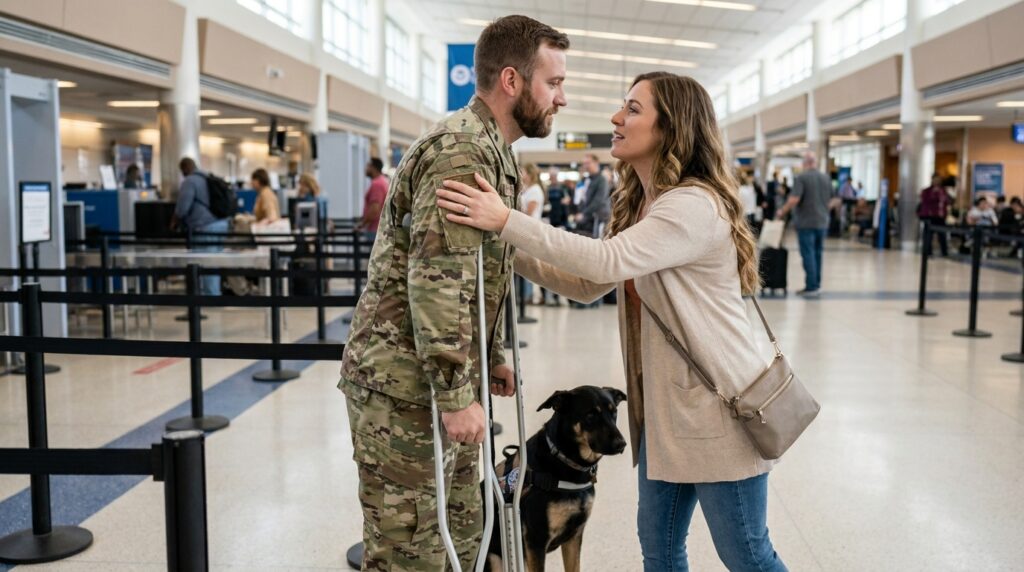
The Cold Geometry of Redirection and the Weight of an Unyielding Threshold
CHAPTER 1: THE FAULT LINE
The metal rollers under the grey plastic bins didn’t roll smoothly; they caught on grease and lint, sending a rhythmic, metallic chatter upward into the low acoustic tiles of the ceiling. Staff Sergeant Garrett Vance watched a stray plastic coin tray slide down the track toward his thumb. The air inside the screening lane smelled precisely of what it was—recirculated aviation exhaust, dry carpet fibers, and the sour, chemical tang of five hundred damp winter coats packed into a single bottleneck.
He didn’t look at the faces in the parallel lines. He didn’t need to. He calculated the queue the way he had calculated standard convoy intervals along the ring routes out of Bagram: six yards between the baggage rollers and the body scanner; three paces of open linoleum where a man on underarm aluminum crutches was entirely exposed to the lateral drift of the crowd; and one thick, textured yellow safety strip that marked the boundary of civil authority.
Ranger’s left shoulder pressed against the coarse fabric of Vance’s trousers, a steady, localized furnace of heat against an aching knee joint that had spent the last fourteen hours locked into an economy-class bulkhead seat. The dog’s harness—heavy black webbing stitched with a single, unwashed tactical flag patch—was rigid under Vance’s left palm. Every three seconds, Vance’s fingers tightened over the small brass challenge coin in his pocket, its milled edge cutting into his skin to anchor him against the throbbing vertical fire radiating from his tibia.
“Step forward into the frame. Not the dog. Just you.”
The voice belonged to the blue shirt behind the glass partition. TSA Supervisor Miller didn’t look up from his monitor when he spoke; his right hand was busy clicking a plastic stylus against the corner of a keyboard, the sound sharp and aggressive like a failing fuel injector. His uniform shirt was stiff with laundry starch, the silver collar pins aligned with a geometric precision that suggested a man who spent his mornings practicing authority in a mirror.
Vance shifted his weight, his forearms bearing down on the worn rubber grips of the crutches until the aluminum tubes gave a faint, clean ping. “He’s a designated medical asset, sir. The transit paperwork is affixed to the front of the folder.”
“The folder stays in the bin,” Miller said. He finally raised his eyes, his gaze sliding down Vance’s camouflage sleeve, skipping the unit patch entirely, and settling on the thick leather handles of the crutches. A small, dark smudge of tarmac grease was visible on Miller’s left cuff. “We don’t read folders while the lane is backed up to the escalator. Send the animal through with the female officer on Lane Three, then step into the box for a manual sweep.”
The family behind Vance shifted. A child’s heavy nylon backpack scraped against the metal stanchion, the sound loud enough to make Ranger’s ears twitch back. The dog didn’t move his paws; he remained locked into Vance’s left flank, his breathing a shallow, rhythmic pulse against the veteran’s boot.
“The dog remains on my left side through the portal,” Vance said. His tone didn’t rise; it dropped an octave, flattening out until the transactional noise of the surrounding lanes seemed to lose its edge. “That’s the standard Department of Defense clearance protocol for active-duty medical transport.”
Miller stood up from the stool. The movement was deliberately slow, designed to use the physical elevation of the platform to look down across the yellow line. He tapped his plastic ID badge against the edge of the metal detector frame, a dull thwack that drew the eyes of three junior screeners two lanes over. “This isn’t a military base, Sergeant. This is my lane. And in my lane, I handle the line.”

CHAPTER 2: THE BOTTLENECK
“Your folder doesn’t overrule a terminal red-flag, Sergeant,” Miller said. The stylus in his right hand stopped clicking against the keys. He pointed the plastic tip directly at Ranger’s chest harness, tapping it against the top of the glass divider with a dull, rhythmic snap. “I have a data mismatch on Lane Two. Until that clears, your animal belongs to civil screening.”
Garrett Vance did not shift his boots. The weight of his entire frame remained balanced through the padded underarm cradles of his crutches, his palms steady against the coarse rubber grips. In his left trouser pocket, his fingers locked onto the brass challenge coin, his thumbnail tracking the raised, serrated edge of the unit crest. The pain in his right tibia was no longer a dull ache; it had become a sharp, structural pulse, timed perfectly to the flickering of the white fluorescent tube directly above the metal detector frame.
“The mismatch is a routing code, sir,” Vance said. His voice remained flat, a low baritone that stayed beneath the high-pitched din of rolling luggage and crying children three lines over. “It’s a standard transit marker for medical evacuations coming out of the Ramstein staging hub. If you run the Department of Defense logistics code on page three, the system will bypass the local civil queue.”
“I don’t run military codes,” Miller replied. He stepped out from behind the safety glass, his boots clicking sharply on the polished linoleum. He was close enough now that Vance could smell the sour residue of cold airport coffee and the distinct, burnt-sugar scent of his over-starched collar. Miller’s eyes narrowed as they swept across Vance’s camouflage jacket, pausing on the scuffed Velcro where his name tape was stitched. “And I don’t take instruction from people trying to push past a federal line because they have a dog and a patch on their arm.”
Behind them, the bottleneck tightened. The family of four had stopped moving entirely, their heavy nylon bags slumping against the grey security stanchions. A man in a dark business suit three paces back checked his watch, his tongue clicking against his teeth with an unmistakable, sharp impatience that rippled through the rest of the queue. The collective friction of fifty travelers, trapped between a dead escalator and a static gate, settled over the lane like heavy dust.
Vance watched Miller’s right hand. The supervisor’s fingers were twitching toward his belt, where a heavy plastic radio casing sat hooked to his hip. On the side of Miller’s plastic stylus, Vance noticed a small, irregular sequence of hand-scratched letters—X-44—marring the factory print. It wasn’t standard TSA issue; it was a military logistics marker, the kind used by cargo handlers to identify transient equipment bags in a loading zone.
“The lane is closing,” Miller announced to the queue, his voice rising to capture the junior screeners on Lane Three. “Everyone in this line, back up and move to the left. We have a non-compliant passenger delaying the portal.”
A low murmur broke out among the holiday travelers. A woman near the baggage rollers muttered something about missing her connection to Denver, her eyes darting angrily toward Ranger. The service dog remained completely stationary, his tail tucked clean against his hocks, his jaw closed as he tracked the shifting weight of Miller’s boots. The animal’s ribs expanded and contracted against Vance’s shin—a steady, silent mechanism of pure discipline that contrasted sharply with the chaotic energy of the terminal.
“I am compliant, Supervisor,” Vance said, his left forearm tightening against the horizontal bar of his crutch until the metal frame creaked against his sleeve. “I have presented my ID. I have presented my transit orders. I am standing exactly where your officer directed me to stand.”
“You’re refusing a separation directive,” Miller countered. He took another step forward, entering Vance’s three-foot perimeter. His hand came off his radio and hovered two inches above Ranger’s leather handle. “That makes you an active obstruction. If I put my hands on this leash, Sergeant, you’re going to step through that frame alone, or you’re going to spend your homecoming in a local holding cell.”
The air in the lane went entirely dead. The junior screener on Lane Three stopped sliding grey plastic bins, her hands freezing on the edge of a roller track. The small brass coin in Vance’s pocket felt ice-cold against his thumb. He could see the slight tremor in Miller’s jaw—not from fear, but from the intoxicating rush of minor institutional power being challenged in front of a captive audience. Miller wasn’t looking at a wounded soldier; he was looking at a metric that was ruining his afternoon processing average.
Vance shifted his weight by a fraction of an inch, his left shoulder dropping slightly to brace the crutch against the floor. He didn’t pull back. He watched the precise angle of Miller’s fingers as they began to descend toward Ranger’s harness. The cold geometry of the checkpoint had narrowed down to the space of a single human breath, and Vance knew exactly how much resistance it would take to break the threshold.
CHAPTER 3: THE INVASION OF SPATIAL SECURITY
Miller’s fingernail caught the edge of Ranger’s heavy nylon chest strap, a small, scraping sound that vibrated directly up the leash into Vance’s palm. The supervisor’s shoulders leaned forward, his torso breaking the vertical plane of the yellow line with the reckless confidence of a man backed by a badge and an institution. He didn’t see the slight rotation of Vance’s left hip, nor did he register the way the aluminum tip of the left crutch dug into the linoleum floor to form an unyielding triangular base.
Vance shifted his weight, his left forearm snapping downward in a micro-movement that carried the clean, dense momentum of an active lever. He didn’t strike. He simply dropped his arm across the vector of Miller’s approach, using the rigid bone structure between his wrist and his elbow to seal the perimeter. When Miller’s wrist collided with the thick, olive-drab canvas of Vance’s sleeve, it wasn’t a violent collision; it was the sudden, absolute cessation of movement, like an unbraked vehicle hitting a concrete barrier.
“Step back from the dog, sir,” Vance said. The words were quiet, but they held the calculated weight of an officer establishing a firing line. His chest didn’t heave; his eyes remained fixed on the small, silver name badge pinned to Miller’s chest, watching how the thin metal reflected the cold glare of the ceiling fixtures.
Miller pulled his hand back, his fingers trembling slightly from the sudden impact against Vance’s rigid arm. His face flushed a dark, mottled red beneath the brim of his supervisor’s cap. He took half a step backward, his boots squeaking in a frantic double-time rhythm as his heel clipped the base of the metal detector frame. “You just touched a federal officer,” Miller hissed, his hand dropping directly to the black radio casing at his hip. “We are in a terminal lockdown situation on Lane Two. Step away from the crutches now!”
The whisper of rolling luggage throughout the terminal vanished instantly. Two lanes to the left, a junior screener dropped a plastic bin onto the rollers with a loud, hollow crash that seemed to echo off the far glass walls of the tarmac lounge. The tired holiday travelers in Vance’s queue recoiled, their bodies leaning away from the stanchions as the atmosphere in the bottleneck turned clinical and dangerous. A woman in a long wool coat grabbed her child’s arm, pulling the boy back until his nylon backpack thumped against the metal divider.
Vance didn’t look at the crowd. His eyes traveled over Miller’s shoulder, mapping the blue digital display mounted to the side of the screening console. On the screen, a solid block of amber text was pulsing beside his scanned military transit number: FLAG CODE: ALPHA-NOVEMBER-FOUR. It wasn’t a civil travel warning. It was a restricted tactical routing flag, the precise designation used by the Department of Defense to halt cargo manifests containing sensitive foreign-theater intelligence material.
The data mismatch wasn’t a simple clerical error. Miller hadn’t just misread the form—he had triggered an encrypted protocol that had been waiting for Vance’s biometric profile to cross a domestic gateway.
“I have a non-compliant passenger who just initiated physical contact on Lane Two,” Miller barked into his shoulder microphone, his voice cutting through the heavy stillness of the terminal. His thumb remained clamped on the talk button, his knuckles turning white. “Need armed response at the checkpoint immediately. Suspend passenger flow on the eastern corridor.”
“The passenger has not moved his feet, Supervisor,” Vance countered, his voice flat, retaining its rhythmic, unhurried cadence. He adjusted his palms against the rubber grips of his crutches, absorbing the sharp ache in his right tibia without a single flinch. “The physical contact was an encroachment violation of a registered service asset under Title 28 of the United States Code. I suggest you look at your console screen before your team executes an unauthorized detainer.”
Miller didn’t turn his head to look at the monitor. His arrogance had become a physical trap, locking him into a defensive posture in front of fifty people who were now holding up their phones, the small glass lenses tracking every line of his face. He could feel the witness pressure shifting; the initial annoyance of the travelers had vanished, replaced by the uncomfortable realization that they were watching an aggressive bureaucrat attempt to corner a wounded soldier on his first day back on American soil.
A junior officer at the end of the roller track quietly stepped away from the terminal, her hands rising to her belt as she looked back toward the security supervisor with a faint, nervous headshake. She knew the code on the screen wasn’t a standard domestic violation, and she knew the man standing on the crutches wasn’t moving like a target who was about to break. He was moving like a man who was holding a position until the real weight arrived.
CHAPTER 4: THE APPLICATION OF STRUCTURAL LEVERAGE
“Drop your arm, Sergeant, or my team will clear it for you,” Miller said. His boots didn’t shift forward this time. Instead, he leaned his weight into his heels, his torso vibrating with a shallow, rapid breath that made the plastic clip-on badge on his pocket click against his blue uniform button. His right thumb remained clamped onto the rubber button of his belt radio, the internal speaker emitting a high, rhythmic hiss that cut through the silent queue.
Garrett Vance did not lower his forearm. The angle of his elbow stayed locked at precisely ninety degrees, his camouflage sleeve forming an unyielding bar between Miller’s hand and Ranger’s harness. To the travelers watching behind the black nylon queue ropes, it looked like a static standoff—a wounded man braced on aluminum tubing refusing to budge. But Vance could feel the structural truth of the lane. Every ounce of downward force he exerted through his palms traveled straight through the scuffed aluminum shafts into the rubber tips, biting into the worn linoleum exactly where the yellow perimeter tape had begun to peel.
He had learned to map stress lines long before a mortar shell tore through the floorboards of his vehicle outside Forward Operating Base Apache. In a tight space, authority wasn’t a matter of volume; it was a matter of who owned the leverage point.
“The arm is a passive defensive block, Supervisor,” Vance said. His voice was too low to register on Miller’s shoulder microphone, but it traveled clearly to the junior officer standing three feet away by the x-ray conveyor. “If your personnel step inside this perimeter while the medical asset is engaged, you are initiating a standard custody breach under joint transit regulations. Run the bypass code on your screen, or wait for the shift supervisor to clear the gate.”
Miller’s jaw tightened, the skin over his cheekbones turning the color of wet chalk. He didn’t look at the console monitor pulsing behind his shoulder, where the amber flag code—ALPHA-NOVEMBER-FOUR—continued its steady, silent oscillation. His focus had narrowed down to the single square yard of floor space between his polished black shoes and the rubber tips of Vance’s crutches. To back away now, under the steady glare of forty smartphone lenses held by silent, staring passengers, would dissolve the minor administrative kingdom he had spent three years building in this terminal.
“You don’t dictate protocol to my team,” Miller whispered, his voice cracking from the strain of suppressed rage. He released the radio button, his hand dropping toward his hip. “We have an active red-flag on your profile. That means you don’t move until I say you move.”
Behind them, the dead air of the bottleneck seemed to expand. The man in the business suit who had been checking his watch three minutes ago slowly lowered his wrist, his face softening into a heavy, uncomfortable stillness. The collective irritation of the line had curdled into something older and darker—the deep, public shame of witnessing a bureaucratic machine grind against a man who still bore the dust of a deployment on his boots.
Vance felt Ranger’s ribcage expand against his left shin, a smooth, deliberate breath that remained completely unhurried. The dog’s jaw was closed, his ears pinned flat against his skull as he tracked Miller’s hands. Ranger wasn’t preparing to strike; he was waiting for the command cue that would never come, trained to treat civilian hostility as nothing more than background wind.
Vance’s thumb rolled over the milled edge of the brass challenge coin inside his pocket. The metal had warmed from his body heat, but it remained sharp enough to ground him against the white-hot fire blooming in his right tibia. He checked the display again over Miller’s starched shoulder. Below the primary flag, a secondary string of digits had populated the terminal: LOG-TRANS-026.
The realization hit him with the cold precision of an incoming round. That wasn’t an airport security code. It was a restricted cargo manifest number from the logistics hub at Ramstein—the exact transport line that had carried his personal gear bag across the Atlantic. The encrypted flag on Miller’s screen wasn’t an automated error. Someone had placed a digital tracer on his travel profile, a specific administrative trap designed to trigger the moment his boots touched a domestic port of entry.
“Supervisor,” the junior officer by the rollers said, her voice small and tight as she stepped forward from the conveyor track. She didn’t look at Miller; her eyes were fixed on the pulsing console screen. “The airport police lieutenant just cleared the lower escalator. He’s coming through the secure side of Lane One right now.”
Miller didn’t turn around. He kept his eyes locked on Vance’s face, his body rigid as he waited for the first sign of compliance. But Vance merely adjusted his grip on the rubber handles, his frame settling deeper into the triangular brace of his crutches. He had survived six months in a medical ward with less leverage than he held right now, and he had no intention of surrendering the threshold before the real authority arrived to read the data.
CHAPTER 5: THE ARRIVAL OF INSTITUTIONAL WEIGHT
“Supervisor Miller, step three inches back from that yellow marker line,” the voice said. It wasn’t loud, but it carried the flat, industrial density of a closed cell block door.
Lieutenant Briggs didn’t look at Miller as he spoke. He walked into the bottleneck from the secure side of Lane One, his dark blue law enforcement uniform tailored with heavy, stiff seams that completely absorbed the flickering fluorescent reflections. His leather duty belt gave a single, muffled squeak as his hand came down onto the metal edge of the glass partition. Beside him, a commercial airline captain stood motionless, his gold sleeve bands catching the cold light like flat brass rulers.
Miller’s shoulders jerked. His thumb came off the talk button of his belt radio with a sharp, plastic pop, his face draining of its dark red flush until it matched the industrial grey paint of the metal detector frame. “Lieutenant, we have a code-four obstruction here. The passenger refused a clear compliance directive regarding his animal, and we have an amber alert on his—”
“I didn’t ask for your report yet, Miller,” Briggs interrupted. He stepped directly between Miller and Vance, his massive physical frame severing the thin vector of tension that had locked the two men together. Briggs turned his head by three degrees, his eyes sliding down the sleeve of Vance’s camouflage jacket until they fixed on the muted olive-drab unit crest stitched below the shoulder line.
Briggs’ left hand raised a heavy leather-bound clipboard. On the top sheet, a printed military transit roster was secured under a flat steel clip. Vance’s fingers remained tightly clamped onto the brass coin inside his pocket, his forearms rigid as he maintained his triangular brace on the aluminum crutches. He could see a small, blue water-seal stamp on the corner of Briggs’ paperwork—the exact classification mark used by the Provost Marshal General’s office at the domestic terminal command.
“Staff Sergeant Vance,” Briggs said, his tone shifting into a sparse, disciplined rhythm that immediately neutralized the chaotic energy of the surrounding queue. “Your medical transport from the Rhine-Main corridor was logged through our transit terminal three hours ago. Why is your manifest documentation still inside a plastic bin?”
“The supervisor flagged the routing code on page three, Lieutenant,” Vance replied. His voice was steady, a clear baritone that cut through the low hum of the conveyor rollers. “He initiated a separation order on the service dog before verifying the Department of Defense logistics number.”
Briggs reached into the grey bin with two fingers, lifting Vance’s transit folder without touching the surrounding plastic. He opened the folder against his forearm, his eyes scanning the data lines with the rapid, practiced tracking of a former military policeman. He stopped at the amber notification text flashing on Miller’s display console.
“Miller,” Briggs said, his head still turned toward the folder. “What code did you pull when you scanned this manifest?”
“Alpha-November-Four,” Miller stammered, his hand remaining frozen over his radio holster. His eyes shifted toward the passengers behind the ropes, who were still holding up their phones, the small glass lenses recording every crack in his posture. “It’s an automated federal block. The system locked the lane. I was following standard protocol for an unverified security variance.”
“You skipped the secondary routing line, Supervisor,” Briggs said. He turned the folder around, slamming the flat of his thumb against the paper with a dull thud that vibrated through the metal rollers. “Look at the logistics string below the primary flag. That’s not a civil travel variance. That’s a military priority courier marker. This transport was pre-cleared by the terminal authority before the aircraft touched the tarmac.”
The airline captain stepped forward, his eyes scanning the blue display monitor over Miller’s starched shoulder. “The lieutenant is correct. That manifest number matches the encrypted logistics line for the Ramstein medical bird that landed at gate twelve. The flag wasn’t put there to stop him from flying, Miller. It was put there to notify my office to clear his arrival lounge.”
Vance’s thumb rolled over the milled edge of the brass coin in his pocket, his mind locking onto the data layout with absolute clarity. The captain was wrong about one detail—the flag wasn’t a standard arrival notice. If it were a routine clearance, the code would have processed through Lane One without triggering an administrative shutdown. Someone had intentionally buried a deep digital tracer in his travel profile, using the loud, clumsy apparatus of civil security to force a physical confrontation at the border of the gate. They wanted his bag checked, and they wanted it done in a space where everything was recorded on federal camera tracks.
Briggs closed the folder with a sharp snap that made the junior screener by the rollers jump. He turned his full frame toward Miller, his posture unyielding as he blocked the supervisor’s access to the terminal console. “You closed a priority clearance lane during a peak holiday traffic window because you didn’t read the bottom four inches of a transit document. You’re going to step out of this portal right now, Miller. You’re going to hand your log stylus to Officer Davis, and you’re going to wait in the sub-station until the terminal director reviews this video track.”
Miller’s mouth opened, then clicked shut without a sound. The administrative kingdom he had used to terrorize the bottleneck for three hours dissolved in the span of five seconds under the heavy, institutional weight of the local jurisdiction. He reached down with trembling fingers, dropping his scuffed plastic stylus into the junior officer’s hand before turning his back on the line.
“Staff Sergeant Vance,” Lieutenant Briggs said, stepping aside to open the two-foot gap through the metal detector frame. He raised his right hand to the brim of his cap in a sharp, quiet salute that made the entire fifty-person queue go completely dead silent. “Your clearance is verified. Welcome home, sir.”
CHAPTER 6: THE RYTHMIC CLEARING OF THE GATE
“The lane belongs to you now, Davis,” Lieutenant Briggs said, his hand dropping from his cap brim to lay flat against the top steel rail of the queue barrier. The metal hummed under his palms, vibrating with the distant, heavy drone of a regional jet taxiing past the glass terminal face.
Garrett Vance did not offer a verbal acknowledgment. He shifted his weight, pulling the scuffed rubber tips of his crutches back by two inches until they cleared the outer seam of the yellow safety tape. The movement required an immediate, sharp contraction of his shoulder blades—a localized knot of physical exhaustion that radiated down his spine to meet the dull, persistent hammering in his fractured tibia. He leaned forward, allowing the padded underarm cradles to bear the sudden momentum of his torso as he crossed the threshold of the metal detector frame.
The dog moved with him. Ranger stayed precisely three inches behind Vance’s left heel, his black-and-tan coat brushing the vertical steel casing of the scanner box without triggering the internal sensor array. His jaw remained dry and closed, his ears pitched forward to filter the sharp, overlapping clicks of thirty smartphones finally dropping back into the pockets of the waiting crowd.
Behind them, the dense queue of holiday travelers broke its long, frozen stillness. The man in the business suit stepped into the open lane, his leather loafers making a loud, scraping sound on the linoleum as he hurried toward the empty plastic bins. He didn’t look at Vance as he passed; his eyes stayed fixed on the floor, his face tightened into a stiff, pale mask of collective embarrassment that seemed to infect the rest of the moving line. The initial anger that had driven the bottleneck had vanished, replaced by the heavy, silent rush of people trying to put distance between themselves and the threshold where a bureaucrat had broken protocol.
Vance swung his right leg forward, his boot heel hitting the polished tile with a flat, hollow thud. He didn’t slow his pace down the exit corridor. His eyes scanned the small slip of paper Briggs had tucked into the front pocket of his transit folder during the document verification—a secondary printout from the terminal data link. On the very bottom margin, below the authorized signature block, a tiny string of alphanumeric text was pulsing in faint red ink: TR-TRACER-09-OFFLINE.
The data mismatch was gone, scrubbed from the local console by Briggs’ administrative override. But Vance’s gaze locked onto the timestamp affixed to the log line. It didn’t align with his arrival schedule; it had been generated twelve hours prior, while his medical transport bird was still taking on fuel at the staging field in western Europe.
The security bulletin hadn’t been an automated trigger caused by an airport network error. The trap had been engineered before he even crossed into the domestic flight region, a deliberate digital marker set to force his transit file into a high-visibility terminal shutdown where every piece of his personal gear would be laid out on a civil screening table under federal tracking cameras. They hadn’t been looking for contraband; they had been checking to see if he was carrying the physical copy of the third-platoon after-action ledger from the valley deployment.
“Staff Sergeant,” the airline captain said, keeping pace with Vance until they reached the glass-walled divider that marked the transition to the civilian terminal lounge. His gold sleeve lace looked dull under the lower, desaturated lighting of the corridor. “My crew is holding the arrival manifest for your connection at gate nine. We can bypass the public tram if your leg needs a cart.”
“I have my transit parameters, Captain,” Vance said, his voice flat, retaining its measured, unhurried cadence as he swung his frame forward another three paces. “The dog has a relief schedule to maintain before the final leg. I’ll clear the terminal on foot.”
The captain stopped at the boundary line, his hand rising in a brief, civilian nod of respect before he turned back toward the secure side of the gate. Vance didn’t look back. He tracked the long, desaturated expanse of the arrival lounge ahead, where the high fluorescent glare of the screening zone faded into a muted pattern of grey industrial carpet and low-backed passenger benches.
His left hand remained clamped over the brass coin in his trouser pocket, the milled edges now smooth against his skin from twenty minutes of continuous, high-friction pressure. The physical pain in his leg was a stable asset now, something he could calculate and budget against the remaining distance to the baggage claim barrier. He knew the digital tracer on his profile hadn’t been killed by Briggs’ override—it had simply gone dark, waiting for his biometric token to ping the next civil network node on his route home. The people who had planted the flag code weren’t in this airport, but they were still tracking the metric of his movement, and the final ledger was still hidden inside the lining of his deployment jacket.
CHAPTER 7: THE TRANSITION TO THE OPEN LOUNGE
The desaturated gray carpet of the arrivals concourse didn’t mask the hard concrete underneath; it merely muffled the rhythmic, forward thud of Vance’s crutches. Every yard of progression down the long corridor felt like an exercise in tactical navigation. The air out here was less compressed than it had been inside the bottleneck, but it carried a different kind of weight—the hollow, multi-directional draft of a public terminal space where people moved without standard military intervals.
Vance kept his right elbow tucked tight against his ribs, his palm absorbing the constant, vertical impact of the aluminum frame. The fire in his shin was down to a dull, chemical burn, a steady baseline he could manage as long as he didn’t catch a rubber tip on the seam of an expansion joint.
Ranger stayed pinned to his left flank. The dog’s pace didn’t alter as they passed the rows of empty passenger benches and the low-backed vinyl chairs of the smoking lounges. His black-and-tan ears remained swiveled backward, tracking Vance’s breathing pattern to calculate exactly when the veteran’s stride would stagger from a sudden surge of physical pain.
“Garrett.”
The name didn’t drop from the overhead speakers. It was a soft, ragged vocal line that cut through the low-frequency rumble of the baggage carousels thirty yards ahead.
Vance swung his frame to a stop, his forearms locking against the crossbars to stabilize his base. He didn’t turn his head quickly. He mapped the space through a slow, deliberate sweep of his eyes, his gaze passing the silver stanchions of the exit queue until it settled on the low chrome railing of the baggage claim barrier.
Claire was standing beside the second steel pillar. Her long, wavy brown hair was slightly tangled from hours of waiting against the industrial drafts of the arrival gate, her light cardigan pulled tight across her chest as her hands gripped the strap of her crossbody bag. She didn’t move forward into the corridor; she stood exactly at the border of the secure exit line, her face pale under the desaturated terminal lighting, her eyes tracking the scuffed canvas of his camouflage sleeve with a quiet, terrified focus.
Vance felt his hand tighten inside his pocket, his thumb pressing so hard against the serrated edge of the challenge coin that the brass metal threatened to puncture his skin. He saw the subtle tremor in her chin—the silent, emotional calculation of a person who had spent six months counting days against a casualty manifest, now looking at the physical consequence of that manifest standing on two aluminum shafts.
“Claire,” he said. The word was sparse, an unhurried baritone that carried no administrative buffer.
She took her first step across the line, her denim jeans scraping against the edge of the chrome railing. But before her hand could reach the coarse fabric of his jacket, Vance’s gaze caught a reflection in the polished glass panel of the baggage console behind her shoulder. A man in a dark, civilian field jacket was leaning against a vending terminal twenty paces back, his right hand holding a small black communication pad, his eyes fixed on the exact seam of Vance’s inner coat lining where the third-platoon deployment ledger was secured.
The digital tracer Briggs had cleared from the screening gate hadn’t been an isolated system error. The people tracking the manifest hadn’t abandoned the metric; they had simply waited for him to exit the secure zone, knowing that a man on crutches, reunited with his family, would drop his guard the moment his boots hit the public floor.
Vance didn’t pull back his frame, but his body settled into a harder, defensive geometry. He looked directly at Claire, using his torso to block her view of the terminal floor behind her. The small, scuffed markings of his military past were still active assets, and the homecoming wasn’t a clean resolution—it was a tactical shift from an absolute threshold into an open, hostile territory where every victory had to be paid for with a deeper level of vigilance.
CHAPTER 8: THE UNBURDENING OF WEIGHT
“I’m so glad you’re finally home,” Claire whispered.
The words did not carry across the wider baggage concourse; they pressed straight into the rough canvas of Vance’s collar as she crossed the last remaining foot of polished linoleum and broke his three-foot defensive perimeter. Her arms went around his neck, her fingers clenching into the stiff fabric of his camouflage jacket with a frantic, unyielding grip that threatened to disturb the delicate balance of his stance.
Vance shifted his weight instantly, executing a micro-correction that had been drilled into his muscle memory through months of physical rehabilitation. He didn’t drop his crutches. Instead, he drove the rubber tips hard into the desaturated gray carpet, locking his elbows out to form a rigid, load-bearing archway that completely absorbed the momentum of her embrace. The physical shock of her weight hitting his chest sent a sharp, geometric spike of fire straight down his right tibia, but his jaw remained locked, his breathing dropping into the rhythmic, silent cadence of a soldier holding a perimeter under direct pressure.
His eyes stayed open, looking past the soft curve of her shoulder, tracking the reflection in the dark glass console twenty paces back. The man in the civilian field jacket had stopped leaning against the vending terminal. His thumb moved across the face of his black communication pad, the small digital screen casting a sharp, blue glow against his cheekbones as he watched the reunion unfold. He was waiting for Vance to separate from his gear—waiting for the crutches to slide to the floor so he could close the distance in the crowd.
Vance’s hand remained flat inside his pocket, his skin pressed so tightly against the milled rim of the brass coin that his thumb had gone completely numb. He looked down at Ranger. The dog had already executed his structural command, his black-and-tan flank anchored firmly against Vance’s left boot, his jaw closed and his gaze fixed on the civilian’s shoes. Ranger wasn’t pacing or growling; he was a silent, living block of military discipline, marking the exact vector of the threat with the tilt of his ears.
The realization settled through Vance with the cold precision of an internal after-action report. The confrontation at the TSA screening gate hadn’t been an isolated failure of civil authority. Supervisor Miller’s petty, administrative power trip had merely been the useful, predictable instrument chosen by an operational logistics officer back at the Ramstein hub. They had planted the encrypted flag code on his transit profile knowing it would trigger a high-visibility bottleneck at his first domestic gateway. They had wanted the civil screeners to strip his jacket, search the double-stitched lining of his gear bag, and seize the encrypted platoon logs before his boots ever touched civilian soil. And when Lieutenant Briggs’ police intervention broke that trap, they had deployed a secondary asset to track his physical movement into the unmonitored expanse of the arrival lounge.
Claire pulled back by three inches, her palms remaining flat against his chest, her eyes searching his face for a fracture in his composure. She could feel the hard, unyielding stiffness of his frame beneath the uniform—the physical truth of a man who hadn’t truly stepped out of the combat zone. “Garrett, what is it? What’s wrong?”
“Nothing,” Vance said. The baritone of his voice was low, transaction-flat, and completely under control. He allowed his right hand to release the rubber grip of the crutch for a fraction of a second, his fingers touching the fraying hem of her light wool cardigan, tracing the texture to ground his focus against the throbbing fire in his leg. “The lane is just heavy today. We’re moving.”
He didn’t explain the digital tracer. He didn’t tell her that the document sewn into his inner pocket contained the real, unedited coordinates of the valley ambush—the data that three separate administrative departments had spent the last two months trying to bury under classified routing blocks. He simply tightened his grip on the aluminum shafts, his body settling back into the familiar, triangular geometry of survival.
The security gate was behind him, and Miller’s administrative kingdom had collapsed into a matter of official record, but the true deployment wasn’t finished. Vance turned his frame by three degrees, using his shoulder to guide Claire toward the outer glass doors where the terminal taxis were lined up under the grey evening sky. He kept his eyes locked on the reflection of the man in the field jacket, his stride remaining slow, deliberate, and entirely active as he drove his crutches forward into the open world.
CHAPTER 9: THE SURVEILLANCE OF THE PARKING DECK
The transition from the arrival lounge to the parking structure was marked by a sudden drop in temperature and the smell of trapped carbon monoxide. The rubber tips of Vance’s crutches didn’t thud against carpet here; they slipped a fraction of an inch on a grease slick before biting into the rough, broom-finished concrete of Level Two, Section G.
He didn’t look at Claire as she pulled her keys from her crossbody bag. His focus remained outward, his head tilted three degrees to the left to catch the low-frequency rattle of an engine idling three rows back in the unlit bay.
Ranger walked a tight heel, his nails clicking against the oil-stained floor with a fast, disciplined tempo. Every four paces, the dog’s head swung outward by two inches, his nostrils expanding to catch the draft coming off the concrete support pillars. He wasn’t tracking airport security anymore; he was tracking a fluid perimeter where a vehicle could become an unyielding piece of cover or an active vector of approach.
“It’s the gray sedan near the fire lane,” Claire said, her finger tapping the plastic fob until the vehicle’s amber parking lights flashed twice against the low concrete ceiling. The small, electric clack of the door locks unlatching sounded thin and vulnerable inside the massive acoustic echo of the deck.
Vance shifted his weight, his palms burning against the rubber grips as he pivoted his torso toward the rear door. “Get in the driver’s seat, Claire. Don’t turn the ignition over until I’m settled in the back.”
“Garrett, you’re looking at the shadows like you’re still on the ridge,” she whispered, her fingers freezing against the cold steel of the door handle. Her face was caught in the desaturated amber glow of the parking lights, her eyes tracking the rigid, mechanical stiffness of his jawline.
“The ridge has a long tail, Claire,” Vance said. His voice was flat, an unhurried baritone that stayed below the hum of the overhead ventilation fans. “Get behind the wheel.”
He didn’t wait for her to answer. He braced his right crutch against the sedan’s rocker panel, his left arm dropping to Ranger’s harness to guide the animal into the narrow footwell behind the driver’s seat. The dog moved without a sound, his heavy frame curling into the dark carpeted space with the practiced economy of a military working dog entering a helicopter bay. Vance followed him in, his injured leg locked straight out across the vinyl seat cushion, his aluminum shafts rattling against the door pocket as he pulled them inside.
Through the tinted glass of the rear window, Vance watched the access ramp twenty yards back.
A dark utility vehicle—a clean, unbadged late-model SUV with no front license plate—slowly rounded the concrete curve of the ramp, its headlights completely dark. The vehicle didn’t pull into an open slot. It drifted down the center lane at a walking pace, its tires making a low, sticky hiss against the damp concrete floorboards. As it passed the gray pillars, Vance caught the brief, red reflection of a handheld communication pad pulsing behind the driver’s side glass.
The asset from the terminal hadn’t lost the scent. He had simply run the logistics loop, bypassing the civil police jurisdiction at the baggage claim barrier to establish a dynamic containment box at the exit gate of the deck. They weren’t trying to recover the platoon logs inside a crowded terminal anymore; they were waiting for the sedan to hit the open highway, where an administrative incident could be reframed as a high-velocity transit accident on an unlit section of the state route.
Vance reach into his inner coat pocket, his fingers sliding behind the heavy winter canvas to touch the coarse, double-stitched oilcloth envelope containing the third-platoon after-action ledger. The data was still safe, but the metric was running out. He reached down and clicked the seat belt into its steel housing with a loud, metallic snap that signaled the completion of his load-bearing arch.
“Ignition, Claire,” Vance said, his eyes never leaving the dark SUV as it stopped thirty feet away, its front bumper angled directly across their exit vector. “And don’t look in the rearview mirror.”
CHAPTER 10: THE EXTRACTION TO THE SAFE HOUSE
“Drop it into reverse, Claire. Now,” Vance said. His voice was a flat, low-frequency command that didn’t leave room for an administrative buffer.
The sedan’s starter motor caught with a wet, metallic wheeze, the engine vibration sending a sharp ripple through the back seat cushion that struck Vance’s fractured tibia like a cold hammer. Claire didn’t look back; her knuckles were white against the artificial leather of the steering wheel, her right foot forcing the transmission selector down into the reverse detent with a heavy, plastic clink. The vehicle rolled backward by six inches before her heel hit the brake pedal, the tires barking on a dry grease patch on the parking deck floorboards.
Outside the rear tinted glass, the dark utility vehicle adjusted its vector instantly. The driver didn’t flash his high beams; he allowed the massive front bumper to drift forward another yard, the cold chrome grille cutting off the primary access lane until they were boxed within three inches of a structural concrete pillar. Through the reflection of the sedan’s side mirror, Vance watched the man in the civilian field jacket step out from the rear stairwell door, his fingers tapping a sequence into a handheld communication pad that emitted a faint, high-pitched digital whine.
“Garrett, the exit gate is completely blocked,” Claire said, her voice dropping into a shallow, panicked rhythm that filled the enclosed cabin like steam. She stared at the unlit SUV in front of them, her foot trembling against the brake pad until the brake lights flickered against the damp pillar.
“They aren’t going to initiate a hard breach inside the airport perimeter,” Vance said, his left hand coming down to pin Ranger’s shoulder webbing against the floorboard. The dog didn’t whine; his body remained stiff, his jaw pressed tight against the carpet as he monitored the external footsteps through the floorpan. Vance used his right arm to wedge the aluminum crutches beneath the front passenger seat rail, forming a solid, cross-braced arch that would keep the metal frames from rattling if the vehicle took an impact. “They want the oilcloth packet, Claire. They don’t want a civil police response on Level Two. Cut the wheel hard right and use the maintenance lane behind the wash rack.”
The sedan’s tires squealed as she dropped the throttle, the front bumper clearing the concrete pillar by less than two inches. The acceleration was a violent, uncoordinated lurch that forced Vance’s weight deep into the seat lining, the localized fire in his right leg blooming into a white-hot spike that made his thumb press into the milled rim of his challenge coin until the skin split. He didn’t look at his hand. He tracked the mirror layout as the dark SUV fell behind by three car lengths, its transmission catching with a delayed hydraulic clank as it attempted to reverse into the maintenance corridor.
Twenty minutes later, the desaturated gray tones of the airport terminal had vanished, replaced by the broken, sodium-lit blacktop of the industrial transit district three miles west of the perimeter fence. The rain had started again—a cold, needle-thin drizzle that left a greasy sheen on the windshield. Claire turned the sedan down an unpaved service alley between two abandoned freight transfer sheds, the tires splashing through deep potholes filled with stagnant oil-water.
She brought the vehicle to a dead stop behind a rusted corrugated steel garage gate. The structure was a former military logistics sub-station, its brick facade cracked and covered in soot, completely isolated from the standard civilian commercial tracks.
“We have exactly twelve minutes before the regional network logs our vehicle token at the intersection camera,” Vance said, his forearms bearing down on the rubber grips of his crutches as he dragged his frame out into the wet gravel. The cold rain hit his face like iron filings, but he didn’t adjust his collar. He swung his weight toward the heavy wooden door of the office locker, Ranger tracking his heel with absolute, silent precision.
Inside, the room smelled of cold floor wax and dead copper wires. A single green monitor terminal sat on a bare steel desk in the corner, its internal cooling fan emitting a high, dry scream that filled the concrete space. Vance didn’t take off his deployment jacket. He dropped his crutches against the edge of the desk, his hands moving to the inner lining to extract the coarse, double-stitched oilcloth envelope.
The fabric was stiff from his body heat, the wax-sealed twine across the flap intact. He tore the seal with his thumbnail, pulling out the single, encrypted third-platoon after-action ledger. He didn’t look at the casualty statistics on the first page; his eyes traveled directly to the technical appendix at the back—the raw satellite transit logs from the morning of the ambush.
On the third line of the data grid, beneath the automated command routing flags, a specific hardware address was printed in blue grease pencil: OP-LOC-OFF-KREIGER.
The realization struck him with the cold weight of an incoming mortar round. Major Kreiger wasn’t a civilian clerk at the Ramstein transit hub—he was the regional logistics director who had overseen the ammunition manifest for the valley deployment. The digital tracer on Vance’s profile hadn’t been an automated security error; it had been an intentional administrative block authorized by the very man who had signed the short-supply order that left the third platoon without a secondary machine-gun line on the ridge. The flag code at the TSA checkpoint was the final layer of a systematic institutional cover-up, designed to seize the physical telemetry data before it could ever cross a domestic judicial desk.
“Garrett,” Claire said, standing by the rusted window frame, her fingers pulling the blind back by a fraction of an inch. A small, blue digital light was flashing on the dash receiver of the car outside—a dynamic ping from an unverified cellular tower. “The gray sedan… the tracking module in the onboard console just re-established its network link. They aren’t looking for the car anymore. They’re dialing the address directly into this sector.”
Vance didn’t close the ledger. He reached down to grab his aluminum crutches, his frame settling back into the triangular geometry of an active position. The false victory at the airport gate was completely shattered, and the true enemy wasn’t an arrogant screening supervisor—it was the administrative architecture that had sent his men into the valley without bullets, and the counter-pursuit had just entered its second phase.
CHAPTER 11: THE TACTICAL EXTRACTION FROM THE SUBSTATION
“Clear the window, Claire. Drop the blind,” Vance said. The words didn’t rise above the dry scream of the green terminal monitor, but they carried the flat, metric density of an order given at an active outpost line.
Before her hand could release the thin plastic slat, the single green light on the console display didn’t just flicker—it died. The dry, high-pitched hum of the internal cooling fan snapped shut, leaving an immediate, heavy silence inside the concrete locker that was broken only by the steady, vertical patter of the cold rain against the corrugated iron roof. Two seconds later, the faint yellow glow from the sodium lamp in the alley vanished, plunging the brick sub-station into a deep, desaturated dark where only the thin crimson dial of the car’s dash receiver remained visible through the rusted window frame.
They hadn’t just traced the cellular ping. They had cut the primary line at the transformer box outside the gravel yard.
Vance shifted his weight, his left arm pinning the oilcloth envelope tight against his ribs while his palms drove downward into the worn rubber grips of his crutches. The localized heat in his tibia had reached a steady, vibrating fire, but he didn’t allow his frame to drop. He swung his right boot forward, the heel making a single, muffled thud against the damp floor wax as he marked the vector to the rear loading gate.
“Ranger, brace,” he whispered.
The service dog didn’t require a second vocal cue. His heavy black-and-tan chest pressed hard against Vance’s left knee joint, his skull fixed forward to guide the veteran through the narrow lane between the steel desks without the aid of a flashlight. Ranger’s breathing was a shallow, disciplined mechanism, his nails picking a clean track through the dark without clicking against the stray copper wires scattered across the floorboards.
Behind them, the gravel outside the office door gave a sharp, wet crunch. It wasn’t the slow, random drift of a civilian traveler lost in the transit district; it was the synchronized, dual-interval tread of two operators clearing a corner in a stack formation. A small, blue laser line—razor-thin and completely silent—cut through the keyhole of the wooden door, its geometric track mapping the empty chairs with clinical precision.
“They aren’t here to negotiate the log, Garrett,” Claire said, her breath catching in her throat as she crouched beneath the level of the steel desk rail. Her fingers were locked into the sleeve of his camouflage jacket, the coarse fabric twisting under her grip until the metal buttons clicked against his chest tape.
“They never were,” Vance replied, his baritone dropping until it was a low vibration beneath the sound of the rain. He adjusted his alignment on the crutches, using the rigid bone structure of his forearms to shield her upper torso as they reached the zinc-coated iron fuse box near the back threshold. “They’re running a dynamic asset recovery under a deniable local profile. If they identify the ledger inside this locker, Major Kreiger’s administrative token stays clean on the department server.”
He didn’t wait for the blue laser line to reach the door hinge. Vance drove the rubber tip of his right crutch upward, striking the heavy zinc master breaker switch with a sharp, structural blow that sent a dull clank through the iron box. The internal relay flipped, locking the building’s emergency backup grid into a hard ground fault.
Outside, the small blue indicator light on the sedan’s dash receiver went dead as the facility’s local cellular repeater short-circuited under the load. The sudden lack of data feedback would force the team in the gravel yard to expand their perimeter by twenty yards, buying the sedan three minutes of unmonitored transition space before the secondary tracking assets could re-establish a biometric lock.
Vance pushed the heavy wooden loading door open with the side of his left crutch, the rusted hinges grooving into the frame with a dry, scraping screech that was instantly swallowed by the roar of the downpour. He didn’t slow down to verify the alley geometry. He swung his frame out into the wet gravel, the cold water driving through his hair and down his neck as he guided Claire toward the dark rear corridor of the freight transfer shed. The false reprieve of his homecoming had completely evaporated, and the tactical ledger was now the only asset that could break the institutional mechanism that had tracked him from the valley ridge to this unlit alleyway.
CHAPTER 12: THE BREACH OF THE REGIONAL DEPOT
“Hand me the secondary key tape, Claire. The one with the green stripe,” Vance said. His voice was flat, an unhurried baritone that remained perfectly level beneath the rhythmic, mechanical thud of a high-pressure hydraulic pump three bays down.
They were standing inside the unlit service corridor of the Regional Logistics Depot, a massive, triple-tiered federal supply structure situated six miles north of the industrial transit district. The air in here was cold and smelled heavily of industrial solvent, packing grease, and the distinct, bitter tang of pressurized machine oil. Overhead, sixty-foot halogen banks cast a blinding, clinical glare down across rows of steel storage racks, but the maintenance walkway where Vance stood remained trapped in a sharp, geometric shadow.
Claire reached into her crossbody bag, her fingers pulling a thin strip of magnetic data tape from a anti-static foil packet. The plastic backing clicked against the metal rail of his aluminum crutch as she slid it into his palm, her knuckles cold and slick from the rain that still clung to the collar of her cardigan. “Garrett, the security terminal at the main entrance… the digital log just updated. They verified Major Kreiger’s administrative token less than four minutes ago. He’s already inside the records cage.”
Vance didn’t adjust his balance on the rubber crutch tips. He drove his forearms deep into the padded cradles, his thumb clamping the magnetic strip down against the scuffed metal grip. The fire in his shin had reached a point of absolute saturation, a deep, structural vibration that timed itself to the low-frequency thrum of the building’s pneumatic ventilation system. “He’s here to purge the database files, Claire. If he clears the server mirrors from the local command console, the raw satellite telemetry from the ridge becomes nothing more than unverified text lines.”
He didn’t wait for her to track the corridor geometry. Vance swung his frame forward, his right boot heel hitting the steel floorboards with a flat, metallic thud that was instantly absorbed by the heavy machinery noise of the depot. Ranger moved with him, his black-and-tan flank anchored to Vance’s left knee joint, his jaw closed tightly as he monitored the shifting shadows between the industrial storage bins.
Ahead of them, the heavy security gate of the central data vault sat locked beneath a reinforced steel housing. On the face of the terminal, a single digital indicator was pulsing a low amber warning code: ACCESS-RESTRICTED-REAR.
Vance didn’t use a civilian bypass tool. He slid the green-striped magnetic tape into the secondary reader slot with a single, firm downward stroke. The terminal didn’t beep; it gave a heavy, hydraulic clink as the internal locking pins retracted, the massive steel panels sliding back by four inches to expose the clinical, white-lit interior of the main server room.
Through the glass partition of the primary console station, Vance caught the reflection of Major Kreiger.
The logistics director was wearing his service dress blue uniform, but his collar was unbuttoned, his tie tucked between the buttons of his shirt to keep it from catching on the equipment racks. His right hand was fast, tapping a series of diagnostic commands into a handheld terminal that was plugged directly into the server’s primary logic board. On the corner of his workstation sat a heavy, zinc-coated master data drive, its internal cooling ring spinning with a high, dry scream that filled the glass enclosure.
Kreiger wasn’t an anonymous bureaucrat operating from a distant office; he was a meticulous, calculating logistics officer who understood exactly which metrics to manipulate to erase an entire platoon’s supply file from history. He had signed the short-supply orders that stripped Vance’s men of their secondary ammunition reserve, and now he was physically executing the final administrative sweep to make sure those coordinates remained permanently unverified.
Vance stepped through the threshold of the data vault, the rubber tips of his crutches clicking sharply against the polished white linoleum floor. He didn’t drop his left arm from his side; the oilcloth envelope containing the third-platoon after-action ledger remained pinned securely against his ribs.
“Major Kreiger,” Vance said, his voice dropping into that quiet, rhythmic baritone that instantly neutralized the high-pitched hum of the server arrays. “Step three inches away from the console board. The telemetry data is already logged through the regional police terminal, and the master line is no longer under your jurisdiction.”
Kreiger’s hand froze over the keyboard. He didn’t spin around in fear; he turned his head slowly, his eyes tracking the scuffed canvas of Vance’s camouflage sleeve and the silent, unyielding stance of the service dog at his flank with the cold, critical assessment of an officer evaluating a hostile position. The false administrative safety of the depot was completely broken, and the true validation of the third platoon’s legacy had just entered its final, institutional phase.