
The Static Weight of Scratched Iron and the Cost of Standing Up

CHAPTER 1: THE PERSISTENCE OF FRICTION

“Don’t touch me again,” the younger man said.

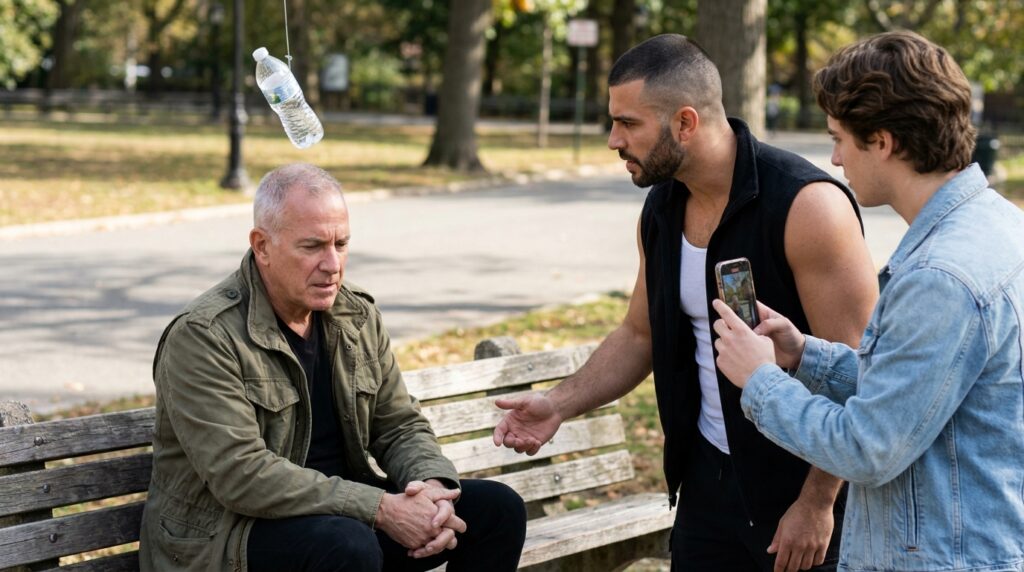
The voice was too loud, artificially clear, pitched for the microphone array of the phone held three feet to the right. The air in the municipal park smelled of dry pine needles and stagnant pond water, a heavy, desaturated heat that seemed to stick to the weathered fabric of Arthur’s olive field jacket. Arthur didn’t look up immediately. He kept his eyes fixed on the cracked concrete beneath the park bench, tracing a jagged line where a stubborn weed had forced its way through the aggregate.

The primary aggressor leaned closer, his shadow falling directly across Arthur’s knees. The black sleeveless vest he wore smelled of synthetic laundry detergent and stale sweat. He shifted his weight, his boots grinding a small pebble into dust. Above them, suspended from a low-hanging oak branch by a length of clear monofilament fishing line, a plastic water bottle swayed gently in the humid breeze. It was a crude mechanism, a cheap setup designed to drop and startle an old man for the amusement of a digital audience that existed only as numbers on a screen.

“I asked you a question, old man,” the voice came again, sharper this time, probing for the micro-expression that would validate the stream. “You think you can just put your hands on people out here?”

Arthur’s hands remained flat near his knees. Against his left wrist, the dead weight of his mechanical watch felt cold, a static block of stainless steel with a deeply scratched crystal face. The internal balance wheel had stopped ticking eight years ago, but he still wore it every morning. It was a silent ballast against the heat rising in his chest. His posture was deliberately small, narrowed to suggest a vulnerability he didn’t possess. He was calculating the distance between the aggressor’s lead boot and the iron frame of the bench—exactly twenty-two inches.

The younger man with the phone laughed, a thin, detached sound that didn’t match the heavy silence of the clearing. There were no other witnesses. The municipal park was wide, desaturated under the gray afternoon sky, its distant pathways empty.

Arthur drew a slow, deliberate breath through his nose, filtering the smell of iron and dry earth. He felt the specific friction of his black shirt against his shoulder blades as his muscles compressed. The restraint was a physical pressure, a domestic boundary he had spent a decade fortifying with gardening tools, grocery receipts, and quiet television sets at dusk.

“Look at the camera when I’m talking to you,” the bearded man commanded, his hand moving toward Arthur’s collar, the fingers curved like a claw.

The movement was inefficient. It lacked the economy of someone who understood what happened when skin met bone at high velocity.

Arthur rose. He didn’t scramble or lunged; he simply corrected his posture, his solid frame unfolding from the wooden slats with the heavy momentum of a counterweight. The physical space around the bench compressed instantly. Before the bearded man’s hand could close on fabric, Arthur’s left palm struck the inside of the man’s forearm, clearing the interaction lane with a dull, wet slap. His right heel drove downward into the arch of the lead foot, anchoring the aggressor to the concrete while his shoulder shifted into the man’s chest.

It took less than three seconds. The bearded man hit the ground first, his breath escaping in a sharp, guttural whistle as his spine met the dirt. The phone-wielding accomplice didn’t even have time to lower his arm before Arthur’s hand closed around the plastic chassis of the device, twisting it cleanly from the slim fingers with a short, metallic snap of the casing. The young man stumbled backward, his denim jacket scraping against the rough bark of the oak tree as he collapsed beside his partner.

Arthur stood composed over them, his pulse steady beneath the dead watch. The gravelly texture of his voice felt foreign even to his own ears as he broke his long silence. “You crossed the line. Back away now.”

The primary aggressor was clutching his ribs, his mouth open but silent, his eyes wide with the sudden, disorienting realization that the elderly target had evaporated. The accomplice remained frozen, his empty hand still shaped around a phone that was no longer there.

Arthur didn’t wait for a reply. He dropped the cracked device onto the gravel, his boot heel coming down once with a heavy, administrative crunch that pulverized the lens module. “We’re done here. Leave.”

He turned away from the bench, his olive jacket rustling slightly as he set his pace toward the western exit of the park. His hands went back into his pockets, fingers brushing against the cold ridges of his apartment key.

He didn’t look back until he reached the perimeter fence, where the desaturated asphalt of the street began. On the lower rail of the chain-link gate, partially obscured by a rusted bolt, a small piece of blue surveyor’s tape had been tied in a double knot—the exact marking he had removed from his porch railing three days ago.


CHAPTER 2: THE ANCHOR CABLE SNAPS

The key didn’t turn because the lock cylinder had already been pushed three millimeters past its housing. Arthur kept his thumb flat against the cold, pitted brass of the deadbolt, feeling the slight rattle of loose pins inside the mechanism. The scent of rain-wet asphalt behind him mixed with something metallic and immediate—the sharp, unmistakable smell of oxidized iron where a crowbar had chewed through the green weather-stripping.

He didn’t pull his hand back. A withdrawal was an admission of panic, a variable that changed the spatial equation of the landing. Instead, he allowed his weight to lean forward, using the bulk of his shoulder to press the swollen oak door into the frame until the fractured latch clicked open.

The apartment was dark, save for the desaturated gray light cutting through the kitchen window from the alleyway. The air inside smelled of linoleum, cabbage, and the cold, static dust of a room that had remained undisturbed for months. But the rhythm of the space was wrong. A single sheet of yellowed newspaper, used to line the boot tray near the threshold, had been kicked two inches to the left, its edge curled back like a dead leaf.

Arthur stepped into the narrow hallway, his boots making no sound on the worn wool runner. His right hand remained in his jacket pocket, his fingers curled loosely around his keys, using the heavy brass rings as an improvised knuckle-weight. He didn’t look for a weapon; the flat-rimmed cast-iron skillet on the stove or the heavy glass salt cellar on the counter were variables, and variables took time to calculate. His mind was already rendering the floor plan as a series of tight intersection lanes.

The small kitchen counter was clear, except for a square shape resting precisely between the toaster and the bread box.

It was a smartphone. The glass screen was a spiderweb of silver fractures, the identical impact pattern Arthur’s boot heel had delivered to the gravel twenty minutes prior. The younger accomplice’s device had been harvested from the park, cleaned of dirt, and placed in the exact center of Arthur’s domestic perimeter. The display was dead, black and reflective, but as Arthur approached, the haptic motor inside the chassis gave a brief, mechanical buzz that vibrated against the Formica.

A single line of text illuminated beneath the shattered glass. It wasn’t a social media notification. It was an encrypted network link, followed by a localized seven-digit string—his old employee identification number from the salt-reclamation facility at Blackwood Estuary.

Arthur’s gaze remained flat. The watch on his left wrist felt heavier now, an inert bracelet of cold iron that seemed to drag at his forearm. The number on the screen belonged to a dead man; it had been buried fifteen years ago beneath three hundred pages of non-disclosure clauses, insurance waivers, and a monthly wire transfer that arrived from a blind trust in Delaware. That money bought the silence. It bought the green field jacket, the flour in the pantry, and the right to sit on a park bench without a past.

The phone buzzed a second time. The text vanished, replaced by a fresh transmission from an unlisted area code.

The footage has an executive buyer, Arthur. You haven’t lost your stride.

The subtext was loud enough to fill the small kitchen. The interaction in the park hadn’t been an accident of the algorithm; it had been a proximity test. The two younger men were merely the grease on the tracks, low-level operators used to draw out a specific physical reflex that could be cross-referenced against an old corporate database. The predatory digital subculture wasn’t the antagonist—it was the cover.

Arthur reached out and picked up the broken device. The plastic casing felt greasy against his palm, carrying the residual heat of a lithium battery that had been forced to run an unindexed background script. He didn’t check the call history. He knew the software architecture; it was an old corporate communication loop that used localized relays to mask the origin point. The private security firm that handled the post-incident containment at Blackwood fifteen years ago used the exact same three-node encryption setup.

He walked to the window, his eyes scanning the alley below. A rusted delivery van was parked by the dumpsters, its engine idling with a low, wet rumble that shook the exhaust pipe. A single man sat in the passenger seat, the glow of a dashboard tablet illuminating the sharp angle of a jawline that Arthur recognized from a different lifetime—a lifetime of corporate non-disclosure and buried cement trucks.

The van didn’t move. It was an anchor, a physical reminder that the perimeter was no longer his own. Arthur watched the exhaust smoke rise into the desaturated gray air, his thumb pressing into the shattered glass of the phone until the screen went dark forever, the slivers of crystal biting small, clean crescents into his skin.

CHAPTER 3: THE UNINDEXED BRIDGE

The delivery van remained fixed against the grease-stained bricks of the alleyway, its tailpipe puffing synchronous white plumes into the rain. Arthur lowered the generic plastic blind with one finger, the thin slats clicking like brittle bone against the flaking white enamel of the frame. The weight of his stopped wristwatch seemed to intensify, its static iron case pressing directly over the radial artery in his left wrist.

He moved away from the glass. The kitchen was cold now, the heat leaking through the compromised deadbolt at the front door. He didn’t activate the overhead bulb; the yellow glare would reveal his positioning to the passenger in the van. Instead, he pulled an old, gray-cased terminal from the utility closet behind the water heater—an obsolete corporate asset he had salvaged from the Blackwood facility before the concrete trucks poured into the primary sump.

The terminal’s cooling fan groaned as it spun up, smelling of hot copper wire and old circuit solder. The display hummed with a low green phosphorus glow that flickered across the deep lines of Arthur’s face. He attached the shattered smartphone to the terminal’s serial interface using a stripped copper jumper wire.

The interface didn’t list a standard data directory. Instead, the monitor began parsing an unindexed network bridge, a raw machine-language stream that bypassed the regional telecommunications network entirely. It was a proprietary pipeline, a localized fallback frequency reserved for corporate security audits when a liability leak became unmanageable.

A red warning marker began pulsing in the center of the green screen.

Arthur’s fingers moved across the heavy mechanical keys, the plastic caps pitted from years of storage. He didn’t type his name; he entered the seven-digit identification sequence that had appeared on the shattered display downstairs.

The system didn’t show a personnel file. It opened a log of digital queries executed over the last forty-eight hours from a terminal located less than three miles away—inside the county clerk’s office. Someone had used an old administrative master key to pull the deed to his apartment, his utility consumption records, and the vehicle registration for the truck he had sold three years ago.

But the final line on the log didn’t belong to a researcher or a rogue private investigator. It was an automated system flag: SETTLEMENT REVIEW STATUS: BREACH DETECTED.

Arthur’s hand remained suspended over the keyboard, his knuckles pale beneath the gray hair on his fingers. The decoy secret was clear on the monitor—the security firm had tracked his identity through the viral footage to check if he had violated the public conduct clauses of his retirement contract. They were treating him like a rogue asset who had gone noisy in a public park.

But the logic didn’t resolve. A regional security firm didn’t maintain an unindexed bridge to an inactive corporate terminal just to claw back a retirement stipend. The volume of data passing through the node was too massive; the green numbers on the screen were shifting rapidly, calculating localized variables that had nothing to do with a physical altercation on a park bench.

The screen flickered violently. A new system dialogue opened, overwriting the log files with a diagnostic report from the Blackwood Estuary containment site—a report dated from that morning. The pressure readings inside the concrete-sealed primary sump were dropping.

The realization hit him not as an abstract thought, but as a physical tightening in his gut. The security firm hadn’t bought the park footage to identify him; they already knew exactly where he lived. They had staged the interaction at the park to verify if his physical reflexes were intact, to see if the older man who had sealed the failure fifteen years ago was still capable of containing what was currently breaking through the concrete below the estuary.

The terminal’s cooling fan gave a sudden, high-pitched whine as the machine-language stream abruptly terminated. The green phosphorus screen went completely black, leaving only a single line of static text at the top edge.

Containment compromise confirmed at 04:00. The asset is required to report.

Outside, the idling rumble of the delivery van cut out completely. The sudden absence of the engine sound left the alleyway entirely silent, save for the rhythmic dripping of rain against the iron fire escape outside Arthur’s kitchen window. A heavy, administrative click echoed from the staircase hallway—the sound of the main building door being unlocked from the street level.

CHAPTER 4: THE RESIDUAL PAYLOAD

The click of the ground-floor latch traveled up the uncarpeted riser pipes, a dull, metallic shudder that rattled the loose iron collar where the heating line met the kitchen linoleum. Arthur stood motionless in the phosphorus-dimmed gloom of the kitchen, his solid frame aligned perfectly behind the structural partition of the refrigerator. His hands came out of his pockets. The heavy brass keyring went onto the counter with a silent, deliberate placement; a loose tool was an unpredictable variable in a confined hallway.

Footsteps began. They were heavy, unhurried, the rubber-soled compression of tactical boots climbing the wooden steps with a rhythmic, measured cadence that intended to be heard. Two men. The spacing between the steps indicated standard separation—six feet—allowing the lead observer to clear the landings while the rear man maintained a covering angle on the vertical shaft.

Arthur looked down at the floor. A single shard of the accomplice’s smashed smartphone lens module remained near his boot, catching the dull green wash of the dying terminal monitor. His world had shrunk to this: twenty-four feet of interior hallway, an oil-stained field jacket, and a sixteen-ounce steel-headed framing hammer resting in the drawer beneath the silverware tray. The thirty-year retirement had been a layer of dry paint over an old hull, and the water was finally coming through the timber.

The footsteps stopped outside the door frame.

There was no knock. No administrative warning. A thin, black carbon-fiber probe slipped through the gap where the crowbar had warped the weather-stripping, its optical lens rotating sixty degrees to scan the dark hallway. Arthur didn’t move to smash it. He remained in the dead-space behind the plaster wall, his breath dropping to an efficient, sub-vocal rhythm that barely registered against the static silence of the apartment.

The door didn’t yield to a kick. A key—a corporate master duplicate minted from the same brass alloy as his own—slid into the cylinder. The lock pins dropped into the sheared line with a sound like a single dry knuckle cracking.

The door swung inward, dragging the broken plastic security tag across the floor with a low hiss. The passenger from the van stepped through first. He was younger than Arthur, but his build carried the same thick, industrial symmetry—broad clavicles, close-cropped hair with early silver at the temples, and a gray canvas field coat that bore no insignia or corporate labels. He didn’t have a weapon drawn; his right hand was hooked into his utility belt, fingers inches from a high-tensile zip restraint.

He stopped three feet into the hallway, his eyes fixing precisely on the corner where Arthur’s shadow should have been if he had remained near the door.

“The sump at Blackwood is at sixty-four percent capacity, Arthur,” the man said. His voice was flat, dry, carried with the heavy, uninflected cadence of an inspector reading a maintenance log. “The concrete didn’t hold. The salt-reclamation valves failed at four this morning. The settlement money is done.”

Arthur stepped out of the kitchen lane, his movements deliberate, unhurried. He didn’t assume a defensive stance. He stood upright beside the linoleum threshold, his solid build catching the gray alleyway light from the kitchen window. The iron watch on his wrist felt colder now, a static dead-weight against his skin.

“You deployed the two boys in the park,” Arthur stated. It wasn’t an interrogation; it was a verification of the logistics.

The man from the van didn’t deny it. He looked at Arthur’s hands, noting the absence of a weapon, then looked at the floor where the broken phone casing lay. “We needed to see if the reaction time was still within the thirty-second threshold. If you had scrambled, or if you had let them take the jacket, we would have signed the medical waiver and let the trust fund expire. But you cleared the bench in less than three. You’re still stable enough for the payload.”

The second man remained on the landing, his shadow bisecting the doorway, his arm extended down toward his hip where a radio transmitter gave a brief, encrypted click.

The true architecture of the trap resolved itself with the cold, administrative finality of a foreclosure notice. The non-disclosure contract hadn’t been a shield to protect him from the world; it had been an inventory hold. They had paid him for fifteen years to remain static, to preserve his body and his reflexes in a small apartment on the edge of town until the structural patch they had poured over the Blackwood disaster inevitably decayed. The settlement hadn’t been an exit; it was an extended shift with a deferred clock.

Arthur looked past the man’s shoulder, out through the open door toward the rusted iron handrails of the stairwell. The air coming up from the street smelled of brackish river water and wet limestone, a heavy, chemical scent that had lived in the back of his throat since his thirty-fifth year. His ordinary life—the tomatoes on the sill, the daily walk to the park bench, the silent accumulation of ordinary receipts—was simply an illusion maintained by a private security ledger that had just been balanced to zero.

“The truck is downstairs,” the man said, stepping back into the doorway to clear the exit lane. He reached into his coat and produced a fresh, unmarred steel wristwatch, its face ticking with a crisp, mechanical pulse. He placed it flat on the hall table beside Arthur’s brass keys. “Your old locker is still on the barge. Let’s go.”

Arthur didn’t touch the new watch. He looked down at his left wrist, at the deep, permanent scratch across the dead crystal face of the iron casing he had worn through fifteen years of silence. The balance wheel inside remained frozen, but the internal friction had finally stopped mattering. He pulled the kitchen door shut behind him, the latch clicking home with a dry, metallic resonance that signified the absolute end of the perimeter.

CHAPTER 5: THE DESATURATED LINE

The latch clicked, and the narrow hallway died.

Arthur did not look back at the heavy oak door as it settled into its warped frame. He descended the stairs one half-pace behind the man in the gray canvas coat, his boots falling into the worn hollows of the timber with a heavy, deliberate rhythm. The air in the stairwell grew colder with every riser, losing the faint, domestic smell of fried cabbage and taking on the raw, wet humidity of the street-level vestibule.

Outside, the rain had turned into a fine, gray mist that hung between the brick buildings like smoke. The delivery van waited by the curb, its side panels covered in streaks of dry highway salt from some distant northern run. The passenger door was already unlatched, vibrating slightly against its rubber dampeners.

Arthur climbed into the cab. The interior smelled of old coffee grounds, damp floor mats, and the sharp, chemical tang of unrefined diesel exhaust. He did not fasten the seatbelt immediately; his left arm remained flat against his flank, his fingers naturally finding the space between his hip and the seat bolster where a weapon would have sat if he were still on the company payroll.

The driver—the man with the sharp jawline Arthur had observed from the kitchen window—put the vehicle in gear before the door had fully clicked into the lock. The transmission whined in reverse, a high, metallic protest that echoed off the damp bricks of the alleyway, before the van lunged forward onto the desaturated asphalt of the avenue.

“The bridge at the river is closed for maintenance,” the driver said. He did not turn his head; his eyes stayed locked on the sweep of the wiper blades across the glass. “We’re taking the old commercial route past the tanneries.”

The man in the gray coat sat in the jump seat behind them, his boots scratching against a corrugated steel tool box. “The tanneries are dead, Miller. The county tore down the culverts three winters ago.”

“The gravel path is still clear enough for the axles,” Miller replied.

Arthur looked out the passenger window. The city was thinning out, its brick storefronts giving way to low, cinderblock warehouses and chain-link compounds where rusted machinery sat under tarps. The dead wristwatch against his skin felt like a lead weight, its frozen balance wheel a silent contrast to the crisp, rhythmic ticking of the new timepiece he had left on the hallway table. They had wanted him to take it. The watch was a token, a small piece of corporate property meant to signal the reinstatement of his schedule. Leaving it behind was his only remaining luxury.

“Who authorized the proximity test in the park?” Arthur asked. His voice was low, gravelly, competing with the wet hum of the tires against the road.

The man in the back did not answer immediately. A heavy canvas gear bag shifted against the steel toolbox as the van bounced across a deep pothole in the asphalt. “The evaluation came from the regional office, Arthur. You know how the insurance underwriters operate after an infrastructure shift. They don’t take the word of a fifteen-year-old ledger. They wanted eyes on the asset before they signed the mobilization order.”

“The two boys weren’t investigators,” Arthur said. “The slim one didn’t know how to hold his weight. His shoulder was forward before he even started the video.”

“They were local talent,” Miller said from the driver’s seat, his thumbs hooked over the steering wheel. “Cheap. Disposable. The kind of people who think everything that happens in a public square is a game for an audience. If you had broken the bearded one’s neck, the county would have called it an old man’s panic and buried the police report in the regional archive. But you didn’t. You kept the leverage localized. That’s what the underwriters paid to see.”

The van turned off the hardtop, the tires dropping onto a packed gravel track that ran parallel to the old industrial drainage canal. The water in the ditch was thick, grey, covered in a yellow foam that gathered around the wooden pilings of the abandoned processing docks. In the distance, rising through the mist like the ribcage of a dead whale, the high steel superstructure of the Blackwood Estuary barge began to resolve against the horizon.

Arthur watched the silhouette grow. The three hundred monthly wire transfers from the Delaware trust had felt like an escape, but as the van’s suspension bottomed out against the wet gravel, he realized the distance had never changed. He had spent fifteen years walking around a square park bench, but the circle had always been anchored right here, in the salt mud where the concrete met the tide.

CHAPTER 6: THE BLACKWOOD INTAKE

The tires hit the corrugated iron decking of the main gate with a sharp, repeating rattle that jarred the steering column. Miller tapped the brakes, the brake pads squealing with a high, metallic pitch against the rusted drums. Outside, the chain-link perimeter fence was choked with river debris and yellow foam from the estuary flats, its lower section reinforced with fresh concrete barriers that looked wet under the fine gray mist.

Arthur kept his right hand balanced against the door armrest, his skin recording the precise vibration of the diesel block as the vehicle cleared the guard post. The post was empty, its glass windows cracked and patched with heavy silver duct tape. There were no municipal police vehicles, no environmental agency decals on the utility trucks parked along the levee. The personnel standing in small groups near the pump house wore the same desaturated gray field coats as the man in the jump seat.

The van rolled to a stop beside a low-slung containment dike built from salt-crusted limestone blocks.

“The secondary reservoir is rising six inches an hour,” the man in the gray coat said, leaning forward between the front seats. His hand reached past Arthur’s shoulder to tap the glass, pointing toward a line of three submerged valves near the water line. “The pressure gauges on the primary cap aren’t registering the shift. The system thinks the volume is static.”

Arthur unlatched the passenger door, the damp sea air hitting him with a cold, chemical sting that immediately cleared the stale smell of coffee from his nose. The ground beneath his boots was a slick slurry of gray mud and crushed limestone gravel. He stood upright, his olive field jacket absorbing the fine drizzle, his eyes automatically panning across the concrete infrastructure he had helped bury fifteen years ago.

The facility had grown older in his absence, its edges rounded by the aggressive salt air, its iron fittings weeping thick orange tracks down the gray vertical faces of the sumps. But the layout remained identical. The architecture of a cover-up didn’t change with time; it merely hardened.

Miller stepped out from the driver’s side, swinging a heavy iron valve wrench down by his hip. “The contract team tried to drop an auxiliary plug into the lower intake at midnight, Arthur. The line rejected the seal. The back-pressure blew the seals out of the primary manifold.”

Arthur walked toward the edge of the limestone dike, his boots sinking two inches into the salt mud. He did not look at the rising water; he looked at the concrete seam where the reservoir met the bedrock. A fresh line of bright yellow industrial wax had been smeared across the auxiliary drainage conduit, its surface pristine, unmarred by the gray silt that coated everything else in the compound.

The micro-mystery was tiny, a localized detail that would have escaped anyone who hadn’t designed the internal baffle system. The wax wasn’t there to seal a leak; it had been applied to keep a mechanical sensor from registering a manual bypass.

“The underwriter didn’t order the proximity test because of an insurance review,” Arthur said, his voice level, gravelly, catching the sharp hum of the drainage pumps behind the levee. He did not turn to look at Miller or the man from the van. “The test was meant to ensure I wasn’t already talking to the group that applied that wax.”

The man in the gray coat stepped up beside him, his boots crunching on the wet limestone. His hands remained tucked into his deep pockets, his posture relaxed but positioned precisely to block Arthur’s route back toward the van. “The footage from the park went to a private server in Munich four minutes after it was uploaded, Arthur. The people who bought it weren’t looking at your reaction time. They were verifying that the original project engineer was still within the state line before they initiated the final pressure spike.”

The decoy of a simple structural failure or a disgruntled corporate rival dissolved into the gray mud. The prank in the park, the muscular aggressor with the sleeveless vest, the shattered phone on the counter—they weren’t part of an exposure channel or an insurance audit. They were the opening moves of a coordinated asset liquidation. The competitor hadn’t hacked the network; they had bought the old blueprints and were using the viral distraction to force the security firm to bring the one man who could open the primary sump directly into the kill zone.

Arthur looked down at his left wrist, at the scratched, inert watch face that had recorded fifteen years of dead time. The machinery below the estuary wasn’t just leaking; it was being driven toward a catastrophic venting cycle by a manual override he had hidden in the primary control block in 1996.

“You have twenty minutes before the lower manifold reaches critical stress,” Miller said from behind them, his fingers tightening around the cold iron handle of the valve wrench. “The barge keys are in the locker, Arthur. Let’s go down.”

Arthur did not answer. He turned his face toward the dark mouth of the subterranean intake tunnel, where the smell of sulfur and old concrete rose from the wet dark like a cold exhalation from a tomb.

CHAPTER 7: THE GROUNDED CORE

The darkness inside the intake tunnel swallowed the gray drizzle of the estuary within five paces. Arthur walked down the thirty-degree incline, his boots splashing through three inches of stagnant, alkaline water that left a white, powdery salt ring on the leather with every step. Behind him, the beams of Miller’s tactical flashlight cut through the suspended limestone dust, casting two long, distorted silhouettes against the curved corrugated liners.

The air here didn’t circulate. It was thick with the weight of subterranean compression, heavy with the sharp, rotten-egg stench of unrefined hydrogen sulfide and the wet, chalky odor of decaying concrete.

“The primary block is at the end of the lower cat-walk,” the man in the gray coat said, his voice echoing off the curved steel plates with a hollow, tinny rattle. He stayed three paces to Arthur’s left, his arm slightly extended to guide the older man toward the iron ladder that dropped into the main sump. “The pressure valves are cycling every ninety seconds now. The manual bypass won’t register our authority.”

Arthur did not look at the ladder. He stopped at the edge of the iron platform, his fingers lightly brushing the wet, rusted handrail. Below, the primary reservoir resembled a black, oily eye, its surface lifting and falling in rhythmic, unnatural lunges as the gas pockets from the salt flats escaped through the lower vents.

The machinery was dying. It was a massive, five-hundred-ton assembly of pumps, filters, and high-pressure gaskets that Arthur had bolted into the bedrock in 1996, and every mechanical vibration traveling through the floor plates felt like a direct pulse against the soles of his boots. He knew the tolerance of every flange. He knew the specific frequency the main shaft emitted right before the primary seal fractured.

He stepped down onto the catwalk, the iron bars grooving into the rubber soles of his boots with a raw, scraping friction.

He reached the primary control block—a heavy cast-iron vault bolted directly into the concrete bulkhead. The gray enamel paint had long since flaked away, replaced by a thick crust of orange iron oxide that came off in dry, brittle wafers under his thumb. The manual override lever was there, a three-foot bar of solid forged steel that should have been locked in the vertical position by a heavy brass securing pin.

The pin was missing. The drilled hole where it should have sat was empty, lined with a fresh streak of black graphite grease that hadn’t yet been fouled by the ambient limestone dust.

“The pin didn’t shear,” Arthur said. He did not turn around to face the flashlights. He left his palm flat against the cold iron of the override lever, feeling the massive mechanical strain building inside the valve chamber behind the wall. “Someone pulled it from the inside before the pressure spike was initiated.”

The light behind him didn’t shift. Miller’s silhouette remained static against the tunnel exit, his shoulder blocking the iron ladder. “The underwriters didn’t just want to see if you could still handle a physical threat, Arthur. They wanted to ensure you would come down here without calling the state authority. The competitor didn’t buy the old blueprints from an archive. They bought them from your old retirement trust.”

The ultimate final truth did not arrive with a dramatic reveal; it settled into the sump room with the cold, administrative permanence of mud. The Delaware trust fund hadn’t been an anonymous settlement paid by a remorseful corporation to buy his silence. It had been an options contract. The private security firm and the competitor were the same entity, two arms of a single liquidation network that had spent fifteen years monitoring his health, his location, and his pulse via a quiet municipal park bench. They didn’t need him to repair the failure; they needed his specific signature on the manual logs to clear the insurance indemnity before the entire facility was flooded with salt water to bury the trace of the 1996 containment breach permanently.

The park bench had never been an escape. It had been the holding pen.

“The log book needs the mechanical stamp, Arthur,” the man in the gray coat said, his hand finally coming out of his pocket to present a heavy, rectangular brass die with Arthur’s old employee number engraved into the face. “Stamp the compliance log and we go back to the avenue. The trust fund stays active. You can go back to the bench by tomorrow afternoon.”

Arthur looked down at the brass die. In the black water below the catwalk, the reflection of the terminal lights flickered like dying stars. The choice wasn’t between his past life and his retirement; the retirement had merely been the final, most sophisticated cage they had built for him. If he stamped the log, the concrete below the estuary would be blown, the salt mud would swallow the evidence of the old dead men under the sump, and he would be allowed to sit on his wooden slats for another ten years until his heart stopped ticking like his old watch.

His hand closed around the forged steel override lever.

He didn’t pull it down to close the valve. He drove his weight backward, his solid frame slamming into the man in the gray coat with the same explosive, unhurried economy of force he had used in the park clearing. The flashlight went spinning into the reservoir, its beam cutting a wild, vertical arc through the dark before the black water swallowed the lens with a dull, heavy slap.

In the sudden, phosphorus-dimmed shadows of the vault room, Arthur didn’t move toward the exit lane where Miller stood with the iron wrench. He reached into the dark core of the control block, his fingers finding the greasy, exposed gears of the manual bypass, and tore the master timing chain from the sprocket with a single, administrative yank that shattered the internal alignment pins.

The machinery gave a long, descending scream of tearing iron as the main shaft seized within its housing, locking the primary sump forever and trapping the three men beneath five hundred tons of unyielding, salt-crusted concrete. Arthur stood still against the vibrating bulkhead, his left hand flat over his dead watch, listening to the absolute silence that followed the snap of the iron line.

Similar Posts

Leave a Reply

Your email address will not be published. Required fields are marked *






