
The Quiet Architecture of Shared Scars and the Scent of Zinc on an Autumn Afternoon

CHAPTER 1: THE WEIGHT OF THE HINGE

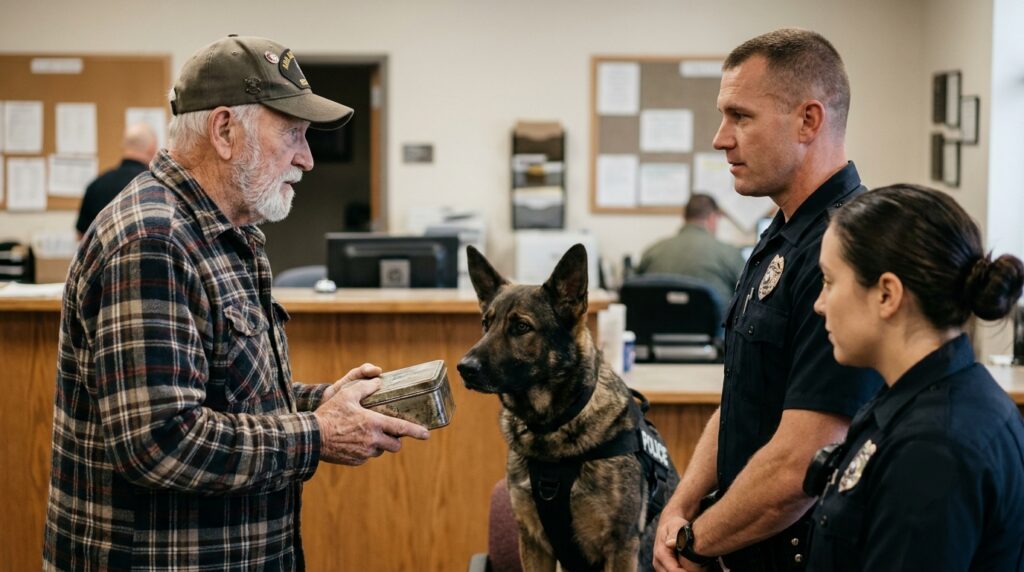
“I never thought I’d see something like this again,” the old man said, his voice scraping against the quiet of the linoleum floor like dry leaves.

The metal keepsake tin sat in his palms, its zinc edges grayed and dulled by decades of skin oil. It wasn’t large—no bigger than an old tobacco box—but his hands shook hard enough under its weight that the small hinges rattled.

Behind the high laminate counter of the reception desk, the young officer didn’t move toward his holster, but his shoulders went tight. He looked at the veteran’s cap, the faded embroidery of an auxiliary unit long since deactivated, and then down at the German shepherd sitting at his heel. The dog’s ears had gone entirely flat against its skull, its nostrils flaring as it pulled in the air coming off the opened box.

“Sir,” the lead officer said, taking a single half-step backward into the command lane. “You can’t just open unvetted containers in the lobby. We have a protocol for property drop-offs.”

“It’s not property,” the old man whispered. He didn’t look up. He didn’t look at the institutional blue walls, or the missing-persons flyers pinned to the corkboard, or the second deputy watching from the secure door. His eyes stayed on the dog. “It’s a signature.”

The German shepherd didn’t whine. It gave a short, rhythmic huff, its heavy leather harness creaking as it leaned its weight away from the officer’s leg. The handler pulled back slightly on the short lead, but the animal’s chest plowed forward, its front paws sliding an inch across the polished floor toward the old man’s work boots.

Then, the old man went down. It wasn’t a fall, but a slow, creaking collapse of his knees, his plaid shirt bunching around his belt as he lowered his torso to the level of the dog’s muzzle. The tin remained held out like an offering, the small square of metal bridging the space between them.

“Karl,” the officer commanded, his voice dropping into a sharp, low register. “Stay.”

The dog ignored him. The German shepherd pressed its thick, black-and-tan snout directly into the center of the old man’s chest, pushing past the metal box until its forehead rested beneath the veteran’s white beard. The old man’s arms closed around the dog’s neck, his fingers burying deep into the coarse winter coat. A wet, shuddering breath tore out of the old man’s throat, leaving a smear of dampness on the dog’s tactical harness.

The desk officer stepped out from behind the glass partition, her boots making no sound on the floor. She looked at the lead officer, her face settling into a hard, protective stillness that didn’t match the sudden twitch in her jaw. “Jesse,” she murmured. “Look at the dog’s tail.”

The animal wasn’t wagging. It was trembling, its rear legs locked in a rigid stance as if bracing the old man’s entire weight against the floorboards.

The lead officer looked down at the tin that had slipped from the veteran’s fingers. It lay open on the floor, its interior dark save for a single scrap of green webbing and a small, hand-stamped brass collar tag bearing a serial number that predated the county’s digital registry by forty years. But beneath the brass tag, wedged into the rusted corner of the box, was a folded piece of yellowed parchment with the lead officer’s own late father’s signature dried into the ink.


CHAPTER 2: THE ANOMALY LOG

The scrap of yellowed parchment drifted onto the gray linoleum, settling beside the zinc tin with a faint, brittle scrape.

Jesse did not breathe. His boots felt glued to the floorboards as he stared down at the handwriting. The loops of the letters were wide, aggressive, and instantly familiar—the exact shorthand his father had used on the margins of old training manuals stacked in their family garage. It was a signature that had been buried three years ago under six feet of damp creek-bed soil, yet here it was, resting against the paw of a county-owned asset that was currently defying every line of its tactical conditioning.

“Jesse,” Desk Officer Miller said again, her voice dropping into that low, dangerous register used when a domestic call turned sideways. She didn’t reach for her belt, but her hand stayed flat against the laminate counter, anchoring her. “The dog isn’t responding to the clicker. He’s fully anchored.”

The old man didn’t look up at them. His fingers were still buried in Karl’s thick ruff, his forehead pressed so tightly against the animal’s shoulder that the white hairs of his beard mingled with the dog’s black-and-tan coat. “He smells the grease,” the veteran murmured, his chest hitching against the dog’s ribs. “The whale oil and the zinc. We used it to seal the seals on the casing. Every time the pressure dropped in the hold, the grease would sweat. You don’t forget that smell. And neither do they.”

“Sir,” Jesse said, his throat dry as flannel. He knelt down, his uniform trousers tightening against his thighs as he reached for the paper. His fingers brushed the edge of the parchment—it felt thin, greasy to the touch, carrying the faint, sweet stench of rancid lard and old iron. “My father ran the K9 unit for twenty-five years before he retired. He didn’t work naval auxiliary. He was county sheriff. There’s no reason his name should be inside a private keepsake container.”

The old man let out a small, wet laugh that turned into a cough. He finally peeled his face away from Karl’s fur, though his left hand remained hooked into the dog’s harness, his thumb rhythmically smoothing down a frayed nylon seam near the buckle. “Your father didn’t build the program out of nothing, son. He took what was left of the border patrol tracking stock after the mid-seventies drawdown. He bought three barks from the federal surplus in Texas. He wanted dogs that could trail through swamp water without losing the line.”

Jesse turned the parchment over. The text on the reverse wasn’t an official document; it was a single leaf torn from a standard-issue ledger book, the blue lines faded to a ghostly gray. Written across the top in his father’s hand were three words: Subject Number Four. Below it, a list of dates spanning three months in the winter of 1984, each followed by a single metric note: Refusal. Refusal. Signal match only.

“Jesse,” Miller said, her voice closer now. She had moved around the counter, her eyes scanning the lobby glass to ensure no civilians were watching the precinct’s primary tracking dog lying on the floor like a family pet. “We have a transport arriving from the district court in twenty minutes. If the supervisor sees Karl out of his kennel with an unverified civilian, it’s an automatic infraction. For both of us.”

“Just give me a minute, Sarah,” Jesse said, his eyes scanning the ledger entries. The tracking logs didn’t make sense. His father’s reputation had been built on absolute procedural perfection; the dogs he trained were machines that followed skin rafts and crushed grass until the target was caught. But these entries described a dog that kept breaking the line, stopping at specific, unmarked coordinates in the pine woods to circle old foundations.

He looked at Karl. The German shepherd’s eyes were wide, dark, and focused entirely on the tin. A small bead of saliva hung from its jowl, dripping onto the zinc surface. The animal wasn’t acting aggressive; it was acting reverent, its entire body vibrating with a quiet, sub-vocal hum that Jesse had never heard in all their hours of active deployment.

“My father didn’t keep duplicates of these logs,” Jesse muttered, his thumb tracing the frayed edge of the paper. “The department records from ’84 were supposedly lost in the municipal yard fire.”

“They weren’t lost,” the old man said, his voice stabilizing as he gripped the edge of a heavy oak desk to pull his lean frame back into a seated position on the floor. His eyes were milky at the edges, filmed with cataracts, but they held Jesse’s gaze with an unsettling weight. “They were quarantined. Your father knew what happened to the handlers who used the old scent markers. He knew why the stock kept coming back to the same three miles of riverbank near the old zinc plant. He didn’t destroy the records, officer. He hid them because if the state found out the whole tracking line was compromised by an old industrial footprint, they’d have put the whole breed down.”

Before Jesse could reply, the heavy glass door at the front of the station rattled, the brass latch clicking open with a sharp, mechanical snap that made Karl’s ears instantly pop back into an alert vertical line.

CHAPTER 3: THE QUARANTINE ORDER

The brass latch clicked with the sharpness of a dry bone snapping.

District Supervisor Vance stepped into the reception lobby, his heavy canvas field coat smelling of damp pine needles and vehicle exhaust. He didn’t drop his keys onto the counter. He held them tight in his fist, his gaze sweeping over the scene on the linoleum floor with a calculation that took less than a second to turn cold. His eyes slid from Jesse’s kneeling posture to the old man on the oaken chair, finally anchoring on Karl’s harness, which was still pressed firmly against the veteran’s plaid sleeve.

“Officer Vance,” Jesse said, rising slowly to his feet while keeping his hand flat over the yellowed ledger sheet. The movement was a shield, but it wasn’t fast enough.

“Why is the active tracking asset out of the secure lane, Deputy?” Vance’s voice didn’t rise, but it carried the flat weight of an administrative hammer. He walked past the high partition desk without offering a greeting, his boots leaving dark, wet half-moons of river mud on Sarah’s clean floor. “And who authorized a civilian contact during a scheduled maintenance block?”

“The gentleman brought in a historical programmatic artifact, sir,” Sarah said from behind the desk, her fingers tapping a rapid, nervous rhythm against her logbook. “We were verifying a chain of custody regarding the old county kennel records.”

“There are no historical artifacts in this precinct,” Vance said. He stopped two feet from the old man, looking down at the white beard, the faded auxiliary cap, and then at the weathered zinc tin sitting between Karl’s front paws. “There is state property, and there is unverified debris. Pick up the box, Jesse.”

Jesse didn’t move. His thumb remained pressed against the greasy paper, feeling the small ridges of his father’s wide, sweeping handwriting. “My father signed this ledger page, Supervisor. It outlines tracking refusals from the winter of 1984. He was logging anomalies in the old bloodlines near the flats.”

Vance’s face didn’t twitch, but his grip on the car keys tightened until the brass edges dug into his knuckles. He looked at the paper under Jesse’s thumb, his eyes narrowing just enough to expose the gray skin around his temples. “Your father was a fine sheriff, Jesse, but his late-career notes are not county policy. The ’84 line was retired due to behavioral degradation. It’s a closed administrative matter. The papers in that tin are unclassified personal waste.”

“It’s not waste,” the old man said softly. He didn’t rise from the chair, but his hand moved from Karl’s neck to the dog’s leather collar, his ancient knuckles gray against the dark hide. “Your father knew me, Vance. He knew what we pulled out of the river when the old zinc works went under. He knew why the dogs wouldn’t cross the marsh behind the municipal yard unless they were following a specific wash. You’re covering a dead line because the county doesn’t want the liability of a contaminated tracking grid.”

“Sarah,” Vance said, ignoring the old man entirely, his voice cutting through the damp air like a blade through tallow. “Log a civilian trespass and clear the lobby. Jesse, take the dog back to the transport kennel immediately. The asset is scheduled for an operational evaluation at the river boundary in ten minutes.”

“Sir, the dog is showing a profound physiological response to the artifact,” Jesse said, his voice dropping into a hardened register. He lifted the ledger sheet, holding it out between himself and the supervisor. “Look at the signal matches. If Karl is reacting to an old training footprint rather than a real scent path, every deployment we’ve done in the northern sector for the last six months is legally compromised. If a defense attorney gets hold of these refusal logs—”

“I said the matter is closed,” Vance interrupted, his hand moving with a sudden, violent efficiency to snatch the ledger sheet directly out of Jesse’s fingers. He didn’t crumple it. He folded it once, slide-tucking it into the deep breast pocket of his field coat before reaching down to scoop the zinc keepsake tin off the floor.

Karl let out a low, guttural rattle from the back of his throat—not a tactical bark, but a warning click that made the hair along his spine stand up in a rigid ridge.

“The dog is unstable,” Vance muttered, taking a step back as his boots clicked against the linoleum. “He’s identifying with non-standard stimuli. That box is being checked into evidence storage under an administrative quarantine order. Deputy, if that animal isn’t in the back of the cruiser before I finish filling out the non-compliance form, I’ll have the regional vet pull his field certification by sunset.”

The old man looked up at Jesse, his milky eyes reflecting the harsh yellow glare of the overhead lights. There was no anger in his face, only a heavy, ancient exhaustion that felt older than the building itself. “He’s going to take it to the yard, son,” the veteran whispered. “Just like they did with the others.”

Vance turned his back to them, his heavy canvas coat rustling as he walked toward the secure rear exit. The metal tin made a dull, hollow thud against his hip as he moved, a sound that made Karl’s head whip toward the door with an intense, unblinking focus.

CHAPTER 4: THE PERMANENT ARRANGEMENT

The rear exit door clicked shut, the heavy pneumatic arm wheezing as it sealed the station’s recycled air inside. Outside, the gravel of the municipal yard was gray, wet, and desaturated under a sky the color of a bruised zinc plate.

Jesse didn’t wait for Sarah to finish filing the civilian non-compliance logs. He walked out into the cold air, his boots crunching heavily against the crushed limestone. Behind him, the old man moved with a fragile but unyielding persistence, his breathing heavy, his faded work shirt damp from the light mist hanging over the river boundary. Karl walked perfectly between them, the short lead slack, his thick head turned entirely toward the perimeter fence where Supervisor Vance’s vehicle was idling near the old equipment sheds.

“He’s going to burn it,” the old man said, his voice catching on the damp wind. “The ledger, the tag. Just like they buried the old tanks behind the foundry in ’84. If the soil maps get redrawn, the county loses the federal easement.”

“He won’t burn it,” Jesse said, though his hand rested on his service belt, his fingers tracing the cold leather casing of his flashlight. He knew Vance’s administrative logic; it wasn’t malice, it was the preservation of a system that couldn’t afford to look back. “He’s checking it into the secondary evidence locker by the old maintenance barn. That’s where the unverified files go to rot.”

They reached the rusted chain-link gate separating the precinct from the overgrown municipal flats. Twenty yards ahead, Vance was stepping out of his utility truck, the gray metal tin gripped in his gloved hand. He didn’t look back at them. He pushed open the creaking door of the corrugated iron shed—the original county kennel block, abandoned since the new digital facility was built on the south highway.

Suddenly, Karl stopped. The German shepherd didn’t bark, but a sharp, violent tremor ran through his entire frame. The animal’s nose lifted, catching a draft of air rolling off the river bank behind the sheds. It wasn’t the scent of an active human target; it was something buried deeper in the mud, a heavy, metallic tang that smelled exactly like the interior of the veteran’s keepsake tin.

“He knows it,” the old man whispered, his hand reaching out to steady himself against Jesse’s shoulder. His fingers were cold, stiff with arthritis, but his grip was surprisingly firm. “He isn’t tracking a scent, Jesse. He’s tracking an identity. The old dogs were trained on the industrial runoff because that’s what the draft evaders used to mask their boots in the marshes. Your father didn’t lose the line—he bred them to remember it.”

Vance froze in the doorway of the iron shed. The wind had shifted, throwing a thick plume of white steam from the municipal drainage pipe across the gravel. Karl broke. With a single, powerful surge that ripped the nylon lead directly out of Jesse’s hand, the dog sprinted toward the supervisor.

“Karl, abort!” Jesse shouted, his voice cracking against the iron buildings.

But the dog didn’t attack. He skidded to a halt three feet from Vance, his front paws digging into the wet river silt. He dropped his muzzle to the ground, his chest plowing into the weeds as he let out a long, mourning whine that echoed off the corrugated metal walls. He wasn’t acting as a weapon; he was acting as a witness.

Vance looked down at the dog, then up at Jesse and the elderly veteran who had managed to reach the edge of the enclosure. The supervisor’s hand remained inside his pocket, his fingers curled around the folded ledger sheet. The desaturated yellow light of the afternoon caught the rusted hinges of the iron shed behind him, revealing a row of old, hand-painted numbers on the concrete foundation—the remnants of the 1984 breeding pens.

“It doesn’t wash out,” Jesse said quietly, walking up to stand beside his partner. He reached down, his fingers burying into Karl’s wet fur, feeling the rapid, rhythmic thump of the animal’s heart. “You can delete the digital files, sir, and you can quarantine the physical tins. But the lineage carries the weight of what happened out here. My father knew it. That’s why he kept the tag.”

A long silence settled over the yard, broken only by the steady, low hum of the river water churning against the concrete pilings. Vance looked at the old man, whose thin shoulders were shaking under the damp plaid shirt, his eyes fixed on the metal box with a quiet, desperate reverence that no administrative protocol could ever codify.

Slowly, Vance withdrew his hand from his pocket. He didn’t hand the ledger back to Jesse. Instead, he dropped the zinc tin onto the hood of his utility truck, the metal giving a short, flat chime as it struck the steel.

“The asset stays on active rotation for the northern sector,” Vance said, his voice flat, drained of its bureaucratic edge. He turned back toward his vehicle, his boots scraping the gravel as he opened the driver-side door. “But he needs a certified civilian volunteer to maintain his tracking baseline near the flats. Someone who understands the historical markers. If the station log shows an unverified civilian on the floor again, I’ll pull the budget. Do you understand me, Deputy?”

“Clear, sir,” Jesse said.

The supervisor’s truck backed out of the yard, leaving a thin trail of blue exhaust that lingered in the damp air before dissolving into the mist. Jesse looked down at the old man, who had already crawled down onto the wet gravel beside the dog, his arms wrapped completely around Karl’s neck. The German shepherd pressed its heavy skull into the veteran’s shoulder, its eyes half-closed as it pulled in the familiar scent of whale oil, zinc, and a lifetime of quiet endurance that had finally found its way home.

Similar Posts

Leave a Reply

Your email address will not be published. Required fields are marked *






