
The Cold Friction of Concrete and Bone Across a Bleeding County Line

CHAPTER 1: THE TASTE OF OIL AND GRAVEL

The petroleum fumes always hovered exactly four inches off the asphalt, thick enough to coat the back of the tongue before the lungs could even reject it.

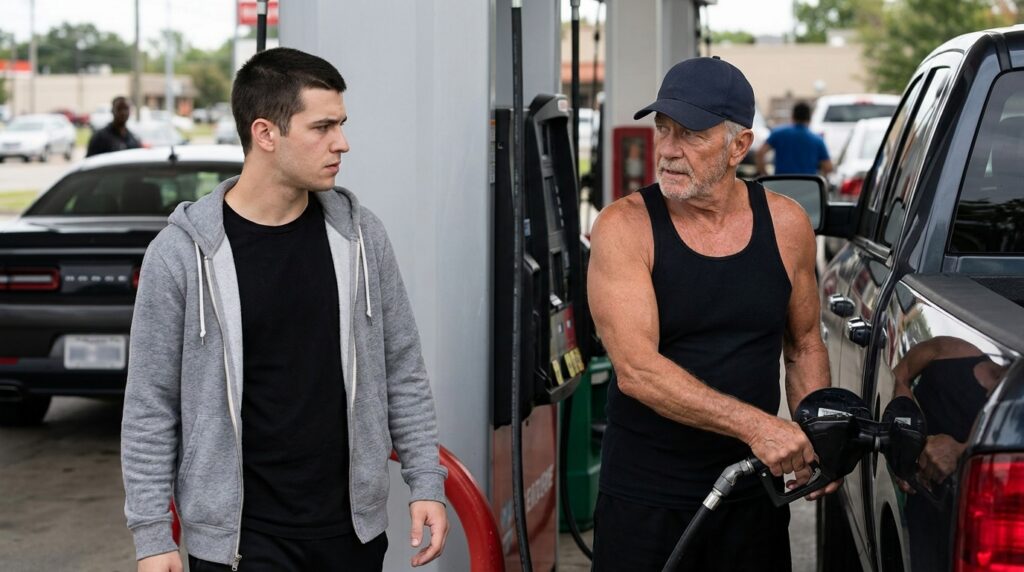
Ben’s face was pressed hard against that greasy grit, the left side of his jaw taking the brunt of the weight. His gray hoodie was twisted tight around his throat, the metal teeth of the zipper biting into his skin just beneath the collarbone. He tried to draw a full breath, but the pressure between his shoulder blades was absolute—not the sharp, sudden strike of a young man’s fist, but the heavy, unyielding mass of an old engine block settling into the earth.

“Don’t twitch, son,” the voice above him gravelled. It didn’t have any heat in it. That was the part that made Ben’s stomach turn over—the complete absence of anger. It sounded like an old mechanic diagnostic, assessing a loose belt. “You’re just going to tear the seam on that coat.”

Ben’s fingers clawed at the pavement, his nails scraping uselessly against the rough aggregate of the refueling lane. Above him, the fluorescent bulb of the canopy hummed with a high, cracked vibration that seemed to vibrate straight through his skull. He could see the rear tire of the old pickup truck—dry-rotted, the sidewalls crosshatched with fine gray cracks like spiderwebs, caked in the white, chalky dust of the limestone quarry three miles south.

The weight left his back with a slow, deliberate creak of joints.

Ben didn’t get up immediately. He stayed there for three seconds, his chest rising and falling against the cold concrete, listening to the metallic clack-clack of the fuel nozzle being hung back on the iron cradle of the pump. The rubber boots of the old man shifted—heavy, oil-resistant soles worn flat at the heels from decades of pacing concrete shop floors.

“You got a lot of miles on you before you’re worth the trouble you’re looking for,” the old man said.

The driver’s side door of the truck groaned on its hinges. It didn’t close with a clean thud; it took two hard slams, the rusted latch finally catching with a loose, tinny rattle that echoed across the empty four-lane highway. The engine turned over on the third try, a low, spitting diesel idle that smelled of unburnt fuel and scorched oil.

Ben pushed himself up onto his knees, his hands trembling as they left the dark silhouette of his own damp print on the asphalt. His ribs on the right side felt hot, a dull, throb-throb that signaled a deep purple bruise by morning. He pulled at the front of his hoodie, trying to force the jammed zipper down, but the metal tab was wedged tight against a loose thread of cheap fleece.

The truck moved forward, its taillights two dim, rectangular scabs of red plastic fading into the heavy, mist-laden dark of the valley.

As Ben wiped the grease from his cheek with the back of his sleeve, his hand hit something hard and metallic lying near the base of the pump. It wasn’t a coin. He reached down, his fingers closing around a heavy, brass-headed key attached to a small, stamped aluminum tag. The numbers 42-B were punched into the metal, clogged with black grease. It hadn’t fallen from his own pockets. He looked out toward the empty highway where the diesel exhaust still hung in the damp air, his fingers tightening around the cold brass until the edges cut into his palm.


CHAPTER 2: TRACKING THE CALCIUM TRAIL

The brass edge of the key dug into Ben’s palm like an iron filings splinter, cold and grease-slicked. He walked with his right arm pinned flat against his ribs to quiet the dull, rhythmic throbbing where the old man’s boot had left its mark. Every step on the gravel shoulder of the four-lane highway sent a shudder through his collarbone, but he didn’t slow down. In this valley, if you stopped moving after dark, the dampness settled into your clothes until you smelled like old cellar insulation.

The white dust was the giveaway. It lay in thick, pale drifts along the weed-choked drainage ditch, sloughing off the tires of the heavy haulers that ran between the pit and the river barges. But the old man’s pickup had a mismatched rear axle; the left wheel tracked two inches wider than the right, leaving a distinct, dragging gap in the soft calcium powder wherever the truck had veered off the asphalt.

Ben followed that broken shadow through the dark. The moon was a gray smear behind the low hanging cloud cover, providing just enough light to illuminate the pale limestone trail where it turned sharply off the state road and plunged into the throat of the old industrial park.

The gate was supposed to be chained. The county had slapped an orange receiver’s notice on the chain-link fence six months ago, but when Ben reached the perimeter, the heavy galvanized links were dangling loose. Someone had cut the padlock with an oxy-acetylene torch—the slag at the tip of the severed link was still cold to the touch, but the iron was raw, unrusted by the evening mist.

He slipped through the gap, the fabric of his gray hoodie catching on a frayed wire barb. He yanked it free with a sharp, angry tug, the sound of tearing fleece loud in the dead air of the yard.

The air here tasted different. The petroleum hum of the highway gas station was replaced by the sour stench of stagnant runoff and old iron scale. This was the graveyard of the county’s manufacturing core—roofless metal sheds where the wind made a hollow, whistling noise against the corrugated iron panels, and piles of discarded casting sand that had hardened into dark, tumorous mounds after the last winter freeze.

The truck tracks led straight toward the back of the property, behind the old machine shop where the foundation had cracked and dropped three inches into the creek bed.

Ben kept his boots in the grass along the gravel lane, avoiding the loose limestone chunks that could roll under his feet and announce his presence. His eyes adjusted to the deeper dark beneath the rusted overhang of the loading dock. The old pickup truck was there, its engine killed, the exhaust manifold still giving off a sporadic, ticking ping as the metal cooled in the damp air.

The truck bed was covered by a heavy, tattered canvas tarp, held down by coarse hemp ropes tied to the stake pockets.

Ben reached the tailgate, his breath coming shallow and hot. His fingers were stiff as he worked the first knot at the corner of the bumper. The rope was stiff with river silt and old grease, smelling strongly of river water and motor oil. He hauled back on the heavy canvas, the fabric stiffened by the cold until it crackled like dried hide.

The beam of his small pocket light—shielded by his fingers so only a thin thread of yellow light leaked out—revealed the cargo.

It wasn’t personal scrap. It wasn’t old lawnmowers or broken cast-iron radiators from a residential basement remodel. Packed tight into the bed of the truck, nested in straw to keep them from clattering against the metal sides, were thick, heavy segments of industrial copper water mains. The metal was dark green with patina, but the freshly sawed ends gleamed like new pennies under his palm. These were municipal lines, the heavy-gauge infrastructure that ran beneath the old foundry hill—the kind of metal that required county blueprints and hydraulic shears to extract.

A soft, metallic clink from inside the darkened office of the machine shop made Ben freeze, his hand still resting on the cold, heavy copper.

Through the cracked windowpane of the foreman’s shack, twenty feet away, a small kerosene lantern flickered to life. The yellow glow didn’t show the old man from the gas station. It caught the side of a desk, a stack of pink weigh station receipts, and a hand holding an old iron crowbar. The hand was missing the tip of the left index finger—a detail Ben knew better than his own reflection. It was his father’s hand.

Ben’s boots remained rooted to the limestone dust, the heavy brass key in his pocket suddenly feeling like a dead weight dragging him down into the floor of the valley.

CHAPTER 3: THE WEIGHT OF THE REVENUE

“Drop the canvas, Ben.”

The voice didn’t come from the foreman’s shack. It came from the deep shadow right behind the front left fender of the pickup truck.

The old man from the gas station stepped into the dim, amber spill of the kerosene lamp. He didn’t have his navy cap on anymore, and his gray stubble looked like iron filings glued to a weathered jawline. In his right hand, he held a rusted iron tire iron—not raised to strike, but held low, balanced against his thigh with the comfortable familiarity of a man who used tools to solve structural problems.

Ben didn’t drop the tarp. His fingers stayed hooked into the rough canvas, the fibers biting into his raw knuckles. “This belongs to the town. The old water grid under the south ridge.”

“The town died five years ago when the kiln shut down,” the old man said, his boots crunching softly on the limestone dust as he closed the distance. “This is just scrap metal waiting for a trench to collapse on it. Your old man knows that. He’s the one who signed the work order to split the line.”

From inside the shack, the screen door gave a short, metallic squeak. Ben’s father stepped out onto the rusted iron plate of the loading dock. His flannel shirt was frayed at the cuffs, and his breath came out in pale, ragged plumes in the midnight chill. He didn’t look at Ben; he kept his eyes fixed on the green-patinaed copper pipes resting in the straw of the truck bed.

“Go home, Ben,” his father said. The voice was thin, lacking the density of the old man’s gravelly tone. “You don’t know the math on this. You don’t know what the bank is asking for by Friday.”

“The math?” Ben’s laugh was a sharp, dry bark that tasted like the oil film on his teeth. He pulled the heavy brass key out of his pocket and let it drop onto the truck’s metal tailgate with a loud, ringing clack. “This opens the pump house on Layer Two. I found it in the dirt after this old bastard put his boot in my ribs. You’re tearing the guts out of the county line.”

The old man looked at the key, then up at Ben. The corner of his mouth twitched, a tiny ripple in a face that looked like it had been carved out of river bluff. “I told you at the pumps you were making a mistake, son. The mistake wasn’t looking at me. It was tracking things you aren’t big enough to carry.”

“I’m big enough to call the sheriff,” Ben said, though his own hand was trembling against the canvas.

His father took two steps down the wooden stairs, his boots sliding slightly on the wet calcium powder. “The sheriff’s got his own truck down at the lower yard, Ben. Who do you think gave us the schedule for the county patrol loops? Everyone’s cutting a piece off the carcass before the state auction handles the receivership.”

The realization didn’t come like a sudden flash of light; it felt more like the cold, greasy settling of the diesel smoke back at the highway lane. The whole valley was liquefying itself from the inside out, turning its own bones into cash to pay off debts held by banks three states away.

Ben reached down, his fingers sliding across the cool, smooth skin of the copper main until they brushed against a wooden crate tucked deeper into the straw. The timber was rough, unplaned oak, but fastened to the top was a clip holding three carbon-copy receipts. He snatched the top sheet, the pink paper rustling loudly in the stagnant air of the shed.

The receipt wasn’t from a commercial scrap yard. It was a private manifest from the foundry’s final inventory, dated two weeks prior, detailing eighty tons of industrial brass fittings still registered as ‘hazardous waste storage’ inside the deep vault of the main foundry building. The signatures at the bottom were clear—the old man’s heavy block letters, and his father’s hurried, sloping scrawl. But below them was a third set of initials, stamped in red ink, that made the skin on the back of Ben’s neck go completely numb.

Before he could read the red letters clearly in the dim light, the old man moved with a sudden, heavy efficiency that defied his seventy years. The tire iron didn’t swing toward Ben’s head; it came down hard on the wooden crate, splintering the oak lid with a loud, dry crack that echoed through the empty sheet-metal bays.

The impact tore the paper right out of Ben’s grip, the pink sheet fluttering into the dark grease pool beneath the truck’s chassis.

“The paper doesn’t change the weight of the truck, boy,” the old man said, his shadow stretching long and black across the limestone floor as he stepped between Ben and the cab. “You either help us close this tarp, or you find out how cold the creek bed gets at three in the morning.”

Ben backed up a step, his heels catching on a rusted piece of channel iron. His ribs flared with sharp, white-hot pain where the earlier bruise was hardening into concrete. He looked at his father, but his father had already turned his back, walking back up toward the yellow lantern light of the foreman’s shack to shuffle the remaining receipts.

CHAPTER 4: THE MIDNIGHT WEIGH

The iron scale plate beneath Ben’s boots groaned, a low, structural protest that sounded like the entire valley giving up its anchor. He didn’t drop his head. The cold air felt sharp against his wet cheeks, but the heat inside his ribs had turned steady, a hard, localized ache that kept him clear.

“The creek bed is full of runoff,” Ben said, his voice flat, taking on the dry texture of the unpainted masonry around them. “And there isn’t enough lime in the pit to hide three sets of tracks.”

The old man didn’t move the tire iron. His knuckles remained fixed against the rusted steel tool, dark grease packed under his nails from forty years of clearing jams. He looked at Ben’s father, then back down at the pink slip of paper turning translucent in the black puddle by the tire.

“Your boy’s got a stubborn hinge on his jaw, Arthur,” the old man said. He didn’t raise his volume, but the density of his words cut straight through the low whistle of the wind in the roofless joists. “Just like you did before the third foreclosure notice came through the slot.”

Ben’s father stepped off the wooden loading dock, his boots leaving dull, white half-moons in the limestone dust on the iron plate. He didn’t approach Ben. Instead, he reached into the cab of the pickup, his fingers hunting through the glovebox until they clicked around a worn leather-bound ledger. The spine was split, held together by gray duct tape that had frayed into sticky black threads.

“Look at the ledger, Ben,” his father said, extending the book with a hand that shook just enough to make the metal rings on the binder click. “Just look at the names.”

Ben didn’t take the book. He didn’t need to. In the dim amber wash of the kerosene lantern, the stamped ink on the open page was wide enough to read without clearing the lime dust. The entries didn’t stop with his father or the old man standing by the bumper. The columns stretched back eighteen months, neat rows of figures tracking weights, tonnages, and dollar values. Every line represented a section of the county’s lifeblood—the high-pressure valves from the municipal reservoir, the heavy copper grounding cables from the defunct sub-station, the bronze bearings from the local irrigation locks.

The signatures running down the margin belonged to the town’s remaining infrastructure trustees. The men who sat on the school board, the inspectors who signed the safety certificates for the dry-docks, the clerks who handled the local property deeds. The decay wasn’t a sudden rot from the outside; it was an organized, meticulous liquidation carried out by the very people who had built the foundations forty years prior.

“We aren’t stealing, son,” his father whispered, his voice disappearing into the vast, hollow space of the machine shop. “We’re just converting the corpse before the regional bank takes the land. If we don’t pull the metal tonight, the state receivers lock the gates on Monday, and every house on the south ridge goes up for public auction to settle the utility bonds.”

Ben looked at the old man. The muscular shoulders under the black tank top remained solid, an immovable boundary of old iron and survival logic. The confrontation at the gas pump hadn’t been an old man defending his pride against a restless youth; it had been an unyielding system protecting its final operational line. The old man wasn’t the enemy of his growth—he was the mirror of what this county did to men who stayed too long in the dust.

The weight of the brass key in Ben’s pocket felt different now. It wasn’t a prize or a weapon. It was a lien.

“You should have told me,” Ben said, his throat tight as he looked at the green-patinaed pipes in the truck bed.

“You were too busy looking for someone to hit, Ben,” his father said softly, closing the ledger with a dull, heavy thud that puffed a tiny cloud of white powder from the tape. “You wanted a fight because you thought the world was hiding something from you. It wasn’t hiding. It was just emptying out.”

The old man lowered the tire iron, letting the blunt end settle against the gravel with a dry crunch. He reached into his pocket, pulled out a pair of heavy leather work gloves, stiffened with dried sweat and scale, and tossed them onto the tailgate right next to the brass key.

“The wind’s turning toward the north,” the old man said, turning his back to check the hemp ropes on the tattered tarp. “The river barge leaves the south dock at four. We need three more lengths from the valve house before we scale the load. Pick up the gloves, son. Or start walking back to the highway.”

Ben stood on the iron plate, the silence between the three of them growing vast and absolute, filled only by the rhythmic ticking of the cooling diesel engine and the steady, cold friction of the valley air.

CHAPTER 5: THE CORE OF THE COLD RIDGE

The brass valves in the valve house didn’t yield to wrenches. They required the direct, bone-shaking impact of a five-pound sledgehammer swung against the frozen iron packing nuts until the rust broke loose in sharp, orange flakes that stung the eyes.

Ben wiped his brow with the stiff leather of the work gloves the old man had thrown him. His palms were already blistered beneath the hide, the raw friction of the hickory handle sending a rhythmic jolt straight up his bruised right side every time the hammer connected with the metal. The air inside the subterranean concrete vault was five degrees colder than the yard, smelling faintly of ancient river silt and dead moss.

“Hit it again, son,” the old man muttered from the dark below the pipe tier. He was holding a rusted flashlight between his teeth, his grease-blackened fingers bracing the primary coupling to keep the main line from buckling under the shock. “The threads are loaded with lead-caulk. She won’t drop until the shoulder clears the casing.”

Ben swung. The iron head struck the valve stem with a flat, echoing clank that filled the narrow vault until his ears rang with a high, steady whistle. With a wet, sucking groan, the three-hundred-pound bronze fitting finally sheared off its mount, dropping two inches into the rotten straw padding they had laid across the concrete floor.

“Get the crowbar under the lip,” his father whispered from the access ladder. He was shifting his weight from foot to foot, his head constantly turning toward the square opening above where the midnight fog was drifting across the ridge line. “We’ve been in this hole twenty minutes too long. The coal trains from the northern gap usually slow down the valley patrol, but the tracks have been quiet tonight.”

“The trains aren’t running because the bridge at the junction has a cracked pier,” the old man said, spitting a dark stream of tobacco juice into the empty pipe casing. He didn’t look up from his work as he hauled his shoulder against the bronze mass. “The state closed the line at noon. If a car comes up the ridge road now, it’s looking for us, not the coal.”

Ben dropped the sledge and shoved the nose of the pry-bar beneath the heavy flange. The metal was cold enough to stick to the leather of his gloves. Working together, his weight balanced against the old man’s brute, calloused leverage, they hoisted the valve up toward the ladder where his father could hook it with the truck’s hand-winch.

The cable clicked—a slow, rhythmic tic-tic-tic of greased iron teeth catching the pawl—as the valve rose into the fog.

Ben climbed out of the vault first, his knees scraping the damp concrete lip of the manhole. He stood up in the high grass of the ridge, his gray hoodie instantly soaking through as the cold mountain mist hit his neck. The pickup truck sat thirty yards away in the shadow of a dying willow tree, its tailgate down, the green-patinaed water mains already hidden beneath the tattered canvas.

Then he saw the light.

It wasn’t a flashlight. It was a single, broad sweep of high-beam yellow cutting through the skeletal white oak trees at the bottom of the ridge road, half a mile below their position. The beam rose and fell with the slow, heavy cadence of a vehicle climbing the washed-out grade—not a commercial car, but something with a stiff, heavy-duty suspension that didn’t bounce when the wheels hit the ruts.

“Arthur,” the old man said, his boots clearing the manhole with a heavy thud. He didn’t look at the light; he looked down at the grease-smeared tailgate where the brass key still lay. “Kill the lantern in the shack. Now.”

Ben’s father scrambled toward the foreman’s shack, his silhouette brief and frantic against the windowpane before the yellow glow died, leaving the clearing in absolute, slate-gray dark.

The headlights below disappeared behind the bend of the old limestone cut, but the sound of the engine followed—a low, rhythmic diesel thrum that matched the idle of their own truck, but sharper, tighter, like a vehicle that had been serviced on a county maintenance schedule.

The old man walked over to Ben, his hand closing around the iron tire iron he had tucked into the stake pocket of the truck bed. His face was completely shadowed by the willow branches, but his breath came out in short, steady plumes that smelled of wintergreen and tobacco.

“That’s the third-shift patrol from the lower district,” the old man said softly, his voice dropping into that transactional gray zone where every word felt like a calculated risk. “He’s twenty minutes early for his loop. Either the bank receiver put a call into the substation after the afternoon inventory check, or somebody down at the four-lane gas station remembered the track width on my rear axle.”

He looked at Ben, his gaze cold and steady under the gray brows.

“Get in the bed of the truck, son,” the old man ordered, shifting his grip on the tire iron until the rusted metal clicked against his belt buckle. “Pull the canvas over your head and hold the valve down so it doesn’t rattle against the copper when we hit the gravel. If he stops us before the junction, you let me do the talking. Your father hasn’t got the stomach for what comes next if the paperwork don’t match.”

Ben hesitated, his fingers tightening around the raw fabric of his hoodie’s pocket. The pink receipt from the foundry was still turning into pulp in the yard below, but the red initials stamped at the bottom seemed to burn straight through his memory. The entire ridge was collapsing, and he was currently sitting directly in the hinge of the break.

CHAPTER 6: THE THREEWAY SPLIT

“The gate isn’t clear, Arthur.”

The old man’s voice barely rose above the low, rhythmic rattle of the truck’s transmission as they coasted down the final embankment toward the river lanes. He didn’t use the brakes. He simply jammed the shifter into low gear, letting the engine compression slow the heavy pickup until the front tires groaned against the wet river silt.

Ben lay flat under the stiff canvas tarp, his face pressed within inches of the cold, oxidized green surface of the copper water mains. The newly harvested bronze valve was a massive, dead weight against his left hip, shifting slightly with every dip in the road. Through a frayed gap in the canvas hem, he could see the gray morning fog rolling off the river, thick enough to taste like wet iron scale.

“What do you mean it isn’t clear?” his father whispered from the passenger seat. His silhouette was sharp, his shoulders hunched tight against the door panel. “The night guard at the barge dock was supposed to leave the slip unbolted until four.”

“Look at the lock box,” the old man said.

The truck rolled to a complete stop, its headlights extinguished, leaving only the dim, amber parking lights to illuminate the perimeter fence of the river yard. Ben shifted his position, squinting through the canvas tear.

The iron gate wasn’t held by the usual commercial chain. A heavy, hardened steel bar had been clamped across the latch mechanism, secured by a bright blue padlock that gleamed under the river mist. Hanging from the center of the bar was a laminated white card—the official notice of asset quarantine from the regional bank’s corporate receiver. The signature at the bottom was fresh, the ink unsmudged by the damp air, dated less than twelve hours ago.

“The receiver didn’t wait for Monday,” Ben’s father muttered, his hand going to his mouth, the stump of his missing index finger twitching against his lip. “They’ve locked the barge slip. They’re running an audit on the structural inventory right now.”

“They aren’t auditing,” the old man said, his knuckles clicking as he tightened his grip on the wheel. “They’re collecting. The barge at the dock isn’t empty, Arthur. Listen.”

Through the dead air, past the low lap of the black river water against the wooden pilings, came a mechanical rumble. It wasn’t the slow, rhythmic chug of a commercial river tugboat. It was the high-efficiency whine of an industrial sorting crane, its iron cables whistling as it lifted heavy material into a steel hopper.

Ben scrambled out from beneath the tarp, the rough canvas scraping across his gray hoodie as he dropped over the side of the truck bed into the soft silt. His ribs flared with a sharp, localized heat, but he ignored it, stepping closer to the driver’s side window.

“They’re already stripping the warehouse,” Ben said, his breath pluming in the dark. “That crane isn’t clearing old inventory. It’s loading the municipal brass fittings from the deep vaults.”

The old man turned his head slowly, his eyes deep pockets of shadow beneath his thick gray brows. He looked at Ben, then down at the ledger sitting on the bench seat between him and Arthur. “The red initials at the bottom of the manifest wasn’t the sheriff, son. It was the state receiver’s field agent. The town board didn’t split the line to save the ridge from foreclosure. They sold the scrap rights to the bank’s holding company three weeks ago to clear their own individual corporate indemnities.”

The whole decoy structure shattered in Ben’s mind like cold slag under a sledgehammer. The town trustees weren’t fighting an desperate, illegal rearguard action to protect the local families from the bank. They had already signed the surrender, and his father and the old man were simply the low-level labor, scavenging the leftover crumbs of copper before the official corporate clearance swept the yard clean.

“Arthur,” the old man said, his gravelly tone dropping into a hard, defensive cadence. “We’ve got eighty thousand dollars worth of municipal copper in this bed that the bank already considers their secured property. If we turn this truck around, the state patrol has the ridge road blocked at the county line. If we stay here, that crane operator calls the receiver’s security detail in exactly five minutes.”

Ben’s father grabbed the taped ledger, his fingers tearing at the frayed duct-tape spine. “The receipts are still inside the shack. If they find the cross-references with my signature—”

“The papers are already turning into pulp in the yard, Arthur,” the old man cut him off, his arm reaching across the seat to plant a heavy, grease-stained palm directly on the center of the book. “The book stays here. The truck stays here. We split the load across the footpaths behind the old smelting bays, or we sit in the cab and wait for the county van.”

He looked up at Ben, the tire iron in his leather-gloved hand giving off a dull, iron gleam.

“You wanted to know what the county was fighting for, boy,” the old man said, his voice dropping into the absolute silence of the river fog. “Now you know. Nobody’s saving the ridge. We’re just deciding who holds the debt when the sun comes up.”

From behind the machine shop at the top of the embankment, two sharp pricks of white light cut through the mist—the high-intensity halogen spotlights of an unflagged security vehicle turning into the river road lane, its tires grinding the wet limestone into mud.

CHAPTER 7: THE RECKONING IN THE RUSTED BAY

The halogen beam hit the back panel of the truck with a sharp, blinding glare that turned the cold river fog into a wall of brilliant, milky white.

“Move,” the old man hissed. His voice didn’t rattle, but his hand slammed down hard on the mechanical throttle lever, forcing the diesel engine to roar against its mounts. The rear tires spun in the soft, gray limestone muck, spraying a heavy fan of wet silt against the rusted fence line before the rubber finally bit into the hard gravel beneath.

Ben didn’t look back at the security vehicle. He vaulted over the rusted tailgate, his boots hitting the packed shale shoulder with a shock that traveled straight through his ankles to his bruised ribs. He grabbed the heavy leather gloves from the truck bed and shoved his hands inside them, the cold hide stiff against his skin. Beside him, his father was already running toward the shadow of the old smelting bay, his breath coming in jagged, high-pitched gasps that cut through the mechanical thrum of the sorting crane downriver.

The truck didn’t follow them into the gap. The old man swung the wheel hard to the left, deliberately putting the heavy steel chassis between the approaching headlights and the narrow footpath behind the foundry. He was anchoring the vehicle into the bottleneck of the gate, sacrificing the exit route to give them forty yards of dead space.

“Ben! Through the hopper door!” his father choked out, his missing index finger catching on the edge of a crumbling brick lintel as he hauled himself upward into the desaturated gray dark of the foundry interior.

Ben scrambled up behind him, the rough masonry tearing at the sleeves of his gray hoodie. Inside, the foundry was an immense, cold cavern of rusted iron frames and dead furnaces. Rain dropped through the collapsed sections of the corrugated steel roof, striking the cold iron plates below with a steady, rhythmic clicking that sounded like a hundred clocks counting down the final hours of the county.

They stopped behind a massive casting ladle, its iron shell coated in a thick, scabby layer of orange rust that flaked off at the slightest touch. Through the iron slats of the outer wall, Ben watched the security car come to a halt ten yards from the old man’s pickup. The door didn’t open immediately. The vehicle sat there, its high-beams washing over the canvas tarp, exposing the green contours of the stolen municipal copper.

His father dropped down onto a pile of discarded casting sand, his hands clutching the leather-bound ledger against his ribs like a shield. “They’ll find the names, Ben. If that ledger gets to the regional receiver’s office, the indemnity clauses are void. The bank takes the houses before sunrise.”

Ben looked down at his father. In the faint, gray light filtering through the roof, the man looked completely drained—shattered by the very math he had tried to exploit. The generational authority Ben had spent months resenting hadn’t been an unyielding wall; it was a hollow frame, rusted out from thirty years of slow, economic stagnation until there was nothing left to trade but the town’s iron bones.

“Give me the book,” Ben said. His voice was steady now, taking on the gravelly weight of the old man who was still sitting calmly in the cab of the truck out in the lot.

His father looked up, his lips moving soundlessly before he handed over the split-spined ledger. The sticky black duct tape left a dark streak across Ben’s work gloves.

Ben walked to the edge of the casting floor where the old overflow chute overhung the river channel. The water below was black as engine oil, moving with a silent, heavy current toward the southern locks. He didn’t hesitate. He swung his arm low and let the ledger fly. The book didn’t make a loud splash; the river simply opened up and swallowed the tape, the pink receipts, and the columns of initials, burying the town’s self-liquidation under six feet of silent, cold silt.

When he turned back, the old man was standing in the doorway of the smelting bay. His navy cap was back on, tilted low over his eyes, and his black tank top was smeared with fresh grease from the gate latch. He didn’t have the tire iron anymore.

“The security agent is a cousin of the clerk down at the drainage board,” the old man said, his low voice echoing off the iron rafters. “He’s taking the truck down to the lower yard to log it as an abandoned vehicle before the state inspectors arrive at five. The copper stays in the bed. The bank gets the weight, but your names aren’t on the manifest.”

Ben stepped out of the shadow of the casting ladle, his boots grinding the white limestone dust into the iron floor plates. “And the ridge?”

The old man looked at him for a long, unblinking three seconds. The pragmatic logic in his eyes was absolute—no comfort, no promises, just the hard friction of reality. “The ridge has to stand on whatever dirt is left after the iron is gone, son. You’ve got two miles of footpath before you hit the state highway. Start walking.”

Ben pulled the jammed zipper of his hoodie up to his throat, the metal teeth finally catching against the torn fleece. He didn’t feel the rage anymore—the untethered, volatile anger that had driven him into the gas station lane hours ago had been ground down into something heavy, cold, and durable. He looked at his father, who was slowly pushing himself up from the sand pile, then turned toward the dark exit that led to the high valley trail.

The air outside was shifting, the smell of iron and dry earth mixing with the first sharp scent of the morning rain.

Similar Posts

Leave a Reply

Your email address will not be published. Required fields are marked *






