
The Ironing of the Friction: A Tale of Wear, Weight, and Restrained Authority in the Dusty Gray

CHAPTER 1: THE FRICTION OF THE LEAN

“You think that gives you the right to talk down to me?”

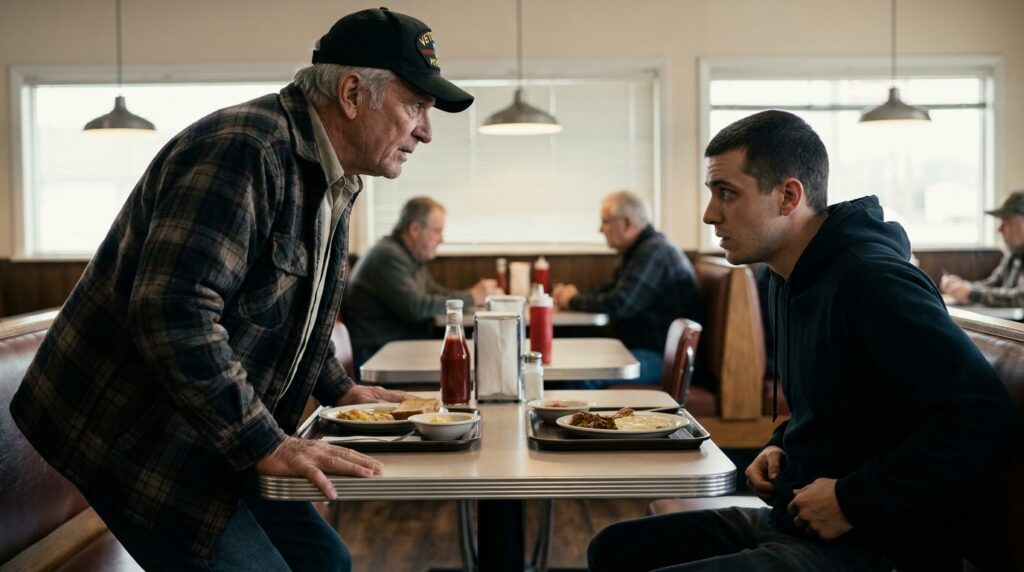
The words didn’t launch across the booth so much as they spilled, heavy with the sour smell of stale gas-station coffee and three days of small-town desperation. The speaker was leaning so far forward that the dark synthetic fabric of his jacket rasped against the metal binding of the table edge. His short, dark hair was damp at the temples, caught in the harsh glare of the noon light that struggled through the greasy pane of the diner window. Between them sat a plate of eggs, the yolks broken and cold, skinning over like gray water on a ditch.

The older man didn’t move his hand from the handle of his mug. His thumb, marked by a pale, jagged line near the joint where a dry-sliding wrench had torn the skin thirty years back, stayed anchored against the warm earthenware. He didn’t look up immediately. He watched the small mound of salt that had gathered near the base of the pepper shaker, tracking the way the vibration of a passing logging truck on Route 9 caused the white crystals to shift and settle.

“Watch your tone,” the veteran said. His voice had the dry, ungreased rattle of an old gate latch. It wasn’t loud. It lacked the theatrical bass of an old man trying to sound large, staying entirely within the low hum of the compressor under the ice machine. “You’re pushing this too far.”

“I’m pushing it?” The younger man laughed, a short, ugly sound that cut through the low clink of silverware three booths down. A waitress with a faded denim apron froze by the register, her finger hovering over the green total key. The air in the corridor between the booths grew thick, smelling of old lard and hot iron. “You sat in that office for twenty years writing off every route my old man ran until the bank took the rigs. Now you sit here with that piece of cloth on your head like you’re some kind of saint. I’m asking you a question, old man.”

The fingers of the younger man’s right hand began to twitch against the Formica, leaving greasy smudge marks on the imitation wood grain. He was looking at the navy cap. The small, tarnished brass pin in the center—the one with the fouled anchor—was slightly crooked, tilted three degrees to the left from years of being handled by fingers that had lost their fine articulation.

The veteran took a slow, heavy breath through his nose. His ribs expanded against the stiff brown canvas of his work shirt. He could feel the friction in his right knee, the dry ache that always signaled a drop in the valley’s pressure, but his spine remained perfectly straight against the upright vinyl back of the seat. He didn’t offer a defense. He didn’t explain that the routes had been dead before the ink had dried on the manifests. He simply watched the small, aggressive twitch of the younger man’s jaw, calculating the distance between the edge of the egg plate and the first metal button of the dark jacket.

The younger man’s shoulder hitched forward, his hand rising from the table in a sudden, sharp arc aimed directly at the brim of the faded blue cap.

Beneath the table, the veteran’s boots shifted two inches to the left, his weight transferring onto the iron heel of his left shoe before the younger man’s knuckles could even clear the space above the cold eggs.


CHAPTER 2: THE GRAVITY OF THE FLOOR

The sleeve of the dark jacket never made contact with the navy cap. Instead, the air between them died, sucked out by the sudden, heavy pivot of the veteran’s left heel against the grease-filmed linoleum.

There was no theatrical display of agility—no polished, rapid-fire sequence from a training manual. It was simply the blunt physics of a mass that refused to be shifted, redirecting a smaller, looser object that had overextended its reach. As the younger man’s hand shot forward, his fingers clawing for the brim of the cap, the veteran’s right forearm rose like a rusted iron bar. It didn’t strike; it merely occupied the space the younger man’s wrist needed to travel through. The impact was dull, the sound of thick canvas meeting synthetic padding with a heavy thud.

The younger man’s momentum did the rest. With his center of gravity already tilted too far over the broken egg yolks, the sudden obstruction of his arm acted as a fulcrum. The veteran didn’t push. He simply closed his calloused fingers around the cuff of the dark jacket—noticing, in that micro-second of extreme proximity, a crude repair job done with a strand of frayed copper utility wire instead of thread—and twisted his hips three degrees back toward the center of the booth.

The movement was short, dense, and finished before the waitress could drop her pencil. The younger man’s boots lost their purchase on the worn floorboards. He spun half a turn, his hip striking the corner of the Formica table with a hollow groan from the bolted iron pedestal beneath the floor, and then he went down.

He didn’t tumble gracefully. He hit the floor with the unvarnished slap of dead weight, his shoulder checking the base of the neighboring booth before his ribs flattened against the gray, salt-pitted linoleum. The small salt mound he had been harassing earlier vibrated off the table edge, scattering like dry sand across the back of his dark shirt.

The diner fell into a type of silence that smelled of old lard and cold exhaust. Three booths down, a man holding a half-eaten slice of rye toast stayed perfectly still, his jaw locked mid-chew. The low, rhythmic clicking of the refrigerator compressor seemed to grow louder, filling the sudden vacuum between the counters.

The veteran didn’t slide back into his seat, nor did he look around to gauge the reaction of the remaining patrons. A sovereign protector doesn’t look for an audience; he checks the boundary. He rose from the bench with a slow, deliberate extension of his bad knee, the joint clicking once with the dry sound of a dry-turning bearing. His solid, late-70s frame seemed to occupy more of the diner’s narrow aisle than it had a minute ago. The brown work shirt remained tucked tightly into his jeans, the faded navy cap still sitting exactly where it had since six that morning—three degrees off-center, the tarnished anchor pin catching the yellowed noon light.

He stood over the younger man, his boots planted wide, anchoring his weight into the floorboards. His breath was steady, drawn through his nose in deep, mechanical expansions that showed no trace of adrenaline. He looked down at the dark jacket, watching the way the younger man’s shoulders heaved as the air returned to his lungs.

“Stay down,” the veteran said. The voice was neither angry nor triumphant. It had the flat, administrative tone of an inspector marking a defective crate on a loading dock. “And calm yourself.”

The younger man didn’t move immediately. His cheek was pressed against the coarse floor, his eyes wide and bloodshot, staring at the base of the table leg where the paint had flaked away to reveal the dark rust beneath. The arrogance had left his face, replaced by the confusion of a machine that had broken down after striking a immovable post. His hand twitched against the floor, his fingers curling into the dust motes that drifted through the light.

Beside his outstretched hand, a long, tri-fold envelope had slid free from the interior pocket of his dark jacket. It lay flat on the linoleum, its white surface smudged with a streak of old motor oil from the floor. The upper corner was torn, and through the gap, a glimpse of blue security paper showed—the heavy, official bond used only by regional liquidation authorities when closing a commercial hub.

The veteran’s eyes locked onto the edge of that blue paper. He didn’t bend to pick it up—not yet—but his gaze didn’t leave the smudged print. He knew that exact weight of paper. He had signed three hundred of them during the long winter of eighty-four, back when the valley’s veins were being systematically drained by men who wore suits instead of work shirts.

The younger man let out a ragged breath, his fingers scraping against the linoleum as he tried to find enough leverage to lift his chest. “You don’t know what they’re doing,” he muttered into the dust, his voice thin, stripped of its previous heat. “You think you cleared your desk and walked away clean.”

The veteran didn’t answer. He adjusted the brim of his navy cap with a single, thick thumb, his eyes staying fixed on the blue paper as a new, cold current of friction began to stir beneath the diner’s quiet floor.

CHAPTER 3: THE GEOGRAPHY OF THE BOOTH

The words left the younger man like water draining through gravel—thin, carrying the silt of an old grievance that had finally run out of room to move. He stayed where he was for three full breaths, his forehead nearly touching the iron base of the table leg, before he dragged his right knee inward. The movement was small and heavy, the coarse denim of his jeans scraping a gray track through the salt crystals on the floor.

The veteran didn’t offer a hand to help him up. A sovereign protector handles an extraction by checking the perimeter first, not by altering the position of the individual who chose to breach the line. His eyes remained anchored to the envelope. The paper was stiff, the cheap wood-pulp stock used by regional administrative offices when the state wanted to minimize its footprint on a foreclosure. The oil smudge across the corner didn’t just blur the name; it formed a greasy lens over the red-ink circular stamp of the District Liquidation Board.

“Get off the floor, Marcus,” the veteran said. His voice was lower now, falling beneath the high-frequency rattle of the ventilation fan over the grill. He hadn’t used the name in ten years—not since the boy’s father had stopped bringing the flatbed trucks through the north gate for the monthly clearance checks.

The younger man—Marcus—flashed a look upward through a tangle of dark hair. His jaw was dark with two days of gray stubble that held the smell of diesel exhaust and stale tobacco. He didn’t look like an aggressor anymore; he looked like a machine that had been run past its service hours on a cold oil pan. He hauled his weight onto the edge of the vinyl bench, his boots dragging over the linoleum with a dull screech that made the waitress by the register flinch again.

“You remember my name,” Marcus said, spitting a grain of salt onto his lower lip. He reached down, his fingers hovering over the oil-stained envelope before he snatched it off the floor with a quick, defensive twitch. His thumb came down directly over the red stamp, hiding it, but his hand was shaking enough that the corner of the blue paper inside rattled against the tear. “I figured you’d have cleared that out with the rest of the ledger files when they handed you your pension.”

The veteran didn’t take his seat. He remained standing in the narrow space between the booth and the counter, his bulk blocking the natural light from the window. The smell of his own breakfast—the cold grease on the thick rim of the plate—was sour in the noon heat, but he didn’t move it aside. His calloused hand stayed near the edge of the Formica, his fingers flat against the fake wood grain, feeling the deep, longitudinal scratch where someone had carved an unreadable set of initials into the plastic decades ago.

“The files stay where they are put,” the veteran said. He looked at Marcus’s jacket sleeve, tracking the line of frayed copper wire that held the cuff together. It was utility wire from the old rail spur behind the grain elevators—the kind of copper people stripped when the scrap yard stopped asking for identification papers. “Your father’s rigs were pulling three tons over the axle limit every Tuesday for four winters. I didn’t need a ledger to see what that did to the concrete on Route 9. I didn’t need a file to see the bearings burning out in the yard.”

“They had to run over,” Marcus said, his voice rising, catching on the silence of the room. He leaned his forearms onto the table, his dark shirt absorbing a dark circle of spilled water from a glass that had tilted during the scramble. “They were under-cutting the state freight rate by forty percent just to keep the tires on the rims. The regional office knew it. The state inspectors knew it. They were letting the big fleets out of the valley carry the clean manifests while my old man took the scrap contracts that wouldn’t clear a county scale. And you signed the non-compliance orders.”

The veteran’s face didn’t change. The skin around his eyes was dry, lined like old harness leather that had spent too many seasons in the back of an unheated barn. He knew the argument. He had heard it from seven different independent drivers before the line was shut down in November of ninety-two. They all had the same logic—that a small violation was just a way of greasing a rusty hinge so the house wouldn’t fall down around them. They never looked at the hinge itself; they just looked at the oil can in their hand.

“The order was for a cracked frame on the number four flatbed,” the veteran said, his voice flat as a level-line across masonry. “It wasn’t about the manifests. It was about seven thousand pounds of scrap iron riding on an eight-inch weld that had a split through the center you could stick a nickel into. I told him to ground the rig. He ran it to the river anyway.”

Marcus shifted the white envelope from his left hand to his right, his fingers digging into the paper until the blue security sheet within deformed with a crisp snap. “He ran it because if he didn’t deliver the tonnage by five o’clock that Friday, the yard was going to cancel the contract and give it to the line out of Chicago. He was trying to save the shop, Miller.”

The name—the veteran’s surname, spoken without the rank he had worn for thirty-two years—sat between them on the greasy table like a dead battery.

Across the aisle, the man with the rye toast slowly lowered his fork, his eyes shifting toward the register where the waitress had finally taken her hand off the total key. She didn’t look at Marcus; she looked at the veteran’s faded navy cap, her face tight with the specific, small-town anxiety of someone who knew exactly whose name was on the mortgage of the building they were standing in.

The veteran didn’t look at her. He kept his eyes on Marcus’s hand, watching the way the oil smudge on the envelope was beginning to transfer onto the younger man’s skin, leaving a dark, slick mark that looked like an old bruise.

“Your father was an idealist, Marcus,” Miller said, his thumb tracking the edge of his coffee mug without lifting it. “He thought a contract was a promise between two men who had clean fingernails. He never looked at the small print at the bottom of the blue sheet.”

Marcus paused, his hand tightening around the paper until his knuckles went the color of lard. “The small print didn’t close the hub, Miller. This notice did. It came from the regional office three days ago. They’re selling the ground under the loading docks to a logistics firm out of Delaware. Every route left in this county is flagged for cancellation by the end of the month.”

He leaned forward again, but this time his shoulders didn’t hold the weight of a threat. They held the dry, brittle tension of someone who had discovered an empty oil reservoir at the bottom of a well. “They’re clearing the whole valley out. And the signature at the bottom of the authorization—the initial field-clearance file from ten years ago—it’s yours.”

The veteran’s thumb stopped moving against the earthenware handle. The low hum of the ice machine under the counter didn’t change its pitch, but to Miller, the sound grew thin, like a wire being pulled tight across an iron peg until the zinc coating began to peel away.

CHAPTER 4: THE THRESHOLD OF THE EXTENSION

Miller did not take his hand off the thick white ceramic handle of his coffee mug. He didn’t blink. The noon light shifting through the grime of the diner window caught the tiny, jagged teeth of the brass anchor pin on his navy cap, casting a small, jagged shadow down across the bridge of his nose.

“A clearance file is just ink, Marcus,” Miller said. His voice was lower than the steady rattle of the ventilation slats, dropping into that flat, unyielding register he used when checking a high-clearance flatbed for hair-line cracks along the axle housing. “It doesn’t move a foot of dirt. It doesn’t pull down a loading dock.”

“It gave them the leverage,” Marcus spat, his thumb grinding into the blue security paper until the edge tore under the friction of his dirty nail. He pushed the document across the Formica, sliding it over the greasy boundary where the salt crystals lay scattered like dry bone shards. “Look at the third section. The regional logistics office didn’t use a standard municipal order. They pulled the old inspection clearance from May of fourteen. Your stamp is on the structural survey for the entire north platform. You called it non-compliant for commercial retention.”

The veteran didn’t reach for the paper. A sovereign protector doesn’t gather evidence from an unverified source while his position remains exposed. Instead, Miller leaned two inches forward, his wide shoulders dropping down into the grey light of the booth until his face was parallel with the young man’s tense jaw. His eyes scanned the blue paper where it lay flat against the imitation wood grain.

The print was crisp, but near the margin where the red ink circular stamp sat, there was a double-stamped date code. The first mark read May 12, 2014. The second, stamped heavily over the top with a machine-ink that had aged into a dark, greasy purple, read May 14, 2014. A forty-eight-hour mismatch. To a driver, it was nothing but a lazy clerk at the county scale; to Miller, it was the exact micro-second where the old system had been split open to hide a rotten ledger.

“The survey was for a shifting foundation on the grain spur,” Miller said, his thumb finally relaxing against the mug handle. “The concrete was splitting three feet deep because the drainage culverts were blocked with slag from the foundry. I didn’t condemn the hub, Marcus. I wrote the maintenance deferral so your father’s crews would have forty-eight hours to clear the yard before the state took the keys.”

“The maintenance deferral is what they used to prove abandonment,” Marcus whispered. His fingers hooked into the table edge, his knuckles turning the color of old tallow. “They’re using your forty-eight hours to claim the local association walked away from the infrastructure. If the association walked, the land reverts back to the regional trust. And the trust is already sold to Delaware.”

The room had gone entirely flat. Three booths down, the man with the rye toast had placed his piece back on the small ceramic plate, his hand staying frozen over his coffee cup. Even the low hiss of the grease trap behind the kitchen door seemed to have dropped an octave, leaving only the mechanical clicking of the ice machine under the counter.

The waitress didn’t move from her spot behind the register. Her face was gray in the shadow of the pie case, her fingers still holding the small yellow pencil she used to write out the totals for the morning specials. She knew what a liquidation notice meant for Route 9; it meant the fuel trucks wouldn’t stop here on their way to the interstate anymore. It meant the diner would be nothing but an empty shell by winter, its windows covered in plywood and its asphalt lot turning to weeds under the valley frost.

Miller shifted his weight from his left hip to his right, his boot heel making a dry, crunching sound as it ground a stray salt crystal into the floorboards. He knew the layout of the regional trust better than anyone still drawing a breath in this valley. He had spent three decades tracking the movement of every ton of iron, every bushel of grain, and every gallon of fuel that crossed the river. He knew that an allocation doesn’t move through Delaware unless someone on the county board had already cleared the tracks from the inside.

“Who handed you this envelope, Marcus?” Miller asked. The question was sharp, transactional, stripped of any grandfatherly softness.

Marcus looked down at his own hand, tracing the line of frayed copper wire that held his dark jacket sleeve together. The copper was dull, oxidized by the damp air of the river bottom where the independent drivers parked their rigs out of sight of the county inspectors. “A courier from the logistics office in the city. He was waiting by my truck when I pulled into the fuel dock at five this morning. He said if I wanted to save what was left of the old man’s shop, I’d bring this to you before the noon shift started.”

“A courier,” Miller repeated. He looked past Marcus’s shoulder, his eyes cutting through the glass pane of the window toward the gravel lot outside.

A silver sedan—a standard commercial fleet vehicle with no dealer plates and a light layer of gray highway dust along the rocker panels—was sitting idling near the diesel pump. The exhaust was thin, nearly invisible in the midday heat, but the vibration of the engine was distinct, a low, rhythmic thrum that caused the surface of the black coffee in Miller’s mug to ripple in concentric circles.

The validation of the threat was instantaneous. The younger man hadn’t come here to start a fight over an old grudge; he had been steered here like a blind mule carrying a heavy pack across a live range. The decoy secret—the idea that a ten-year-old structural survey had caused the collapse of the hub—was already cracking under the weight of the double-stamped date code on the blue sheet.

Miller slowly pulled his right hand away from the coffee mug, his thick, lined fingers flattening out against the cold surface of the table. He could feel the old rust in his joints, the dry ache that came from seventy years of laboring in a world that didn’t value a level-line, but his posture didn’t give an inch to the shadow outside the window.

“They didn’t give you a notice, Marcus,” the veteran said, his voice dropping into the deep, quiet center of the room. “They gave you a leash.”

The younger man started to answer, his mouth opening to press the argument, but the sound was cut short by the sharp, metallic click of a car door opening in the gravel lot outside, the noise traveling through the screen door like the snap of a dry branch.

CHAPTER 5: THE DYNAMIC HOLD

The crunch of the boot on the gravel outside didn’t just vibrate through the screen door; it hit the soles of Miller’s feet through the joists of the floorboards. The rhythm was deliberate—the heavy, unhurried tread of a man who didn’t work for a living by the hour, but by the contract.

Miller didn’t drop his posture. His right hand shifted away from his coffee mug, his forearm resting flat on the Formica like an unpainted structural timber. Under his skin, the muscle fibers along his forearm pulled tight, his bones registering the low-frequency shudder of the sedan’s engine still idling outside near the kerosene tank. An unbalanced tie rod was ticking under the frame—a corporate fleet vehicle run hard on county gravel without an alignment.

“Don’t turn around, Marcus,” Miller said. The command didn’t carry weight because it was loud; it carried weight because it was flat, leaving no pocket of air for the younger man to negotiate with.

Marcus froze, his hand still clamped over the torn corner of the white envelope. The copper wire stitching on his dark jacket sleeve gave a tiny, metallic rasp against the edge of the bench as his fingers twitched. His jaw stayed open, his bloodshot eyes darting toward the reflection in the grease-filmed window pane where the silver sedan blotted out the view of the highway scale.

The screen door didn’t slam. It was held back by a thick, calloused palm that let the springs groan before clicking into the wooden frame. The man who entered didn’t smell like gas station coffee or diesel exhaust. He smelled of laundry starch and the chemical tang of new vinyl—the kind of scent that clings to a man who spends his mornings in an air-conditioned corporate branch office forty miles up the river. He wore a gray canvas field coat over a blue poplin shirt, the fabric crisp enough that the creases along the sleeves hadn’t dropped yet.

“Miller,” the newcomer said, his boots stopping exactly two paces inside the threshold, where the linoleum gave way to the unwashed grit near the door mat. He didn’t look at Marcus on the bench; his eyes locked directly onto the tarnished brass anchor pin on the veteran’s navy cap. “They told me I’d find you here before the noon manifest was posted. You’re a hard man to locate when the local office switches its phone relays.”

The veteran slowly rose from the bench, his bad knee clicking once with a dry, metallic pop that was lost in the hum of the ice machine. He didn’t offer a name. He didn’t need to. He recognized the type from thirty years of regulatory enforcement—the mid-level operators who carried leather binders and signed their names with fine-point rollers so the ink wouldn’t bleed through the cheap duplicate paper.

“The relays are right where they’ve been since eighty-four,” Miller said, his boots set wide, anchoring his frame across the narrow width of the aisle. His solid, late-70s build occupied the full distance between the high counter and the back of Marcus’s booth. “If you’re looking for the manifest, it’s tacked to the board by the county scale. If you’re looking for something else, you’re on the wrong side of the creek.”

The man in the gray coat smiled, but his eyes stayed small, tracking the way Miller’s thick, calloused thumb remained hooked into the pocket of his brown work shirt. He reached into his coat, his hand sliding behind the stiff canvas flap before pulling out a small, pocket-sized ledger bound in black oilcloth. The corners were frayed, the fabric showing gray threads where it had rubbed against the interior pocket of a desk drawer for a decade.

“The creek has a new owner, Miller,” the man said, his voice carrying the flat, professional rhythm of an auditor reading an estate settlement. He flipped the ledger open, his thumb stopping at a page marked with a yellowed plastic tab. “The regional logistics board cleared the north platform survey yesterday afternoon. The forty-eight-hour maintenance deferral you signed in May of fourteen? It expired forty-eight hours ago. The county trust doesn’t need to post a public auction if the abandonment file is certified by the original inspector.”

Marcus let out a sharp, ragged breath, his boots scraping the linoleum as he made a move to slide out of the booth. “He told you,” he muttered, his hand rising toward the gray coat. “The courier said you had the sign-off, Miller. You let them hold the file until the clock ran out.”

The veteran didn’t look back at the boy. He kept his steady, unwavering gaze fixed on the man by the door mat, tracking the subtle shift of the man’s weight from his heels to his toes. The decoy secret—the idea that a simple liquidation notice was just a routine corporate overreach—was collapsing into a larger, uglier reality. The forty-eight-hour mismatch on the double-stamped date code wasn’t an administrative error from ten years ago; it was a deliberate fuse, timed to explode the moment the local transport association tried to renew its fuel contracts at the hub.

“The file wasn’t certified, son,” Miller said, his voice dropping into that deep, mechanical center that made the waitress behind the counter stop cleaning the coffee machine. “Because the inspector who signed that deferral didn’t use a county stamp. He used a federal inventory clearance code from the river command.”

The man in the gray coat stopped flipping the pages of his black ledger. His fingers stayed flat against the oilcloth, the small smile vanishing from his lips like grease dissolving in gasoline. He looked from Miller’s face down to the thick, scarred hand that was now resting flat against the edge of the Formica table.

“The code was retired when they pulled the motor pools out of the valley,” the man in the gray coat said, his voice losing its professional smoothness, turning thin and sharp like a rusted tin edge. “The county records don’t recognize a federal allocation after twenty years of commercial transition. It’s just dead paper, Miller.”

“The paper isn’t dead until the equipment is out of the yard,” Miller said, taking one slow step forward, his boot heel coming down directly between Marcus’s envelope and the man by the door mat. “And the equipment on the north platform doesn’t belong to the regional trust. It belongs to the state guard asset reserve. I parked it there myself before they turned the keys over to your father’s association, Marcus.”

The revelation hit the aisle like a dropped tire iron. Across the room, the patron with the rye toast slowly slid his wallet out of his back pocket, his hand staying low against the vinyl cushion as he watched the space between the veteran and the door.

The man in the gray coat took a step back, his heel catching on the edge of the dry door mat with a small, coarse rasp. His hand stayed near the interior of his coat, but he didn’t reach for the ledger again. He looked past Miller’s shoulder toward the window, where the silver sedan’s engine suddenly kicked into a higher idle, the ticking of its unbalanced tie rod accelerating through the glass like a warning bell.

“You’re holding onto a ghost, Miller,” the man said, his hand dropping down to his side as he reached behind him for the latch of the screen door. “The company out of Delaware isn’t looking at the manifests. They’re looking at the ground. And the ground doesn’t care about a river command stamp.”

The latch clicked, the sound sharp as a pistol hammer in the quiet diner, and the veteran stood perfectly still as the screen door began to swing open into the hot, midday glare of the gravel lot.

CHAPTER 6: THE SHADOW OF THE LEDGER

The screen door swung wide, its rusted spring screaming with the dry, high-pitched scrape of iron filings grinding inside a tight sleeve. The midday glare hit the threshold like a physical blow, carrying the scent of baking asphalt and scorched rubber from the idling sedan.

Miller didn’t take two paces to trail the man in the gray coat. A sovereign protector doesn’t leave his high ground to pursue an unverified target across an open sector. Instead, his thick, scarred hand went down flat on the torn corner of the blue paper Marcus had left on the table. The friction of his broad thumb against the bond paper was distinct—a solid, unyielding brake that pinned the document to the fake wood grain before the heat from the open door could lift it.

“Get your gear, Marcus,” Miller said. His voice was lower than the steady vibration of the sedan’s tie rod, dropping into that mechanical register used for sealing a leaky valve under head pressure. “We’re out of time on this bench.”

Marcus didn’t move for two full breaths. His fingers were still hooked into the gray vinyl of the seat cushion, his dark eyes wide, locked on the empty doorway where the man’s laundry-starnished scent was already being blotted out by the smell of diesel exhaust. The copper wire stitching on his cuff glinted once in the sharp noon light, a single strand of utility metal caught on the edge of a small, bright screw head beneath the table binding.

“The asset reserve,” Marcus muttered, his teeth clicking together as the adrenaline began to cool in his jaw. “You didn’t say anything about the guard trucks when the county inspectors pulled the scales out of the yard. You let my old man take the hit for the weight violations while you were sitting on fifty tons of federal steel.”

“Your father wanted the yard clean so the Delaware firm would write the commercial lease,” Miller said, his voice level as an unchipped masonry line. He picked up the blue document, folding it once with a heavy crease from his calloused palm before sliding it into the deep breast pocket of his brown canvas shirt. “He thought if he cleared the county ledgers, the rest of the track would lie flat. He didn’t know the regional board had already filed the liquidation notice before the first flatbed hit the river bridge.”

The veteran turned toward the register, his heavy work boots grinding the stray salt crystals into gray powder against the linoleum floor boards. The waitress hadn’t dropped her yellow pencil, but her hand had shaken enough that a thin line of graphite had tracked down across the margin of her pad. She looked at Miller, then at the navy cap sitting three degrees off-center on his lined forehead, her features tightening with the ancient, unexpressed fear of a valley that had been losing its blood to the interstate for thirty years.

“Put the specials on my tab, Clara,” Miller said, his face as unyielding as the cast-iron frame of the stove behind her. He didn’t wait for her to check the totals. He dropped a worn ten-dollar note onto the counter near the glass pie case, the paper old and soft enough that it didn’t rattle against the wood.

Across the aisle, the patron with the rye toast finally stood up, his hand staying tucked inside his denim jacket where the leather shape of an old utility knife showed against the seam. He didn’t speak to Miller, but he gave a short, transactional nod toward the door—the silent recognition of two men who had worked the same concrete shifts before the foundry had put the chains across the main gate.

Miller didn’t return the nod. He grabbed Marcus by the shoulder of his dark jacket, his grip closing over the frayed fabric with enough mechanical leverage to lift the younger man out of the vinyl booth without a struggle. The physics of the movement were short and efficient, calibrated to minimize the dry ache in Miller’s right knee before the joint could lock under the weight of his seventy-eight years.

They hit the screen door together, the metal mesh rattling against the wood frame as they stepped out onto the gravel lot. The heat was immense, rising from the gray stones in heavy, shimmering waves that blurred the shape of the highway scale two hundred yards down the access road.

The silver sedan wasn’t waiting near the kerosene tank anymore. It had swung around the diesel pump, its front tires kicking up a low cloud of white limestone dust as the driver aligned the bumper with the narrow exit lane that led back to Route 9. Through the rear window, the man in the gray coat was visible, his head turned toward the ledger where the black oilcloth cover lay flat against his knee. The frayed legal seal—a small, lead button that had held the records closed since the winter of ninety-two—was gone, leaving a ragged white scar across the fabric where the string had been cut with a clean blade.

“They’re going to the north platform,” Marcus said, his hand reaching for the latch of his own truck—an old, rusted three-quarter-ton with a split windshield and a left fender held in place by two lengths of baling twine. “The security keys are still in the office drawer, Miller. If they break the lock on the gate, the county association doesn’t have a legal standing to file the counter-injunction.”

“The keys aren’t in the drawer,” the veteran said, his boots stopping near the rear tire of Marcus’s truck, where the smell of leaking differential fluid was sharp in the heat. He reached into his pocket, his fingers closing around a heavy ring of unpolished iron keys—the old four-sided bitted ones that hadn’t been stamped by a commercial locker smith since the army had cleared the motor pools. “The keys stay where the inventory is marked. Get in the truck.”

The engine of the three-quarter-ton caught with a heavy, unbalanced roar, the manifold leaking gray smoke through the gap in the hood as Marcus slammed his weight onto the torn spring of the driver’s seat.

Miller didn’t climb into the passenger side immediately. He stood on the running board, his thick hand gripping the frame of the mirror, his eyes scanning the long, straight gray line of Route 9 where it disappeared into the pine scrub at the edge of the valley. The silver sedan had already cleared the gravel entrance, its brake lights flashing once before the driver accelerated into the heat, the low, rhythmic ticking of its tie rod fading into the general hum of the midday valley like a fuse burning down inside a concrete vault.

The veteran pulled himself into the cab, the rusted door closing with a dull, hollow clank that marked the boundary of the sector behind them, the absolute truth of the ledger still locked deep beneath the iron plates of the platform ahead.

CHAPTER 7: THE RECKONING OF THE LINE

The three-quarter-ton truck didn’t clear the diner’s gravel margin so much as it tore through it, the rear tires digging two parallel trenches into the white limestone dust until the rubber struck the broken lip of the asphalt on Route 9. Inside the cab, the smell of burnt gear oil rose through the uninsulated boot of the floor shifter, thick and hot enough to dry the throat in seconds.

Miller kept his right palm pressed flat against the cracked vinyl of the dashboard, his fingers absorbing the erratic, lateral shudder of the front suspension. Every pothole along the corridor road sent a dry, metallic shock straight up through the floorboards into the marrow of his bad knee. He didn’t look at Marcus. He kept his steady, unblinking gaze tracked on the low ridge of the horizon where the corrugated iron roof of the north platform cut across the heat haze like an old serrated blade.

“They aren’t going to wait for the county scale to close, Miller,” Marcus muttered, his knuckles white against the black plastic rim of the steering wheel. A drop of sweat had tracked through the gray grime on his cheek, leaving a clean, pale line down to his jaw. “If the gray coat gets his surveyor behind the gate before we clear the inventory manifests, the district court won’t even look at the state guard titles. They’ll call it an undocumented site attachment.”

“They can call it what they want,” Miller said. His voice was flat, carrying the cold weight of a man who had spent forty winters marking down non-compliance numbers on the side of iron storage bins. “The gate doesn’t move because a county clerk registers a deed in the city. The gate moves when the key turns the pin.”

The truck crested the grade by the old rail spur, the ungreased leaf springs squealing as Marcus jammed his boot down on the brake pedal. The north platform layout opened below them—a long, concrete island surrounded by a perimeter fence of heavy galvanized mesh that had turned the color of dry lead after forty years of coal smoke and diesel exhaust.

The silver sedan was already there. It sat angled across the approach lane, its driver’s side door flung wide, the engine still ticking as the heat from the exhaust manifold baked the dry cheatgrass near the ditch.

But the gate wasn’t closed. The heavy chain—the one Miller had secured with an unmachined iron lock when the river command had packed its trunks—lay draped over the gravel like a dead snake. The lock body itself was sitting on the top of an empty oil drum near the post, its case split open by a clean, blue-hot cut from an oxygen-acetylene torch. The zinc coating around the wound had bubbled into a white, powdery crust that was still smoking in the noon air.

“They’re inside,” Marcus said, his voice dropping into a thin, ragged whisper as he killed the ignition. The engine gave one final, violent dieseling shudder before dying, leaving only the sound of a crow calling from the top of the abandoned grain elevator.

Miller didn’t wait for the dust to settle around the running board. He pushed his door open, the rusted hinges grinding with a dry, coarse rasp that seemed to cut through the heavy silence of the yard. He stepped down into the gravel, his work boots sinking an inch into the dry stone as he adjusted the brim of his navy cap. The tarnished brass anchor pin caught the glare, cold and sharp, as his eyes tracked the grease marks leading up the concrete ramp toward the main loading dock.

The man in the gray coat was standing near the center bay, his leather binder open across the top of a rusted iron shipping crate. Beside him, a younger man wearing a clean orange safety vest was holding a digital surveying tool, its red laser line tracing a level path across the base of the massive structural pillars that held up the roof.

“You’re late with the manifests, Miller,” the gray coat said, without looking up from his oilcloth pages. He pointed a fine-point roller pen toward the back of the bay where a row of heavy, green-tarped shapes sat under the shadow of the steel trusses. “The regional board certified the vacancy at eleven-fifteen. The surveyor is already marking the structural datum points for the demolition crews.”

The veteran didn’t answer with a quote from the code book. He walked up the concrete ramp, his heavy, rhythmic tread echoing through the empty bay with the solid, unyielding cadence of an inspector checking the depth of a foundation. He stopped three feet from the iron crate, his solid frame blocking the red laser line from the surveyor’s tool.

“The datum points are forty feet out of alignment,” Miller said, his voice falling into the vast, hollow space of the roof like a dropped hammer. “Because you’re measuring from the county easement. The footprint of this platform doesn’t stop at the fence line. It locks into the sub-grade storage vault beneath the rail link.”

The man in the gray coat slowly lowered his pen, his fingers tightening against the edge of the ledger until the oilcloth backing deformed with a soft, dry crinkle. He looked at the veteran’s face, tracking the deep, weather-carved lines around his jaw, then down to the heavy ring of iron keys that Miller was now holding flat against his thigh.

“There is no vault on the county plot map, Miller,” the gray coat said, his voice losing its professional smoothness, turning sharp and dry like salt on a fresh cut. “We checked the registry back to fifty-six. It’s a solid concrete fill.”

“The county map only tracks what you can grow corn on,” Miller said, taking one final step forward until his boots were touching the shadow of the gray coat’s binder. He reached out, his thick, calloused thumb coming down directly over the top of the open ledger page, covering the columns of figures with a broad smudge of diner grease and dry iron dust. “The fill isn’t concrete. It’s sixteen hundred tons of high-grade bar stock and replacement turbines for the river lock system. It was marked for emergency strategic retention when the state guard closed the spur. I didn’t bury the ledger ten years ago to save your father’s trucking line, Marcus. I buried it because if the regional office found out what was under these floorboards, they’d have sold the whole valley to Delaware before the tracks could rust.”

The ultimate reality of the line hit the bay like a shifting load on a steep grade. Marcus stepped back, his hand dropping away from his jacket cuff, his face turning the gray color of unwashed linoleum as he looked from the veteran down to the smoking lock on the oil drum. The decoy secret—the idea that this was a battle over a small-town shipping hub—shattered entirely. The platform wasn’t an abandoned warehouse; it was a sealed tomb for the valley’s remaining leverage, and the fuse that had been burning since nineteen-eighty-four had just reached the powder charge.

The man in the gray coat didn’t reach for his pen again. He looked at the heavy iron keys in Miller’s hand, then past the veteran’s shoulder toward the access road where the sound of a second engine—heavy, multi-axle, and unhurried—began to rumble through the floorboards from Route 9.

CHAPTER 8: THE GRAVEL AT THE HORIZON

The vibration didn’t start in the air; it came out of the limestone substructure of the yard, a deep, three-cycle diesel thrum that made the dust on the lip of the rusted iron shipping crate dance in uniform circles. The heavy transports from the Delaware fleet were arriving, three minutes ahead of the logistics board’s certified schedule.

Miller didn’t turn his head to look down the access lane. Time didn’t dilate because he was old; it dilated because forty years of regulatory precision had trained his mind to isolate every micro-action down to its friction points. He could hear the specific, dry click of the silver sedan’s radiator cooling fan cycling off, the soft hiss of the oxygen tank near Marcus’s rusted truck, and the sharp, shallow breath the man in the gray coat took as his roller pen finally slipped from his fingers, clattering against the concrete floor.

“The board didn’t send those rigs for the warehouse frames, Miller,” the gray coat said, his voice flat, stripped of its administrative arrogance, sounding like a dry bearing running on a bare shaft. He reached down to close the black oilcloth binder, but his hand stayed frozen over the yellowed plastic tab. “They have the federal clearance from the state capital. The liquidation field is closed.”

“The field is only closed when the iron is out of the vault,” Miller said. His voice was lower than the multi-axle rumble from the road, a dense, mechanical block of sound that occupied the entire central bay.

He didn’t look at the surveyor or the clean orange safety vest that was now retreating toward the concrete ramp. The veteran moved his wide frame two inches to the left, his heavy work boots grinding a track through forty years of accumulated foundry soot until his heel struck a raised seam in the floorboards. Beneath the gray grease and the limestone dust lay the corner of a heavy, galvanized cast-iron plate—the hatch cover that locked the old state guard asset reserve into the sub-grade rail spur.

The ring of iron keys in Miller’s hand felt cold, the heavy four-sided bitted steel carrying the specific chill of subterranean vaults that had never seen the noon light. He didn’t drop them into the latch hole. A sovereign protector doesn’t expose the core asset while the boundary remains breached by an active agent. He simply held them flat against his canvas-covered thigh, a visible, performable proof of his absolute command over the structural reality of the valley.

Marcus stepped forward, his breath rattling in his throat as his dirty hand gripped the edge of the shipping crate. The copper wire stitching on his jacket sleeve was gray with limestone dust, a crude repair job caught in the sharp glare of the noon sun. “You took the blame,” he whispered, his eyes wide as they tracked the outline of the cast-iron plate beneath Miller’s boot. “When the bank took my old man’s rigs… you let the whole town say you were a lazy clerk who didn’t check the scale manifests. You let him die thinking the system had just run over him.”

“If the system hadn’t run over him, Marcus,” Miller said, his gaze staying locked on the gray coat’s eyes, “it would have dug up this floor. Your father’s shop was the only independent line left with an easement over the spur. I signed the non-compliance orders because an administrative failure is a temporary block. A federal seizure is a permanent fence.”

The man in the gray coat took a step back, his field coat rustling as his heel caught on the edge of the surveyor’s plastic case. He looked at the heavy iron ring, then down at the smudged print on his oilcloth page where Miller’s grease-stained thumbprint had blotted out the regional trust’s liquidation stamp. The double-stamped date code from May of fourteen wasn’t a mistake; it was the exact record of a twenty-four-hour standoff between the river command and the corporate auditors—a standoff Miller had settled by locking the vault and carrying the key into thirty years of silent retirement.

“Some people mistake peace for weakness,” Miller said, his voice dropping into that deep, quiet center that made the entire loading dock seem to contract around his words. “Don’t make that mistake again.”

The sound of the approaching fleet transport reached the foot of the concrete ramp, the air brakes releasing with a massive, rhythmic hiss that shook the corrugated iron panels of the roof. The driver didn’t clear the gate post; he stopped the massive cab directly across the entrance lane, the chrome grille blotting out the view of the highway scale and Route 9 like a wall of polished tin.

The gray coat didn’t try to salvage the binder. He left the black oilcloth ledger sitting on the rusted shipping crate, its pages fluttering once in the hot draft from the diesel exhaust before he turned and walked down the concrete ramp toward the idling sedan. His movements were quick, short, and stripped of the professional smoothness he had carried into the diner an hour ago. He didn’t look back at the platform, nor did he look at the surveyor who was already climbing into the front passenger seat of the silver fleet vehicle.

Miller stood perfectly still in the center of the bay, his wide shoulders set against the gray glare of the midday sky. He didn’t adjust his navy cap. The tarnished brass anchor pin remained fixed three degrees off-center on his lined forehead, a quiet, unglamorous marker of a service that didn’t require an audience or a parade to maintain its boundary.

Marcus looked down at the cast-iron plate, then up at the veteran’s face, his fingers finally letting go of the dark jacket sleeve where the frayed copper wire had begun to unravel from the cuff. The valley was still hot, the smell of zinc oxide, old lard, and dry iron dust remaining heavy in the noon air, but the friction that had been building since nineteen-eighty-four had finally settled into the concrete floorboards, hard and unyielding as a level masonry line.

The silver sedan swung into the access road, its tires throwing up a final cloud of white limestone dust that blotted out the highway for three long seconds before the ticking of its unbalanced tie rod was completely swallowed by the heavy, multi-axle roar of the Delaware rigs. Miller didn’t move his boot from the hatch. He waited for the dust to clear from the horizon, his hand staying firm against the iron ring of keys as the afternoon heat settled over the valley like a sheet of old iron.

Similar Posts

Leave a Reply

Your email address will not be published. Required fields are marked *






