
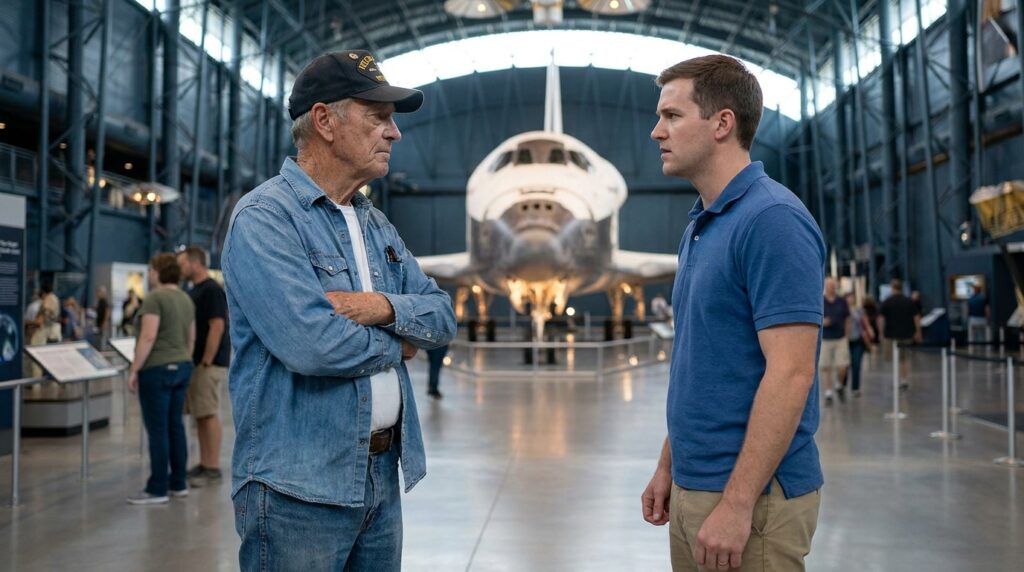
The Concrete Canopy Under Which Men Measure the Friction of Their Remaining Years
CHAPTER 1: THE FRICTION OF IRON
The heat inside the hangar didn’t move; it settled into the marrow like the damp air of a low-altitude tarmac before dawn. Frank “Mac” MacAllister kept his right thumb hooked inside the lip of his denim pocket, his skin catching on the coarse weave until it met the cold, hexagonal flats of the brass nut. He rolled it twice. The metal was dull, stripped of its plating forty years ago by hydraulic wash, but it remained heavy enough to anchor his hand.
Above him, the underbelly of the shuttle rose like a blackened cliff. The silicate tiles were scarred, pitted by fires that had burned out before the kid in the blue polo shirt had even learned to draw breath.
The kid was loud. It wasn’t the volume of a man who wanted to be heard; it was the sharp, aggressive pitch of a modern creature who assumed the world was an unmonitored hallway. He had his palm flat against the anodized aluminum stanchion that held the woven boundary rope, leaning his athletic frame forward until the braided nylon groaned under the tension. His khakis were crisp, the crease down the front sharp enough to cut lard.
“Look at the sign,” Frank said. His voice didn’t carry through the hangar; it stayed low, dropped directly into the two-foot space between them like a dry washer on a bolt. “It says keep clear of the landing gear assembly.”
The kid didn’t take his hand off the stanchion. He turned his head sideways, his eyes scanning the faded blue lettering on Frank’s cap before settling on the deep, cross-hatched wrinkles around Frank’s jaw. A small, thin smirk twitched the corner of his mouth—the specific look of a man who calculated value by the speed of a stride and found Frank entirely bankrupt.
“I’m just getting a look at the hydraulic lines, old man,” the kid said. His tone had the slick, transactional grease of a city salesman. He shifted his weight, his shoulder checking Frank’s left flank to clear a path toward the restricted platform. “Some of us have a schedule. Move out of the way before you get hurt out here.”
Frank didn’t shift his boots. They were old leather, the soles worn flat but wide, planted against the gray concrete with the absolute stillness of a bulkhead. He felt the grease-slicked air of the hangar pass through his teeth as he breathed. He didn’t look at the crowd that was beginning to slow down near the cockpit replica twenty yards away; he looked at the bridge of the kid’s nose, right where the bone met the cartilage.
“I’ve stood my ground against far worse than you,” Frank murmured.
The kid laughed—a dry, sharp bark that died instantly in the vast overhead rafters. He took a full step forward, his chest crowding Frank’s shoulder, his right hand rising to shove Frank’s chest away from the rope. The movement was fast, driven by the easy confidence of a man who had never felt his center of gravity stolen by someone who knew exactly where the human skeleton failed under load.
Frank’s hand came out of his pocket. His fingers were stiff with the early winter chill, but the wrist was grease-hardened and heavy. He didn’t strike; he simply cleared the space between his ribs and the kid’s advancing palm, his forearm catching the kid’s sleeve with a dry, sand-paper scrape that turned the momentum entirely sideways.
Underneath the black tiles of the shuttle, something small and metallic—a forgotten inspection tag Frank hadn’t noticed during his morning rounds—swung loose against the main landing strut, its copper wire snapping with a sudden, high-pitched ping that echoed off the concrete.

CHAPTER 2: THE ANGLE OF RESTRAINT
The copper wire’s snap was still expanding through the hangar’s rafters when the kid’s weight shifted forward. He didn’t know his balance was already gone. In the lexicon of the asphalt and the ready-room, a man who reached out with a stiff elbow was a man offering his ribs as a fulcrum.
Frank didn’t slide back. The worn rubber of his soles bit into the polished concrete, finding the gritty microscopic residue of old turbine oil and dust that never quite settled. His left hand—the skin thick and yellowed around the knuckles like old canvas—came up under the kid’s rising wrist. It wasn’t a blow. It was the simple application of iron against wood. He caught the sleeve of the blue polo, the fabric bunching beneath his fingers with a dry, heavy crunch, and stepped into the pocket of space the kid had left undefended.
“Hey—” the kid started, the syllable rising from his throat, sharp and thin.
The word never cleared his teeth. Frank rotated his hips precisely three inches to the left. It was the exact movement he had practiced on the wet decking of the USS Kitty Hawk while the sea threw spray over the catamarans, a mechanical repetition that stayed in the ligaments long after the names of the admirals had faded from memory. The kid’s own momentum became an anchor around his neck. Frank’s shoulder took the impact of the kid’s sternum—a dull, meat-and-bone thud that rattled the loose change in the kid’s khaki pockets.
Then came the floor.
The concrete didn’t give. When the kid hit, it wasn’t a clean slide; it was the flat, resonant slap of a hundred and eighty pounds of meat meeting five inches of reinforced slab. The impact went through the floorboards of the hangar, vibrating up through the rusted steel stanchions and into the safety rope, which whipped back and forth like a severed fuel line. A family three yards away—a man in a sunburned visor and two children holding plastic fighter jets—froze, their breath catching in a synchronous, small gasp that seemed to vacuum the air out of the immediate radius.
Frank didn’t look down. He dropped his center of gravity, his knees flexing into a low, triangular stance that kept his shadow spread wide across the floor. His breath came through his nose, rhythmic and cold, smelling of the stale tobacco and winter mints he kept in his shirt pocket. His right thumb remained hooked in his denim belt loop, his fingers steady against the brass nut. The metal was warm now, heated by the friction of his skin.
The kid lay on his side for two seconds, his short brown hair dusted with the white lime of the concrete. His eyes were wide, the pupils dilated until the dark centers swallowed the reflection of the shuttle’s overhead floodlights. His mouth worked silently, like an intake valve coughing on dry fuel, before he managed to drag a ragged chest of hangar air back into his lungs.
“Don’t,” Frank said. The word was small. It had the weight of an old lock clicking shut in an empty basement. “Don’t mistake the uniform for the man who wore it.”
The kid scrambled backward on his elbows, his neat khakis smearing against the gray floor, his boots kicking fruitlessly at the air until his spine met the square steel base of the space shuttle’s display stanchion. The aluminum rail groaned. A few more tourists had stopped now, their faces dark against the light of the entrance doors, their phones held low near their belts like small, square shields. Nobody spoke. In the American midwest, a public display of violence was an embarrassment that required silence before it required an officer; the crowd simply watched the geometry of the old man’s shoulders and waited for the kid to find his feet.
Frank kept his eyes on the kid’s hands. They were soft, the nails clipped clean, the fingers trembling as they dug into the concrete to find leverage. The arrogance had leaked out of the blue polo shirt the moment the hip met the floor, replaced by the sharp, metallic tang of adrenaline and public shame.
“I’m retired,” Frank said, his gravelly voice dropping down into the kid’s face, holding him against the steel base. “But my combat experience is still with me. Don’t mistake that.”
The kid didn’t answer with a curse. He looked at the faded lettering on Frank’s cap—VF-111 Sundowners—and then down at the wide, immovable placement of Frank’s work boots. His chest heaved once, twice, the fabric of his shirt stained with a dark patch of sweat between the shoulder blades. He was calculating now, but the math wasn’t corporate anymore; it was the basic arithmetic of a man who had just realized the old fence post he’d tried to kick over was actually a buried iron rail.
He took a slow, cautious half-step back along the floor, his knees pulling up toward his chin as if to decrease the target he presented. His mouth opened, closed, and then settled into a tight, thin line that tasted of gray dust.
“I understand,” the kid whispered, his voice cracking slightly before he caught the register. He didn’t look at the crowd watching him from the path. “I’ll back off.”
Frank didn’t move his boots. He stayed inside the triangular stance, his shadow locked over the younger man, while the loose copper wire on the landing gear above them continued its microscopic, rhythmic swing.
CHAPTER 3: THE COLD ANCHOR
The kid didn’t use the aluminum rail to stand. He slid flat against the square steel base plate, his heels scraping two pale, parallel tracks through the gray dust until his spine hit the vertical stanchion. The metal didn’t ring; it was too heavy, too thick with five decades of industrial lacquer to vibrate for a civilian. He kept his palms spread wide against the concrete, the white lime powder sticking to his sweat-slicked fingers like dry flour.
Frank didn’t look down at him. He kept his eyes fixed at a point three inches above the kid’s hairline, watching the jittery, erratic pulse in the boy’s carotid artery. The air between them remained thick with the smell of the winter mint Frank had chewed at ten o’clock and the sharp, chemical tang of modern laundry detergent from the polo shirt.
“Stay down until the air settles,” Frank said. His voice was old leather dragged over gravel, but it didn’t shake. The arthritic ache in his left shoulder blade was beginning to bloom now, a cold, familiar iron wedge driving itself beneath his collarbone, but he didn’t adjust his denim sleeve to hide it. “You rise too fast, your blood stays in your boots.”
The crowd twenty feet away had gone small. The family with the plastic fighter jets had drifted backward into the shadow of a twin-engine trainer display, the father’s hand wrapped tight around his son’s neck, pulling the boy’s face into his thigh. Nobody ran. In this part of the state, people didn’t scatter from an explosion of force; they watched it from the treeline, waiting to see if the secondary fire was coming. The only movement came from a small, yellow floor cleaning machine parked near the emergency exit, its battery charger humming a low, flat B-flat that vibrated through the soles of Frank’s work boots.
The kid pulled his right knee up toward his chest. His breathing had slowed from the frantic, shallow panting of a dropped animal to the rhythmic, heavy rasp of a man trying to convince himself his ribs weren’t cracked. His short brown hair was matted against his temple where it had caught the floor dust.
“You’re crazy,” the kid whispered. The slick, corporate grease was entirely gone from his tongue, replaced by the thin, metallic taste of a split inner lip. He didn’t look at the bystanders; his eyes stayed locked on the wide, greasy toes of Frank’s leather boots. “You could have killed me on this floor.”
“The floor didn’t move,” Frank said. He didn’t take his thumb out of his pocket. His thumb was still resting against the hexagonal flat of the brass nut, pressing the metal into his skin until the edge left a sharp, temporary groove in his flesh. “You’re the one who brought the speed. I just gave you an anchor to wrap it around.”
He shifted his weight by a fraction of an inch, his left boot pivoting on the concrete with a dry, gritty squeak. The movement made the kid flinch, his shoulders locking tight against the stanchion base. Frank saw the boy’s eyes drop to the aluminum display plate riveted into the steel—the one listing the weight, the fuel capacity, and the operational history of the hydraulic actuators beneath the shuttle’s main gear.
Right under the corner of that plate, where the heavy structural bolts met the floor, Frank noticed something he hadn’t seen during his seven-and-a-half-hour walkthrough the day before. The red wax inspector’s seal—the small, thumb-sized disc that federal logistics teams stamped over the access threads—was gone. In its place was a thin, oily smear of black grease that smelled faintly of high-pressure tallow, the kind they hadn’t used in the fleet since the winter of seventy-four.
The kid saw him look. Even with the white dust on his khakis and his breath rattling in his throat, the boy’s mind was still functional enough to recognize a shift in terrain. He stopped pulling his knees up. His gaze followed Frank’s eyes down to the dark gap between the steel plate and the concrete.
“I didn’t touch that,” the kid muttered, his hand twitching against the floor. “I was just looking at the lines. The rope was already slack.”
“The rope doesn’t matter,” Frank said. He turned his face back to the boy, his jaw tightening until the old scar beneath his ear—the one from the shattered canopy glass at Miramar—turned white against his weathered skin. “The grease is fresh. A man doesn’t get that kind of tallow on his fingers from a tourist brochure.”
The kid didn’t answer. He looked past Frank’s shoulder toward the bright glare of the museum lobby doors, where the modern glass panels reflected the silhouette of a state highway patrol vehicle parked out by the perimeter fence. His tongue came out, tasting the blood on his lip, his fingers curling into fists against the lime-dusted concrete. He wasn’t an impatient salesman anymore; he was a calculation that had run out of digits.
Frank stayed planted in the low, triangular stance, the cold steel of the shuttle’s landing strut rising behind him like an unyielding spine, while the yellow cleaning machine across the hangar clicked twice and began its second automated cycle.
CHAPTER 4: THE ACCESS CORE
The fresh tallow smell was stronger when Frank dropped his hand from his belt loop. He didn’t bend his knees further; he simply let his weight settle lower into his boots, his gaze remaining fixed on the unsealed gap where the structural steel plate met the museum’s concrete floor. The kid stayed quiet, his shoulders rising and falling in irregular, shallow hitches against the aluminum railing, his hands flat on the stone like two dropped rags.
“You didn’t do this,” Frank said. His tongue felt thick, coated with the dry grit of the hangar’s air. He reached down, his blunt index finger tracing the edge of the unsealed steel plate. The metal was cold enough to stick to his skin, but the grease beneath it was fluid. It didn’t have the chalky texture of the commercial silicon lubricants the museum staff used on the display ropes. This was heavy-sulfur ordnance grease, designed to preserve structural threads against the corrosive moisture of deep storage bunkering.
“I told you,” the kid muttered. His voice was gaining a tight, thin edge of civilian indignation now that the physical shock was clearing his system. He wiped his palms down the sides of his dusty khakis, leaving two long, gray smudges across the front of his thighs. “I was just looking at the lower actuator arm. I saw the rope was down three inches on the western side. That’s all.”
Frank didn’t answer him. He slipped the brass nut back into his right pocket, letting it click against the small pocket knife he’d carried since his second tour in the Tonkin Gulf. His left hand worked into the narrow space behind the stanchion’s base. His fingers found the notched edge of a recessed service panel—an old inspection hatch that wasn’t marked on the public floor maps. The metal here was rougher, the factory paint flaking off in tiny, green scales that smelled of zinc chromate.
The small copper tag he’d heard snap earlier wasn’t a standard museum inventory label. As he turned it over in his calloused palm, the light from the shuttle’s high floodlights caught the stamped letters: USAMC-ORD-44. United States Army Materiel Command. Ordnance Division.
A low vibration passed through the concrete under his heels. It wasn’t the rhythmic thrum of the automated cleaning machine, which had moved toward the far end of the pavilion near the commercial airliner cockpits. This was a deeper, subterranean shudder, the kind that happened when heavy valves cycled through high-pressure lines three floors down. The tourists near the gift shop entrance didn’t notice it; their ears were tuned to the ambient chatter of the public address system and the soft chime of cash registers. But Frank’s boots had spent forty years on engine room gratings and steel decks. He knew the difference between a building’s air conditioning unit and the heavy mechanical breath of buried infrastructure.
“Get up,” Frank said. He didn’t look back to see if the kid obeyed. He kept his shoulder leaned against the shuttle’s main landing strut, using the bulk of his body to shield the open access panel from the three tourists who were still lingering near the perimeter ropes.
The kid scrambled to his feet, his joints popping with a dry, youthful snap that made Frank’s arthritic shoulder ache in sympathy. The boy stood three feet back, his athletic frame slightly crooked as he favored his left hip where it had taken the brunt of the concrete floor. His blue polo shirt was twisted at the collar, the fabric stained with grease from the stanchion rail.
“The security guard is coming,” the kid said. His eyes were darting toward the western corridor, where a small golf cart with a amber beacon was idling near the historic engine displays. “You need to tell him what happened. You can’t just throw people around in a public building.”
“The guard knows where the doors go,” Frank said. He pulled his hand back from the dark gap inside the panel. His fingers were slick with the gray tallow, and between his thumb and forefinger, he held a loose leaf of old, oil-soaked log paper. The edges were charred, the grid lines drawn with the purple ink of a military mimeograph machine from the late sixties. “You wanted to see the hydraulic schematics, son. Look at the bottom of the page.”
The kid hesitated, his short brown hair damp with sweat as he took a half-step closer. His gaze dropped to the stained scrap of paper in Frank’s hand. At the bottom of the log, beneath the column headings for pressure checks and fluid volumes, someone had hand-written a single line in thick grease-pencil: Vault 3-B secured under structural dead-load. Do not breach prior to decommissioning of carrier assets.
“What is that?” the kid asked. His voice had lost its defensive edge, dropping down into the same quiet register Frank used when the wind came off the runway. “This is a civilian museum. My uncle worked the procurement team when they brought the shuttle in from the air force base. He said the whole foundation was poured fresh in ninety-two.”
“Your uncle only saw the concrete they wanted him to pay for,” Frank said. He tucked the paper into his denim shirt pocket, buttoning the flap down until the brass snap clicked against his ribs. He turned his head slowly, his eyes locking onto the dark walkway that led beneath the shuttle’s tiled wing toward the administrative offices. “The foundation isn’t five feet deep. It’s an old roof.”
The yellow floor-cleaning machine near the emergency door gave a sudden, high-pitched whine as its brush assembly caught on a loose piece of wire, its red warning light spinning twice before the motor cut out entirely. The silence that followed was heavy, filled only with the cold, constant smell of old iron and the small, wet sound of the kid swallowing the blood from his lip.
CHAPTER 5: THE DUSTY RETREAT
The low, electric hum of the approaching security cart ground against the concrete, its amber beacon casting long, rhythmic slices of orange light across the black thermal tiles of the shuttle’s underbelly. The kid didn’t stay to argue. He didn’t wait for the guard to park the fiberglass vehicle or ask for a supervisor. He rose with a jerky, disjointed sequence of movements, his fingers catching the top rail of the aluminum stanchion to haul his weight upward, his boots leaving gray smears of lime dust across the polished floor.
He didn’t look at Frank. He looked at the floor, his head tucked into his shoulders as if trying to shrink the surface area of his blue polo shirt. The crowd of tourists—the small, silent circle that had formed near the cockpit replica—parted for him without a word. They didn’t ask if he was hurt; they didn’t offer a hand. In the vast, cold space of the hangar, an unmoored man who had just been dropped by an elder was a social contaminant. The boy bled back into the wide public corridor, his modern canvas shoes clicking with a rapid, uneven hitch until the bright glare of the exit foyer swallowed his shadow entirely.
Frank remained standing in the shadow of the landing strut. The buttoned flap of his denim shirt felt tight against his ribs where the oil-soaked log paper rested. He didn’t adjust his cap. His right hand went back to his pocket, his fingertips finding the brass nut, but the cold wedge in his shoulder had spread down into his elbow now, a dull, throbbing ache that reminded him his marrow was as old as the airframe above him.
“MacAllister,” a voice called out from the golf cart. It wasn’t loud. It had the flat, tired cadence of a man who spent ten hours a day watching security monitors in a building that never changed.
The cart stopped three feet outside the boundary rope, its small tires squeaking against the concrete finish. The guard behind the wheel was a heavy-set man in his early sixties named Miller, his gray uniform shirt stretched tight over a stomach that had once been iron during his time with the military police in Frankfurt. He didn’t get out of the seat. He rested both thick forearms on the black plastic steering wheel, his eyes scanning the empty space where the kid had been, then drifting down to the open service panel behind Frank’s boot.
“The kid looked like he was carrying a short leg,” Miller said, his gaze settling on the gray dust patterns on the floor. “He hit hard?”
“He brought too much speed for the turn,” Frank said. He didn’t move his boot away from the open panel, but he tilted his shoulder back against the landing gear casing, hiding the loose copper wire with his torso. “He was leaning on the stanchion. The rope gave an inch.”
Miller looked at the stanchion. Then he looked at Frank’s right hand, which was still tucked into his denim pocket. He knew the look of an old master-at-arms; he knew that men who had spent thirty years on flight decks didn’t call for assistance when a civilian got loud. But he also knew the specific, unyielding geometry of the floor plates beneath the shuttle.
“The director’s been looking at the logbooks for the western wing, Frank,” Miller murmured, his voice dropping below the steady whine of the cart’s battery charger. He reached down to turn the key, cutting the ignition until the amber light stopped its rhythmic sweep across the tiles. The silence that rushed into the gap was sudden and cold, smelling of the damp earth that always managed to seep through the lower foundation seams during a frost. “The blueprint office in the city says we’re showing a variance in the load-bearing columns under this section. Three inches of drift since the frost in late November. They think the concrete is settling into an old drainage culvert.”
Frank’s fingers tightened around the brass nut in his pocket. “It’s not a culvert.”
“They’re bringing a core drill in on Tuesday,” Miller continued, ignoring the interruption with the stubborn patience of an old clerk. “They want to sink three test holes right through the center of this display lane. Right where you’re standing. They think the old municipal map from sixty-eight shows an empty cistern under the foundation.”
A cold draft passed over Frank’s ankles. It didn’t come from the main entrance doors, which were sealed against the winter wind, and it didn’t come from the overhead heating ducts. It was a thin, high-pressure whistle that smelled of old sulfur and rust, rising directly from the unsealed dark behind his heel.
Frank didn’t shift his boots, but his eyes dropped to the base of the stanchion where the kid’s weight had slammed into the steel plate. Tucked into the narrow, dark crevice between the iron riser and the concrete—hidden from Miller’s angle by the shadow of the tire—was a heavy, old-pattern Master Lock. The brass body was pitted with green corrosion, but the steel shackle hadn’t rusted through. It had been cleanly sheared by a hydraulic cutter, the bright, unoxidized silver of the internal steel face glistening like a small, cold tooth in the dust.
The decoy logbook in his pocket wasn’t the only thing that had been left behind. The layout anomalies weren’t structural failures from a settling foundation; someone had been down here with iron tools within the last forty-eight hours, and they hadn’t used the service stairs to get in.
“Tell the director the drill will crack the secondary casing,” Frank said. His voice was flat, devoid of the gravelly warmth he usually kept for the old guards. He looked Miller straight in the eyes, his jaw set until the scar near his ear pulled tight. “The concrete under this strut isn’t five feet deep. If they drop an air-hammer through that slab on Tuesday, they won’t find a cistern. They’ll find out why the city didn’t build an interstate through this valley.”
Miller stared at him for three seconds, his heavy hands remaining motionless on the plastic wheel. The tired, institutional indifference in his gray eyes flickered for a fraction of a second, replaced by the sharp, defensive calculation of a man who had seen the old manifests from the ordnance depots before the state turned them into public parks. He didn’t ask about the sheared lock. He didn’t look at the panel. He simply turned the key, the golf cart’s electric motor catching with a low, sullen click that shook the fiberglass frame.
“I don’t write the work orders, Mac,” Miller said, his voice rising to clear the noise of the engine as he shifted the lever into reverse. “I just check the badges at the gate.”
The cart backed away into the gray light of the central aisle, leaving Frank alone under the massive, silent weight of the tiles, the sheared brass padlock still waiting for him in the dust behind his boot.
CHAPTER 6: THE RESPECT OF THE GUARD
The smell of Miller’s exhaust—stale battery acid and scorched copper—lingered in the corridor long after the red gleam of his cart’s tail-lamps cleared the far stanchions. Frank knelt. The movement was no longer mechanical; it was a slow calculation against the wet iron ache in his hip joint, his denim trousers stretching tight over his knee as he leaned down into the lime dust behind the stanchion’s base plate.
His fingers closed over the brass body of the sheared lock. It was heavier than the standard commercial models used to secure the facility’s display ropes—an old-pattern five-pin cylinder with a hardened steel shackle that had been severed cleanly by a portable hydraulic bite. The cut face was bright, entirely free of the brown oxide crust that covered the rest of the casing. Someone had used a silent, oil-cooled jaw to take this off, and they hadn’t done it from the floor level.
“MacAllister.”
The voice came from the dark lane between the administrative partition and the structural pillars of the wing. It wasn’t Miller. It was a leaner shadow, the footsteps clicking with the crisp, deliberate heel-and-toe strike of an active service uniform. Frank didn’t rise from his knee. He kept his left palm flat on the concrete, his thumb resting against the cold edge of the access panel while his right hand slipped the sheared brass body into his pocket next to the hexagonal nut.
A man stepped through the perimeter rope, his hand rising to touch the braided nylon with a familiarity that didn’t belong to a casual visitor. He wore the standard dark charcoal shirt of the senior facility staff, but his chest lacked the plastic name-tag and the laminated corporate barcode. Instead, three small, silver-plated screws held an antique ordnance inspector’s plate directly into the cloth above his pocket. His hair was cropped close to the scalp, the skin around his temples pale where a duty cap had rested until very recently.
“Miller said you were still hanging around the landing assembly,” the man said. He didn’t offer a name, but his eyes went straight to the gray grease smudges on Frank’s denim sleeve. “The tour buses left twenty minutes ago, Frank. The facility director wants the floor clear before the maintenance team brings the heavy rigging in for the western displays.”
“The rigging won’t hold if you set the outriggers on this section of the slab,” Frank said. He stood up slowly, using the thick aluminum stanchion to steady his weight until his boots were planted wide. “The steel underneath is hollowed out three feet past the main strut. You’ve got an eighteen-ton dead-load resting on an unreinforced cap, and someone’s already cleared the security pins from the lower valve guide.”
The man didn’t flinch. His face had the dry, desaturated texture of a career logistics officer who had spent twenty years reading cargo manifests in unheated warehouses. He stepped closer, his boots clicking once against the concrete before he stopped precisely two feet from Frank’s chest—the standard interpersonal distance of a formal inspection.
“The blueprints from ninety-two show a solid footer,” the man said, his voice dropping into a low, transactional cadence that didn’t carry past the shuttle’s tiled wing. “The city signed off on the structural density before the air force transferred the airframe. Whatever you think you remember about the old storage grid isn’t on the current registry, MacAllister.”
Frank reached into his shirt pocket. He didn’t pull the oil-soaked mimeograph sheet all the way out; he simply flicked the buttoned flap open with his thumb, allowing the man to see the purple ink lines and the hand-written grease-pencil signature at the bottom of the log.
The man’s gaze locked onto the scrap of paper. For three seconds, his jaw didn’t move. The shallow, rhythmic breathing of his chest slowed until his shoulders went rigid beneath the charcoal cloth, his eyes tracing the specific alphanumeric code—USAMC-ORD-44—stamped across the top margin.
“Where did you pull that from?” the man asked. His tone wasn’t administrative anymore; it had the sharp, hard ring of an officer who had just found a live primer in a scrap heap.
“Under the third bolt,” Frank said. He let the denim flap snap shut, his thumb returning to his lower pocket where the brass nut was warm against his thigh. “The grease on the threads is high-pressure tallow from seventy-four. The kind they used to seal the vent pipes on the ordnance vaults before they poured the public park over the top of the bunker. Your city engineers didn’t find a drainage cistern, son. They found the air cap for the lower chamber.”
The man looked down at Frank’s work boots, then back at the dark, narrow slit of the unsealed access panel. His right hand drifted toward his belt, his fingers hovering near a heavy ring of iron keys that hung from a brass clip, but he didn’t unhook them. He was calculating the cost of an exposure—not the public embarrassment of a museum dispute, but the systemic collapse of a logistical lie that had kept thirty feet of subterranean steel hidden beneath a layer of tourist concrete for three decades.
“The core drill is already scheduled for Tuesday morning,” the man said, his voice dropping so low it was almost lost beneath the distant, rhythmic thud of the main facility air compressors. “The work order came down from the state level. If I try to pull the clearance now, the regional office will send an investigative team to verify the structural variance.”
“Then you’ll have more than an old master-at-arms to worry about,” Frank said. He turned his back to the man, his eyes tracking the huge, dark shadow of the shuttle’s fuselage as it stretched toward the high glass walls of the hangar. “The secondary seal is brittle, Miller knows it, and you know it. If that drill bit hits the casing at thirty pounds of line pressure, the gas in that lower chamber won’t wait for the city to revise the map.”
The man didn’t move to stop him. He stood perfectly still under the towering canopy of the wing, his hands flat against his sides, his eyes fixed on the unsealed steel plate as if he could already see the old, rusted iron threads turning underneath the floor.
“We have two days,” the man said behind him.
Frank didn’t look back. He kept his feet moving toward the side corridor where the private benches were set near the old propeller engines, his leather soles catching the grit of the concrete with every slow, deliberate step.
CHAPTER 7: THE BACKROOM BALANCE
The door to the maintenance alcove didn’t swing smooth; its bottom edge scraped a semi-circle of white score marks into the green enamel floor paint. Inside, the air was small, choked with forty years of floor wax, dead flies, and the heavy, humid heat of a steam pipe that ran behind the electrical breaker boxes. Frank stepped over the threshold, his leather soles catching on a loose seam in the linoleum.
He didn’t turn on the overhead fluorescent bulb. The gray twilight filtering through the glass of the main hangar was enough to strike the raw edges of the metal lockers that lined the eastern wall. They were navy surplus—heavy, double-gauge iron boxes with slatted vents that had been dented and hammered back into square so many times the latches had to be forced home with a heel.
Frank stood between the lockers and the brick utility stack. His left shoulder was stiff now, a hard, cold knot of calcified muscle radiating heat down through his ribs, but he kept his forearm clamped against his side to hold the oil-soaked log paper steady beneath his denim shirt flap. He reached behind the second locker, his fingers tracking the rough, unmortared joints of the masonry where the museum’s new drywall met the original 1944 retaining wall.
The gap was only two inches wide. His knuckles scraped the brick, shedding tiny, red flakes of dry clay that fell down his sleeve like rust.
“You shouldn’t be back here, Mac,” a voice said from the open doorway.
It was Miller again, but he wasn’t on the golf cart. He stood in the frame, his heavy frame silhouetted against the wide, dim expanse of the hangar floor. He held a small, black plastic flashlight in his left hand, the beam unlit, his thumb resting flat on the rubber toggle button. He smelled of tobacco juice and the cold lard from his lunchbox.
“The director’s clerk just pulled the master manifest from the basement safe,” Miller said, his voice flat as a dry plank. He didn’t look at Frank’s hand behind the locker. He looked at the floor between them, where a small pile of swept-up metal shavings lay next to a discarded push-broom. “The registry numbers on your mimeograph don’t match the ninety-two transfer agreement. They’re showing the ordnance depot was cleaned out during the consolidation under Carter. There shouldn’t be anything under that slab but river gravel and lime.”
“The consolidation was on paper, Miller,” Frank said. His hand stopped moving behind the iron locker. His fingertips had brushed against something cold—not the powdery clay of the brick, but the dense, heavy edge of a machined iron casting. “The logistics teams from Rock Island didn’t want to transport forty tons of high-pressure storage casings across three state lines when they could just pour two hundred yards of grout over the intake valves and call it a drainage ditch. You know how they handle the dead-load.”
Miller shifted his weight, his uniform trousers whistling as his knees rubbed together. He didn’t answer right away. He tapped the plastic flashlight against his palm—three short, dull clicks that timed themselves to the distant, rhythmic thud of the main compressor out in the pavilion.
“The core drill on Tuesday is a diamond-head three-inch,” Miller murmured. He looked up then, his gray eyes catching the dim amber reflection of the safety lights from the hangar. “They’re bringing the rig in through the cargo doors at midnight. If they hit iron three feet down, they’re just going to think it’s an old footer from the crane tracks. They’ll increase the torque to clear the obstruction.”
“If they increase the torque, they’ll shear the bleed-off collar,” Frank said.
His fingers finally locked onto the object behind the locker. It wasn’t loose; it was wedged between two structural brick courses like a cold chisel. He pulled, his forearm straining until the denim of his sleeve groaned against his bicep. The metal gave with a dry, sand-paper rasp, bringing a loose chunk of grey lime mortar down with it.
It was an old-pattern manifold key—ten inches of heavy, T-shaped iron with a square-socket head that was choked with hard black graphite grease. Stenciled along the crossbar in faded white lead-paint were the numbers 044-BUNK.
Frank didn’t show it to Miller. He kept the iron vertical against his thigh, his hand wrapping around the thick stem until the cold of the casting soaked into his palm.
“The clerk found something else,” Miller said, his voice dropping into the small space between the lockers until it was almost lost beneath the hum of the transformer boxes behind the wall. “The contractor who signed off on the foundation pour in ninety-two—the one the kid’s uncle worked for. He didn’t die in retirement, Frank. He went on the payroll at Rock Island three months after the museum opened. He spent five years checking the pressure gauges on the old pipeline up by the reservoir before they tore the tracks out.”
Frank looked down at the key in his hand. The graphite grease was stiff, but underneath it, the iron was smooth, completely free of the pitting that happened to tools that had been left in the damp river soil. Someone had been maintaining this key. Someone had greased it, wrapped it, and tucked it into the masonry long after the museum had been dedicated to the public.
“He wasn’t checking the pipeline, Miller,” Frank said. He turned his face toward the door, his jaw set until the white line of the scar beneath his ear caught the light from the hallway. “He was checking the vent pressure. He was keeping the cap cold so the city could build the hotel across the road.”
A low, liquid gurgle echoed from the floorboards—a deep, rhythmic rattling through the old iron drainage pipes that ran beneath the green linoleum. It sounded like a valve trying to seat itself against ten pounds of back-pressure, the wet iron clicking twice before the line cleared with a high, thin whistle that smelled of sulfur and dead water.
Miller didn’t drop his flashlight, but his thumb moved off the toggle. He took a slow half-step backward out of the maintenance alcove, his boots clearing the green enamel sill until he was back on the wide, gray expanse of the public concourse.
“The director’s leaving at five,” Miller said, his voice flat as old iron again. “I’re locking the side gates myself tonight, Mac. If you’re still here when the night crew rotates at eight, I’ll have to log your badge as an unescorted presence.”
Frank didn’t answer. He waited until the heavy, regular scrape of Miller’s boots faded past the twin-engine displays, then he let the heavy iron T-key drop into the wide pocket of his jeans, the weight of the casting pulling the denim down until the hem dragged against his heel.
CHAPTER 8: THE COLD RUNWAY OF THE MINDS
The weight of the T-shaped manifold key dragged the right side of Frank’s jeans down until the coarse denim cuff scraped flat against the heel of his work boot. Every step out of the maintenance alcove was a lesson in ballast. The iron stem was ten inches of unyielding cold, pressing through his pocket liner into the dry skin of his thigh like a tire iron tucked into a bedroll.
He didn’t look back at the dark slot behind the metal lockers, and he didn’t check the open access panel beneath the space shuttle’s main gear strut. The hangar was empty now, its massive overhead mercury-vapor tubes clicking off one by one in a timed sequence that left the black thermal tiles of the underbelly swimming in a vast, subterranean blue twilight. The automated cleaning machine sat silent in the far corner, its dead batteries smelling faintly of boiled acid and lead.
Frank pushed through the heavy panic-bar of the administrative exit door. The seal broke with a soft, rubbery hiss that smelled of old vacuum grease, and then the winter air hit him.
It was five-fifteen. The sun had already dropped behind the limestone ridge that ran parallel to the state highway, leaving the parking lot spread out like a desaturated sheet of zinc. The macadam was cracked, its fissures filled with the gray salt crystal of the season’s first frost. Across the multi-lane blacktop, the red and neon-green canopy of the new corporate hotel flickered through the steam vents of a commercial laundry line, its bright, plastic presence an absolute contradiction to the forty feet of weapon-grade history sealed forty inches beneath his heels.
Frank walked toward his truck. It was an old eight-cylinder long-bed, the paint on the hood long ago bleached down to the gray primer coat by the sun of three different naval stations. He didn’t use the key fob; he turned the iron blade in the door lock manually, the internal cylinders dry and full of graphite dust that rasped against the brass teeth.
He sat on the cracked vinyl bench seat, the cold of the springs rising instantly through his denim trousers. He didn’t turn the ignition. He reached into his pocket and hauled the heavy iron manifold key out, setting it flat across the dashboard where the windshield defroster vents were clogged with dead pine needles. The white lead-paint stenciling—044-BUNK—glistened under the orange pulse of the highway lights.
His right hand stayed on the wheel, his thumb rolling the smaller brass nut against his palm. The metal was losing its heat now, returning to the ambient temperature of the cab, but the impression it had left in his flesh remained—a deep, hexagonal groove that wouldn’t clear for an hour.
Miller had been right about one thing: the registry didn’t matter anymore. The contractor who had taken the state money in ninety-two to bury the intake lines hadn’t been buying a retirement home; he’d been buying thirty years of silence from the municipal planning board. The whole aerospace museum wasn’t a monument to the sky; it was a three-million-dollar concrete cork driven into the neck of a forgotten cold-war bunker that the modern city had grown too large to acknowledge.
Frank leaned his head back against the glass of the rear window. The ache in his arthritic shoulder had settled into a dull, rhythmic thrum that matched the low, constant vibration of the interstate trucks passing a mile to the west. He thought about the kid in the blue polo shirt, whose uncle had helped pour the floor. The kid would go home with a bruised hip and a ruined pair of khakis, convinced he had simply crossed an old man with a short temper in a public museum. He would never know that his boot had been six inches from a high-pressure bleed valve that had been greased by hand before his mother had even been born.
The world out there—the one with the neon hotel signs, the timed core drills, and the corporate logistics schedules—moved with a frantic, shallow speed that assumed the past was just something you put behind a velvet rope. They thought they could drill three test holes through the center of a display lane because the computer map showed an empty drainage cistern. They didn’t understand that some things were built with an economy of force that required them to stay buried until the iron itself turned back into dust.
Frank reached out, his thick, calloused fingers wrapping around the crossbar of the iron T-key. He didn’t hide it in the glove box. He left it right there on the primer-gray dash, right where the morning sun would hit the white lead-paint when he came back through the gate at seven-thirty on Monday morning.
He turned the key in the ignition. The old eight-cylinder engine caught with a heavy, unshielded rumble that shook the rust flakes from the inside of the tailpipe, and as he shifted the long lever into reverse, Frank “Mac” MacAllister looked back through the mirror at the massive, silent shadow of the hangar canopy rising against the winter stars. He had two days before the drills arrived. It was more than enough time to reset the balance.







