
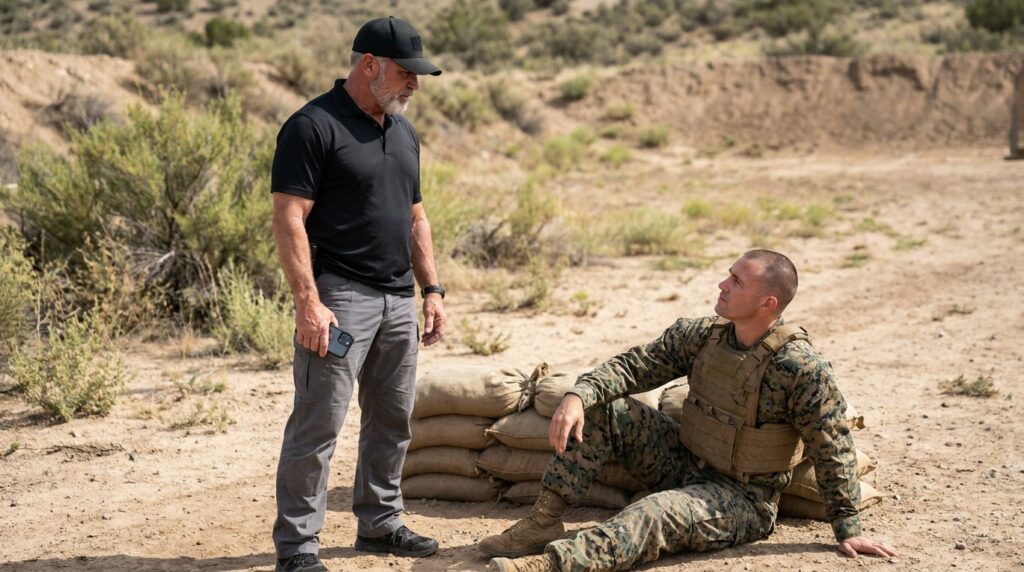
The Iron Economy of a Fallen Shadow and the Weight of Unspoken Command

CHAPTER 1: THE FAULT IN THE LINE

The third shot was low and left. It hit the dirt three inches below the steel silhouette, kicking up a miniature geyser of gray Texas limestone that peppered the base of the sandbag wall.

Arthur Stafford did not adjust his stance. He stood six feet back from the firing box, his heels dug into the loose gravel, hands hanging loose and unknotted at the seams of his gray tactical pants. Beneath the brim of his plain black cap, his eyes remained fixed on the shooter’s shoulder pocket. The man was over-gripping the weapon. The muscles in his forearms were corded like old rope, white-knuckled and trembling under the weight of a rifle he didn’t trust.

“Time!” Marcus Miller’s voice cut through the heavy, cordite-thick air like a blade. He didn’t use a whistle; he didn’t need one. He stepped into the lane, his heavy nylon tactical vest clicking with every stride, his shadow falling long and dark over the trainee’s bench. “Sloppy. You’re anticipating the break. You look like a civilian trying to handle a hot stove.”

The trainee—a junior corporate security officer named Vance—let the muzzle dip. His face was slick with sweat and red from the relentless afternoon glare. He looked at the gravel, his chest heaving under his stiff body armor.

Stafford’s finger brushed the unbranded steel stopwatch hanging from his belt loop. It was a cold, smooth circle against his hip. He didn’t look down at it. He had measured the drill internally. Twenty-four seconds. Four seconds over the baseline standard for a defensive line-break. Miller was pushing the class for raw speed, sacrificing the kinetic economy that kept men alive when the lighting changed and the cover got thin.

“Again,” Miller barked, his close-cropped head tilting back as he scanned the line of six other green contractors. They stood rigid, fingers twitching near their holsters, their heavy breathing the only sound against the distant, rhythmic thud of the long-range berms two hundred yards away. “Load it out. If you can’t clear the box in twenty, you don’t belong on the transport.”

Stafford took one step forward. His boots made no sound on the crushed rock. He observed the slight cant of Vance’s rifle as the young man slammed a fresh magazine into the well. The bolt locked forward with a sharp, metallic slap, but the safety stayed off. The muzzle drifted three degrees to the left, pointing directly at the knee of the shooter in lane two.

Miller didn’t see it. He was already looking at his digital clipboard, his jaw set in a hard, competitive line, eager to show the civilian consultant from the corporate office that his methods were law.

Stafford didn’t raise his voice. He reached out, his hand moving with a quiet, practiced precision that bypassed the trainee’s peripheral vision, and placed a single index finger against the top of Vance’s receiver, forcing the barrel down toward the dirt.

“Weapon is hot, son,” Stafford said, his voice a low, dry rumble that barely carried past the sandbags. “Watch your spacing.”

Miller froze. He didn’t look at the trainee; he looked directly at Stafford’s gray-bearded face. The silence on the range instantly deepened, the heat rising off the gravel in visible waves as the young contractor turned his body completely toward the older man, his eyes narrowing with calculated venom.

In the bottom compartment of the open gear bag at Stafford’s feet, a tarnished brass key tag bearing the stamp of an inactive logistics company lay half-buried under a clean cleaning rag—a small, heavy shape that didn’t belong to any civilian consulting firm.


CHAPTER 2: SPACING AND APERTURES

“Take your hand off the weapon.”

Miller’s voice didn’t rise in volume, but it dropped in pitch, hitting that flat, hard register used by men who measured their worth by the weight of their kit. He didn’t close the distance immediately. He stayed five paces out, his boots rooted in the gravel, his thumbs hooking slowly into the heavy load-bearing D-rings of his camouflage vest.

Stafford didn’t pull his finger from Vance’s rifle frame immediately. He held it there for one complete breath, letting the trainee feel the steady, downward pressure—the physical absolute of a barrel locked into safe dirt. Only when he felt Vance’s forearm relax did Stafford lift his hand, returning it to his side. His thumb brushed the serrated edge of his steel stopwatch.

“The line was flagged, Marcus,” Stafford said. His voice was level, dry as the caliche dust drifting off the berms. “Lane two was inside his cone.”

“I don’t care if his cone was wrapped around your neck,” Miller snapped. He took three steps forward, his chest expanding under the rigid plates of his armor. The nylon straps creaked with the movement. He was thirty-eight, his skin leathered by contract tours in the dry sectors of Marib and Erbil, and he had spent the last eighteen months building a reputation at this facility as an operator who didn’t let corporate analysts dictate the tempo of his deck. “On this range, my word is the safety brief. You’re here to audit the logistics ledger, Colonel. You aren’t here to touch my line.”

The word Colonel came out twisted, laced with the specific irony junior officers used when they thought an elder had grown soft behind a green-felt desk in Washington.

Behind them, the six trainees stayed frozen in their boxes. Vance was sweating through his high-collared shirt, his knuckles still white against the polymer grip of his rifle. Not one of them adjusted their gear. They knew the rules of the subculture—when two instructors crossed lines, any movement from the gallery was an invitation to take a share of the blast.

Stafford looked past Miller’s shoulder, his eyes catching the sharp, blinding glare of the sun hitting the hood of the logistics truck parked near the briefing shed. The heat was an active weight, pressing down on the small area of exposed skin between his black cap and his collar. He noticed the layout of the range with a clinical, unblinking focus: the sandbags were stacked five high, wrapped in weathered burlap that was starting to fray and spill fine, yellow sand onto the crushed rock. The corners were sharp, geometric, and unforgiving.

“The ledger covers the men, Marcus,” Stafford said softly. “If they flag each other during a dry-fire run, they won’t live long enough to clear the invoice.”

“They’re clearing twenty-four-second intervals because that’s what the transit contract demands,” Miller said. He was closer now, close enough for Stafford to smell the sour blend of energy drinks and gun oil on his uniform. Miller’s jaw was working, a small muscle twitching beneath his close-cropped sideburn. “We aren’t running peacetime drills for the National Guard. These boys are going into private security details for the logistics corridors. My corridors.”

Stafford didn’t shift his weight. He kept his feet spaced exactly twelve inches apart, his center of gravity low and immovable. His mind wasn’t on the safety violation anymore. It was on the small, heavy object resting at the bottom of his canvas gear bag three yards away—the tarnished brass key tag stamped with 10th-LOG-DIS.

He had found it three days ago in the central office file while reviewing the facility’s ammunition requisitions. It was an old ordnance token from his final deployment in the Arghandab—a deployment where seven men from his command had been left behind on a ridge because a private supply convoy had turned its trucks around twenty miles short of the extraction zone. The company that ran that convoy had changed its name twice since then, but the procurement serial numbers on Miller’s current supply crates matched the old manifest digit for digit.

Miller was looking down at him now, using his three-inch height advantage to crowd Stafford against the edge of the lane barrier. “You’ve been walking my perimeter for forty-eight hours, Stafford. Checking the seals on the crates. Looking at the fuel reserves. You think because you had a star on your shoulder ten years ago, you can come down here and play inspector general?”

“I’m here to ensure compliance,” Stafford said. He didn’t blink. His expression remained a gray mask, entirely devoid of the anger Miller was trying to provoke. “The facility is running hot on its numbers. You’re over-scheduled and under-manned.”

“We’re running at the pace required to survive,” Miller said, his teeth catching the light as he leaned in. His hands remained near his vest, but his shoulders were tight, his weight shifting forward onto the balls of his feet. “You want to talk about compliance? Let’s talk about why a retired spec-ops desk rider is so interested in our ordnance logs from 2018. Let’s talk about what you’re really looking for in the dark after the range clears.”

The accusation hung in the hot air between them. Stafford felt his pulse remain steady—forty-eight beats a minute, exactly where it had been when he crossed the border into Iraq thirty years ago. He didn’t answer with his mouth. He used the silence, letting it stretch until Miller’s chest hitched slightly with the unreturned pressure.

A low, metallic scrape came from the direction of the trainees. Vance had shifted his foot, his boot heel grinding a loose piece of brass against the stone.

The sound broke the spell. Miller tore his gaze away from Stafford, turning back to the squad with his jaw clamped tight. “Get these weapons cleared and stacked on the ready-bench,” he shouted, his anger finally spilling into the open lanes. “We’re moving to the sandbag enclosure for block two. Move!”

As the trainees scrambled to eject their magazines, Stafford looked down at his canvas bag. The cleaning rag had shifted under the vibration of the gunfire earlier, exposing the edge of the brass key tag. It gleamed under the harsh Texas sun, a small, jagged reminder that the past wasn’t dead—it was just waiting for the spacing to close.

CHAPTER 3: THE CORNER OF THE ANCHOR

The interior of the sandbag enclosure was four degrees hotter than the open lanes. Built from heavy, triple-layered polymer sacking filled with wet-packed river silt, the walls stood six feet high, forming a tight, geometric horseshoe that absorbed everything except the vertical glare of the midday sun.

Stafford carried his own canvas kit bag, the heavy strap resting flat against his left clavicle. He took a position three feet inside the entrance threshold, his back aligned with the corner pillar where the timber supports met the earth. Every line in the space was sharp, clean, and rigid. Across from him, the six trainees sat on low pine benches, their knees nearly touching their chest rigs as they unbuckled their protective eyewear. They were silent, but their eyes tracked Miller as he unlatched a large, heavy plastic transit case resting on a folding table at the center of the pit.

“Block two is close-quarter containment,” Miller said, his boots scraping heavily against the hard-packed floor as he pivoted. He ignored Stafford completely, directing his voice over the heads of the class. He pulled a black, skeletonized short-barrel rifle from the foam insert of the case. The receiver was dry, stripped of cosmetic branding, but the industrial anodizing had a specific blue-gray sheen under the sun. “In this sector, you don’t have twenty yards of clearance. You don’t have time to build a platform. Your platform is whatever wall is behind your kidneys.”

He slammed the weapon’s bolt back, the sound a sharp, mechanical crack that vibrated against the dense sandbag walls. Stafford’s left hand remained hanging by his pocket, his index finger resting lightly on the knurled rim of his steel stopwatch. His gaze wasn’t on the rifle Miller was handling. It was on the side of the plastic transit case.

Stenciled beneath the factory latch was a white alphanumeric string: NX-4402-LOG.

The numbers were faded, partially scoured away by steel wool, but Stafford recognized the structure of the registry. It wasn’t a standard domestic logistics label. It was a tactical redistribution prefix from the automated depot at Bagram, 2018. The exact same depot that had signed off on the fuel and ammunition reductions for the 10th Logistics District forty-eight hours before his team’s perimeter had collapsed.

Miller noticed where Stafford was looking. His jaw tightened, the skin over his cheekbones turning pale as he stepped around the folding table, the rifle held diagonally across his chest in a low-ready posture. “Vance,” he called out without breaking eye contact with Stafford. “Get up here.”

The young trainee scrambled off the bench, his nylon vest rustling loudly as he adjusted his belt. His face was still damp from the heat, his breathing shallow. “Sir.”

“Take the blue gun from the tray,” Miller ordered, gesturing with his chin toward a solid plastic training replica lying on the timber table. “You’re entering an unsecured blind corner. I’m the primary obstruction. Show the evaluator what we do when the spacing collapses to zero.”

Vance gripped the blue polymer weapon, his arms stiffening into an aggressive forward press. He took two steps toward Miller, his boots slipping slightly on the loose silt.

“Stop,” Miller barked. He didn’t look at Vance. His eyes remained locked on Stafford, wide and bright with a confrontational intensity. “Look at the posture on the consultant, Vance. Look at how he stands near the gate. Hands out of the line, weight shifted back. He thinks this is an administrative review. He thinks when the door kicks open in a hot zone, you have time to wait for a signature.”

The trainees on the bench shifted, the wood groaning beneath their weight. The air inside the horseshoe felt thick, smelling of hot plastic and dry earth. Miller was deliberately narrowing the circle, using the presence of the class to sharpen the edge of the blade he was driving into Stafford’s territory.

“A real professional doesn’t wait for the space to clear,” Miller continued, his voice dropping into a rhythmic, transactional drone designed to provoke. He took a long step toward the threshold, his shoulder armor brushing the edge of the sandbag wall right next to Stafford. “He dominates the line before the old man can remember where he left his spectacles. Isn’t that right, Colonel?”

Stafford didn’t pull his shoulders back. He stayed locked into his vertical anchor against the timber support, his expression a smooth, unreadable gray mask. “The drill requires a two-man clearing sequence, Marcus. You’re isolating the lead element.”

“I’m showing them how to handle an dead weight,” Miller said. He stepped directly into Stafford’s personal space, his chest plate pressing within four inches of Stafford’s polo shirt. The blue-gray metal of the skeletonized rifle was a cold bar between them. “Some people spend thirty years living off a title they earned when M16s had carry handles, Stafford. They come down to a live deck and they think they’re ghosts. But out here, if you don’t have the muscle to hold the box, you’re just a liability with an expense account.”

The disrespect was no longer subtextual. It was a direct, public challenge to Stafford’s kinetic presence, delivered in front of the very men he had been sent to evaluate. Miller’s breath was hot against Stafford’s face, his body coiled tight like a spring that had been overwound by pride and a hidden, frantic fear of exposure.

Stafford felt the cold steel of his stopwatch under his thumb. He didn’t move his feet. He looked through Miller, his gaze cutting straight to the faded white numbers on the transit case behind him. He didn’t need to check the ledger anymore; the physical evidence of the old district betrayal was sitting right there on the table, wrapped in the uniform of a private training firm.

“You’re crowded, son,” Stafford said, his voice entirely clear of friction, a low baseline that made the surrounding silence feel absolute. “Reset the lane.”

Miller didn’t move back. He let his teeth show, a thin, hard smile that didn’t reach his eyes. “Make me.”

CHAPTER 4: THE GEOMETRY OF PRESSURE

Miller didn’t drop his chin. He used the short-barrel rifle like an extension of his rib cage, shoving the flat edge of the receiver directly against Stafford’s upper chest. The blue-gray anodized metal bit hard through the black cotton of the polo shirt.

“I said make me,” Miller repeated, his voice dropping into a dry, jagged rasp.

The space between them was gone. Stafford didn’t pull his shoulders back against the timber support pillar. He didn’t blink against the sweat pooling in the gray creases beneath his black cap. He tracked the micro-adjustments of Miller’s mass—the tightening of the right hip pocket, the subtle drop of the contractor’s left shoulder as he prepared to drive his entire weight forward to force Stafford out of the gate lane. It was a standard shock-entry block, designed to break a man’s balance through raw momentum before he could anchor his heels.

Miller launched the shove. His heavy nylon tactical vest creaked as he threw his upper body into a two-handed thrust, aiming directly for Stafford’s sternum.

Stafford didn’t fight the pressure with counter-force. He absorbed the initial shock by dropping his center of gravity three inches, his knees flexing with the fluid precision of a hydraulic press. As Miller’s weight committed fully to the forward rush, Stafford’s left hand shot upward from his side. It moved with a quiet, unhurried efficiency that bypassed Miller’s peripheral vision entirely, his thumb and fingers closing precisely over the meat of Miller’s left wrist.

With his right hand, Stafford didn’t strike. He simply caught the underside of the rifle’s receiver, twisting the barrel three degrees upward, away from his center.

The kinetic transition took less than half a second. Stafford pivoted his right heel inward against the gravel, creating an immediate structural vacuum where his chest had been a moment before. Miller’s forward momentum, locked into a heavy tactical vest and forty pounds of body armor, suddenly had no resistance to hit. He stumbled into the empty space, his balance unspooling as his own weight dragged him past the threshold line.

Stafford completed the pivot. He didn’t use an elite tactical strike or an aggressive takedown combo. He used a single, clean leverage check—a fluid rotation of his wrist that turned Miller’s trapped arm against the natural hinge of the elbow, combined with a quick, horizontal sweep of his left boot against Miller’s trailing heel.

The physics were absolute. The heavy contractor went airborne, his camouflage-clad legs clearing the dirt by six inches before the unyielding mass of his torso hit the crushed limestone floor of the enclosure.

The sound was a dull, dense thud that shuddered through the wet-packed river silt of the sandbag walls. The skeletonized rifle tore loose from Miller’s grip, skittering across the gravel until it hit the leg of the pine bench with a hollow metallic clang. The sandbags themselves remained entirely unmoved, their rough burlap faces absorbing the vibration without dropping a single grain of dust.

Silence collapsed onto the horseshoe like a dead weight.

Across the pit, the six trainees sat frozen on their benches, their bodies locked in mid-movement. Vance’s arms were still extended, his hands clutching the blue plastic training weapon as if the polymer had melted to his palms. Not a single man breathed loudly. The rhythmic thud of the long-range berms outside seemed to recede into a distant, background hum, leaving the interior of the enclosure in a state of clinical vacuum.

Stafford stood perfectly upright in the entry lane. His feet were spaced exactly twelve inches apart, his hands hanging loose and relaxed at his sides, just inches away from his pockets. His black cap was completely straight, his gray beard steady against his collar. His pulse hadn’t spiked past its baseline forty-eight beats. He didn’t look down at Miller with anger or triumph; his eyes held the flat, dispassionate gaze of an evaluator looking at a broken piece of machinery on a spreadsheet.

Grounded in the dust, Miller lay flat on his back, his heavy nylon vest coated in a thick layer of fine gray limestone. His close-cropped head was tilted back against the dirt, his mouth open as his lungs fought to recover the air that had been driven from his chest by the impact. His fingers clutched blindly at the gravel near his hip, his face rapidly changing from a deep, sun-baked red to a pale, mottled ash.

Stafford took one small step forward, his boot sole making a clean, singular scrape against the rock. He looked down at the contractor’s trembling jaw, his voice breaking the silence in a low, level register that carried the absolute authority of a sovereign command room.

“You’re finished,” Stafford said. “Stand down and collect yourself now.”

Miller didn’t answer. He couldn’t. His fingers rolled into loose fists against the dirt, his ego completely stripped away in front of the green line of shooters who had been brought here to watch his dominance. The power dynamic inside the horseshoe hadn’t just shifted—it had been entirely dismantled by twelve inches of calculated space and a single second of discipline.

CHAPTER 5: THE PRICE OF CALCULATION

The contractor didn’t move for three complete seconds. He lay in the dust, a dark smear of Texas caliche coating the left shoulder of his camouflage jacket, his chest rising and falling in rapid, violent jerks beneath the heavy ceramic plating of his vest.

“Stay down,” Stafford said again. His voice was no louder than the wind dragging across the corrugated tin roof of the adjacent armory shed. It carried a flat, institutional resonance that bypassed the ringing ears of the six men on the benches.

Miller’s fingers twitched against the gravel. A bright crimson graze was beginning to bloom beneath the dust on his left forearm where the skin had scraped against the sharp limestone shards. He didn’t rise to his feet; he rolled to his side first, using his right hand to brace his weight against the ground while his boots kicked blindly into the dirt, trying to establish a baseline of support. His eyes were wide, bloodshot, and fixed entirely on the unmoving black tip of Stafford’s boot.

“You…” Miller managed, the word catching in his throat as his diaphragm spasmed from the residual shock of the impact. “You broke the lane parameter.”

“The parameter was compromised when you placed your hands on an evaluator, Marcus,” Stafford replied. He didn’t offer a hand to assist. He didn’t alter his stance by an inch. He remained balanced, his boots planted firmly twelve inches apart, his thumbs loosely hooked into his pockets, maintaining an exact radius of defensive isolation.

Behind them, Vance let the blue plastic training weapon slip from his fingers. It hit the pine planks with a dull clatter that seemed to break the collective paralysis of the row. One by one, the other five trainees lowered their gazes, their eyes tracking the gray dust clouds kicked up by Miller’s heavy boots. They knew what they were witnessing wasn’t a standard safety intervention anymore. It was an execution of authority—the clinical dismantling of a reputation built on performative force.

Stafford turned his face slightly toward the center table, ignoring the contractor’s struggles to sit upright. His attention was locked onto the open tray of the plastic transit case. Under the harsh, vertical glare of the sun, the scoured white markings of the old Bagram registry looked like a scar across the black polymer.

He stepped toward the table, his movement deliberate, unhurried, and precise. He reached down and flipped the interior lid of the case, exposing a secondary compartment hidden beneath the foam padding. Tucked into the narrow slot was a thick, leather-bound manifest log with an unbranded steel binding. It was stamped with a duplicate series of logistics indicators matching the numbers on the brass tag at the bottom of his own canvas kit bag.

He flipped the first page. The entries weren’t standard inventory numbers for a private civilian range. They were active supply coordinates—grid segments in the western sector that didn’t correspond to any legitimate military deployment or state authority.

“Leave that alone,” Miller rasped from the floor. He was on his knees now, his hand clutching the front of his tactical vest as he dragged his body up against the support beam of the sandbag wall. The arrogance had drained from his face, replaced by a pale, frantic desperation that made the skin around his jaw look tight and translucent. “That’s company property, Stafford. You don’t have clearance for those logs.”

“The procurement bureau signed off on these serial numbers four years ago, Marcus,” Stafford said, his finger running down the line of faded black ink. “The same bureau that cut the fuel reserves for the Arghandab perimeter. You didn’t buy these crates from a surplus dealer. They were assigned to you before your team ever left the sector.”

Miller’s mouth opened, but no sound came out. The small muscle beneath his cheekbone was twitching with a frantic, animal cadence. He wasn’t looking at Stafford as a corporate auditor anymore; he was looking at a man who had pulled a thread that connected directly to the foundation of the entire facility.

A low, metallic rumble vibrated through the caliche outside the enclosure. The heavy, dual-axle suspension of an unmarked command vehicle was rolling up the main gravel lane from the highway gates. The sound grew louder, the deep hum of a diesel engine cutting through the range’s remaining silence until the tires ground to a halt right beside the sandbag barrier.

Stafford closed the logbook with a single, sharp snap of his wrist. He didn’t look back at the class. He felt the cold edge of the steel stopwatch against his hip, a familiar weight that reminded him that every action had a calculation, and every calculation carried a price. The trap hadn’t been set by Miller; the contractor was just the trigger mechanism for a much larger machine that was finally beginning to turn in the high heat of the desert.

CHAPTER 6: THE COMMAND OVERREACH

The door of the unmarked utility vehicle swung open with a heavy, pressurized hiss that cut right through the settling caliche dust. A man stepped onto the gravel, his crisp, starched khaki trousers completely out of place against the raw stone and grease of the training compound.

Stafford didn’t leave his position by the central table. His right palm rested flat on the closed cover of the leather-bound manifest, feeling the faint, coarse texture of the grain. He didn’t turn his head to track the approach; his ears measured the cadence of the footsteps—firm, rhythmic, leather-soled shoes that clicked against the crushed limestone with the specific arrogance of a man who held a direct budget line from the procurement bureau.

“Marcus,” the new arrival said, his voice carrying a dry, clipped East Coast inflection that dropped into the hot air like an unexploded shell. He didn’t look down at the contractor currently kneeling against the sandbag support timber. He walked directly toward the threshold of the enclosure, a slim leather document case tucked securely under his left arm. “Get off your knees. You look like a green sub-lieutenant who can’t handle a basic field review.”

Miller didn’t answer immediately. He used the timber to haul his mass upward, his boots slipping once before he found purchase on the hard-packed silt. The ash-gray hue of his face was deep now, sweat carving long, clean lines through the limestone dust on his neck. “Director Vance,” he muttered, his fingers trailing along the edge of his nylon vest as if searching for a dropped magazine. “The audit… the evaluator altered the line parameter.”

Director Vance stepped inside the horse-shoe. He was fifty, thin-lipped, his silver hair cropped tight to his skull with surgical precision. He stopped exactly three feet from Stafford, his eyes dropping briefly to the white stenciled letters NX-4402-LOG on the plastic tray, then rising to lock onto Stafford’s gray-bearded face. He didn’t extend a hand. He simply reached into his breast pocket and produced an ink-stamped leather folder, letting it click open to reveal a gold federal seal backed by an active procurement authorization card.

“The audit is closed, Colonel,” Vance said. The word was delivered without the sarcasm Miller had used; it was flat, cold, and final, the clinical application of an administrative order. “Your temporary evaluation contract was rescinded by the oversight board exactly forty minutes ago. You’re operating on a dead ticket.”

Stafford let his eyes rest on the gold seal. He recognized the signature at the bottom of the authorization card—it wasn’t from the standard civilian logistics branch. It was the personal stamp of the senior procurement deputy who had overseen the asset consolidation at Bagram during the winter of 2018. The same deputy who had signed the emergency variance that reclassified Stafford’s entire special operations detachment as an unlogged regional security detail, effectively erasing their legal perimeter before the mortar fire began.

“The registry logs are incomplete, Director,” Stafford said, his voice entirely steady, keeping the low, unhurried cadence that had governed his movements since he arrived at the gates. “The serials in this tray don’t belong to a domestic training asset. They are active-theater ordnance reserves from the tenth district.”

“The tenth district doesn’t exist on the active registry, Stafford,” Vance replied, his thin lips curving into a tight, humorless line that didn’t disturb the skin around his eyes. He reached down and placed his leather case on top of the logbook, covering the steel binding with a smooth, black hide barrier. “What sits on this range belongs to the facility infrastructure. The corporate board has complete title, cleared through the procurement bureau’s liquidation office. If you’re looking for old ghosts, you’re digging in an empty trench.”

Behind them, the trainees remained as silent as the stones. Vance hadn’t dismissed them, but his presence had created an entirely new layer of institutional pressure that made Miller’s earlier physical posturing look primitive. Miller was still leaning against the burlap wall, his chest heaving as he stared at the back of the Director’s starched shirt, realizing for the first time that his own authority on the range was nothing more than a temporary lease held by the man with the gold seal.

Stafford looked at the black document case covering his evidence. He could feel the small, heavy weight of his own brass tag shifting slightly inside his canvas bag near his heel—a physical anchor that Vance didn’t know he possessed. The decoy secret had been laid bare: Miller wasn’t a rogue operator running a black-market supply ring; he was a hired sentinel, placed here by the bureau to keep a perimeter around the physical remnants of a paper trail that went all the way back to Washington.

“The numbers match the Arghandab manifest, Vance,” Stafford said softly, his index finger tapping the edge of the timber table once, a single, sharp click that broke the monotone of Vance’s delivery. “Every crate you brought through the highway gates carries the same batch code as the fuel trucks that turned around.”

Vance didn’t look down at the table. He leaned in closer, his silver hair catching the white glare of the noon sky as his shadow fell over Stafford’s chest. “A batch code isn’t a subpoena, Colonel. And a retired shadow commander without a portfolio is just an old man trespassing on private property. Your transport is waiting outside the gate. I suggest you collect your kit before the security detail handles the spacing for you.”

The threat was absolute, backed by the full weight of an office that could turn a man’s entire career into a redacted PDF file with a single stroke. Stafford felt the cold steel of his stopwatch against his hip, its internal gears tracking a countdown that Vance couldn’t see. The line had been drawn, and for the first time in forty-eight hours, the old commander knew exactly where the target was hiding.

CHAPTER 7: THE RECOVERY VALUE

“The transport leaves in three minutes, Stafford.”

Director Vance didn’t lift his fingers from the leather document case resting on the table. His posture was perfectly straight, his starched khaki shirt presenting a flat, unyielding plane against the dusty, shadowless heat of the enclosure.

Stafford didn’t look down at the covered logbook. He let his arms drop fully to his sides, his fingers relaxing completely. “Three minutes is a clean margin, Director,” he said, his voice dropping into that quiet, rhythmic baseline that carried no trace of the sand or the sweat that stained his gray tactical pants.

He bent down with an unhurried, mechanical economy of motion, his muscular frame silhouetted against the blinding glare of the entrance. His right hand reached into the loose, fine limestone gravel beside his boots, his fingers closing around the worn nylon strap of his canvas kit bag. As he lifted the heavy bag, his thumb brushed the edge of the tarnished brass tag hidden beneath the cleaning rag—the metal tag stamped with 10th-LOG-DIS. It was a small, cold wedge of fact, entirely secure within the canvas walls.

Beside the timber pillar, Miller remained on his knees, his hands braced flat against the earth as if the limestone itself were the only thing preventing him from sliding out of the lane completely. His camouflage jacket was white with caliche dust, his face pale and empty under his close-cropped hair. He didn’t look up when Stafford adjusted the strap across his left clavicle. His ego had been scoured away, leaving nothing but an active-duty operator who had been shown that his physical capability meant nothing inside a system governed by paper liquidations and gold federal seals.

Stafford took his first step toward the horseshoe exit. His boot sole caught a loose piece of spent brass, pressing it firmly into the silt with a sharp, dry crunch that broke the finality of Vance’s silence. He didn’t look back at the six trainees on the benches. They sat like statues, their blue plastic training weapons resting across their laps, their eyes fixed forward on the table where the black transit case sat like an unmarked headstone under the desert sun.

“Colonel,” Vance called out just as Stafford cleared the corner pillar. The voice was thin, sharp, and perfectly insulated from the glare outside. “Make sure you hand in your gate badge at the checkpoint. You don’t have secondary access to this sector.”

Stafford paused for a fraction of a second, his shadow stretching long and narrow across the threshold rock. He didn’t turn around. “The checkpoint doesn’t keep a log for ghosts, Director. You should check your ledger.”

He walked out into the open range. The sun hit his face with a sudden, violent heat, the white limestone floor reflecting the light until the entire horizon looked like an overexposed strip of film. Two hundred yards away, the rhythmic thud of the long-range rifle lanes continued, a flat, mechanical beat that measured the distance between the training ground and the larger institutional war that had just locked its teeth into his life.

He reached his hip, his fingers closing over the smooth, unbranded steel stopwatch hanging from his belt loop. He clicked the crown once. The ticking stopped. The hands froze exactly on the twenty-four-second mark—the baseline standard for a break in the perimeter line. He unhooked the cold metal circle from his pants and dropped it into the front pocket of his canvas bag, letting it sink beside the brass token from Bagram.

The private training facility was disappearing behind him, its heavy sandbag walls and corrugated tin sheds shrinking against the vast, gray line of the Texas scrubland. Stafford didn’t speed up his stride. He kept his feet spaced exactly twelve inches apart, his body moving with the silent, calculating momentum of a machine that had been designed to survive the winter of 2018 and was now tracking the signal all the way back to the source.

CHAPTER 8: THE COLD FILING

The air in the basement tier of the Alexandria facility tasted of copper and industrial desiccant. It was a subterranean grid—a dead-storage depot operated by a shell company under the procurement bureau’s secondary logistics wing, tucked beneath a forgotten commercial printing press four miles outside the Pentagon perimeter.

Stafford didn’t use a flashlight. He walked by the rhythmic, yellow blink of the overhead emergency ballasts, his canvas kit bag gripped firmly in his left hand. The floor was unsealed concrete, cold enough to draw the moisture from his boots, leaving faint, evaporating prints on the gray stone. Every structure here was functional, block-shaped, and rusted at the hinges.

He stopped at Aisle 14, Sector C.

The storage lockers were built from heavy, corrugated steel plates, green-painted and scoured by decades of humidity. He stood before box number 4402. The steel face was stamped with a faded white stencil that matched the prefix on Miller’s transit tray digit for digit: NX-4402-LOG.

Stafford reached into his pocket, his fingers passing over his steel stopwatch to withdraw the tarnished brass key tag from the Arghandab. The metal was cool against his palm. He didn’t hesitate; he inserted the jagged tooth of the key into the heavy, ungreased padlock hanging from the locker’s cross-bar.

The mechanism didn’t turn smoothly. It required a hard, three-degree counter-clockwise twist—the specific mechanical tolerance of old ordnance hardware manufactured in the late nineties. The internal tumblers dropped with a heavy, metallic clank that echoed down the empty corridor like a distant rifle shot.

Stafford pulled the bar back. The door groaned on its hinges, scraping a semi-circle into the white limestone dust on the floor.

Inside the narrow locker, sitting atop a single green wooden crate, was a portable field terminal from the Bagram asset liquidation office. The power indicator was dead, its grey screen coated in a thin, greasy film of cosmoline oil. But beside the terminal lay a fresh, modern logistics router with an active green link light pulsing in the dark—a live connection drawing power from the building’s primary grid.

Someone had been using this dead file to route active procurement traffic within the last twelve hours.

Stafford leaned into the locker, his hand reaching for the router’s interface cable. Before his fingers could make contact, the faint, yellow ballast light above his head clicked off, plunging the sector into absolute, pitch-black silence.

The air didn’t move, but the sudden absence of the hum from the transformer box down the hall told him his perimeter had just been cut. He didn’t pull his weapon. He dropped his weight three inches, his back finding the sharp edge of the steel door frame, his ears tracking the small, dry scrape of a leather sole shifting on concrete twenty feet behind him in the dark.

“You’re thirty-six minutes behind the schedule, Colonel,” a voice said out of the blackness—low, dry, and entirely steady.

In the dark, the small green light of the modern router continued to blink, casting a faint, rhythmic emerald shadow over Stafford’s gray beard, a tiny beacon counting down the seconds before the system locked him out completely.

CHAPTER 9: THE INK AND THE BLOOD

“You should have stayed in Texas, Arthur.”

The sound didn’t come from the primary aisle. It slid through the perforated steel mesh of Sector C’s storage partitions, flat and completely devoid of acoustic lift. Stafford stayed anchored against the door frame of Locker 4402, his knuckles loosely resting on the nylon strap of his kit bag. He didn’t turn his head toward the pitch-black corridor. He calculated the distance by the subtle click of the speaker’s tongue against their teeth—nine feet, slightly elevated by the concrete drainage step near the main junction.

“The air is cleaner here,” Stafford said. His voice was a dry, level baseline that didn’t rattle the loose sheet-metal panel beside his shoulder. “The paper doesn’t burn as fast when the humidity is high.”

A small, high-intensity penlight flared twenty feet to his left. It didn’t track to his face; it illuminated the concrete floor three inches before Stafford’s boots, revealing the fine layer of gray limestone sand he had carried all the way from the range floor. Behind the beam stood a woman in a dark gray administrative blazer, her shoulder-length brown hair pulled back with a plain plastic band. Her right hand remained inside the deep pocket of her coat, the heavy, blocky outline of an issued subcompact frame altering the hang of the fabric.

“The board didn’t authorize a second retrieval run,” she said. Her features were sharp, hard-edged under the harsh ricochet of the white light. Her left hand held a thick folder of heavy, ink-stamped government credentials. “Director Vance thinks you’re hunting for old invoices, Colonel. He doesn’t know you kept the original field tokens from the Arghandab.”

“He knows,” Stafford replied softly. “That’s why he bought the facility. He wanted the stencils on the crates to match the inventory he filed in Washington before the logs were redacted.”

The woman—Major Sarah Miller, an administrative analyst from the procurement bureau’s oversight branch—took one slow, measured step onto the drainage step. Her leather soles made no sound on the damp concrete. Her eyes were dark, unblinking, and entirely locked onto the pulsing green LED of the live router inside the open locker.

“The tenth district logs weren’t redacted, Arthur,” she said, her voice dropping into a tight, transactional murmur that barely vibrated through the metal mesh. “They were cloned. Vance didn’t erase your unit from the registry to hide a failure. He needed the serial numbers for a shadow manifest that was already signed off by the deputy chair six months before your perimeter collapsed.”

The revelation hit the silence like a cold iron weight. Stafford’s left hand remained stationary near his belt, his thumb brushing the knurled rim of his steel stopwatch. His internal pulse didn’t jump its forty-eight baseline. He didn’t ask for names or dates; he let the subtext fill the space between them. The physical evidence inside the locker wasn’t an illicit surplus transaction; it was a live administrative mirror—a duplicate procurement terminal drawing active data from the central bureau to validate assets that had theoretically been destroyed on a ridge in Afghanistan four years ago.

“The men weren’t left behind because the trucks turned around,” Stafford murmured, his gaze cutting through the dark to trace the sharp outline of her blazer. “The trucks never existed on the real ledger.”

“They were logged as delivered,” Sarah said, her jaw tightening as she shifted her weight, the fabric of her coat rustling against the partition. “Seven thousand crates of high-grade munitions, completely cleared through the Bagram transit yard and signed for using your automated command stamp. If those numbers surface in a domestic compliance check, your legacy isn’t the only thing that goes into the shredder. My department signed the verification variance.”

The circle was closing. The equal intellect of the opposition hadn’t just anticipated his trajectory; they had built the legal and institutional framework of his entire career into the trap. The administrative clerk standing before him wasn’t an investigator sent to assist; she was a witness whose own career was anchored to the very paper trail he was trying to tear down.

A sudden, metallic scrape from the far end of Aisle 14 broke the stillness. It wasn’t the clean, smooth movement of an office shoe; it was the heavy, uneven drag of an ungreased combat boot scraping against a floor it didn’t trust. The sound grew closer, accompanied by the wet, erratic breathing of a man whose lung capacity had been broken by an impact that hadn’t fully healed.

Stafford didn’t pull his shoulders from the frame. He looked down the dark line of the aisle as a massive, asymmetric shadow broke the pale yellow light of the distant elevator bank, the silhouette wrapped in a dirty, dust-coated nylon tactical vest that didn’t belong in a government archive.

CHAPTER 10: THE LIQUIDATION INTERVAL

“The transport at the gate didn’t have an order number.”

Marcus Miller stepped into the light of the aisle ballast, his shoulder armor scraping hard against the galvanized wire mesh of the sector divider. He wasn’t tracking Sarah’s penlight. His gaze was fixed four inches below Stafford’s chin, his jaw locked so tight the skin over his neck cords looked white and strained under the cold subterranean glare. He had torn the nametag from his uniform, leaving only a frayed patch of black hook-and-loop fastner across his chest.

Stafford didn’t shift his heels. He kept his spine anchored flat against the steel door of Locker 4402, letting his weight settle onto the frame with calculated stability. “They didn’t come for an audit, Marcus,” he said, his voice dropping into the lower register that filled the concrete corridor without waking an echo. “The liquidation office doesn’t leave an active ledger.”

“They cleared the barracks,” Miller rasped, his breathing wet and shallow, the air hitching in his throat as his damaged diaphragm fought the weight of his plate carrier. He held his right arm tight against his ribs, his fingers dug into the mesh to stabilize his posture. “Vance’s security team. They brought the industrial shredders to the central office before my second shift could sign the weapon logs out. They aren’t re-routing the inventory anymore, Sarah. They’re dumping the registry entirely.”

Sarah didn’t lower her folder. Her left thumb remained clamped against the edge of the official credentials, but the beam of her penlight dipped slightly, catching the gray dust clouds kicked up by Miller’s unlaced boots. “The deputy chair signed the execution variance two hours ago, Marcus,” she said, her voice dropping into a tight, monotone whisper. “The facility in Texas is listed as deactivated due to environmental contamination. If you’re on the floor when the clean-team arrives, your credentials don’t match any active payroll.”

The trap had unspooled further than the decoy manifest had indicated. Stafford observed the geometry of the alignment—three broken pieces of an institutional puzzle, standing inside an unmapped corridor while the central terminal in Washington scoured their files from the primary network. Miller wasn’t a hunter tracking a target; he was an obsolete gear-tooth being scoured from the mechanism by the same bureau that had written his contract.

“They’re burning the Arghandab logs from the bottom up,” Stafford murmured, his palm resting steady against the cold grain of the leather manifest inside the locker. His internal pulse stayed firm at forty-eight beats. He didn’t offer a tactical solution. He watched the realization settle into Miller’s eyes—the sharp, physical understanding that thirty years of service didn’t buy a single line of recovery space when the procurement bureau changed its signature.

Miller looked at the blinking green light of the live router, his mouth opening slightly as the chemical smell of the damp concrete seemed to choke the words before they could form. “The crates… the ones we hauled from the Bagram transit yard. They’re still registered to your old detachment code, Colonel. If the clean-team takes the terminal, the stamps point straight back to your unit’s extraction failure.”

“They’re supposed to,” Stafford said softly. He didn’t pull his hands from his pockets. He let the silence stretch until the rhythmic click of the router’s internal fan became the only sound in the basement tier. The ultimate reality wasn’t an illegal arms network; it was an intentional deletion front—a system designed to use Miller’s ego and Stafford’s search to draw all the threads into a single repository before the bureau dropped the curtain.

A sudden, sharp mechanical whine traveled down the elevator shaft at the far end of Aisle 14. It was the high-frequency vibration of a commercial paper-shredder unit combined with the heavy, hydraulic thump of an industrial de-manufacturing press being deployed on the ground floor above them. The clean-team had reached the secondary archive.

Stafford reached down, his fingers closing around the canvas strap of his kit bag with an unhurried, statuesque finality. He didn’t look at the administrative folder in Sarah’s hand or the stripped uniform on Miller’s chest. He looked straight down the sharp, narrow line of the concrete corridor, tracking the first faint smell of burning insulation as it drifted down through the ventilation ducts.

CHAPTER 11: THE PROTOCOL OF DELETION

“The data bridge is cutting.”

Sarah didn’t raise her voice to compete with the grinding vibration coming down the elevator shaft, but her left hand tightened until the edge of the official folders began to buckle. The pulsing emerald reflection from the router terminal on Locker 4402 flickered twice, then settled into a dull, solid amber—the system status indicating an external override from the primary bureau core.

Stafford didn’t look down at the dead interface. His hand remained unknotted around the canvas strap of his kit bag. He kept his heels dug into the unsealed concrete, his body blocking the locker’s opening from the view of the corridor junction. “The core signature belongs to Vance’s office, Sarah,” he said, his delivery level, dry, and entirely steady against the low-frequency hum of the building’s cooling vents. “They aren’t just wiping the logs. They’re dropping the line voltage to the sector.”

“We can’t clear the directory from here,” Miller muttered from the steel mesh partition. He was leaning his entire weight against the support bar now, his boots kicking a small pile of calcified dust across the drainage trough. His tactical vest hung loose where the side plates had been stripped, the empty nylon loops white with the dust of the training range. “The shredder crews… they have three separate line-drops before they reach the basement level. If we aren’t at the transport dock before the elevator hits bottom, we aren’t on the payroll when the grid goes dark.”

The ultimate reality of the perimeter failure in the Arghandab wasn’t a hidden ledger or an unauthorized transaction network. It was this specific corridor—the calculated assembly of every surviving witness from the 10th Logistics District inside a single dead-file room while the bureaucratic machine scoured its own memory from the upper floors. Vance hadn’t built a front to exploit the past; he had built an archive to isolate it before the final liquidation code was entered.

Stafford pulled his right hand from his pocket. His fingers held the smooth, cold circle of his unbranded steel stopwatch. He didn’t look at the dial. He clicked the crown once, the mechanical tooth dropping into place with a singular, metallic snap that was completely insulated from the acrid smell of burning wire drifting down from the ceiling.

“The transport at the gate isn’t ours, Marcus,” Stafford said softly, his eyes tracking the fine layer of rust flaking off the top hinges of Locker 4402. “The manifest was cleared for the clean-team before you left Texas.”

Sarah lowered her folders, her face turning a pale, translucent ash under the dying yellow light of the ballast. “The deputy chair signed the entire sector over to the liquidation office, Arthur. There isn’t an unlogged exit path left on the schematic.”

“The schematic only tracks the wired lines, Major,” Stafford replied.

He didn’t check his weapon. He didn’t alter his twelve-inch baseline stance. He reached into his kit bag, his thumb catching the edge of the tarnished brass tag from Bagram, and jammed the sharp, heavy tooth of the metal tag directly into the central circuit block of the live router inside the locker. The copper traces shorted with a sharp, blinding blue spark that scoured the remaining amber indicator into a dead black smear. The local terminal went cold, its memory loop frozen on the exact sequence of the Arghandab manifest—an unalterable physical block that would jam the automated deletion sequence at the central core for exactly forty-two minutes.

Stafford lifted his kit bag, the canvas strap resting flat and secure against his shoulder. He looked straight down the narrow line of Aisle 14 as the heavy, hydraulic thud of the de-manufacturing press above them stopped its rhythm, replaced by the deep, hollow echo of the elevator doors shifting on their runners at the end of the hall. The equal intellect of the bureau had run its calculation, but they had timed the perimeter break by their own digital ledger, forgetting that a retired shadow commander measured his spacing by the cold, mechanical economy of an iron clock.

He moved toward the junction, his boots making no sound on the concrete as the darkness of the subterranean grid closed behind his heels, leaving the dead steel box of Locker 4402 locked in the dark.

Similar Posts

Leave a Reply

Your email address will not be published. Required fields are marked *






