The Shadow of the Vanguard: A Story of Rusted Iron, Faded Cloth, and Earned Ground

CHAPTER 1: THE LIQUID CRYSTAL WALL

“The system doesn’t pull a file, Mr. Vance. If the network doesn’t drop a token into the active queue, there’s no ledger to pull.”

The clerk didn’t look up from the screen. The green glow of the terminal reflected off his safety glasses, painting twin rectangular lenses across his eyes. He had a clean, high-fade haircut that smelled faintly of cheap pomade and an administrative building’s synthetic lavender soap. His thumb stayed fixed on a plastic pen, tapping a steady, irritating rhythm against the Formica counter.

Elias Vance did not move his hands from the wooden lip of the partition. His left wrist settled against the grain, the rusted silver links of an old dog-tag chain shifting beneath his cuff with a dry, metallic rattle. He could smell the ozone coming off the mainframe cooling towers down the hall, mixed with the distinct, sour odor of old coffee grounds rotting in a breakroom bin. The room was too bright, illuminated by cheap fluorescent tubes that hummed at a frequency only men with damaged eardrums seemed to catch.

“Look under the auxiliary manifest,” Elias said. His voice was thick, weathered like salt-cured leather, the syllables dropping short and flat. “Nineteen seventy-four. The classification wouldn’t clear through the standard Department of Defense portal. It’s an unlisted line item.”

The clerk let out a dry, performance-heavy sigh, the breath rustling the stack of printouts on his desk. “Sir, I’ve been over this. I have three hundred intake files today for the regional clinic. The 1974 physical books were digitized twelve years ago. If your dependents aren’t showing up under the medical allocation block, you aren’t in the system. No system, no voucher.”

Elias looked at the small, square stamp on the clerk’s desk—a red rubber block with the words REJECTED / INSUFFICIENT DOCUMENTATION molded into its face. The wood of the handle was dark with grease from a thousand repetitive rejections. Beyond the glass partition, a row of orange plastic chairs held six other men, all of them curved inward, staring at the linoleum floor or the industrial clock ticking toward five.

“My wife’s prescription is forty-two hundred dollars every twenty-eight days,” Elias said. He didn’t raise his voice. He kept his posture straight, his lean frame balanced on the soles of his work boots. His long white hair hung loose over his collar, clean but fraying at the tips like old hemp rope. “The oversight happened when the local command switched to the digital tracking network. The clerk back then didn’t copy the vanguard rosters. He left the names on the gray ledger.”

“Then you need to take it up with the command liaison,” the clerk said, his fingers already striking the keys to clear the screen for the next appointment. He finally looked up, his gaze skimming over Elias’s faded gray work shirt, lingering briefly on the frayed cuffs and the dull, hand-stitched black skull patch on the left sleeve. “But they don’t see walk-ins without an active clearance badge. Next.”

Elias didn’t shift his weight. He watched the clerk’s hand reach for the next folder. With a single, deliberate movement, Elias pressed his palm flat against the document intake slot, sealing the glass opening. The silver chain on his wrist clicked against the glass.

“Where is the duty officer?” Elias asked.

The clerk’s eyes went small, the professional indifference turning into a sharp, defensive coldness. “He’s at the operational compound two miles north. And the guards at that gate don’t use plastic pens, Mr. Vance. They use standard-issue service pistols. Now move along before I hit the perimeter bell.”

Elias turned his back to the glass. The air outside the VA Annex was thick with the smell of parched earth and frying diesel exhaust from the interstate. He pulled his cap down, the brim casting a deep shadow over his lined face, and began the long walk toward the iron gate.


CHAPTER 2: TWO MILES OF ASHPHALT

The heel of Elias’s left boot was splitting. Every step across the state highway route took a fraction of a millimeter more of the vulcanized rubber, leaving a faint, dark smudge on the white shoulder line of the asphalt. The heat didn’t just come down from the midday sun; it rose directly from the road bed, thick and laden with the smell of boiled tar and old motor oil. Two miles on the shoulder of a Texas transit corridor was a math problem measured in structural friction and the rhythmic, hollow rattle of the silver dog-tag chain against his skin.

Elias kept his thumb hooked inside the strap of his canvas utility bag. Inside, wedged behind a packet of yellowed medical receipts, his fingers brushed the worn fold of his leather bifold. Buried deep within the silk lining of the bill compartment sat a small, notched brass key. It had no tag, no stamped inventory number, and no modern digital barcode. It was simply five ounces of cold metal that had remained silent for forty-two years. The teeth of the key were cut to fit a dual-bolt lockbox at the old logistics depot—the kind of locker they stopped building before the current gate guard’s parents had even met.

A tractor-trailer roared past, its air brakes hissing a sharp, concussive blast that caught the loose white strands of his hair and whipped them across his eyes. Elias didn’t flinch. He wiped a streak of gray road-grit from his cheek with the back of his hand, his fingernails catching on the coarse fabric of his gray work shirt. The black skull patch on his shoulder felt heavy, the dense embroidery holding the heat like a small iron plate.

To a casual driver passing at sixty miles an hour, he was merely a piece of highway debris—an old man walking because his truck had died or his mind had wandered. But Elias’s eyes remained fixed on the horizon, where the shimmer of the heat waves began to break against the clean, gray concrete shapes of the operational command perimeter. The base didn’t look like the fort he remembered from 1974. The old timber guard shacks and pine-board barracks were gone, replaced by low-slung, blast-resistant structures of aggregate concrete and high-tensile steel.

He reached the first approach marker—a yellow diamond sign reading SECURITY CHECKPOINT 500 YARDS—REDUCE SPEED. The gravel beside the road was white and sharp, crushed limestone that crunched under his weight with a dry, splintering sound. His breath was steady, drawn through the nose, timed to every four paces. It was a habit from the delta, a rhythmic oxygen preservation cycle that his lungs remembered long after they had forgotten the names of the men who had marched beside him.

As the perimeter fence line drew closer, the chain-link gave way to heavy anti-ram cables woven through steel I-beams. Elias could see the gatehouse now. It sat in the middle of a triple-lane approach, surrounded by yellow concrete pillars that looked like oversized teeth driven into the earth. A single soldier stood under the corrugated metal awning of the main lane, his uniform crisp, his posture tight with the artificial importance of a man who believed the entire safety of the nation depended on a plastic swipe-card reader.

Elias stopped twenty feet before the yellow painted line on the pavement. He reached into his pocket, his hand passing over the brass key, and pulled out his faded, paper-laminated veteran ID—the one the digital terminal at the Annex had refused to read. His fingers left a faint smudge of road-dust on the plastic edge. He knew the young soldier was already watching him through the reinforced glass of the shack, his hand likely moving toward the small, black radio housing on his chest.

The air between them was dead, heavy with the smell of parched grass and the electric hum of the automated barrier arms waiting to drop. Elias took one more step, his boot heel grinding into the white limestone dust at the margin of the lane. He didn’t look down at his trembling hand. He looked straight at the reinforced glass, waiting for the iron to clear.

CHAPTER 3: THE PERIMETER LINE

“Identify your business at this installation or step back across the yellow line immediately.”

The voice didn’t come from a throat; it came through a gray horn-speaker mounted above the turnstile, distorted by a bad ground-wire that left a low, electrical hum trailing after the words. The young guard stepped out from behind the reinforced glass structure. His olive training shirt was stretched tight across a broad, athletic chest, the fabric unmarked by sweat despite the dry heat rising off the road bed. His hand stayed flat against the black retention hood of his sidearm holster, his fingers curved, checking the mechanical latch with a repetitive, unconscious twitch.

Elias Vance kept his hand extended, holding the paper-laminated identification card between his index and middle fingers. The heat-brittled plastic edges scraped faintly against the coarse grain of his skin as the wind tried to catch it. He could feel the small, notched brass key tucked deep inside his bifold wallet, pressing hard against his hip through his denim pocket like a blunt iron nail.

“I need the officer of the day,” Elias said. He didn’t yell. He let the flat timbre of his voice run underneath the mechanical drone of a nearby climate control compressor. “My name is Elias Vance. I am here to correct an administration failure on the vanguard manifest from nineteen seventy-four.”

The guard took two steps forward, his black combat boots clicking against the limestone dust that had drifted onto the asphalt lane. His eyes didn’t look at Elias’s face; they skimmed down the faded gray work shirt, taking in the frayed buttonholes, the white hair lifting in the draft from the highway, and stopped directly on the black skull patch sewn onto the sleeve. A small, cold crease formed between the young soldier’s eyebrows—not a look of recognition, but of sharp, bureaucratic distaste for a civilian wearing military-coded imagery.

“Sir, this isn’t a museum, and it’s not a pension office,” the guard said. His voice was lower now, stripped of the megaphone’s distance, carrying the rigid, thin authority of a man who had memorized a security manual but had never seen an unpaved road. “The regional veterans administration handles all records claims. If you don’t possess a current common access card or a pre-cleared biometric token, you are technically obstructing a secure military transit lane. Step back behind the yellow boundary marker.”

“The regional office uses a digital network,” Elias replied, his boots remaining fixed in the groove worn into the hot asphalt. “The digital network doesn’t have the paper books. The paper books were moved to the old logistics locker here when the regiment deactivated the second platoon. The key is right here.” He reached his left hand toward his pocket, his wrist turning. The rusted silver links of his dog-tag chain slid down his arm with a dry, iron rattle.

The guard’s posture changed instantly. He dropped into a shallow defensive stance, his heel sliding back into the dust, his thumb snapping the security hood off his holster with a clean, plastic click. “Keep your hands visible, sir. Do not reach into your pockets. I will not warn you a second time.”

Inside the security shack, a second figure moved—a younger clerk with a headset, her face pale behind the tinted green glass, her fingers striking a red console key. From the secondary access lane behind the barriers, a low, rhythmic thrumming began to shake the parched earth. It was the heavy, unhurried idle of a diesel engine. A white-and-blue security vehicle rolled out from behind the aggregate concrete wall, its rooftop light-bar dark for now, but its bull-bar angled directly toward the yellow line where Elias stood.

Elias didn’t drop his hand. He kept the faded card leveled between them, his eyes locked on the guard’s pupils. He could see the reflection of the chain-link fence and his own long white hair mirrored in the soldier’s protective glasses. The friction between his splitting boot heel and the soft tar beneath him felt like the only steady anchor left on the base.

“I’m not looking for trouble, son,” Elias said softly, his thumb tracing the frayed edge of his canvas bag where the carbon manifest copy lay hidden in the seam. “I’m just looking for the ledger. It has my wife’s name on the line.”

“Step back,” the guard repeated, his voice rising an octave as the patrol vehicle stopped ten feet behind him, its transmission whining as the driver dropped it into park. “Final warning.”

CHAPTER 4: THE WITNESS GLARE

The overhead strobes ignited with a wet, hydraulic click. Instantly, the bleached white lane of the checkpoint dissolved into a rhythmic, violent oscillation of crimson and cobalt light. The glare caught the edges of the galvanized chain-link fence, turning the steel wire into a vibrating matrix of red and blue teeth. The driver of the patrol vehicle shoved his door open, the heavy steel-reinforced panel catching the parched wind with a hollow groan.

“Step away from the guard line! Place your hands flat on the hood of the cruiser now!”

The second officer didn’t approach through the soft margin of the road; he used the concrete Jersey barriers as a lane block, his leather utility belt creaking under the weight of his high-tensile zip-ties and operational gear. Elias Vance did not drop his hands, but his fingers slowly curled around the edge of his paper ID card until the old lamination popped faintly under the strain. The red flashes swept across his lined face, casting deep, ink-black shadows into the hollows of his cheeks.

“I have the tracking voucher inside the bag line,” Elias said. He kept his feet planted in the soft tar groove, but the compression of the air brakes behind him shook the worn leather of his splitting boot. “The ledger number matches the secondary shelf in the logistics annex. It’s the old nineteen seventy-four roster. You don’t have to pull the piece.”

The young gate guard’s thumb was still locked onto the retention snap of his holster, his knuckles turning a sharp, bloodless white against the olive drab nylon. He didn’t look at the patrolmen behind him; his eyes stayed fixed on the faded black skull patch on Elias’s shoulder. The blue light split the skull’s stitched jawline in half every half-second. “He’s non-compliant, Sergeant. He reached for his pocket when the perimeter alert went active. He’s claiming he has an archive key.”

“I have the key,” Elias repeated, his left arm remaining steady as the old dog-tag chain rattled softly against his wrist. He didn’t move toward the pocket this time. He knew the math of the distance. At twenty feet, with two young men trained on a standard reactive loop, any sudden motion through the dusty gray air would end with three ounces of lead breaking through his gray work shirt before he could clear his wallet. “The key fits the box with the carbon ledger. The digital portal didn’t carry the names forward because the platoon was run under a blind billing index.”

The sergeant from the cruiser stopped five paces out, his heavy tactical boots grinding a white chunk of limestone into fine powder. He had his hand resting on the grip of his non-lethal deployment tool, his eyes assessing the length of Elias’s white hair, the frayed canvas strap of the utility bag, and the distinct lack of a modern identity badge. “Old man, I don’t care if you have the key to the mint. You walked past two distinct federal warning markers to stand in a primary operational lane. This isn’t an information desk. Turn around and give me your wrists.”

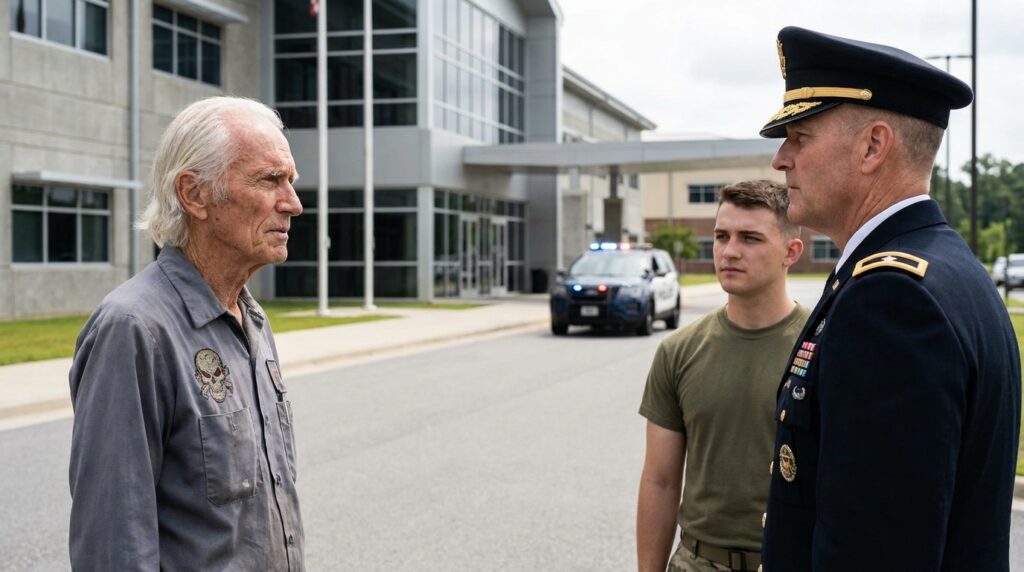
Beyond the perimeter gate, the heavy glass door of the main administrative annex swung inward with a low, vacuum hiss. Elias’s gaze shifted past the guard’s shoulder. A senior figure stepped out into the light, his polished peaked cap cutting a sharp line across the glare of the building’s tinted windows. The dress uniform was dark, the silver stars on the shoulder straps catching the sun with a hard, mirror-like flash.

“What is the delay on the primary lane, Sergeant?” The voice was crisp, carrying the dry, unhurried weight of forty years of command presence. The senior officer didn’t look at the flashing lights; he looked at the obstruction.

Elias braced his heels against the asphalt. He reached his left thumb up, catching the small tear in the inner lining of his canvas bag. His fingernail scraped against something stiff and dry—the brittle corner of a forty-two-year-old carbon manifest form tucked behind the canvas seam. He didn’t pull it out. He needed the officer to move three feet closer. He needed the man who wore the regiment’s crest to see the physical ink before the patrolmen forced his weight down onto the gravel.

“We have an unverified civilian blocking the transit grid, Colonel,” the sergeant called back, his body slightly obscuring Elias’s frame. “Claims he’s looking for old platoon files. He’s refusing to clear the barrier.”

The guard took a half-step back, his chest dropping as he fell into a rigid attention line, his hand finally dropping from his holster hood as the commander entered the active zone. The red strobe light washed over the colonel’s clean-shaven jaw as he stepped onto the sun-baked asphalt, his eyes scanning the lane with a cold, professional detachment that Elias had seen on a hundred different field desks before the world went digital.

“The lane is closed to civilian inquiries,” the colonel said, his voice level as he approached the yellow boundary line. “Take him down to the processing hut.”

“Look at the patch, sir,” Elias said, his voice flat against the thrum of the cruiser’s engine. He stood his ground as the sergeant’s hand reached for his shoulder. “Look at the registration line on the sleeve.”

CHAPTER 5: THE CORE REVERSAL

“Hold your movement, Sergeant.”

The colonel’s voice didn’t bounce off the concrete barriers; it dropped like an iron sheet across the lane, flat and unyielding. The patrolman’s leather gloved hand froze two inches from Elias Vance’s collar, the coarse material of the uniform sleeve brushing against the faded gray twill of Elias’s shoulder. The red and blue strobes continued their violent, rhythmic sweep, painting the colonel’s clean-shaven face in alternating cuts of shadow and hard, primary light as he stepped past the yellow boundary line.

The senior officer did not look at the young gate guard, nor did he look at the idling patrol cruiser. His eyes were fixed on the left sleeve of Elias’s work shirt. The faded black skull patch, hand-stitched with heavy nylon thread that had begun to rot at the edges, sat perfectly still under the flickering glare. The colonel reached up, his fingers touching the stiff brim of his peaked cap, adjusting it with a microscopic, habitual tilt before he took another step forward. The silver stars on his shoulder straps caught the cold reflection of the security shack’s searchlights.

“Where did you acquire that registration mark?” the colonel asked. His voice was lower now, stripped of the administrative tone he had used at the glass doors. He stood three feet away, close enough for Elias to smell the heavy laundry starch on his uniform shirt and the faint scent of gun oil from his sidearm.

Elias did not lower his left arm. The silver links of the old dog-tag chain rattled faintly against his wrist bone as he shifted his grip on the canvas utility bag. “Nineteen seventy-four. The second platoon manifest at the third division staging terminal. We stitched them ourselves after the line item went dark.”

The young guard’s chest dropped an inch out of its rigid attention line. He looked from Elias’s long white hair down to the colonel’s face, his eyes wide behind his protective lenses. “Sir, the individual has no modern identification token. He was ordered to clear the transit lane and refused compliance.”

The colonel ignored the soldier completely. He stepped into the active speaking lane, his polished leather dress shoes crunching over the white limestone dust. He leaned closer to Elias’s shoulder, his eyes tracing the irregular, hand-done knots at the base of the skull’s jawline. A distinct, gray stillness settled into the commander’s features—a physical shift that made the sergeant slowly lower his hand from Elias’s frame and step back toward the cruiser’s open door.

“The third division staging terminal was leveled in seventy-nine,” the colonel said softly, his gaze finally lifting to meet Elias’s eyes. “The personnel logs from that sector don’t exist on the active mainframe.”

“They don’t exist on the mainframe because they were cleared by hand,” Elias replied. He didn’t blink against the blue strobe light hitting his pupils. He slowly reached his right thumb into the inner seam of his canvas bag, his movements deliberate, calculated to give the guards no reason to reset their safety latches. He pulled the frayed canvas flap back just enough to expose the brittle, yellowed corner of the old carbon form hidden inside. “The ledger was moved to the old logistics annex on this compound before the digital migration. I have the double-bolt brass key in my bifold. I’m here for my wife’s line.”

The colonel’s hand moved toward the canvas bag, his fingers stopping a fraction of an inch from the yellowed paper. He didn’t pull the document out. He didn’t need to. His eyes had caught the faint, violet-ink stamp at the top of the carbon layer—a circular registration mark with a handwritten serial number that matched the prefix of his own regiment’s secret lineage.

“Let’s handle this with respect, everyone step back and stay calm,” the colonel announced, his voice rising just enough to cut through the low thrum of the diesel engine behind them. He turned his head slightly toward the sergeant. “Kill the light-bar. Clear the lane.”

The sergeant hesitated for the fraction of a second before hitting the console switch. The violent red and blue oscillations died instantly, plunging the checkpoint back into the flat, heavy glare of the late afternoon sun. The sudden silence of the color shift left the air feeling thick and hot, the smell of parched earth rushing back to fill the space between the men.

The young guard remained frozen at his post, his face turning a pale, hollow gray as he realized the nature of the shift. The old man he had mocked as a confused vagrant was now standing face-to-face with the base commander, the space between them defined not by security barriers, but by an unwritten, generational code that the modern manual didn’t contain.

The colonel looked back at Elias, his expression hard but his posture shifting out of its rigid administrative distance. “The old logistics boxes are locked behind a dual-bolt secure bulkhead in the basement of the main command building, Mr. Vance. The modern digital files don’t show the tracking line because the field office was decommissioned by an executive signature forty years ago.”

Elias let the canvas flap fall back into place, concealing the carbon form against the worn twill of his shirt. He could feel the silver chain on his wrist loosening as his fingers relaxed. “I know who signed the order, Colonel. I just need the physical ledger to clear the voucher.”

The colonel didn’t answer immediately. He looked down at the old brass key now visible through the worn slot of Elias’s bifold as the old man carefully stowed it away. “The name on that executive order was Vance,” the colonel murmured, his voice too quiet for the guards to catch over the hum of the air units. “My father didn’t leave a secondary index.”

Elias stood his ground, the split heel of his boot holding the soft tar. “He left the paper, son. That’s why I kept the key.”

CHAPTER 6: THE IRON THRESHOLD

“The tumblers are mechanical. The modern facility was built directly over the foundations of the nineteen-seventy bunker line.”

The colonel didn’t use his flashlight. He stayed at Elias’s left shoulder as they moved into the sub-level cage, his formal dress uniform trousers catching the gray dust of thirty years of dead storage. The air down here carried no highway heat; it was cold, thick with the sharp tang of floor sealant and the heavy, grease-laden scent of cosmoline preservative from long-forgotten crates.

The notched brass key went into the iron lockbox plate with a dry, precise scrape. Elias didn’t rush his fingers. The tremble in his left wrist had slowed down, the rusted silver dog-tag links remaining dead against his skin as the double-bolt mechanism finally yielded with a leaden, solid thud. He pulled the heavy drawer outward until the iron runners reached their limit, revealing three bound books of heavy, unruled fiber paper.

The colonel reached into his pocket, his hand emerging not with a regulation document or an identification scanner, but with a small, worn piece of silver—his father’s old administrative signet ring. The baseline of the seal bore the exact three-notched pattern cut into the teeth of the key Elias had carried across two miles of blistering asphalt. The realization didn’t drop into the room with an explosion; it came like the slow settling of winter frost over a field of dry grass.

“He didn’t erase the names to deny the medicine, Mr. Vance,” the colonel said softly. His voice was flat, stripped of the command echo that had cleared the transit lane upstairs. “He cleared the index because the secondary team was still operational in the eastern corridors until eighty-four. If the network had pulled the names into the standard personnel ledger, the line would have broken.”

Elias turned the brittle cover of the topmost ledger. The paper made a dry, splintering sound under his calloused thumb, a small puff of paper-dust rising into the light of the overhead utility tube. His fingers traced down the hand-ruled vertical margins until they stopped on the blue carbon line near the base of the sheet. There was the stamped unit designation, the unadorned skull mark, and his own distinctive signature, written in the black ink of an old fountain pen. Directly beneath it, in a neat, regular hand, his wife’s name was entered into the dependent health allocation column.

“The work was done under the old ground rules,” Elias said. He didn’t look up from the page. His thumb pressed flat against the carbon mark, his skin picking up a faint trace of forty-year-old ink dust. “The clerks at the Annex don’t understand the ground rules. They only know the screen.”

“The screen changes today,” the colonel replied. He reached across the table, his hand settling firmly against the top margin of the ledger, his signet ring clicking against the iron binding screw. “The operational credit will be transferred to the active VA ledger under my authorization code. The young man at the gate will be the one who delivers the digital validation to your residence before the shift change.”

Elias closed the ledger. The heavy thud of the binding settling onto the wooden bench table sounded like the closing of a cell door. He looked up, his eyes taking in the colonel’s formal cap, the sharp lines of his uniform, and the distinct family likeness that time had failed to blur from the old commander’s profile. The friction of the long highway walk was gone from his joints, replaced by a cold, heavy sense of finished business.

“Thank you for hearing me,” Elias said, his voice dropping into the small, dark space between them. “That’s all I wanted from the beginning.”

The colonel stepped back, his boots aligning perfectly against the concrete floor as he raised his right hand to the brim of his cap. It wasn’t a ceremonial salute for a parade ground; it was the sharp, abbreviated movement of an operator acknowledging the senior man on the line.

“The perimeter is clear, Sergeant Vance,” the colonel said. “You’ve held the ground long enough. Go home.”

Elias pulled his utility cap down, the worn brim setting a familiar shadow over his lined face. He hooked the strap of his canvas bag over his shoulder, his fingers leaving the brass key inside the lock of the iron box for the colonel to clear. When he walked out past the security turnstiles into the late afternoon sun, the gate guard didn’t move from his station. The young soldier stood at a rigid, uncomfortable attention, his eyes fixed straight ahead on the empty highway, his face still pale under the fading glare of the Texas sky.

Similar Posts

Leave a Reply

Your email address will not be published. Required fields are marked *